
In today’s renovation and construction landscape, trust isn’t just a nice-to-have—it’s the make-or-break factor in every deal.
Homeowners are wary. They’ve heard the horror stories: contractors disappearing with deposits, projects stalling halfway through, and payment disputes turning into lawsuits. And it’s not just about bad actors—many reputable contractors lose out on great jobs simply because clients are afraid.
But there’s a solution that turns this fear into confidence.
It’s called construction escrow, and if you’re not offering it yet, you could be losing jobs to someone who is.
Let’s break down five powerful reasons why every contractor—yes, even the honest, experienced, five-star reviewed ones—should start offering escrow in their bids. Not only does it protect both sides, but it also gives you an edge in a highly competitive market.
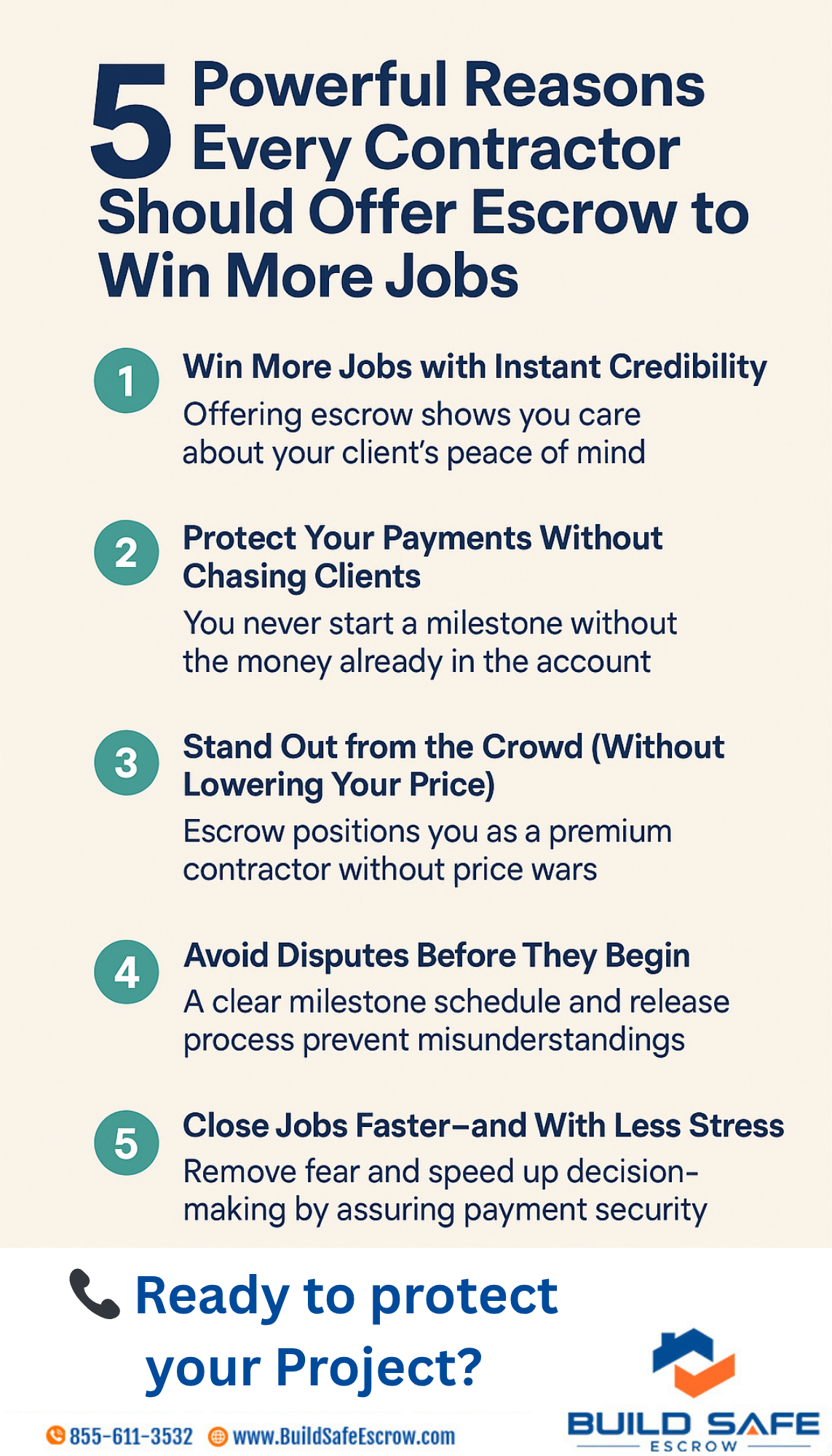
1. Win More Jobs with Instant Credibility
Imagine you’re a homeowner comparing two contractors:
- Contractor A asks for 30% upfront, promises a payment plan, and says “don’t worry, I’ve been doing this for years.”
- Contractor B says, “We use a secure escrow system where you only release payments when work is completed to your satisfaction. No money disappears. Everyone’s protected.”
Who would you choose?
Offering escrow shows that you have nothing to hide, believe in accountability, and care about your client’s peace of mind. That’s a trust boost before the first nail is hammered.
And let’s be real: trust sells. When property owners feel safe, they say yes faster.
💬 Client insight: One Build Safe Escrow client said, “We chose our contractor because they offered escrow—it made us feel like we were in control, not guessing whether they’d show up next week.”
2. Protect Your Payments Without Chasing Clients
You’ve been there.
The job is 95% done, and suddenly the client ghosts you. Or claims the work isn’t complete when you’re ready to move to the next phase. Maybe they hit a financial snag, or they’re just nervous about sending the next check.
Either way—you’re stuck. Unpaid. Unprotected.
But with construction escrow, you never start a milestone without the money already in the account. The funds are there, secure and reserved. Once you hit your agreed milestone, the money is released—fast and clean.
No chasing. No begging. No awkward “hey, did you get my invoice?” calls.
Just professional, automated, milestone-based disbursements.
🛠️ Pro tip: You can align your existing project schedule into milestones with payment triggers—for example, demo complete, framing done, rough plumbing passed inspection, and so on.
3. Stand Out from the Crowd (Without Lowering Your Price)
Let’s face it: everyone is bidding for the same jobs. When clients ask for quotes, they don’t just want a number—they want confidence.
So how do you compete?
Lowering your price eats into your margin and signals desperation. But offering escrow? That’s a value-added service that positions you as a premium contractor without slashing a dime off your rate.
You’re not the cheapest—you’re the smartest. And savvy clients respect that.
With escrow, you differentiate yourself based on professionalism and financial transparency, not price wars.
💡 Contractor quote: “Since we started offering escrow, we don’t get ghosted anymore. Clients take us more seriously—and they’re willing to pay more for the peace of mind.”
4. Avoid Disputes Before They Begin
Construction disputes rarely start on Day 1. They creep in slowly—confusion over payments, misaligned expectations, or clients who change their minds mid-project.
Escrow protects you from that slow slide into frustration. Here’s how:
- The milestone schedule is written out and agreed upon at the start.
- Both parties know when and how much will be paid, and for what.
- If work slows, or issues arise, no funds are released until both sides agree it’s time.
This process naturally fosters communication, clarity, and accountability. It’s like having a referee on the field—not to take sides, but to keep the game fair.
🔍 Related blog: Construction Disputes Are Costly—Here’s How Escrow Solves Them
5. Close Jobs Faster—and With Less Stress
The sales process can drag on for weeks: estimate reviews, follow-ups, re-quotes, client anxiety. A major reason homeowners hesitate is fear—fear of being scammed, of not knowing how their money will be used, or of losing control.
When you offer escrow as a built-in part of your proposal, you eliminate that fear before it grows. Suddenly, they don’t need to run it by three family members, Google horror stories, or interview ten contractors.
You’ve already answered their biggest question: “How do I know I can trust you?”
The result? Faster closes, less ghosting, and more clients ready to sign.
🔗 Bonus: Read how escrow helped George protect his investment property renovation
FAQs Contractors Ask About Construction Escrow
Q: Isn’t escrow only for big commercial jobs?
A: Not anymore. Today, platforms like Build Safe Escrow are built specifically for small and medium residential projects, too. Whether it’s a kitchen remodel or a multi-unit buildout, escrow works.
Q: Will it slow down the process?
A: Actually, no. Most escrow accounts are set up in less than 48 hours. Once your client approves the milestone plan, funding begins—and you’re ready to work with full security.
Q: Who pays the escrow fee?
A: That’s up to you. Many contractors include it in the proposal as a service charge or split it with the homeowner. Either way, it’s a small price for the trust it builds.
How to Start Offering Escrow Today
You don’t need a legal team or a complicated setup to start using construction escrow. Here’s how Build Safe Escrow helps contractors like you:
- Custom Escrow Agreement: We draft a tailored agreement outlining your project milestones and payment structure.
- FDIC-Insured Account: Client funds are held in a secure third-party account.
- Draw Request System: Submit proof of milestone completion—photos, inspection reports, etc.
- Fast Payment Releases: Funds are disbursed quickly upon approval, typically within 24 hours.
- Client Trust Portal: Your client can log in, view progress, and approve payments in real time.
It’s professional. It’s transparent. It’s what the best contractors are already doing.
Learn more or get started: www.buildsafeescrow.com
Final Thoughts: The Future Belongs to Contractors Who Build Trust
You already deliver high-quality work. You show up, meet deadlines, and take pride in your craft.
Now it’s time to match your business operations with that same level of professionalism.
Construction escrow isn’t just a financial tool—it’s a competitive edge. It tells your clients: “You can trust me, and here’s how.”
And in this industry, trust is everything.
So, the next time you’re preparing a proposal, don’t just include your timeline and materials—offer escrow. Show clients that you’re not just a contractor; you’re a partner in their project’s success.
Because the contractors who build trust are the ones who build lasting businesses.
Ready to open your Construction Escrow Account?
👉 Schedule a free consultation and learn how Build Safe Escrow can protect your next project.
About Build Safe Escrow
Build Safe Escrow is a third-party construction escrow company helping homeowners, contractors, and developers secure their projects with milestone-based payment systems. With over 10 years of experience, we make projects safer, clearer, and conflict-free.
📩 Contact us today
📞 Call us at (855) 611-3532
🌐 Visit www.buildsafeescrow.com
- Contractor Payment Process for Property Managers: How to Build One That Survives an Audit.
 Sooner or later an owner asks who approved that payment. This guide gives property managers five controls and a simple payment file that make every contractor invoice audit-ready.
 - Construction Draw Verification: How Investors Know Their Capital Went Into the Build.
 Monthly photos show activity, not proof. This guide shows passive investors the six checks that tie every construction draw to verified work, plus the one test that catches a budget running short.
 - What Is Retainage in Construction? A Subcontractor’s Guide to Getting the Last 10% Paid
 Retainage is money you already earned, held until someone else says the job is done. This guide shows subcontractors what state law now limits and seven contract moves that get the last 10% paid sooner.
 - Commercial Build-Out Escrow: Who Should Hold the Money, and Who Should Not
 Commercial tenants pay to build inside a space they do not own. Here is who should hold the build-out money, how to stop a lien landing on you, and what to expect from an escrow provider on a large project.
 - How to Vet a Home Builder Before Signing a Contract: A Homeowner’s Guide
 Seven checks that catch a builder who is talented and broke at the same time, the things you should never agree to, and how escrow removes the consequences of guessing wrong.
 - Paying Contractors Upfront: A Homeowner’s Guide to Deposits, State Rules, and Safer Alternatives
 How much deposit is normal, which states cap it, what the money legally covers, and the structure that lets owners fund a project without paying ahead of the work.
 - Home Renovation Cost in 2026: What Owners Should Budget, State by State
 What a renovation really costs in 2026, why the same kitchen is priced differently in Texas and New York, and how owners keep every dollar tied to finished work.
 - Construction Escrow for Contractors: How It Works and How You Get Paid
 Escrow from the contractor’s seat: proof the money exists before you start, a milestone schedule you help write, and payment that arrives on verification instead of on a promise.
 - How Construction Escrow Works: A Simple Guide for Property Owners
 A plain walkthrough of how construction escrow works for homeowners funding a renovation or build: where the money sits, when it moves, and what happens if a contractor stops.
 - Construction Escrow for Property Managers: How It Works, Simplified
 A plain walkthrough of construction escrow for property managers: how funds are held, how milestones get verified, and how the whole thing becomes a report your owners can read.
 - Property Manager Vendor Payments: How to Pay Contractors Across a Portfolio Without Carrying the Risk
 A property manager’s guide to paying contractors and vendors across a portfolio without becoming the one who absorbs the risk: verified releases, lien protection, and a structure that keeps owner funds separate and accountable.
 - Tenant Improvement Allowance Escrow: Who Holds the Money, and When It Releases
 A commercial tenant’s guide to the TI allowance: why the money usually arrives last, what that does to your build-out, and how escrow puts the landlord’s contribution and your contractor’s draws on the same verified schedule.
 - Before Signing a Construction Contract: 9 Checks Every Homeowner Should Make
 A homeowner’s checklist for the hour before you sign: the nine things to verify in a construction contract, and the one clause that decides whether your deposit is ever at risk.
 - How to Evaluate a Home Builder Before Signing a Contract: A Homeowner’s Guide
 Most builder problems are visible before the contract is signed, if you know where to look. Here is how to evaluate a home builder on licensing, money, and structure, plus the terms no homeowner should accept.
 - Verify Construction Progress Remotely: A Proven Playbook
 Your money is in one state and your project is in another. A verification stack that tells you what is actually built, and a payment structure that acts on it.
 - Pay When Paid Clauses: The Sentence in Your Contract That Delays Every Check
 One sentence in your subcontract decides when you get paid, and most subs sign it without reading twice. What a pay when paid clause really means, and the structure that makes it irrelevant.
 - Home Renovation Payment Schedule: The Smart Way to Stage Every Payment
 The payment schedule decides who carries the risk on your renovation. Structure it around verified milestones and the biggest check of your year stops being a leap of faith.
 - Change Order Payment: Proven Ways to Stop Losing Money
 The work that wasn’t in the contract is the work you’re least likely to get paid for. Here are five fixes that turn every change order payment from an argument into a scheduled release.
 - How Should an HOA Pay a Contractor (HOA boards)
 Board members ask how should an HOA pay a contractor because the money is not theirs. It belongs to every homeowner in the community. Here is the payment structure that protects it.
 - Contractor Went Out of Business? Smart Recovery Steps
 When your contractor went out of business mid-project, panic is natural — but there is a clear sequence of moves that protects your money, your property, and your restart. Here it is.
 - Retainage in Construction: Stop Losing 10% of Every Job to a Waiting Game
 On a 10% margin, 10% retainage means you finished the job and haven’t earned a dollar yet. Here’s how to negotiate it down, track it like the receivable it is, and get it released on verification instead of goodwill.
 - Contractor Asking for Money Upfront? When It’s Normal — and When to Walk
 An upfront request isn’t automatically a scam — but it isn’t automatically safe, either. Here’s the number that’s normal, the signs that mean walk, and the structure that protects every dollar.
 - Contractor Final Payment: How to Make Sure You Get the Last Check
 The last ten percent is the hardest ten percent. Here is how contractor final payment actually gets released, why it stalls, and the structure that ends the wait.
 - The Safest Way to Pay a Contractor (And Why Zelle Isn’t It)
 Some payment methods can be reversed. Most cannot. Here is the safest way to pay a contractor, ranked by how much protection each method actually gives you.
 - Contractor Deposit Protection: How Much Should You Really Pay Up Front?
 There is a safe deposit number, and there is a safer structure. Here is how contractor deposit protection works, what your state may already cap, and how escrow keeps your money tied to completed work.
 - Commercial Construction Escrow: Protect Every Draw
 On a commercial build, one unverified draw can cascade into liens and stalled work. Here is how commercial construction escrow ties every dollar to verified progress.
 - Win More Construction Bids: The Proven Escrow Edge
 You do not have to be the cheapest bid to be the chosen one. Here is how contractors win more construction bids by removing the owner’s biggest fear — and getting paid faster doing it.
 - How to Avoid a Mechanics Lien: A Smart Owner’s Guide
 A mechanics lien can attach to your home even after you have paid. Here is how to avoid a mechanics lien with waivers, verification, and escrow that pays only for finished work.
 - Escrow for Property Managers: Protect Owner Capital Across Every Vendor
 You steward other people’s money across many projects and vendors. Escrow for property managers turns that responsibility into a repeatable, defensible, audit-ready process.
 - Subcontractor Payment Protection: Get Paid on Milestones, Not Maybes
 Last to get paid, first to get stiffed. Subcontractor payment protection through escrow ties your money to verified work — so a shortfall upstream stops being your problem.
 - Tenant Improvement Escrow: Tie Your Build-Out Funds to Completed Work
 You’re funding a build-out in a space you don’t own, on someone else’s timeline. Tenant improvement escrow makes sure your dollars only pay for finished, verified work.
 - Construction Escrow for Investors: Protect Every Dollar in the Build
 You wired the funds and trusted the sponsor. Construction escrow for investors turns that trust into structure — releasing capital only as verified work is completed.
 - 1 Contractor Payment Protection: Why You Get Paid Faster With Escrow
 Escrow is not a brake on your cash flow — it is a guarantee. Here is how contractor payment protection gets you paid faster, on verified work, with fewer disputes.
 - 5 Ways Milestone Payments Prevent Construction Payment Disputes
 Most construction payment disputes trace back to one thing: money moving before the work is verified. Here are five milestone-based fixes that protect owners and contractors at the same time.
 - What Is Construction Escrow? A Plain-English Guide for Homeowners
 A plain-English guide to construction escrow for homeowners — how milestone-based fund releases keep your renovation money protected until the work is actually done.
 - Construction Escrow for Pool Builders
 Construction escrow for pool builders secures the customer’s money up front and releases it phase by phase as you build — so you get paid through the busy season with your cash flow, and your reputation, protected.
 - What Is Construction Escrow? A Homeowner’s Guide to Protecting Your Money
 What is construction escrow? It’s a neutral third party that holds your renovation funds and releases them only for completed, verified work — so your money never moves ahead of the job. Here’s the plain-language homeowner’s guide.
 - How Contractors Can Avoid Payment Disputes on Every Job
 Avoid payment disputes before they start. A clear contract, written change orders, the right lien waivers, and milestone-based escrow make getting paid predictable — not adversarial. Here’s the contractor’s playbook.
 - Fix-and-Flip Renovations: How Investors Protect Their Capital With Escrow
 With flip margins at their thinnest since 2008, protecting your renovation capital is survival. Here’s how fix-and-flip investors use escrow to safeguard every dollar.
 - HOA Renovation Escrow: Protecting Association Funds on Major Projects
 When an HOA funds a major project, every reserve and special-assessment dollar is under scrutiny. HOA renovation escrow holds those funds neutrally and releases them only for verified work — protecting the money and the board.
 - Getting Paid on Commercial Tenant Buildouts
 Getting paid on commercial tenant buildouts is slow for a reason: more parties, and a TI allowance that’s reimbursed only after the work is done. Here’s why the money stalls — and how construction escrow secures it up front and pays you by verified milestone.
 - Construction Escrow vs. Title Company: What’s the Difference?
 They sound interchangeable, but construction escrow vs. title company is a distinction every property owner should understand before a renovation. A title company protects your ownership; construction escrow protects the money you hand your contractor. Here’s exactly what each one does — and which one safeguards your project funds.
 - Why HVAC Contractors Lose Money on Large Installs — and How Escrow Fixes It
 HVAC pros: you front the equipment, then wait 60–90 days to get paid. That gap is where your profit quietly disappears on big installs. Here’s how escrow closes it — and lets you take bigger jobs without betting your cash reserves
 - How Offering Escrow Helps Contractors Close Bigger Jobs Faster
 Most homeowners are not comparing contractors on price alone. They are comparing them on risk. They have read the horror stories — the vanished deposit, the half-finished kitchen, the money gone. So when you sit across from a prospective client, the quiet question in their mind is rarely just ‘How much?’ It is ‘Can I trust this person with a large sum of my money?’ Construction escrow lets you answer that question before they even ask it. Construction Escrow helps Contractors win more and better jobs.
 - Your Contractor Disappeared With Your Money — Here’s What to Do Next
 The deposit cleared. The first few site visits went fine. Then the texts slowed, the calls stopped, and the job site went quiet. If your contractor has disappeared with your money, you are not alone — and more importantly, you are not without options. This guide walks through exactly what to do now to recover… Read more: Your Contractor Disappeared With Your Money — Here’s What to Do Next
 - Commercial Tenant Buildouts: Why Retailers, Restaurants & Office Tenants Are Turning to Construction Escrow
 You’ve signed the lease and committed $200,000 to a buildout. The clock is running. Here’s how to make sure your funds are protected every step of the way.
 - Cash Flow Is Killing Small Construction Businesses. Milestone Payments Are The Fix.
 Most small contractors don’t fail because of bad work. They fail because the money never arrives on time. Here’s the fix.
 - How to Properly Vet a Contractor: The 10 Questions Every Homeowner Must Ask Before the First Shovel Goes In
 Most homeowners let the contractor run the consultation. These 10 questions shift that dynamic — and take less than an hour to ask.
 - HOA Renovation Escrow Projects Without the Drama: How Condo Boards Protect Community Funds With Construction Escrow
 Managing an HOA renovation project means spending other people’s money—and facing the fiduciary pressure that comes with it. Discover why construction escrow is the smartest, most defensible way for condo boards to protect community reserve funds, ensure contractors meet their milestones, and eliminate project drama.
 - How Contractors Win More Bids Without Lowering Your Price: The Trust Advantage
 You’re not losing bids because your price is too high—you’re losing them because the client is using price to measure risk. Discover the three undeniable “trust signals” that help contractors stop competing on price and start commanding premium rates.