

Table of Contents
- The number that surprises most owners
- What is the cost of a home remodel?
- Home renovation cost per square foot, by scope
- Kitchens and bathrooms: where the budget goes
- How home renovation cost compares across 11 states
- Why the same project costs more in one state than another
- Five ways a renovation budget leaks
- From the field: a kitchen in two cities
- How escrow keeps the budget attached to the work
- FAQ
- References
The number that surprises most owners
Home renovation cost is the first question every owner asks and the last one anyone answers plainly. You get a national average, then a warning that it depends. It does depend. But the dependence has a shape, and once you see it, budgeting stops feeling like guesswork.
This guide gives you the 2026 baseline, the per-square-foot tiers, the kitchen and bathroom numbers, and a short comparison of eleven states where our clients build. Then it covers the part most cost guides skip: how owners protect the budget once the work starts.
What is the cost of a home remodel?
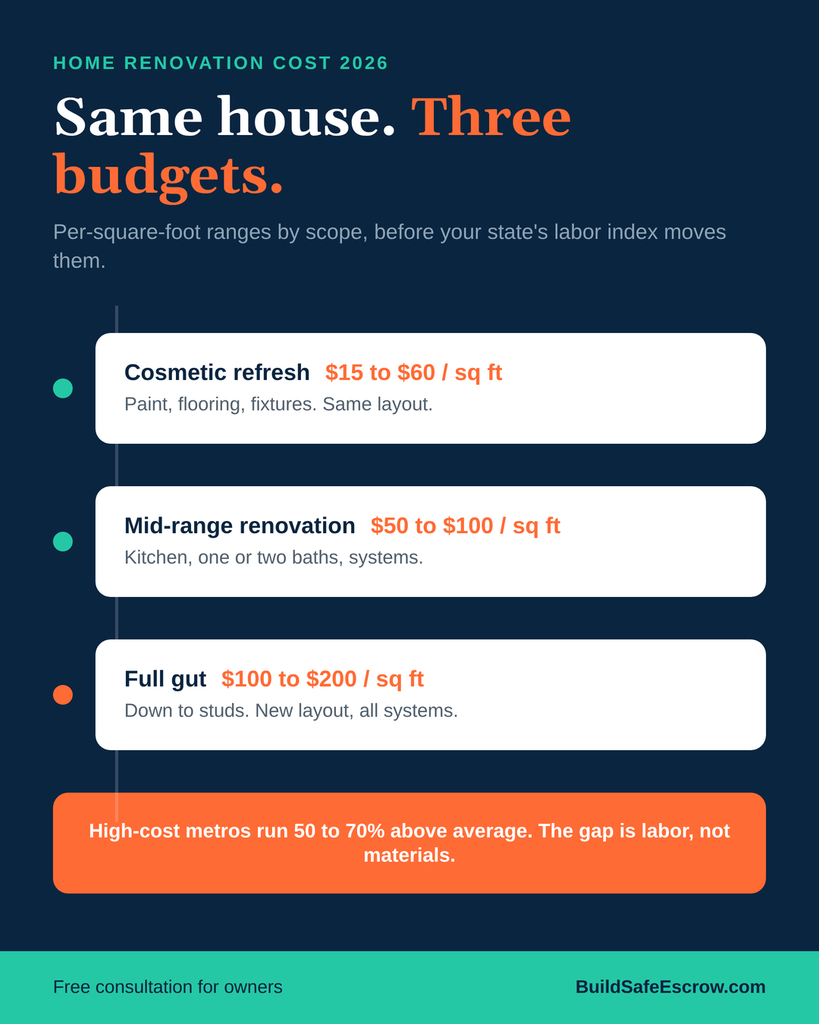
A typical home remodel in 2026 costs $15 to $60 per square foot for cosmetic work, $50 to $100 for a mid-range renovation, and $100 to $200 for a full gut, with a whole-house project on a 1,250 to 1,600 square foot home averaging about $52,000.
That last figure comes from Angi’s 2026 data, and it hides a range of roughly $19,500 to $88,400. The spread is not random. Three things move a project from the low end to the high end: how much of the house you touch, whether you move plumbing or walls, and where the house sits on the map.
Labor is the largest line on almost every invoice. Across the industry, labor now accounts for 50 to 60 percent of total renovation spend. That matters for the state comparison below, because materials cost roughly the same in Columbus as they do in Seattle. Labor does not.
Home renovation cost per square foot, by scope
Per-square-foot pricing is the fastest way to frame home renovation cost, but it is a planning tool, not a quote. It becomes useful only when the scope is defined. Here is how the tiers break out for 2026.
| Scope | What it includes | 2026 range per sq ft | 2,000 sq ft home |
|---|---|---|---|
| Cosmetic refresh | Paint, flooring, fixtures, hardware, same layout | $15 to $60 | $30,000 to $120,000 |
| Mid-range renovation | Kitchen and one or two baths, flooring, electrical updates, some systems | $50 to $100 | $100,000 to $200,000 |
| Full gut | Down to studs, new layout, all systems, all finishes | $100 to $200 | $200,000 to $400,000 |
Two cautions when you use this table.
First, the bottom of each range assumes a lower-cost market and standard finishes. The top assumes a coastal metro or premium materials. Most owners land in the middle, then drift up as scope grows during construction.
Second, the per-square-foot number for a whole house is not the per-square-foot number for a kitchen. A $60,000 kitchen remodel on a 200 square foot kitchen is $300 per square foot. The same $60,000 spread across paint and flooring in a 3,000 square foot house is $20 per square foot. Same money, completely different work.
Add 15 to 20 percent as contingency on top of any home renovation cost estimate. Older homes hide surprises behind the drywall, and a budget with no cushion is a budget that ends in a change order fight.
Kitchens and bathrooms: where the budget goes
Kitchens and baths dominate home renovation cost because they pack plumbing, electrical, cabinetry, and finishes into small rooms.
Kitchen. A mid-range remodel with semi-custom cabinets, quartz counters, quality appliances, and minor layout changes runs $25,000 to $60,000 nationally in 2026. Cabinetry alone takes 30 to 40 percent of the budget. Moving a sink adds $1,500 to $4,000 in plumbing labor before a single tile goes down. Luxury custom kitchens pass $100,000 and can exceed $150,000.
Bathroom. Remodeling Magazine’s 2026 Cost vs. Value Report places a mid-range bathroom remodel (a standard five-by-seven room, all fixtures and finishes replaced, same footprint) at roughly $27,000 nationally. The National Kitchen and Bath Association’s 2026 outlook puts a full primary bath near $25,500. High-end primary baths start around $30,000 and climb past $75,000 with heated floors, custom tile, and frameless glass.
One pattern worth knowing: kitchen and bath costs are bimodal. Most projects land either well under the average (a refresh in the $5,000 to $15,000 range) or well over it (a full remodel past $50,000). The tidy $25,000 middle is rarer than the averages suggest, and it tends to creep into the next tier once demolition reveals what is behind the walls.
How home renovation cost compares across 11 states
Home renovation cost varies 40 to 60 percent across the country for identical scope, and nearly all of that gap is labor. Below is a quick comparison for the states where Build Safe Escrow sees the most projects. The index shows each state’s typical cost relative to the national average (1.00). The kitchen figure is a mid-range remodel in the state’s largest metro.
| State | Cost index vs. national | Mid-range kitchen, major metro | What drives it |
|---|---|---|---|
| California | 1.40 to 1.60 | $48,000 to $60,000 (Bay Area, LA) | Highest labor rates in the country, Title 24 energy code compliance, permit complexity |
| New York | 1.35 to 1.55 (NYC) · 0.95 to 1.05 upstate | $55,000 to $60,000+ (NYC) | Co-op and condo board rules, apartment logistics, inspection requirements; upstate is near average |
| Washington | 1.25 to 1.40 (Seattle) · 0.90 to 1.00 eastern WA | $42,000 to $50,000 (Seattle) | Tight skilled-labor supply in the Puget Sound market |
| Illinois | 1.18 to 1.25 (Chicago) · 0.85 to 0.95 downstate | $38,000 to $45,000 (Chicago) | Union labor in the city, strict permitting; downstate is well below average |
| Pennsylvania | 1.15 to 1.20 (Philadelphia) · below average elsewhere | $36,000 to $44,000 (Philadelphia) | Philadelphia metro pricing; Pittsburgh and rural counties run lower |
| Virginia | 1.25+ (Northern VA) · 1.00 (Richmond) | $40,000 to $48,000 (NoVA) | DC-suburb labor market; Richmond sits at the national average |
| Florida | 1.00 to 1.15 | $34,000 to $42,000 (Miami) | Hurricane and wind-load codes, Miami above state average, Tampa and Orlando near it |
| Texas | 0.90 to 0.98 | $30,000 to $38,000 (Dallas, Austin) | No state income tax, large contractor pool; Austin and DFW rising fast |
| Georgia | 0.90 to 0.98 | $30,000 to $36,000 (Atlanta) | Competitive labor market; Atlanta slightly above the state figure |
| North Carolina | 0.90 to 0.98 | $30,000 to $37,000 (Charlotte, Raleigh) | Fast-growing metros with contractor demand outpacing supply in places |
| Ohio | 0.88 to 0.95 | $28,000 to $34,000 (Columbus) | Lower labor rates, older housing stock adds surprise costs |
Read the table as direction, not destination for your own home renovation cost. A San Francisco kitchen at $48,000 and a Columbus kitchen at $28,000 are the same cabinets, the same quartz, the same appliances. The $20,000 difference is almost entirely what the people installing them are paid, plus the cost of getting a permit approved.
We publish a detailed guide for each of these states, starting with Florida. Each one covers the major metros, the state’s permitting quirks, and its rules on contractor deposits.
Why the same project costs more in one state than another
Four forces set the gap in home renovation cost from one state to the next.
Labor rates. General contractors charge $50 to $150 per hour depending on market. Plumbers run $45 to $200, electricians $50 to $130. High-cost metros now sit 50 to 70 percent above the national average on labor alone, up from 40 to 50 percent before the pandemic.
Permits and code. Permits added 8 to 18 percent to project cost in 2025 and 2026 depending on jurisdiction. California’s energy code, New York City’s inspection regime, and Florida’s wind-load requirements each add compliance work that a contractor in Ohio never bids.
Contractor supply. Booming markets (Austin, Nashville, Charlotte, Raleigh) sometimes price above their index because demand outruns the available crews. Slower markets see contractors compete harder for work.
Housing stock. A 1920s row house in Philadelphia and a 2005 build in suburban Atlanta hide very different things behind their walls. Age drives the contingency you need more than any other single factor.
Five ways a renovation budget leaks
Home renovation cost is only half the budget question. The other half is whether the money you set aside reaches the finish line. Owners lose renovation dollars at five predictable moments.
- The oversized deposit. A contractor asks for 40 or 50 percent up front. If the project stalls, that money has already left your control. Several states cap deposits by law; most do not.
- The vague scope. Anything not written down becomes a change order, and change orders are priced without competition.
- The mid-project payment made on a promise. “We need the next draw to order the cabinets.” You pay, the cabinets arrive late or not at all, and the leverage is gone.
- The unpermitted shortcut. Skipping permits saves a few thousand today and costs 15 to 25 percent of home value at resale, plus voided insurance coverage on any damage.
- The final payment paid early. The punch list is “almost done.” You release the last 10 percent. The almost never finishes.
Every one of these is a sequencing problem. Money moved before the work was verified.
From the field: a kitchen in two cities
Renata owns a townhouse in Alexandria, Virginia, and her sister Dani owns nearly the same floor plan in Raleigh. Both remodeled their kitchens this spring: semi-custom cabinets, quartz, new appliances, no layout change.
Home renovation cost in Northern Virginia showed up immediately. Renata’s bids came in between $41,000 and $47,000. Dani’s came in between $31,000 and $35,000. Same scope, same finish level, a $10,000 gap explained entirely by Northern Virginia labor rates and Alexandria’s permit process.
The costs diverged. The risk did not. Both contractors asked for a third up front. Renata paid it and spent six weeks waiting for cabinets that had not been ordered. Dani put the funds in escrow with a four-milestone schedule: demo and rough-in, cabinets delivered and set, counters and plumbing, final punch list. Her contractor was paid within two days of each verified milestone. The project finished nine days early.
Same kitchen. Different state, different price, and one very different experience of where the money was while the work happened.
How escrow keeps the budget attached to the work
Knowing the home renovation cost in your state tells you what to set aside. It does not tell you how to keep it safe once a contractor is holding a key to your house, and that second question decides the real home renovation cost more often than the first.
Construction escrow answers the second question. The full project budget goes into a neutral, FDIC-insured account before work begins. The contractor sees it is funded, which is a stronger signal than any deposit. Then the money is released in stages, only as each agreed milestone is completed and verified.
For you, that means no oversized deposit, no payment on a promise, and no early final check. For the contractor, it means guaranteed funds and fast payment on every stage, which is why experienced contractors increasingly prefer it. Our escrow services page walks through how the milestone schedule is set, and our construction escrow FAQs cover the questions owners ask most.
The state you build in sets the price. The structure you use sets whether that price is what you actually pay. Money should never move ahead of the work.
FAQ
What is the average home renovation cost per square foot in 2026? Cosmetic work runs $15 to $60 per square foot, mid-range renovations $50 to $100, and full gut renovations $100 to $200. Location and finish level move a project within those ranges.
Which states have the highest home renovation cost? California, New York (especially NYC), Washington (Seattle), and Massachusetts run 30 to 60 percent above the national average, driven by labor rates and permit complexity.
Which states are least expensive to renovate in? Ohio, Texas, Georgia, and North Carolina sit 2 to 12 percent below the national average. Southern and Midwestern states generally have lower labor rates and simpler permitting.
How much contingency should I add to my home renovation cost estimate? Plan on 15 to 20 percent above the contract price, and closer to 20 percent for homes built before 1980, where hidden plumbing, wiring, and structural issues are common.
How much deposit should I give a contractor? Ten percent or less is common practice and, in some states, the legal cap. A larger deposit moves money ahead of the work. Escrow removes the need for a deposit altogether by showing the contractor the project is fully funded.
Does home renovation cost include permits? Not always. Ask whether the bid includes permit fees and inspection scheduling. Permits typically add 8 to 18 percent depending on the jurisdiction.
Keep the budget safe, whatever your state
Get one short read each Friday on how construction money actually moves. Subscribe to The Build Brief.
Planning a renovation this year? Schedule a free consultation and we will walk through a milestone schedule built for your project and your state.
References
- Remodeling Magazine (Zonda), 2026 Cost vs. Value Report
- National Kitchen and Bath Association, 2026 Kitchen and Bath Market Outlook
- Angi, 2026 Home Renovation Cost Data
- Cost to Renovate, Home Renovation Cost Report 2026 (49-metro regional analysis)
- Homestery, 2026 Home Improvement Cost Report (regional multipliers, permit cost share)
- Build-Folio, Home Improvement Costs by State: 2026 Regional Pricing Guide