
Table of Contents
- Why is your contractor asking for money upfront?
- The number that’s normal (and your state may set it by law)
- Is it normal for a contractor to ask for money upfront?
- Five rules before any money leaves your account
- What to say instead of no
- When to walk away
- From the field: Priya’s driveway deposit
- How escrow removes the problem at the source
- FAQ
- References
A contractor asking for money upfront puts you, the property owner, in an uncomfortable spot on day one. You want the project to start. You want to be a good client. But you’re being asked to hand over thousands of dollars for work that doesn’t exist yet.
Here’s the honest answer: an upfront request is sometimes reasonable, sometimes a warning, and always worth structuring properly. This guide gives you the normal numbers, the red flags, and the payment structure that protects you either way.
Why is your contractor asking for money upfront?
There are legitimate reasons a contractor wants money at signing:
- Materials. Cabinets, windows, and trusses are often custom-ordered and non-returnable. A contractor fronting a $14,000 window order for a client they just met is taking real risk.
- Schedule commitment. A deposit proves you’re serious before they turn away other work to hold your dates.
- Cash flow. Small construction businesses run thin. Labor gets paid weekly; you might not pay for a month.
And there are bad reasons that look identical from the outside:
- Your money is finishing someone else’s job. A contractor in a cash crunch uses your deposit to close out the last project — and needs the next client’s deposit to start yours.
- Insolvency. If the business fails mid-project, your deposit is an unsecured IOU.
- Intent. A small number of operators collect deposits and disappear. The Federal Trade Commission logs home improvement complaints in the tens of thousands every year.
Here’s the uncomfortable truth: a contractor asking for money upfront for good reasons looks identical to one asking for bad ones. You can’t see motive from the outside. So you don’t manage motive. You manage structure.
The number that’s normal (and your state may set it by law)
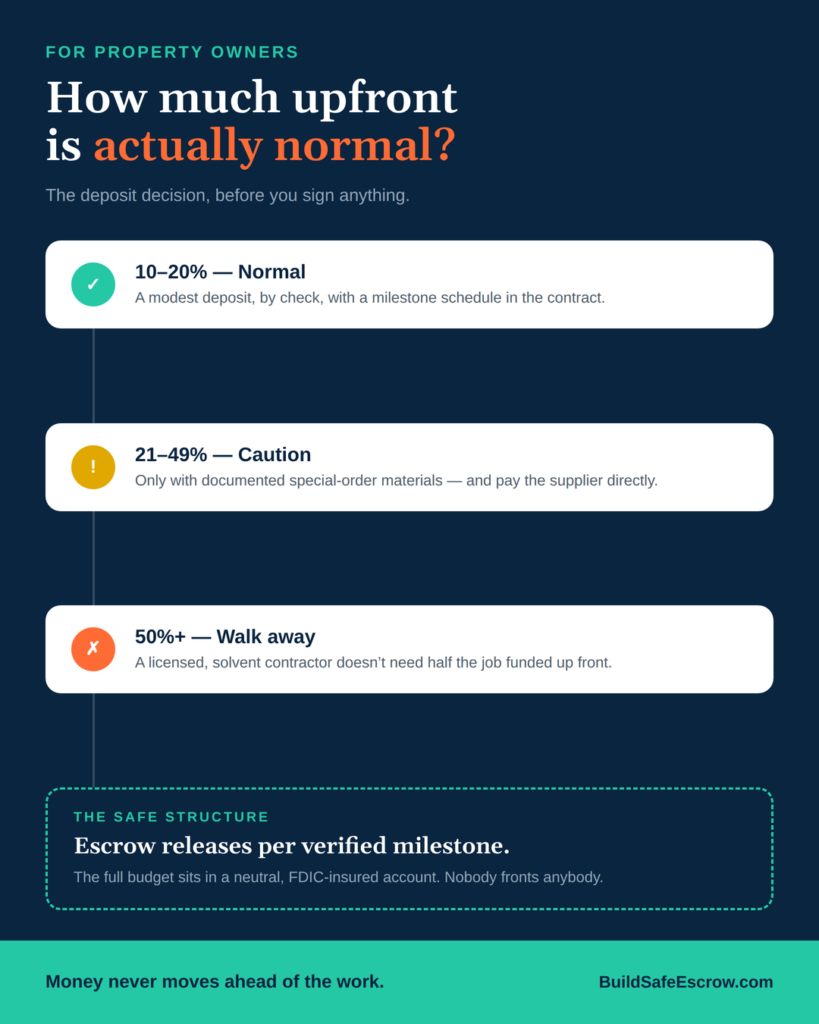
A contractor asking for money upfront should be asking for a small fraction of the contract — not half of it.
- California caps home improvement down payments at 10% of the contract price or $1,000, whichever is less. That’s the strictest standard in the country, and it’s a useful mental benchmark everywhere.
- Maryland caps deposits at one-third of the contract price for home improvement work.
- Most states set no hard cap at all — which means, across most of the country, a contractor asking for money upfront is bound only by the contract you sign. Your contract is the only cap that exists.
A common industry rule of thumb where no law applies: 10–20% down, with larger upfront amounts justified only by documented special-order materials — and even then, the safer move is paying the supplier directly or routing the money through a neutral account rather than handing it to the contractor.
Anything at or above 50% upfront is outside normal practice for a licensed, solvent contractor. That’s not a negotiating position. That’s a signal.
Is it normal for a contractor to ask for money upfront?
Yes — a modest deposit of roughly 10–20% is normal, but a contractor asking for money upfront at 50% or more is a warning sign, not a standard practice. Legitimate contractors have supplier credit, working capital, and a reputation to protect; they don’t need half the job funded before a shovel hits dirt. The deposit’s job is to prove commitment and cover early materials — not to finance the business.
Once you know the normal range for a contractor asking for money upfront, the question shifts from how much to how the rest is structured. That’s where most owners get hurt: they negotiate the deposit hard, then pay the remaining 85% on a handshake schedule.
Five rules before any money leaves your account
1. Know your state’s cap — and put a cap in the contract regardless. If your state limits deposits, cite the statute in your agreement. If it doesn’t, write your own limit in. A contractor asking for money upfront who resists a reasonable 10–20% cap is telling you something.
2. Tie every payment to a milestone, not a date. “50% at start, 50% at finish” is not a payment schedule — it’s a coin flip. A real schedule reads: deposit at signing, payment two when the demo is complete, payment three when rough inspection passes, and so on. Money follows verified work. Dates pay for time; milestones pay for progress.
3. Get the payment schedule in writing before signing. The schedule belongs inside the contract, itemized, with what “complete” means for each stage. Vague stages (“halfway done”) create disputes; inspection-tied stages resolve them before they start.
4. Pay traceably — never cash, and never peer-to-peer apps. Checks and bank transfers create a record; Zelle and cash create a story you can’t prove. Traceability isn’t about distrust. It’s about having evidence if you ever need it.
5. Move the whole schedule to neutral ground. The strongest answer to a contractor asking for money upfront is a structure where nobody fronts anybody: a construction escrow account. Your full project budget sits in an FDIC-insured account with a neutral third party, and the contractor is paid stage by stage as each milestone is completed and verified. You can read exactly how staged releases work on our escrow services page.
What to say instead of no
Refusing a deposit outright can cost you a good contractor. Restructuring it rarely does. Three scripts that work:
- “I can do 15% at signing by check, with the balance on a milestone schedule we write into the contract. Does that work?” — Reasonable contractors say yes; they’ve seen worse terms.
- “For the special-order materials, send me the supplier quote and I’ll pay them directly.” — Covers their real risk without creating yours.
- “I’d rather put the whole budget in escrow so you can see the money’s committed, and it releases as each stage passes.” — This one surprises people: good contractors often prefer it, because their risk of not getting paid drops to zero.
Notice what each script does. It never questions the contractor’s honesty — it changes the structure so honesty stops being the load-bearing element.
When to walk away
A contractor asking for money upfront crosses from normal to warning when you see:
- A demand for 50% or more without documented special-order materials
- Cash only, or payment apps only — no checks, no traceable methods
- Pressure to decide today (“this price expires tonight”)
- No license number, no proof of insurance, or a license that doesn’t match the business name
- Refusal to put a milestone schedule in writing
None of these alone proves bad intent. Any two together means the risk is being transferred entirely onto you — and there are contractors who won’t ask you to carry it.
From the field: Priya’s driveway deposit
Priya, a homeowner in Georgia, got three bids to replace her driveway and add a walkway. The lowest bid came from a contractor asking for money upfront on unusual terms: 60%, cash or Zelle, “to lock in the concrete price this week.”
She almost said yes — the savings were real. Instead, she countered with the structure above: 15% at signing by check, the balance in three milestone payments tied to excavation, pour, and final cure inspection. The low bidder vanished within a day. The second bidder accepted the schedule without blinking, asked one clarifying question about the inspection stage, and finished eight days early.
The structure didn’t just protect Priya’s money. It filtered her contractors before a dollar moved.
How escrow removes the problem at the source
Every rule in this guide manages the same underlying risk: money moving ahead of the work. A deposit is, by definition, payment for work that hasn’t happened. The smaller and better-structured it is, the less exposed you are — but some exposure always remains as long as your money sits in the contractor’s account before the work is done.
Construction escrow closes that last gap. Your funds go into a secure, FDIC-insured account held by a neutral third party — not you, not the contractor. As each milestone is completed and verified, that stage’s payment releases. The contractor sees the full budget is real and committed, so they’re not financing your project. You see that nothing releases until the work exists.
Trust is a feeling. Structure is protection. Escrow turns the feeling into the structure. If you have a project coming up, the construction escrow FAQs cover how accounts open, who verifies milestones, and what it costs. <!– MEDIA: Infographic here (deposit rules / milestone flow). Alt text: “Infographic showing safe payment structure when a contractor asking for money upfront exceeds normal deposit limits” –>
FAQ
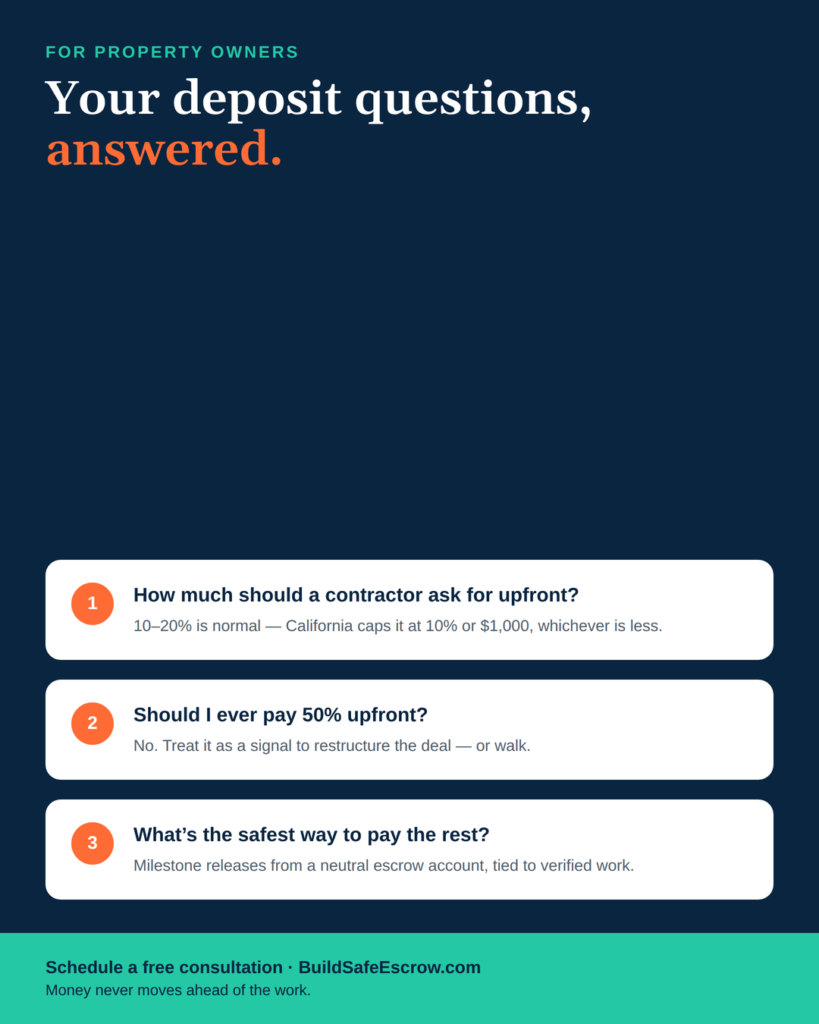
How much should a contractor ask for upfront? Roughly 10–20% of the contract price on a standard project. California law caps it at 10% or $1,000, whichever is less — a useful benchmark even outside California.
Is a contractor asking for money upfront ever breaking the law? Possibly. Some states cap home improvement deposits by statute, and exceeding the cap is a license violation. Check your state’s contractor licensing board before signing.
What if a contractor asking for money upfront says it’s for materials? Ask for the supplier quote, then pay the supplier directly or fund the purchase through a neutral escrow account. That covers the materials without handing over unsecured cash.
Should I ever pay a contractor 50% upfront? No. A licensed, solvent contractor doesn’t need half the job funded before starting. Treat a 50% demand as a signal to restructure the deal or walk.
What’s the safest way to structure the rest of the payments? Milestone-based releases tied to verified completion — ideally held and released through a neutral escrow account, so money never moves ahead of the work. <!– MEDIA: FAQ image card here. Alt text: “FAQ card answering top questions about a contractor asking for money upfront” –> <!– MEDIA: Optional explainer video embed slot here (how milestone escrow releases work). –>
Protect the next payment before you make it
Get one short read each Friday on how construction money actually moves — subscribe to The Build Brief.
And if you’re facing a contractor asking for money upfront and you’re not sure what to sign, schedule a free consultation. We’ll walk through your payment schedule before the first dollar moves.
This article is information, not legal or financial advice. Deposit caps and licensing rules vary by state — consult your own professional for your specific situation.
References
- Federal Trade Commission — Hiring a Contractor: https://consumer.ftc.gov/articles/hiring-contractor
- Contractors State License Board (California) — down payment rules: https://www.cslb.ca.gov/
- Maryland Attorney General — Home Improvement consumer guidance: https://www.marylandattorneygeneral.gov/
- Levelset — construction payment resources: https://www.levelset.com/