
The draw request says sixty percent complete. The site says otherwise.
Table of Contents
- When the numbers and the building disagree
- Why commercial projects fail differently
- What commercial construction escrow actually does
- Seven protections on every draw
- Who sits around the table
- A short field example
- How escrow removes the risk at the source
- FAQ
- Protect your project before the first draw
- References
When the numbers and the building disagree
Commercial construction escrow exists because of one gap: the distance between what a draw request claims and what has actually been built. If you are an owner, developer, or commercial build-out sponsor, that gap is where your capital disappears.
On a residential remodel, a bad payment costs you a kitchen. On a commercial project, a bad draw cascades. Subs go unpaid, liens attach to the asset, the lender freezes funding, and the schedule slips into another quarter of carrying costs.
The frustrating part is that nothing dramatic has to go wrong. No fraud, no disappearing contractor. Just money released slightly ahead of progress, repeatedly, until the remaining budget cannot finish the remaining work. That is a structure problem — and structure problems have structural fixes. Commercial construction escrow is the fix.
Why commercial projects fail differently
Scale changes the failure mode. Here is what makes commercial builds uniquely exposed.
The payment chain is long. Owner to general contractor to subcontractors to second-tier subs to suppliers. Every handoff is a place where money can stall. You may be four layers removed from the party who can file a lien against your asset. Commercial construction escrow shortens that distance to a single verified record.
Draws are self-reported. A draw is a scheduled release of funds tied to project progress. In most deals, the contractor states the percentage complete and the owner pays against that statement. Without independent verification, you are funding an assertion.
Front-loaded billing is normal. Contractors often bill heavier in early phases to cover mobilization and materials. Reasonable in isolation. But it means the money curve runs ahead of the construction curve — and if the job stops, the remaining funds will not finish it.
Retainage is not enough. Retainage is the five to ten percent held back until completion. On a project with real overruns, that holdback rarely covers the cost to finish.
Liens attach to the asset itself. Unpaid subs and suppliers can file against the property. On a commercial building, that clouds title, blocks refinancing, and can trigger default provisions in your loan — which is why commercial construction escrow collects waivers at every release.
Multiple parties, no shared source of truth. Owner, lender, GC, and tenant each track progress differently. Disagreement is inevitable when nobody is looking at the same verified record.
Every one of these is a sequencing problem. Commercial construction escrow fixes the sequence.
What commercial construction escrow actually does
Build Safe Escrow is a neutral, third-party service. We are not a lender, not a contractor, and not on anyone’s side. We hold project funds in a secure, FDIC-insured account and release them in stages, only as each agreed milestone is completed and verified.
That neutrality is the entire product. The party holding the money has no stake in whether the draw gets approved. Verification is not a favor from the owner or a concession from the contractor. In commercial construction escrow it is simply the condition of release.
Practically, commercial construction escrow means the full project budget — or each funded tranche — sits in a secured account before work begins. Milestones are defined in advance. When a stage is complete and verified, and the corresponding lien waivers are signed, funds release. Not before.
Read that from every seat at the table and it holds up. The owner knows capital is tied to progress. The contractor knows the money exists and is committed. The lender knows the collateral is actually being built. Nobody has to trust anybody, which is exactly why everyone can move quickly.
Seven protections on every draw
1. Funds verified and committed up front. The budget is deposited before mobilization. Contractors stop financing your project on their credit, and you stop wondering whether the next tranche will clear.
2. Every release tied to verified work. No draw moves on a self-reported percentage. The milestone is confirmed — inspection, walkthrough, or neutral verification — before funds leave the account. This is the core of commercial construction escrow.
3. Lien waivers collected at each release. A lien waiver is a signed document in which a contractor, sub, or supplier gives up the right to file a lien for the payment received. Collecting them at every release means you accumulate proof that the chain got paid.
4. The money curve tracks the construction curve. Because releases follow verified progress, the remaining funds always roughly match the remaining work. Front-loaded billing stops quietly draining the budget.
5. A shared record for every party. Owner, lender, GC, and tenant reference the same verified milestone history. Disputes shrink because there is one source of truth instead of four.
6. Faster resolution when something is contested. Because scope and milestones are defined up front, a disagreement stays contained to one line item. The rest of the project keeps funding on schedule.
7. Cleaner closeout with commercial construction escrow. Final retainage is held neutrally and released on verified completion and final waivers, rather than becoming a months-long negotiation.
Notice the pattern. Every protection points the same way: confirm the money early, and move it only on proof of work.
Who sits around the table
Commercial construction escrow is unusual in that it improves every seat at once, which is why deals close faster with it than without.
Owners and developers protect capital and keep liens off the asset. Lenders get assurance that draws fund real, verified progress and that the collateral is being built as underwritten. General contractors get confirmed funding and faster milestone payments instead of chasing checks. Subcontractors and suppliers get paid from an account that cannot be spent elsewhere. Commercial tenants funding a build-out know their money buys finished work.
No side gives up anything except the ability to move money ahead of the work — which nobody should want in the first place. That shared benefit is why commercial construction escrow spreads across a portfolio once a sponsor uses it one time.
A short field example
Consider a developer — call him Victor. A 14,000-square-foot retail build-out, a reputable GC, a construction loan behind it.
Victor ran the first phase the traditional way. Draw requests came in monthly with a percentage-complete figure. He approved them. By month five, the paperwork said seventy percent complete. His own walkthrough suggested closer to fifty. Two subs had not been paid in six weeks and were threatening liens. The lender caught the discrepancy and froze the next tranche. Work stopped for nineteen days.
His next project ran through escrow. The funded tranche went into a secured, FDIC-insured account. Six milestones, each with defined completion criteria. Every release required verification plus signed waivers from the GC and each sub touching that phase. When one milestone came in short, that release simply did not fund — and the shortfall surfaced that week instead of four months later.
Same GC. Same trades. Same loan structure. The difference was that on the second project, the money curve could not outrun the building. Nothing froze, nothing stalled, and the certificate of occupancy came in on schedule.
How escrow removes the risk at the source
Trust is a feeling. Structure is protection. Commercial projects fail not because people are dishonest but because money is allowed to move ahead of the work — and at commercial scale, that gap compounds fast.
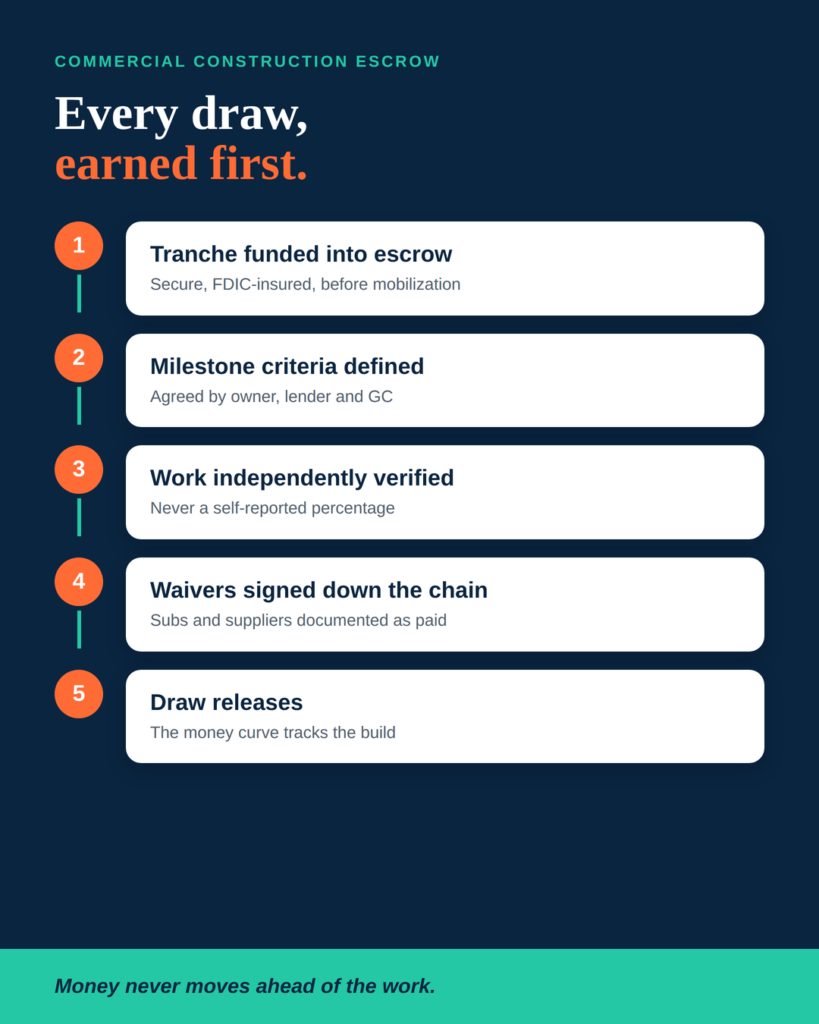
Escrow fixes the sequence. Funds are deposited and confirmed first. The work is completed. The work is verified. The waivers are signed. Only then does the money move. Money never moves ahead of the work.
That single rule closes every gap described above. A draw cannot be funded on an assertion. A sub cannot go unpaid while the owner believes otherwise. A lender cannot discover in month five that the collateral is behind the draw schedule. The record is verified as it happens, not reconstructed after something breaks. That is the practical value of commercial construction escrow.
Our escrow services are built for multi-party projects where several stakeholders need the same assurance at once. Want the mechanics in detail? Our construction escrow FAQs break down verification, milestones, and waivers step by step. If you would rather talk it through against your actual draw schedule, contact us.
FAQ
How is this different from a title company escrow? Title escrow typically handles a closing — a single transfer at one moment. Commercial construction escrow administers many staged releases across the life of the build, each tied to verified progress.
Does escrow slow the draw cycle down? It usually tightens it. Funds are pre-deposited, criteria are defined in advance, and releases happen in days once a milestone is verified — instead of waiting on a lender’s tranche to clear.
Can it work alongside a construction loan? Yes. Lender tranches can fund into escrow, and releases are documented against verified milestones — which is generally exactly the assurance a lender wants.
Who verifies that a milestone is complete? Verification is agreed up front and can include inspection reports, third-party walkthroughs, or architect sign-off. What matters is that it is defined before the first dollar moves.
Does this protect against mechanics liens? It addresses the root cause. Because waivers are collected at each release, you accumulate documented proof that the payment chain was satisfied at every stage.
Is there a project size that is too small? Any build where staged draws and multiple subs are involved benefits. The value comes from the structure, not the dollar amount.
This article is information and structure, not legal or financial advice. Talk to your own attorney, accountant, or lender about your specific project, loan documents, and state lien laws.
Protect your project before the first draw
If you are funding a commercial build, one habit changes everything: never let the money move ahead of the work.
Get one short read each Friday on how construction money actually moves — subscribe to The Build Brief.
Ready to protect your capital? Schedule a free consultation and we will walk through your draw schedule and show you where escrow tightens it.
References
- Associated General Contractors of America (AGC): https://www.agc.org/
- Cornell Legal Information Institute — Mechanic’s Lien: https://www.law.cornell.edu/wex/mechanic%27s_lien
- FDIC — Deposit Insurance: https://www.fdic.gov/resources/deposit-insurance/
- U.S. Small Business Administration — Managing Your Business Finances: https://www.sba.gov/