Table of Contents
- Why the roof is where reserve funds get exposed
- Is an HOA required to set up an escrow account for roof replacement?
- Do HOAs have escrow accounts for replacing roofs?
- Six moves that make HOA roof replacement escrow work
- Field example: a 48-unit roof, paid in five steps
- How HOA roof replacement escrow keeps money behind the work
- FAQ
- Keep the next big job on schedule
- References
An HOA roof replacement escrow gives property managers a clean way to pay for the largest project most boards ever approve. You are the one who drafts the payment schedule, signs off on invoices, and answers the owner who asks where the reserve money went. The roofer wants a big deposit next week. The board wants to know the money is safe, and so do you.
You know this moment. The contract is signed, the reserve study says the roof is due, and the first invoice is larger than any other line in the budget. What happens next decides whether the project stays boring, which is exactly what you want.
Why the roof is where reserve funds get exposed
A roof replacement is often the single largest check a board writes. It may draw down years of reserve contributions, or a special assessment (a one-time charge to every owner) that people grumbled about at the annual meeting. When that much money moves at once, small gaps in process become big ones.
Most of the exposure sits in the timing. Roofing contracts commonly ask for a deposit up front to order materials and hold a crew. Some schedules front-load payments so the contractor collects most of the price before the old roof is even off.
None of that is bad faith. Roofers carry real costs before the first shingle goes down. The risk is structural: once funds leave the association’s account ahead of the work, you have lost your leverage and your documentation trail at the same time.
A few root causes show up again and again:
- Deposits sized by habit, not by what the contractor needs to mobilize.
- Payment triggers written as dates (“30 days after start”) instead of verified events.
- Weather delays, supply backorders or a crew pulled to another job, all of which stretch the gap between paid and done.
- No single file showing what was paid, why, and who confirmed it.
That last one matters more than it looks. Owners, auditors and future boards will ask. Your process has to answer them without anyone’s memory, and closing that gap is what an HOA roof replacement escrow is built for.
Is an HOA required to set up an escrow account for roof replacement?
Not as a general rule we know of: escrow for a roof replacement is usually a board decision, so confirm what your governing documents and local rules require with the association’s attorney.
The rules that touch a roof project mostly deal with how associations fund and protect reserves. A reserve study is the planning tool behind that: the Community Associations Institute describes reserve studies as budgetary planning tools that help associations prepare for the maintenance and replacement of shared components, and a roof is one of the biggest.
Reserve rules shape how much you set aside and what that money can pay for. They generally speak to funding, not to how payments to a contractor are released. That part is left to the board, the roofing contract and the association’s advisors.
So an HOA roof replacement escrow is a choice, made with counsel. Rules change and governing documents add their own requirements, so check yours before you build a payment structure.
Do HOAs have escrow accounts for replacing roofs?
Some do, by choice: an association can use third-party escrow on a large capital project so that each payment is tied to verified work.
Without escrow, the reserve account pays the contractor directly as invoices arrive. That can work on small jobs. On a six or seven figure roof, an HOA roof replacement escrow adds a step between the money and the release. That step is the protection.
The roofer benefits too. With funds deposited up front with a neutral party, the contractor knows the money exists before ordering a single bundle of materials.
Six moves that make HOA roof replacement escrow work
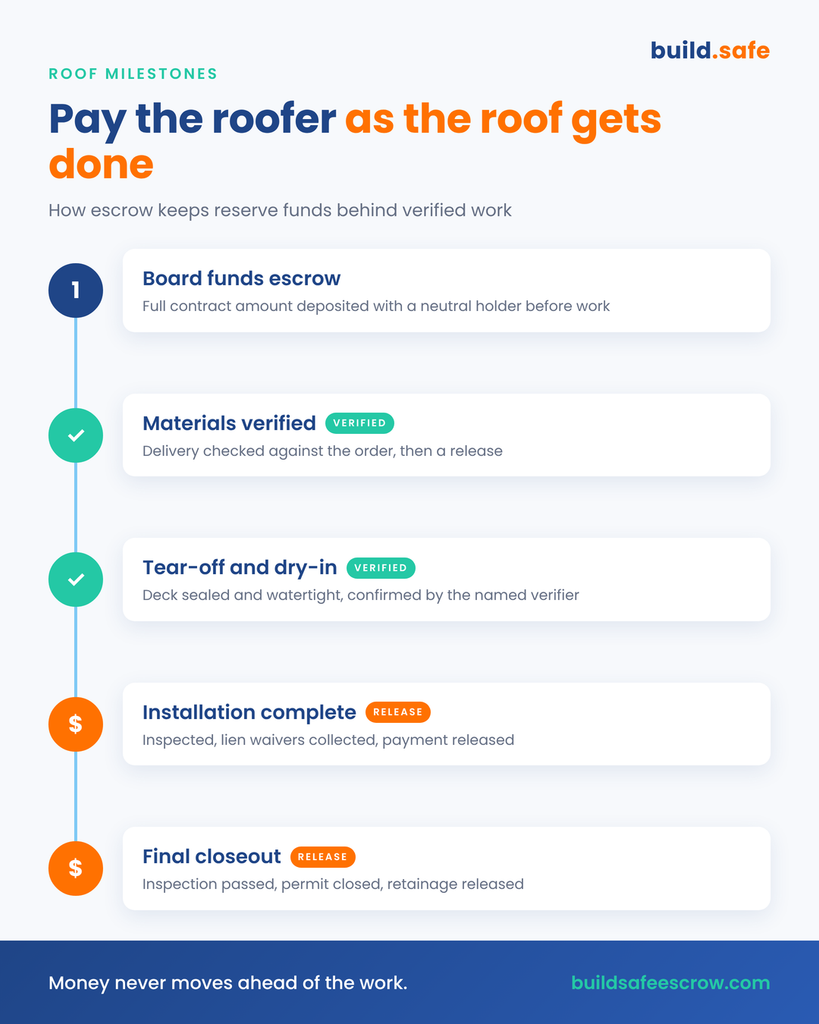
Use these as a checklist when you set up an HOA roof replacement escrow. They run roughly in order.
- Fund before you mobilize. Deposit the full contract amount (or the approved phase) with the escrow holder before work starts. The board and the roofer both see that the money is real.
- Size the deposit to real costs. Ask the contractor what mobilization and material ordering actually require. A smaller, justified mobilization payment keeps the crew moving without putting most of the reserves at risk on day one.
- Write milestones as events, not dates. Every HOA roof replacement escrow runs on its milestone schedule. A strong one for a roof might look like this:
- Materials delivered to site and verified against the order
- Tear-off complete and dry-in (the deck sealed with underlayment so the building is watertight)
- Installation complete
- Final inspection passed and the permit closed out
- Name who verifies each milestone. Your roofing consultant, an engineer, or you with photos and a site visit. Put the name and the evidence required in the contract, so nobody argues about it later.
- Collect lien waivers with every release. A lien waiver is a signed release from the contractor or a supplier giving up the right to file a lien for the amount paid. Ask for conditional waivers before a release and unconditional ones after, for the roofer and major suppliers. Your attorney can tell you which forms fit your state.
- Keep retainage until closeout. Retainage is a small share of each payment held back until the job is fully finished. It gives everyone a reason to close the permit, fix the punch list, and deliver the warranty paperwork.
Keep every approval, photo, waiver and release in one project file. When an owner or auditor asks, you send the file.
Field example: a 48-unit roof, paid in five steps
This is a fictional scenario to show the structure.
Dana Whitfield manages a 48-unit condominium association near the coast. The board approves a $612,000 roof replacement, funded from reserves and a modest special assessment. The roofer’s standard proposal asks for 40% at signing.
Dana suggests an HOA roof replacement escrow instead. The board deposits the full amount with a neutral escrow holder. They agree on a smaller mobilization payment for material ordering. After that, funds release at verified material delivery, at dry-in and at installation. A final payment, held as retainage, waits for inspection, permit closeout and final lien waivers.
Three weeks in, a tropical storm stalls the job for nine days. Nobody panics. The money for the next stage is sitting in escrow, the roofer knows it is there, and the board knows it will not move until the deck is sealed.
At the annual meeting, an owner asks how the roof money was spent. Dana hands over a one-page ledger, with each release matched to an inspection note and a waiver. The question takes two minutes, because the HOA roof replacement escrow produced that record along the way.
How HOA roof replacement escrow keeps money behind the work
The whole idea fits in one line: payments should follow finished work, never run ahead of it.
You may trust your roofer completely, and that is worth having. Trust, though, is a feeling. A milestone schedule held by a neutral party is protection you can show a board. Escrow turns the first into the second.
Every thread in this article connects to that point:
- Deposits stop being a leap of faith because the bulk of the money stays put until work is verified.
- Delays stop being a crisis, because nothing has been overpaid.
- Documentation builds itself, release by release.
- The roofer gets certainty that funds exist and a clear path to being paid on time.
Build Safe Escrow acts as that neutral referee. We hold the funds in FDIC-insured accounts and release them only when each agreed milestone is completed and verified. We are not a lender or a contractor, and we do not take sides. You can see how the process runs on our construction escrow services page, and our construction escrow FAQs cover common questions from boards.
If you are still weighing payment options, our guide on how an HOA should pay a contractor walks through the alternatives. If the roof is funded by owners directly, see our piece on special assessment escrow for HOAs.
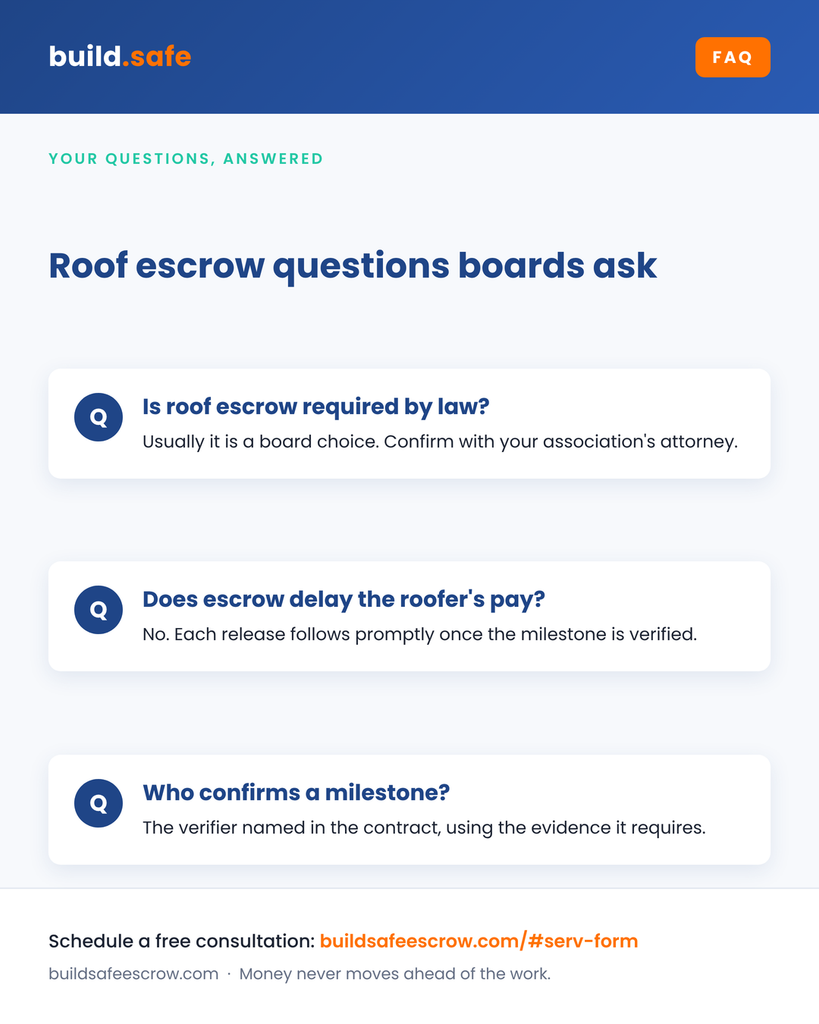
FAQ
What is an HOA roof replacement escrow?
It is an arrangement where a neutral third party holds the roof funds and releases them to the roofer at agreed, verified milestones.
Does escrow slow down payments to the roofer?
It should not. When milestones and verification are defined up front, each release follows promptly once the step is confirmed.
Who decides when a milestone is complete?
The contract does. Name the verifier (a consultant, engineer or the manager) and the evidence required for each stage.
Can reserve funds be placed in escrow for a roof?
That depends on your governing documents and state law. Ask the association’s attorney before moving reserve funds.
Should the board vote on an HOA roof replacement escrow?
Follow your governing documents. Approving the payment structure alongside the roofing contract, with counsel’s input, puts the decision on record.
Does an HOA roof replacement escrow work for any association?
Yes. The structure works for community associations anywhere in the USA. Rules on reserves and liens differ, so confirm locally with your attorney.
Keep the next big job on schedule
Get one short read each Friday on how construction money actually moves: subscribe to The Build Brief.
Planning a roof or another capital project for one of your boards? Schedule a free consultation and we will map out a milestone schedule with you.
References
- Reserve Study and Funding public policy, Community Associations Institute: defines reserve studies as budgetary planning tools for maintaining and replacing association components.
- Understanding Deposit Insurance, FDIC: how FDIC deposit insurance protects eligible deposits.