Table of Contents
- Why multifamily rehabs leak capital before anyone notices
- How does multifamily renovation escrow work?
- Why do multifamily investors use renovation escrow?
- Seven fixes that keep capital tied to finished scope
- Field example: a 24-unit rehab where the draw matched the building
- Escrow closes the leak at the source, for both sides
- FAQ
- Control from a distance starts with one conversation
- References
Multifamily renovation escrow is how investors funding a value-add apartment rehab from far away make sure every dollar lands in the building. You approve a draw for “unit turns, 60 percent complete” and wire the money. Three weeks later, a walkthrough video shows half the kitchens still stripped to the studs, and nobody can say exactly where the gap went.
General information only, not legal or financial advice. Rules vary; confirm the details with your own attorney or accountant.
Why multifamily rehabs leak capital before anyone notices
A single-family flip has one kitchen, one roof and one crew. A multifamily rehab has dozens of kitchens, a shared roof, a boiler or a stack of water heaters, hallways, a parking lot and four or five trades working at once. That scale changes how money slips away.
The usual causes look ordinary on their own:
- Many units, many trades, all in parallel. Plumbers sit in unit 3 while painters finish unit 11 and flooring waits on unit 7. Progress is real, but it is scattered.
- Front-loaded draws. Early requests often cover demolition and materials. Cash goes out fast while visible value lags behind.
- Percent-complete guesses across a whole building. “The building is 45 percent done” averages a finished unit with an empty one. Nobody can verify an average.
- Occupied units. Tenants stay in place, so work happens in waves. Schedules slip, and draws get requested on the calendar anyway.
- Scope creep across units. One unit reveals rotted subfloor. Then the same fix quietly gets applied to six more, with no written approval.
- The sponsor or GC also controls the money. When the party doing the work also holds the funds, the checks and balances live only in good intentions.
- Distance. You are not walking the site. You see photos someone else picked.
None of this requires bad faith. It only requires a system where money can move before anyone confirms the work behind it. That gap is what multifamily renovation escrow is built to close.
How does multifamily renovation escrow work?
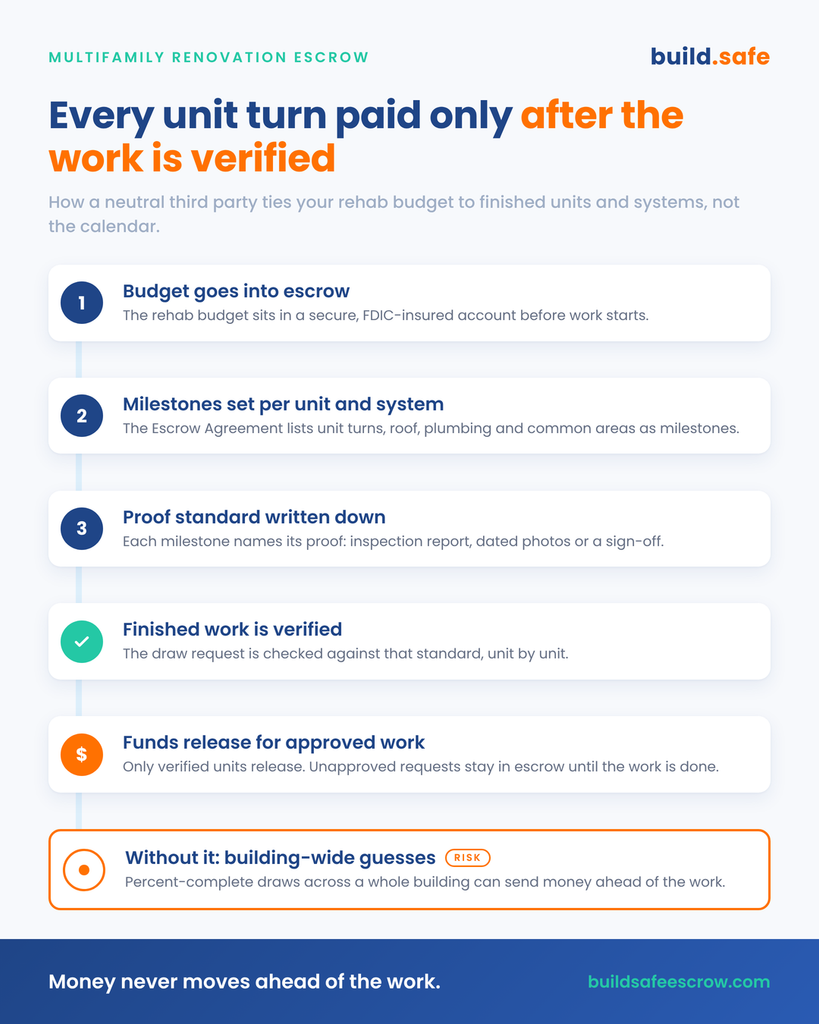
Multifamily renovation escrow places your rehab budget with a neutral third party, who releases funds in stages only after each agreed unit or building milestone is completed and verified.
You, the contractor and the escrow company sign an Escrow Agreement, the document that lists every milestone and what counts as proof. Proof can be an inspection report, dated photos, a sign-off from your project manager, or a mix.
The renovation budget sits in a secure, FDIC-insured account. When a milestone is done, the contractor submits a draw request. The work is checked against the standard written for that milestone. If the request is approved, the matching funds release. If it is not approved, the money stays in escrow.
With multifamily renovation escrow, milestones can be granular. A unit-level milestone might be “unit 9 turned: flooring, fixtures, paint, appliances, final clean.” A building-system milestone might be “roof replaced and inspected” or “domestic water lines repiped and pressure tested.” Each one has its own dollar amount and its own proof.
If a dispute comes up, the agreement sets a resolution process that aims to keep everyone out of court. Either party can bring in a third-party mediator.
Why do multifamily investors use renovation escrow?
They use it because it gives them control at a distance: proof that capital went into the building before more capital goes out.
Investors who fund from another city, or who back a sponsor they have not worked with before, want visibility without micromanaging. Multifamily renovation escrow gives them a rule both sides agreed to in writing.
Contractors benefit as well. A GC who sees the full budget confirmed in place knows the money exists before ordering cabinets for 24 kitchens. Payment follows approved work, not a sponsor’s mood or a slow capital call. Trust is a feeling. Structure is protection, and escrow turns the feeling into the structure.
Disputes are the other reason. Arcadis tracks large North American construction disputes, and in 2024 they lasted 12.5 months on average. Owner-directed changes ranked among the top causes. Your rehab is smaller than those projects, but the lesson carries over. In a multifamily building, a fight over one change order can freeze work on every floor.
Seven fixes that keep capital tied to finished scope
These fixes work with or without an escrow company. Multifamily renovation escrow makes them enforceable.
- Unit-level and building-system milestones. Break the budget into units and systems, not phases of the calendar. “Units 1 through 6 turned” beats “month two.”
- A written verification standard per milestone. Decide up front what proves each milestone: an inspection, a photo set with unit numbers visible, a sign-off. Write it down.
- A draw schedule tied to completed scope. Draws follow finished work. If the crew finishes faster, money moves faster. If they slip, money waits.
- Change orders in writing before money moves. A change order is a signed amendment to scope and price. No signature, no payment. That one rule stops scope creep from spreading unit to unit.
- Holdback or retainage for the punch list. Retainage is a portion of each payment held back until final punch items are complete. Your attorney can help you set the percentage.
- A capital reporting rhythm. Agree on a cadence, such as every draw or every two weeks, for a short report: units verified, funds released, funds remaining, open change orders.
- Separate the money from the people doing the work. When a neutral party holds the funds through multifamily renovation escrow, nobody has to choose between their project and their bank balance.
Some of these feel like paperwork. They are cheaper than finding out at refinance that the building is worth less than the money spent on it.
For a deeper look at checking each request, see our guide to construction draw verification for investors.
Field example: a 24-unit rehab where the draw matched the building
Elena Whitfield, a fictional investor, buys into a 24-unit value-add rehab with a sponsor she has not worked with before. She lives far from the property. The renovation budget is $1,200,000, and it goes into multifamily renovation escrow before work starts.
The Escrow Agreement splits the budget this way:
| Line | Amount |
|---|---|
| Unit turns: 24 units at $30,000 each | $720,000 |
| Building systems: roof and water line repipe | $252,000 |
| Common areas and exterior | $120,000 |
| Contingency | $108,000 |
| Total | $1,200,000 |
Each unit is its own milestone. Proof is a dated photo set of the finished unit plus the project manager’s sign-off. The agreement holds back 10 percent of each unit as retainage for the punch list, so a verified unit releases $27,000 and $3,000 stays in escrow.
In week nine, the GC requests a draw for units 7 through 12, six units worth $180,000. The photo sets show four units finished. Two still lack flooring and appliances.
Four units are verified, so $108,000 releases (4 x $27,000). The other $72,000 stays in escrow: $60,000 for the two unfinished units and $12,000 in retainage on the four that passed. Nobody argues about percentages. The two units release when their photos come in.
Then unit 14 reveals rotted subfloor. The GC prices the repair at $6,500 and sends a written change order. Elena signs it, and the amount comes from contingency, which drops to $101,500. When the crew finds the same problem in unit 16, it becomes a second change order, not an assumption.
The GC benefits too. The money for every approved unit was confirmed in place from day one, so the crew kept moving and nobody waited on a capital call.
Escrow closes the leak at the source, for both sides
Look back at the causes. Parallel trades, front-loaded draws, whole-building percentages, scope creep, the sponsor holding the cash, distance. Each one is a way for money to move ahead of the work.
Multifamily renovation escrow answers each one with the same rule. Funds release per verified milestone, against a standard both sides signed. A building-wide guess becomes a unit count. A verbal change becomes a signed change order. Distance stops mattering as much, because proof travels to you.
Build Safe Escrow stays neutral. We are not a lender, not a contractor, and not on anyone’s side. We hold the funds, follow the agreement, and release money when a milestone is completed, verified and approved. The investor gets proof. The contractor gets certainty that the money exists. Money never moves ahead of the work.
You can see how the process runs in our overview of construction and renovation escrow services, or browse common questions in the construction escrow FAQs.
FAQ

What is multifamily renovation escrow?
It is an arrangement where a neutral third party holds your apartment rehab budget in an FDIC-insured account and releases it in stages as each agreed milestone is completed and verified.
Can milestones be set per unit instead of per phase?
Yes. In multifamily renovation escrow, many investors set unit-level milestones for turns and separate milestones for building systems such as the roof, plumbing or electrical.
What happens if a draw request is not approved?
The funds stay in escrow. The contractor can finish the work or supply the missing proof, and the agreement’s dispute process applies if both sides disagree.
Does escrow help the general contractor?
Yes. With multifamily renovation escrow, the GC can see that the full budget is confirmed in place, and payment follows approved work instead of waiting on a slow capital call.
Is multi-family real estate escrow only for large buildings?
No. The same milestone structure works for a fourplex or a 200-unit property. What matters is clear milestones and a written proof standard.
Control from a distance starts with one conversation
Get one short read each Friday on how construction money actually moves: subscribe to The Build Brief.
Funding a multifamily rehab you cannot walk every week? Talk with our team about your unit turns, systems work, draw schedule and how multifamily renovation escrow would fit. Schedule a free consultation.
References
- Arcadis, Construction Disputes in Motion: Speed, Agility, and Adapting to Change, 15th Annual Construction Disputes Report, North America (2025): https://www.cmaanet.org/sites/default/files/2025-09/202515~1.PDF
- Federal Deposit Insurance Corporation, Understanding Deposit Insurance (last updated April 1, 2024): https://www.fdic.gov/resources/deposit-insurance/understanding-deposit-insurance