
Table of Contents
- What is construction draw verification?
- Why passive investors lose sight of their money
- How do I know my investment money is going into the construction?
- Six checks that turn “trust me” into proof
- The balance-to-complete test
- From the field: the fourplex that looked fine in photos
- How escrow makes construction draw verification the default
- Construction draw verification FAQs
Construction draw verification is the difference between knowing your capital went into the build and hoping it did. If you’re an investor who wired money into a development and now gets a monthly update with a few site photos, you already sense the gap.
You funded the project. Someone else spends the money. Between those two facts sits a draw process you probably can’t see.
What is construction draw verification?
Construction draw verification is the process of confirming that the work being paid for is actually in place, matches the budget, and is free of unpaid liens before any money is released.
A draw is a payment from the project’s funds to the builder as construction moves forward. The builder asks for it with a draw request (sometimes called a pay application) listing what was completed and what it cost. Verification is the step in between: someone checks the request against the site, the budget, and the paperwork before funds move.
Banks treat this as basic risk control. The Comptroller of the Currency’s commercial real estate lending handbook tells examiners that disbursement controls should make each draw match the improvements in place on the inspection date, backed by inspection reports and lien waivers.
Most private investors get far less construction draw verification than their lender does.
Why passive investors lose sight of their money
The lender on a project usually has an inspector, a draw desk, and a title company. The equity investor often has a quarterly email.
A few patterns explain the blind spot:
- The operator controls the account. Your capital lands in the sponsor’s or builder’s account, and draws are approved by the same people requesting them.
- Reports describe progress instead of proving it. Photos and narrative updates show activity. They don’t tie dollars to budget lines.
- Budgets get front-loaded. Early line items (site work, mobilization, “general conditions”) can be padded so more cash comes out sooner than the work justifies.
- Money moves between projects. When one operator runs several builds, funds can drift toward whichever job is shortest on cash.
- Nobody collects lien waivers. A lien waiver is a signed statement from a contractor or supplier giving up the right to file a lien for an amount they’ve been paid. Without them, a subcontractor who wasn’t paid can file a lien against the property your capital is sitting in.
Usually nobody set out to deceive anyone. The structure just leaves the person with the most money at risk holding the least information. The SEC’s investor alert on red flags in unregistered offerings lists vagueness about where the money is going among the warning signs.
How do I know my investment money is going into the construction?
You know when every draw is checked against completed work by someone independent of the builder, documented line by line, and released from an account the builder doesn’t control.
Anything short of that is reporting, not verification. Reporting can be accurate. It just can’t prove itself.
The good news is that construction draw verification doesn’t require you to visit the site or read every invoice. It requires a structure where the checks happen automatically, and where you can see the results.
Six checks that turn “trust me” into proof
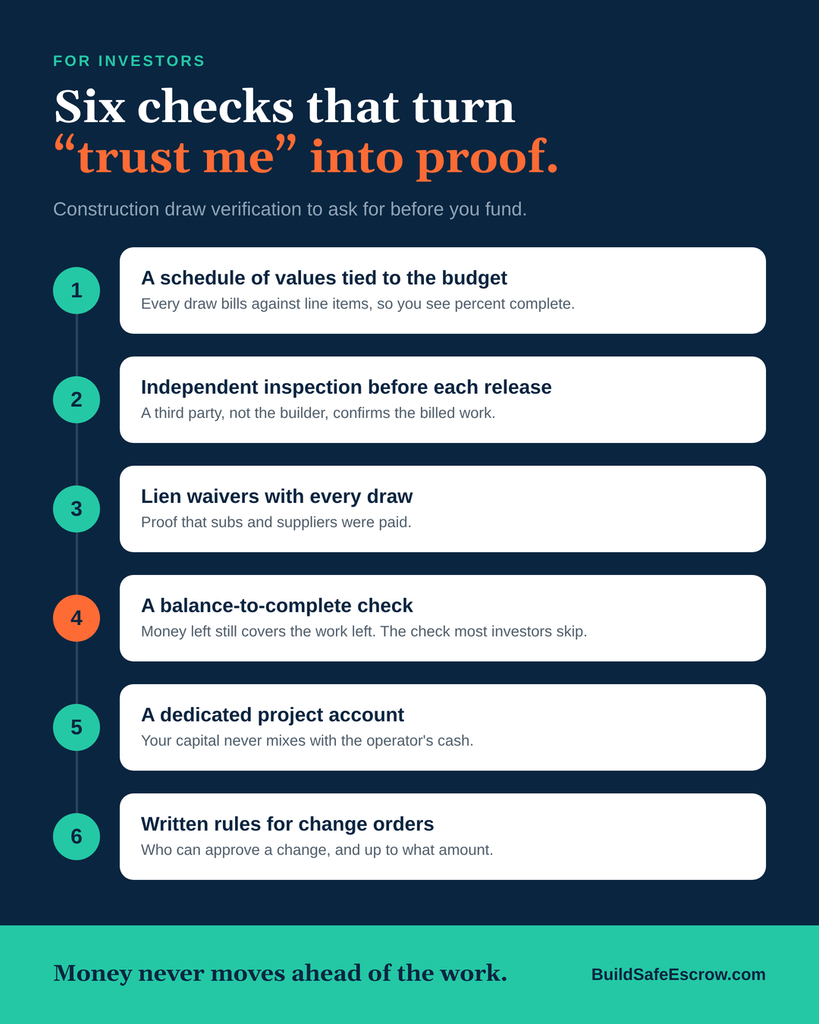
Ask for these before you fund. They’re far easier to negotiate before the wire than after it.
- A schedule of values tied to the budget. This is the project budget broken into line items (foundation, framing, roofing, and so on), each with a dollar value. Every draw should bill against it, so you can see percent complete by line, not just a total.
- Independent inspection before each release. A third-party inspector, not the builder’s superintendent, confirms the work billed is in place. Dated photos should match the line items being paid.
- Lien waivers with every draw. A conditional waiver takes effect once payment clears; an unconditional waiver confirms payment was received. Collect conditional waivers for the current draw and unconditional ones for the last.
- A balance-to-complete check. Before each release, confirm the remaining funds still cover the remaining work. More on this below, because it’s the check most investors skip.
- A dedicated project account. Your capital should sit in an account used only for this build, ideally held by a neutral party, never mixed into the operator’s operating cash.
- Written rules for change orders. A change order is an approved change to scope or price. Decide in advance who can approve one and up to what amount, so the budget can’t drift without your knowledge.
Even three of these change the picture. All six make construction draw verification routine instead of a favor you have to ask for.
The balance-to-complete test
Of all the steps in construction draw verification, this one catches the most trouble.
Say the project budget is $1.2 million. Draws to date total $700,000, leaving $500,000. The inspector reports the work is 50% complete, which means roughly $600,000 of work remains.
Remaining money: $500,000. Remaining work: $600,000. The project is $100,000 short, today, even though every report says “on track.”
That gap usually means early draws ran ahead of the work. Caught at draw four, it’s a conversation. Caught at the last draw, it’s a capital call or a stalled building. Ask for this calculation with every draw request.
From the field: the fourplex that looked fine in photos
Corinne is a Seattle-based investor who put $350,000 into a fourplex build in Tacoma alongside two other limited partners. The sponsor sent monthly updates with clean photos and a short note. The fourth draw was described as “framing complete.”
It wasn’t. When the lender’s inspector visited for the next draw, framing was closer to 60% done. Part of the earlier money had gone to finish a different project the sponsor was running across town. Nothing about the photos was false. They just showed the parts of the building that were finished.
The project survived, after a capital call and a crash course in construction draw verification. Corinne’s next investment came with three conditions: a schedule of values, third-party inspection before every draw, and funds held in escrow.
How escrow makes construction draw verification the default
Construction escrow puts the project funds with a neutral third party before work starts. The escrow agent holds the money in a secure, FDIC-insured account and releases it in stages, only as each agreed milestone is completed and verified.
For an investor, that changes the structure in a few specific ways:
- The builder can’t approve its own draw. Release depends on verification, not on whoever controls the bank login.
- Each release comes with documentation. Inspection results, the milestone being paid, and the supporting paperwork are on record.
- Your capital stays with the project. It can’t drift to another job, because it isn’t in the operator’s account.
- Everyone sees the same numbers. Investors, the sponsor, and the contractor work from one record.
It protects the other side as well. Contractors get paid promptly once a milestone is verified, and sponsors get a reporting trail that makes the next raise easier. We’ve seen that play out with an investment group that used escrow to raise its next round.
Trust is a feeling. Verification is a structure, and money never moves ahead of the work. You can see how the process runs on our construction escrow services page, or read the construction escrow FAQs for the basics.
Construction draw verification FAQs
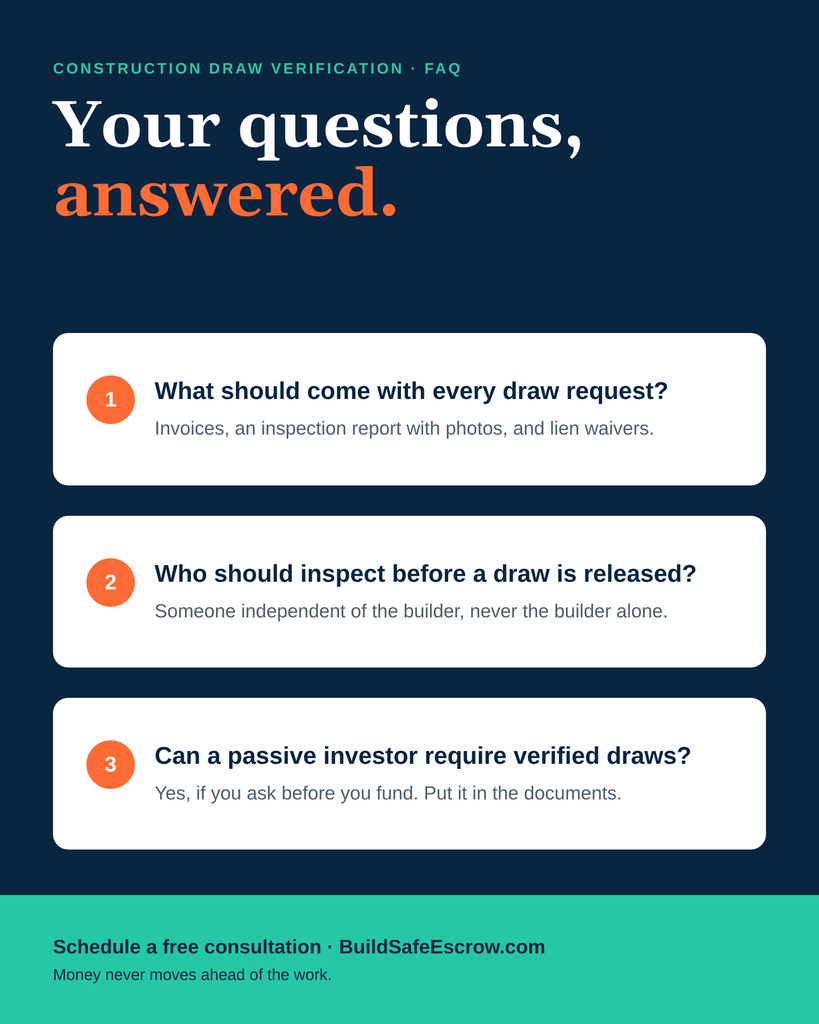
What documents should come with every draw request?
A draw request against the schedule of values, invoices for the work billed, an inspection report with dated photos, and lien waivers from the contractor and major subs and suppliers.
Who should inspect the work before a draw is released?
Someone independent of the builder: a third-party construction inspector or the escrow agent’s verification process. The builder’s own superintendent shouldn’t be the only sign-off.
How often are construction draws usually released?
Most projects draw monthly or at defined milestones. Milestone-based draws tie money more directly to finished work.
Can a passive investor require construction draw verification?
Yes, if you ask before you fund. Conditions like third-party inspection and escrowed funds can be written into the operating or subscription documents. Have your own attorney review them.
Does escrow slow down payments to the contractor?
It usually makes them more predictable. Once a milestone is verified, the release follows on an agreed timeline instead of waiting on whoever controls the account.
Know where every dollar went
If you’re putting capital into a build, you deserve proof, not updates. Schedule a free consultation and we’ll show you how a verified, escrow-held draw schedule would work on your next project: schedule a free consultation.
Get one short read each Friday on how construction money actually moves. Subscribe to The Build Brief.
This article is general information, not legal, tax, or investment advice. Talk to your own attorney and financial advisor about your specific situation.
References
- Commercial Real Estate Lending, Comptroller’s Handbook (Office of the Comptroller of the Currency)
- Investor Alert: 10 Red Flags That an Unregistered Offering May Be a Scam (U.S. Securities and Exchange Commission, Investor.gov)
- Managing Real Estate and Construction Lending Risk (Abrigo)
- Understanding Deposit Insurance (FDIC)