
Table of Contents
- Why your collateral can fall behind your loan balance
- What does a construction draw inspector check?
- How often should a lender order a construction draw inspection?
- Five ways a construction draw inspection fails the lender
- Seven fixes that put the report back in charge
- A field example: one rough-in draw, two different answers
- Escrow turns the inspection report into the gate
- FAQ
- Put structure behind your next draw
- References
A construction draw inspection is the only thing standing between a borrower’s draw request and your wire. As a hard money lender, you know the routine: the request lands Tuesday, the borrower wants funds by Friday, and the photos look fine. The real question is whether the house on the ground is worth what you have already advanced against it.
Your loan is only as safe as the asset being built. Every dollar released before the work exists is collateral you are hoping to find later.
Why your collateral can fall behind your loan balance
On a fix-and-flip or ground-up loan, the property is still a work in progress. Its value grows only as fast as labor and materials are installed. Your exposure grows every time you fund a draw.
Those two lines should rise together. They drift apart for ordinary reasons:
- Optimism. Borrowers report the progress they expect by Friday, not what is in place on Tuesday.
- Speed pressure. Short-term loans carry high costs, so everyone wants money moving.
- Thin verification. A desk review of borrower photos is cheaper than a site visit, and it misses more.
- Budget drift. Change orders and overruns eat contingency while nobody updates the cost to complete.
The OCC’s Comptroller’s Handbook on commercial real estate lending (2022) calls failure to properly monitor construction progress and manage disbursements “a control weakness.” It expects disbursement controls “confirming construction draws are commensurate with verified improvements.” Examiners wrote that for banks, but the logic fits any private lender.
What does a construction draw inspector check?
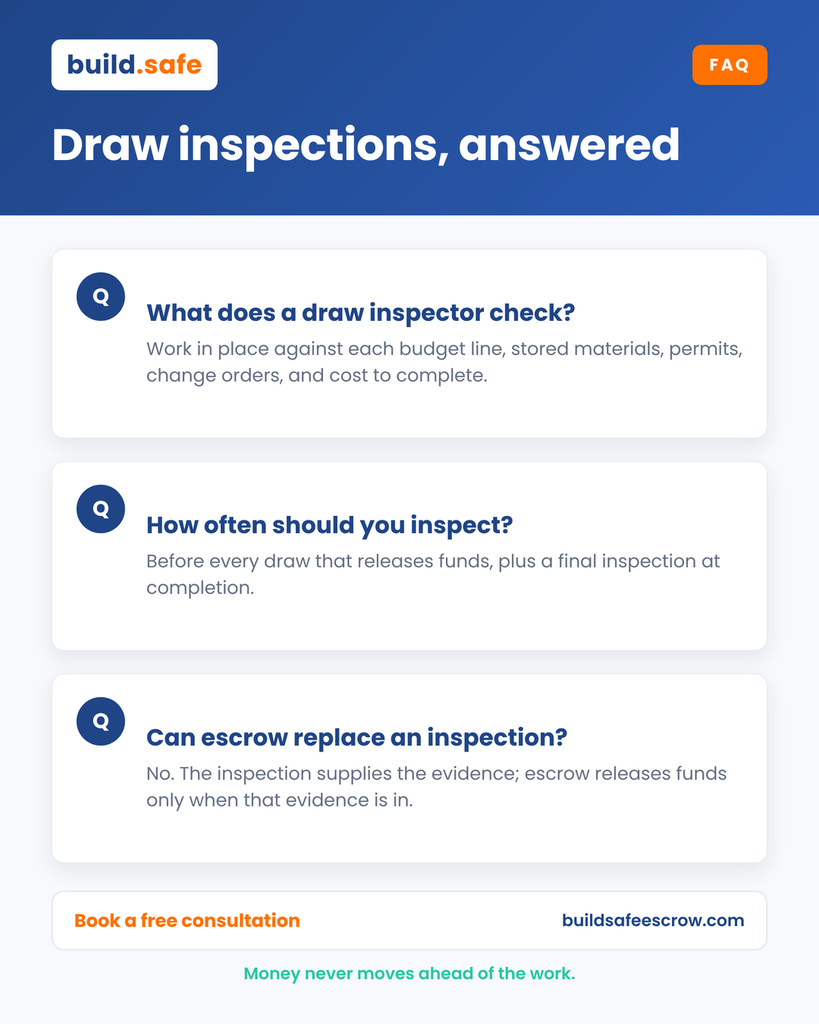
A construction draw inspector visits the site, confirms how much of each budget line is complete, and reports whether the draw matches that work before you fund it.
A construction draw inspection is a third-party site visit. The inspector compares work in place against the schedule of values, the line-item budget that assigns dollars to each phase or trade. The report gives a percent complete for each line and overall.
A thorough report covers more than one headline number:
- Work in place versus line items. Is framing 100 percent done, or 70 percent with trusses still on the ground?
- Materials on site versus installed. Cabinets in the garage are not installed cabinets.
- Stored materials. If the budget pays for them, the inspector confirms they exist, are secured, and match the invoice.
- Dated photos taken by the inspector, not supplied by the borrower.
- Change orders, approved or not.
- Permits and municipal sign-offs. Rough-in work that failed a building department inspection is not complete work.
- Budget remaining versus cost to complete. If the undisbursed balance cannot finish the house, you have a gap, even when this draw looks right.
That last line protects you most. The OCC handbook expects “the budget remains in balance with sufficient funds available to fund completion.” A good construction draw inspection report says so plainly.
How often should a lender order a construction draw inspection?
Order a construction draw inspection before every draw that releases funds, plus a final one at completion.
Some lenders skip inspections on small draws to save fees. Three small unverified draws can add up to one large one.
Agency renovation programs set the same expectation. Fannie Mae’s Selling Guide for HomeStyle Renovation mortgages (updated December 2025) is one example. Before additional escrow draws, the lender “must obtain periodic inspections to confirm the work is being completed as planned.” Your loan documents may differ, but the principle holds: verify, then fund.
Match frequency to the draw schedule you set at closing. Fewer, larger milestones (foundation, dry-in, rough-ins, drywall, final) keep costs predictable and each report meaningful.
Five ways a construction draw inspection fails the lender
An inspection only protects you if the process around it holds. These gaps show up most often.
- A front-loaded budget. Too much money sits in early phases like demolition and site work. Each draw matches the budget but overpays the work, and the back half runs short.
- Desk reviews with borrower photos only. Photos show activity. They cannot show whether the electrical passed rough-in.
- Paying for stored materials without controls. Materials in a yard can walk away, get damaged, or end up on another job.
- An inspector too close to the borrower. If the borrower picks or pays the inspector, the report can soften. The OCC handbook notes that borrower-commissioned feasibility studies “may be biased and should be critically reviewed.”
- Draws released before lien waivers arrive. A lien waiver is a signed release in which a contractor or supplier gives up lien rights for amounts paid. Without them, an unpaid sub can file a lien that competes with your position. Rules vary by state; confirm with your attorney.
That fifth gap has a human side. Siteline’s The State of Subcontractor Billing in 2026 found that 92 percent of subcontractors floated payroll from their own pockets in the past year. Slow or sloppy draws hit the trades building your collateral first.
Seven fixes that put the report back in charge
None of these needs new software. They need rules set before the first draw.
- Review the budget before closing. Have a qualified reviewer check the schedule of values for front-loading, then rebalance.
- Require a site visit for every construction draw inspection. Desk reviews can supplement it, never replace it.
- Hire the inspector yourself. Pass the fee through if you like, but the engagement and the report belong to you.
- Write a stored-materials rule. Decide whether you pay, at what percentage, and with what proof.
- Ask for cost to complete on every report. A balance-to-complete check compares undisbursed funds with remaining work. A shortfall means the borrower adds equity before the next release.
- Make lien waivers a release condition. Collect conditional waivers with each request and unconditional waivers for the prior draw. Your attorney can confirm which forms apply.
- Track change orders in writing. No line moves without a signed change order and an updated budget.
Each fix moves a decision from after the money leaves to before it leaves.
A field example: one rough-in draw, two different answers
Denise Hartwell is a private lender. She funds a $640,000 loan on a gut renovation with an addition, holding back $410,000 for construction in five draws.
Draw three, rough-ins, comes in at $92,000. The borrower’s photos and note say plumbing, electrical, and HVAC are complete.
Denise orders a construction draw inspection anyway. Plumbing and HVAC check out. The electrical rough-in has not passed its municipal inspection, and part of the request covers light fixtures in a storage unit with no invoice. The cost-to-complete line shows the remaining holdback about $18,000 short, thanks to an earlier change order nobody re-budgeted.
She approves a partial draw for verified work. The borrower adds equity, the electrical passes a week later, and the balance releases then. Nobody acted in bad faith. The loan and the house had drifted apart, and her construction draw inspection showed exactly where.
Escrow turns the inspection report into the gate
An inspection tells you what is true on site. It does not, by itself, stop money from moving.
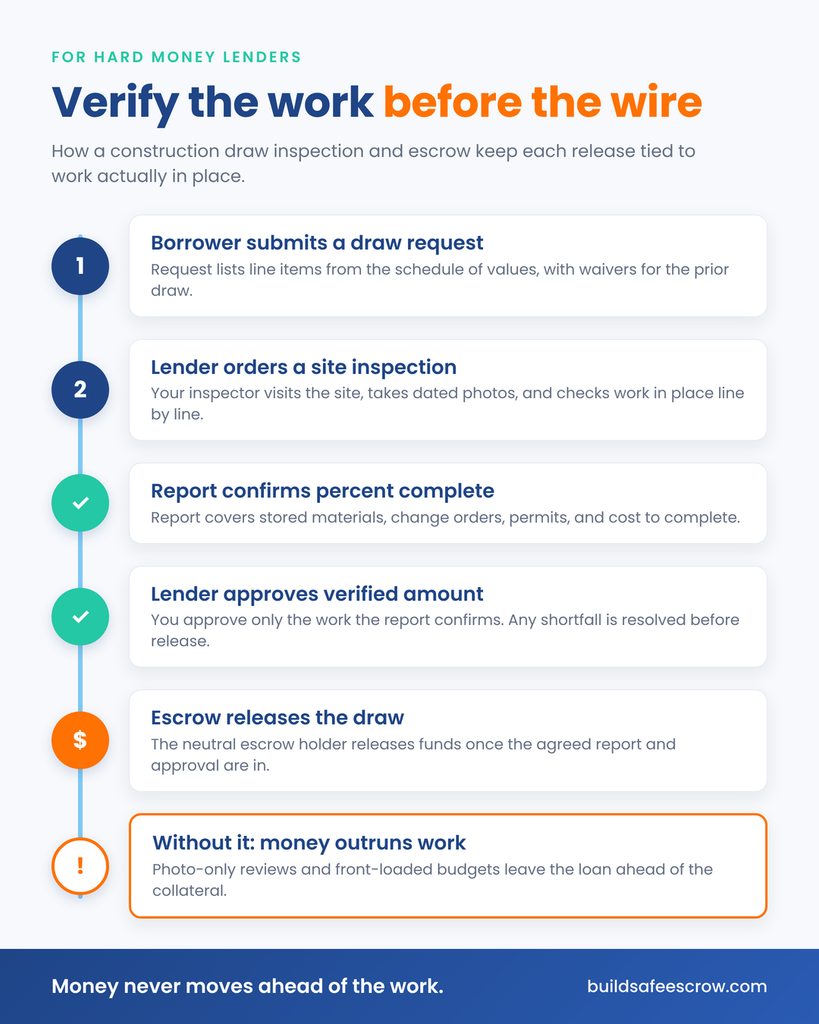
Trust is a feeling; structure is protection. With construction escrow, a neutral third party holds the draw funds in a secure account. It releases them in stages, only when the agreed verification is in. Build Safe Escrow does not perform inspections. The Escrow Agreement can make each release conditional on the construction draw inspection report you order, plus your written approval.
Every thread ties back to one rule: money never moves ahead of the work.
- Front-loaded budgets surface sooner because releases follow verified milestones.
- Photo-only reviews stop being enough once the agreement names an inspection report as the release condition.
- Lien waivers and stored-materials proof can be documents required before release, if the agreement says so.
- Disagreements follow the agreement’s dispute-resolution process. If approval is withheld, funds stay in escrow, and either party can bring in a mediator.
The lender can deposit the funds, so your holdback sits with a party on no one’s side. Contractors see the money is real and waiting, which steadies the trades your collateral depends on. Learn more about our escrow services or browse our construction escrow FAQs.
If you also invest equity, our related post on how passive investors confirm draws are real covers the same problem from the investor’s seat.
FAQ
Who should pay for a construction draw inspection?
The lender hires the inspector, and many lenders pass the fee to the borrower. What matters is that the inspector reports to you.
Is a desk review ever enough?
It can supplement a site visit for a minor change or a document check. For any draw that releases meaningful funds, a site visit gives far better evidence.
What should a construction draw inspection report include?
Percent complete by line item, inspector-dated photos, stored materials, change orders, permit status, and cost to complete versus the remaining loan balance.
Can escrow replace a construction draw inspection?
No. Escrow holds and releases funds under the Escrow Agreement. The inspection supplies the evidence. Together they keep releases tied to verified work.
Does Build Safe Escrow charge fees?
Yes, there are fees for using escrow services. Build Safe Escrow discusses the costs with you before setting up the account.
This article is general information, not legal or financial advice. Lien rules and lending requirements vary by state; consult your own attorney and accountant.
Put structure behind your next draw
Get one short read each Friday on how construction money actually moves: subscribe to The Build Brief.
Lending on a project now, or about to close one? Schedule a free consultation and see how an Escrow Agreement can tie each release to your inspection report.
References
- Office of the Comptroller of the Currency, Comptroller’s Handbook: Commercial Real Estate Lending (March 2022). occ.gov
- Fannie Mae, Selling Guide B5-3.2-04, HomeStyle Renovation Mortgages: Costs and Escrow Accounts (December 10, 2025). selling-guide.fanniemae.com
- Siteline, The State of Subcontractor Billing in 2026 (August 13, 2026). siteline.com