
You wired the funds. You backed the sponsor. Now you are three states away, hoping the building is actually going up.
Table of Contents
- The problem passive capital can’t afford
- Why construction capital goes missing
- Five ways construction escrow for investors protects your capital
- A short field example
- How construction escrow for investors removes the risk at the source
- FAQ
- Protect your capital before the first dollar moves
- References
The problem passive capital can’t afford
Construction escrow for investors exists to solve the one thing passive capital cannot afford: money that moves before the work does. You invested to own a piece of a finished, income-producing asset. What you actually hold on day one is a wire confirmation and a promise.
That distance between “I funded it” and “I can see it” is where investors lose sleep — and sometimes principal. The good news is simple. This is a common problem, and it is a solved one.
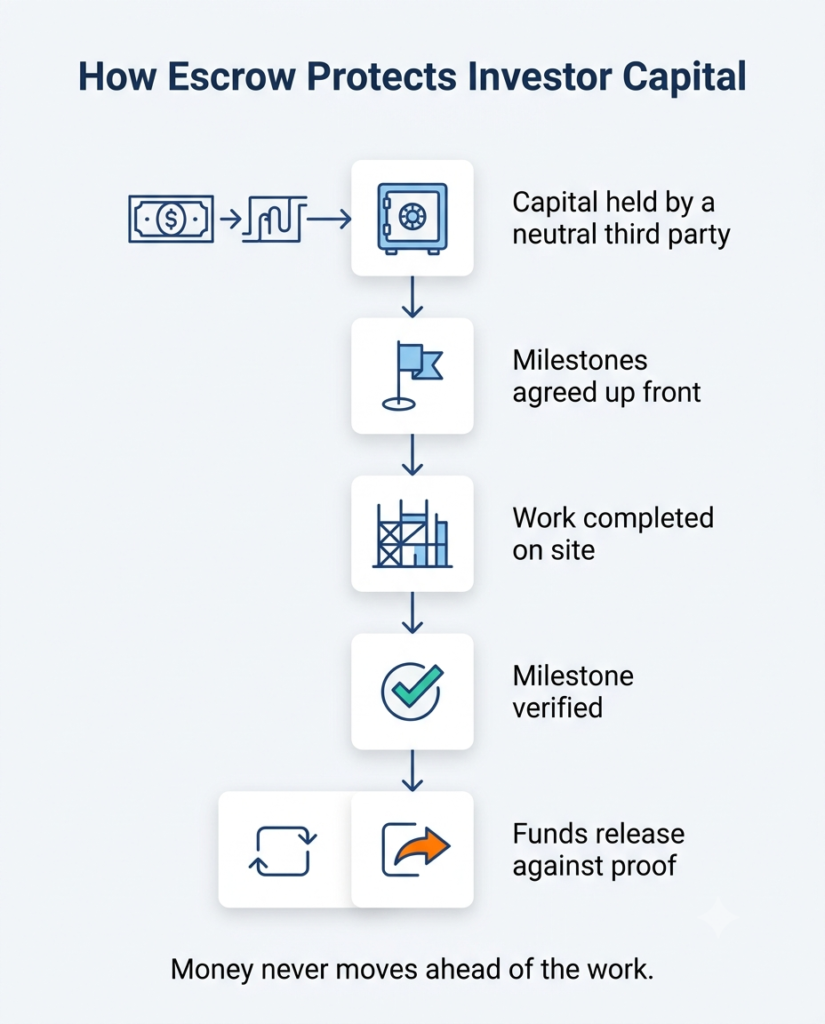
Construction escrow for investors is a neutral, third-party account that holds project funds and releases them in stages — only as each agreed milestone is completed and verified. Your capital stops being a lump sum handed over on trust. It becomes a series of releases tied to proof.
Build Safe Escrow is not a lender, not a contractor, and not on anyone’s side. We hold the money and release it as the work earns it. That neutrality is the point. You get verification without having to police the job site yourself.
Why construction capital goes missing
Money rarely disappears in one dramatic theft. It leaks, through a handful of predictable gaps. Name them, and you can design around them.
The full budget moves at once. In a traditional deal, capital is deployed in a big early tranche. Once it leaves your account, it is out of your control and inside someone else’s operating account, mixed with everything else.
Draws are not verified. A draw is a scheduled release of funds tied to progress on the project. When a draw releases on a calendar date or a sponsor’s word instead of verified work, you are funding a schedule, not a building.
Trust replaces structure. The deal runs on the sponsor’s reputation and a signed agreement. But a contract is a promise to sue later. It is not protection today. Structure — not trust — is what actually guards the money.
Capital gets reallocated. Funds meant for your project get pulled to cover a shortfall on another one. It is rarely malicious. It is cash-flow triage. Either way, your dollars are now building someone else’s asset.
You find out last. By the time a quarterly update reveals a problem, the money is spent and the schedule has slipped. Passive means you are far from the job — and far from the warning signs.
Every one of these is a structure problem, not a character problem. Structure problems have structural fixes. That is exactly what construction escrow for investors provides.
Five ways construction escrow for investors protects your capital
Here is the practical core. Construction escrow for investors delivers five concrete protections, each one a reason to require escrow on your next deal.
1. A neutral third party holds the money. The project funds sit in a secure, FDIC-insured account controlled by neither you nor the sponsor. No one can quietly move your capital because no single party has the keys. The money is parked where reputation and cash-flow pressure cannot reach it.
2. Releases are tied to verified milestones. Funds move only when a defined milestone — foundation, framing, rough-in, finish — is completed and independently verified. This is draw verification, and it is the heart of the model. Each release answers one question: did the work actually get done? If yes, the money moves. If no, it waits.
3. You get real transparency. Every deposit, milestone, and release is documented. You are no longer relying on a rosy quarterly summary. You have a clean record of where every dollar went and what it built. Control at a distance, made real.
4. Capital can’t be reallocated. Because the funds are held for this project and released only against this project’s verified milestones, they cannot be swept to cover a gap somewhere else. Your dollars build the asset you invested in — nothing else.
5. The holding account is FDIC-insured. The money sits in a secured, insured account while it waits. It is not commingled with an operating account that a single bad month could drain. The money can’t vanish.
Notice the pattern. Every protection points the same direction: capital is confirmed early and moves only on proof of work. That is the whole idea behind our escrow services.
A short field example
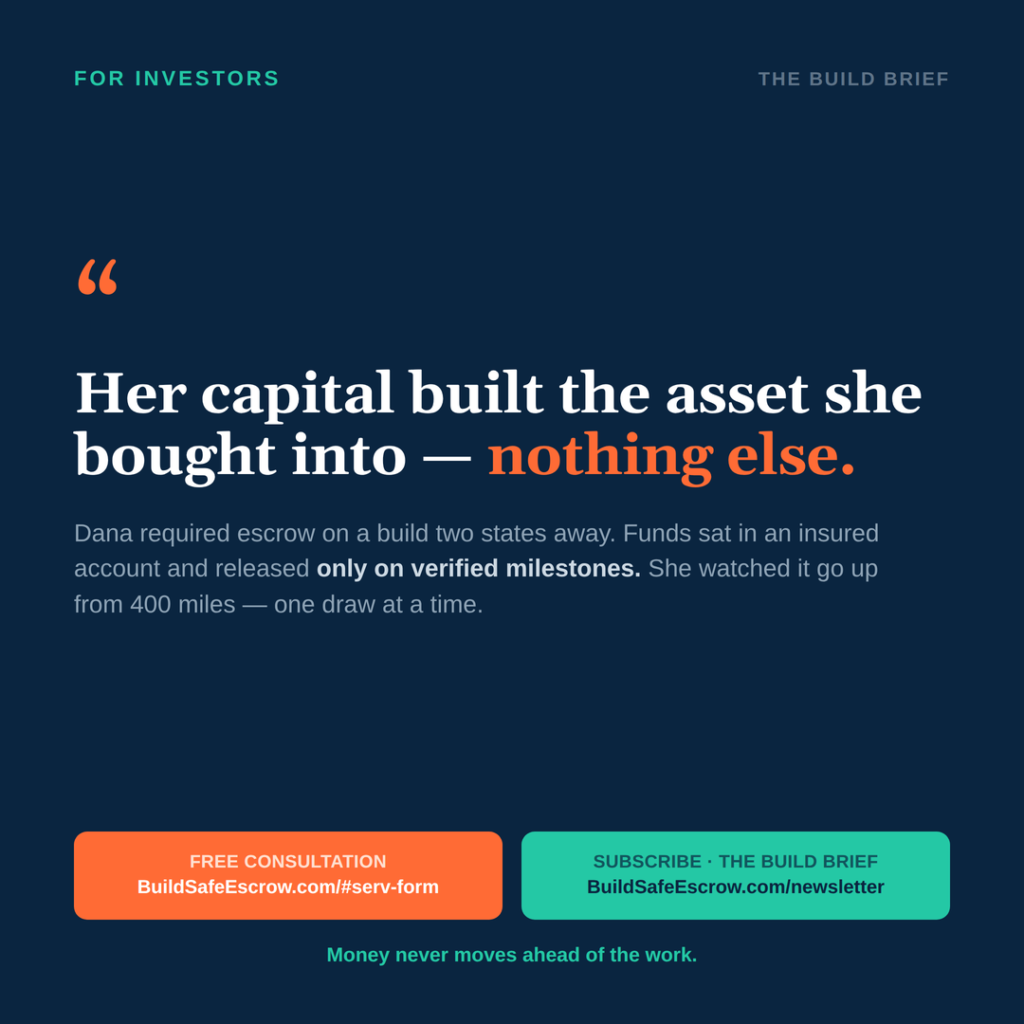
Construction escrow for investors is easiest to see in one real situation. Consider a passive investor — call her Dana. She put $250,000 into a small ground-up residential project two states away. A trusted sponsor, a clean pro forma, a fair split.
Dana used to invest the old way. Wire the capital up front, receive quarterly updates, and hope. On an earlier deal, the sponsor hit trouble on a separate project and quietly borrowed from Dana’s build to keep the other one alive. By the time the update landed, her project was two months behind and short on cash. She recovered most of her money. The time and the worry she never got back.
This time, Dana required escrow. Her capital went into a secured, FDIC-insured account, released against four verified milestones. When the sponsor’s other project ran short, nothing happened to Dana’s money — it was held for her project and released only on verified progress. Each draw arrived with photos, inspection sign-off, and a paper trail. She watched the building go up from 400 miles away, one verified milestone at a time.
Dana funded nothing on faith. Her capital built exactly the asset she bought into. That is construction escrow for investors doing precisely what it should.
How construction escrow for investors removes the risk at the source
Trust is a feeling. Structure is protection. The reason passive capital goes missing is that money is allowed to move ahead of the work.
Escrow fixes that by fixing the sequence. Money should never move ahead of the work. With escrow in place, it can’t. The funds are held by a neutral party and released only when a milestone is verified. From your seat, the protection is simple and total: your capital sits in an insured account and converts into building, milestone by milestone, on proof.
That is the quiet power of construction escrow for investors. You stop investing on faith. You stop absorbing a sponsor’s cash-flow problems as your own risk. You stop finding out last. A neutral third party holds the money, verifies the work, and releases the funds. That is the entire mechanism, and it runs in your favor.
Want to see how verification and release timing work step by step? Our construction escrow FAQs break down milestones, draw verification, and disbursement in plain language.
FAQs
Does construction escrow for investors slow down a project? No. Funds are deposited before work begins and release in days once a milestone is verified. The sponsor is never waiting on your wire — the money is already there, waiting on proof of work.
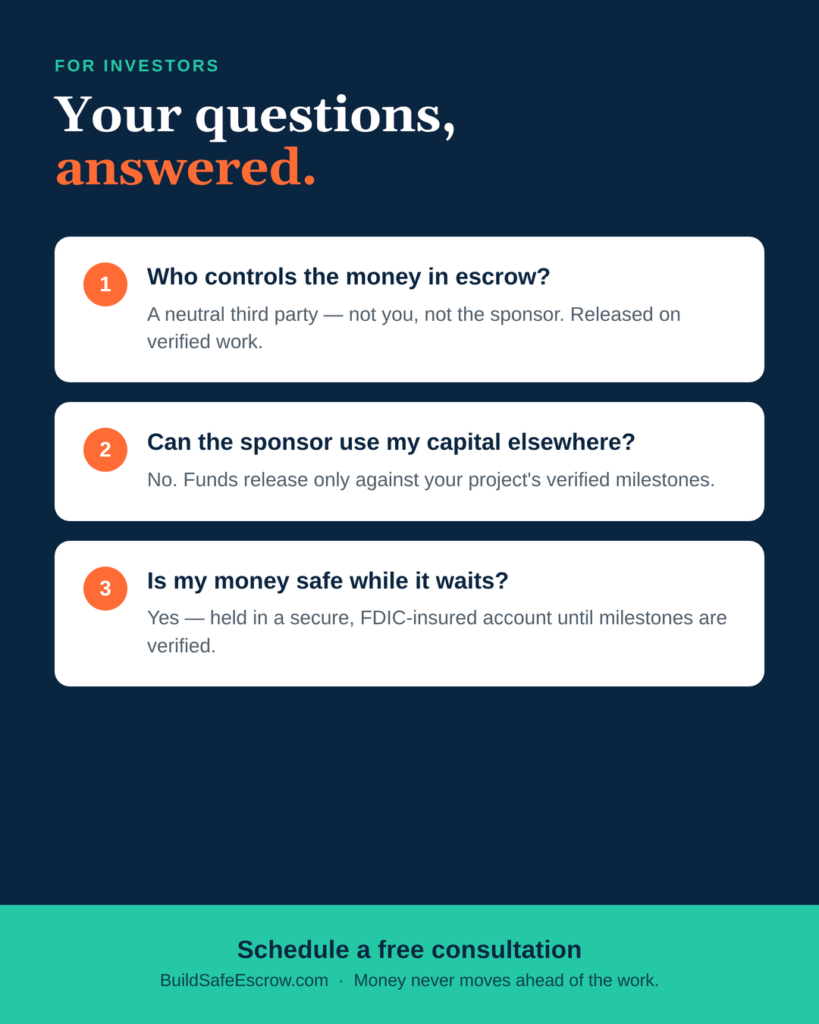
Who controls the money in escrow? A neutral third party. Not you, not the sponsor. Funds sit in a secure, FDIC-insured account and release only when a defined milestone is completed and verified.
How do I know a milestone was actually completed? Each release is tied to documented verification — inspection, sign-off, and a record of the work. You get transparency into every draw instead of a quarterly summary.
Can the sponsor use my capital on another project? No. Funds are held for your project and release only against your project’s verified milestones. They cannot be swept to cover a shortfall elsewhere.
Is my money safe while it waits in escrow? It is held in a secure, FDIC-insured account by a neutral third party — not commingled with anyone’s operating account. Released only on verified milestones.
Is escrow only useful on large deals? No. Construction escrow for investors fits any project where your capital leaves your hands before the work is done — from a single flip to a multi-phase build — by tying every release to verified progress.
This article is information and structure, not legal or financial advice. Talk to your own attorney or financial advisor about your specific investments and agreements.
Protect your capital before the first dollar moves
If you deploy capital into construction, one habit changes everything: put the money where it can’t move ahead of the work.
Get one short read each Friday on how construction money actually moves — subscribe to The Build Brief.
Ready to tie your next investment to verified work? Schedule a free consultation and see how construction escrow for investors protects your capital from day one.
References
- FDIC — Deposit Insurance: https://www.fdic.gov/resources/deposit-insurance/
- U.S. Securities and Exchange Commission — Investor.gov: https://www.investor.gov/
- Rabbet — Construction Payments Report (payment dysfunction data): https://www.rabbet.com/
- Levelset / Procore — Construction finance & payment resources: https://www.levelset.com/