
Table of Contents
- Why ADU builds leave investors exposed
- Do you need escrow for an ADU project?
- How to structure ADU construction escrow, step by step
- From the field: a $186,000 backyard cottage that stayed on budget
- How escrow keeps your money behind the work
- ADU construction escrow FAQs
- Get the next step
- References
ADU construction escrow is how real estate investors keep control of a backyard build they may never stand inside until it is finished. You might be a small landlord adding a rental unit, or a passive investor funding a partner’s build. Either way, the builder wants a deposit this week. You want proof your capital turns into a finished, rentable unit, not a slab and a promise.
An ADU (accessory dwelling unit) is a second, self-contained home on a lot that already has a house. It can be a backyard cottage, a converted garage, or a unit attached to the main home. HUD describes ADUs as “additional living quarters on single-family lots that are independent of the primary dwelling unit.”
Owners are still putting real money into their homes. Harvard’s Joint Center for Housing Studies projects national home improvement and repair spending of $519 billion through mid-2027, even as growth slows. When growth slows, every dollar has to land where it was meant to.
The good news: ADU risk is predictable, so you can plan for it.
Why ADU builds leave investors exposed
ADUs look small on paper. The money behind them is not. The project carries many of the same risks as a full home, on a tighter budget.
A few root causes show up again and again:
- Small builders. Many ADU contractors are lean shops. That can mean great craftsmanship and personal attention. It can also mean thin cash reserves, so one delayed payment from another job ripples into yours.
- Prefab and modular deposits. Factory-built units often require a large deposit before anything ships. That is normal industry practice. It is also the biggest point where your money leaves before you can see the work.
- Permit and utility milestones that stall. An ADU usually needs its own permits. It often needs new or upgraded water, sewer and electrical connections too. Those steps depend on inspectors and utility schedules, not just the crew.
- You are not on site. Investors often fund from a distance, or fund a partner’s property. You see photos when someone remembers to send them.
- Budgets run lean. ADU pro formas are built around a target rent. A modest overrun can push the return below what made the deal worth doing.
None of this makes ADU builders untrustworthy. It means the payment structure has to carry the weight your physical presence cannot. That is the job ADU construction escrow is built for.
Do you need escrow for an ADU project?
If you fund an ADU from a distance, ADU construction escrow is the clearest way to release each dollar only after the matching work is verified.
Whether you need it comes down to how close you are to the work.
Without escrow, you usually pay the contractor directly on an invoice schedule. That works when you live next door and can walk the site. It works less well when you are three meetings deep in another deal and the draw request arrives by text.
With escrow, the funds sit with a neutral third party in an FDIC-insured account. Neither side can move them alone. The contractor knows the money exists and is committed. You know it moves only when the agreed stage is done.
That balance matters for both sides. A builder working on a well-funded escrow account has less reason to worry about getting paid. You have less reason to worry about paying for work that has not happened.
One caution: rules on ADUs vary by state and locality, including zoning, permits, owner-occupancy and rental requirements. Check with your local permitting office and your attorney before you commit capital. This article is general information, not legal or financial advice.
How to structure ADU construction escrow, step by step
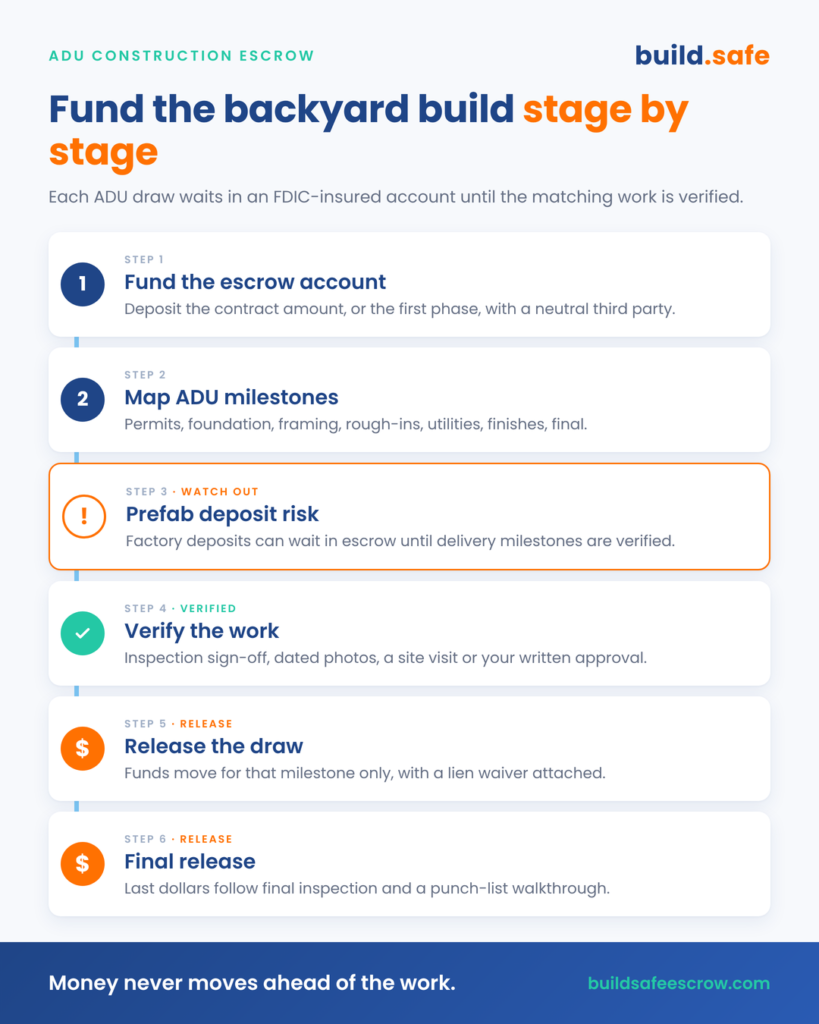
A good ADU construction escrow structure is mostly written down before the first shovel. These are the pieces that matter most.
- Fund the ADU construction escrow account first. Deposit the full contract amount, or the first phase on a larger project. The builder can see the funds are committed before ordering materials.
- Write a milestone schedule that matches ADU stages. A milestone is an observable stage of work with a dollar amount attached. For a typical site-built ADU, a schedule might look like this:
- Permits issued
- Foundation complete
- Framing complete
- Rough-ins (plumbing, electrical, mechanical) passed
- Utility connections complete
- Finishes installed
- Final inspection, or certificate of occupancy where your jurisdiction issues one
- Name the verification method for each milestone. Verification is the check that the scope is actually done. Options include a permit inspection sign-off, photo documentation, a site visit, or your written approval. Inspection sign-offs fit rough-ins and final. Photos with dates work well for finishes. Decide who verifies before work starts, not during a dispute.
- Treat a prefab deposit as its own milestone. With a modular or factory-built unit, the factory deposit is a risk point. One structure option holds that money in escrow until delivery milestones are verified. Examples include the unit shipping or arriving on a finished foundation. Whether a manufacturer accepts that depends on its terms, so raise it early.
- Release funds as draws. A draw is the payment released when a milestone is verified. Some contracts also hold back retainage, a small percentage kept until the end to make sure punch-list items get finished. Retainage is optional and set by your contract.
- Collect lien waivers with every draw. A lien waiver is a signed release of lien rights for work that has been paid. A lien is a legal claim against the property. Ask for a conditional waiver with each draw request and an unconditional waiver after payment clears. This protects you from paying twice if a subcontractor or supplier goes unpaid.
- Run every change through a change order. When scope grows, add a new milestone and fund it. Do not stretch an existing milestone to cover extra work. A clean change order keeps the schedule honest and your budget visible.
- Protect the rental timeline. Put the final release behind the final inspection and a punch-list walkthrough. Your ADU starts earning when it can legally be occupied, so tie the last dollars to that moment.
Escrow enforces the payment schedule inside your contract. It does not replace the contract, so have your own attorney review it.
From the field: a $186,000 backyard cottage that stayed on budget
Marcus Bell, a small landlord with four rental doors, decided to add a detached cottage behind one of his single-family rentals. The contract came to $186,000. He lives about two hours from the property and planned to visit only a few times.
Marcus and his builder agreed on an ADU construction escrow schedule with seven milestones. Permits and foundation were verified by inspection sign-off. Framing and finishes were verified by dated photos plus one site visit by a third party. Rough-ins and final relied on the permit inspector.
The project hit one real snag. The utility connection took six weeks longer than planned. Because the utility milestone had not been verified, that draw stayed in the ADU construction escrow account. The builder kept working on interior finishes, which were already funded by their own milestone, and nobody argued about money.
Late in the job, Marcus asked for an upgraded mini-split system. They wrote a change order, added a funded milestone, and kept the original budget intact. The final draw released after the final inspection and a walkthrough. Marcus listed the unit for rent the next week.
What he valued most was simple: at every point, he knew exactly how much of his capital had turned into finished work.
How escrow keeps your money behind the work
Every risk above comes back to the same gap. Money moves before the work, and you find out later.
ADU construction escrow closes that gap at the source.
- Small-builder cash pressure eases because the builder can see committed funds and a clear path to each payment.
- Prefab deposits can sit in the account until delivery milestones are verified, if the structure fits the deal.
- Permit and utility delays stop being payment fights. The milestone is not verified, so the draw waits.
- Distance matters less because verification is written into the schedule, not left to whoever remembers to send photos.
- Lean budgets stay protected by lien waivers and funded change orders.
Trust in a builder is a feeling. A written schedule with verified draws is protection. And if a builder walks off the job, unreleased funds stay in the account and can pay a replacement contractor to finish.
Your capital waits for the work, every time.
For more on checking draws, see our guide to construction draw verification. For the broader investor picture, read construction escrow for investors.
ADU construction escrow FAQs
What does ADU construction escrow cost?
Build Safe Escrow charges a flat fee for setup and administration, and you know it before the project starts. The amount depends on the project. Ask for a quote during a free consultation.
Is my money insured while it sits in ADU construction escrow?
Funds are held in an FDIC-insured account. FDIC insurance covers $250,000 per depositor, per insured bank, for each account ownership category. For larger balances, ask how the account is structured.
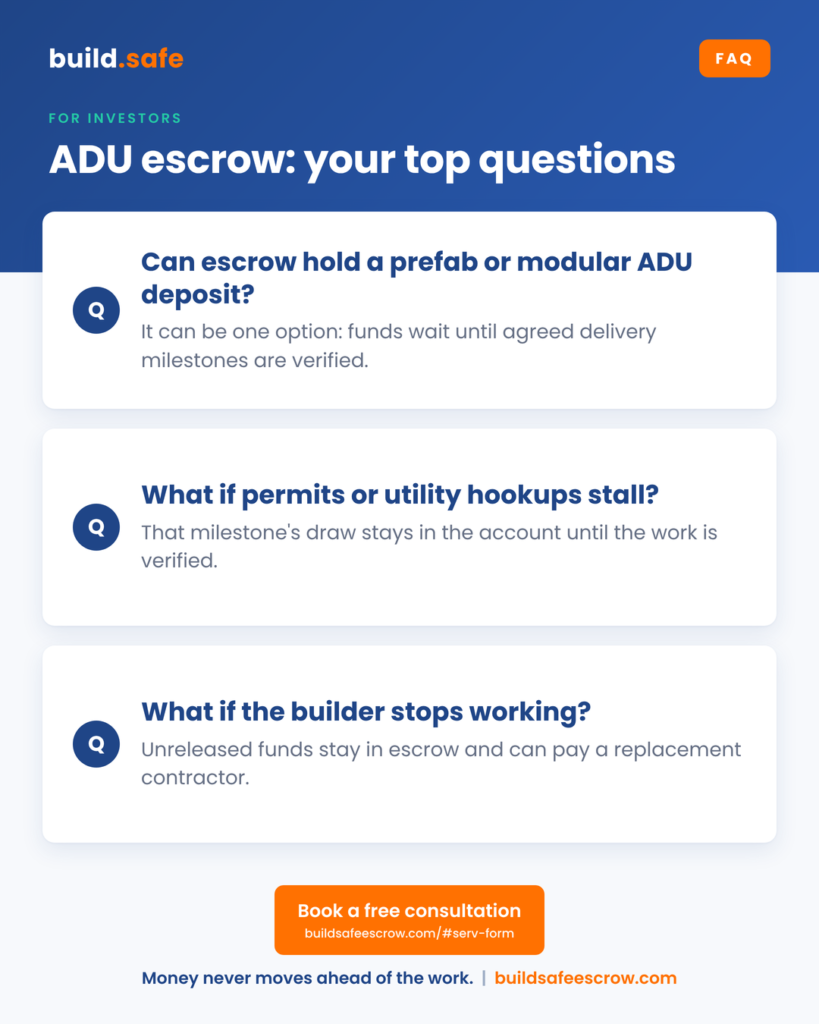
Can ADU construction escrow hold a prefab or modular deposit?
It can be one structure option. The deposit sits in escrow until agreed delivery milestones are verified. The manufacturer has to accept those terms, so negotiate them before you sign.
What if my ADU stalls waiting on permits or utilities?
The draw for that milestone stays in the account until it is verified. Work on other funded milestones can continue. Your unreleased money stays put while you wait.
What happens if the builder stops working?
Unreleased funds stay in escrow under the terms of your agreement. You can hire a replacement contractor and fund the remaining milestones from the same balance.
Does ADU construction escrow replace my contract?
No. Escrow enforces the payment schedule written into your contract. Have your own attorney review the contract, and confirm local ADU rules with your permitting office.
Get the next step
Get one short read each Friday on how construction money actually moves. Subscribe to The Build Brief.
Funding an ADU from a distance? Schedule a free consultation and we will map a milestone schedule to your build. You can also review our construction escrow services.