
Table of Contents
- Why the insurance check and the contractor’s bill run on different clocks
- How do you pay a contractor with insurance money?
- Should I sign my insurance check over to my contractor?
- Assignment of benefits: know what you are handing over
- Six ways to keep insurance claim contractor payment tied to finished work
- Field example: Dana’s $48,000 water damage repair
- How escrow keeps money from moving ahead of the work
- FAQ
- Your next step
- References
Insurance claim contractor payment gets confusing fast, usually the same week the first check arrives. For homeowners, the scene is familiar. A pipe bursts or a storm tears through, an adjuster visits, and a check arrives naming you and your mortgage lender. Then a contractor asks you to sign it over, or to hand across a big deposit so they can “get started.”
You are not alone in this. In 2023, 5.3 percent of insured homes had a claim, according to the Insurance Information Institute, citing ISO. The average amount paid per claim (what the industry calls claim severity) was $20,062 on standard homeowners policies. That is a lot of money, and every insurance claim contractor payment you make from it deserves a plan. This guide shows you how to spend it in step with the repairs, not ahead of them.
Why the insurance check and the contractor’s bill run on different clocks
Insurers rarely pay a claim in one lump. The Insurance Information Institute notes that “the first check you get from your insurance company is often an advance,” and that you can reopen a claim later if you find more damage.
Three things drive the staged timing:
- Recoverable depreciation. On a replacement cost policy, the insurer may first pay only the actual cash value (the repair cost minus wear and age). The withheld amount, called recoverable depreciation, is paid once you show the repairs are done. The NAIC Post-Disaster Claims Guide describes this two-step payment.
- Supplements. A supplement is an added payment for damage found after the first estimate, often once walls are opened up.
- Your mortgage lender. If your home is mortgaged, the repair check is generally made out to you and the lender. Lenders often hold the money in an escrow account and release it as work is completed, sometimes after an inspection.
Your contractor, meanwhile, wants money now. Crews, materials and dumpsters all cost cash up front. So the insurance claim contractor payment pressure lands on you, the person in the middle.
How do you pay a contractor with insurance money?
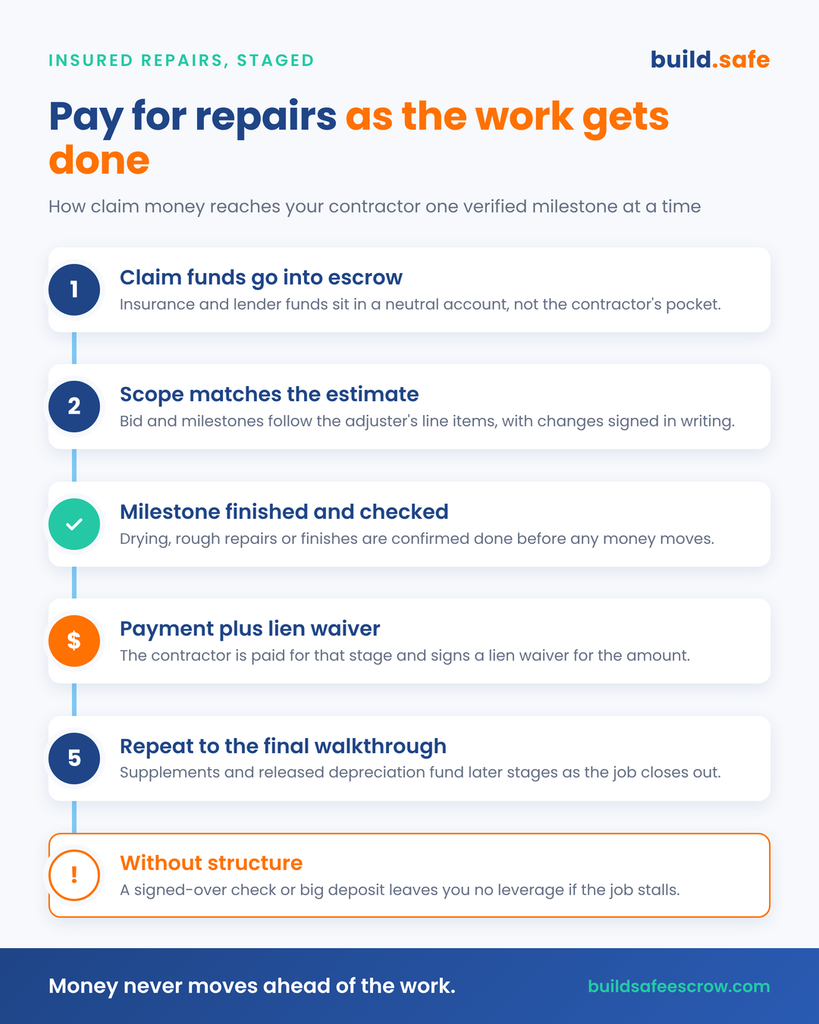
You pay a contractor with insurance money in stages, releasing each payment only after a defined piece of the work is finished and checked, never in one lump up front.
That approach to insurance claim contractor payment mirrors how the money reaches you. The insurer releases funds in stages. Your lender may release its share in stages. Your contractor should be paid in stages too.
Every insurance claim contractor payment should trace back to the adjuster’s estimate. It lists the scope the insurer agreed to pay for, line by line. Ask your contractor to build their bid and payment schedule against that document. When the bid and the estimate match, every milestone has a clear dollar value and a clear finish line.
Keep the deposit modest. Triple-I warns homeowners to “beware of contractors who ask for a large amount of money up front,” and the NAIC guide adds that reputable contractors usually don’t ask for one. The right amount depends on your contract and your local rules, so confirm it with your attorney.
For a deeper look at the general principle, see our guide on the safest way to pay a contractor.
Should I sign my insurance check over to my contractor?
Signing the whole check over hands your contractor the full repair budget before any work is verified, and you lose your leverage if the job stalls.
Triple-I advises making sure you are “completely satisfied with the repair work and that the job has been completed before signing any forms.” Once the money is endorsed away, getting it back can be slow and expensive.
The lender on the check adds another layer. Your mortgage company has a stake in the home, so it may require its own endorsement and its own inspections before releasing funds. That process can slow insurance claim contractor payment and frustrate some contractors. It also protects you.
A cleaner path for insurance claim contractor payment: deposit the funds into a controlled account, then pay out against finished milestones.
Assignment of benefits: know what you are handing over
An assignment of benefits (AOB) is an agreement that transfers some of your rights under the policy to a third party, often your contractor. The contractor can then deal with your insurer directly and seek payment. In practice, an AOB changes who controls insurance claim contractor payment on your job.
The NAIC warns that you could sign away “any extra money you’re owed,” lose your right to mediation, and see the contractor demand more than the insurer offers. Once an AOB is signed, the insurer may communicate only with the third party.
Two facts worth holding onto:
- You are not required to sign an AOB to get repairs done, per the NAIC.
- AOB rules vary by location and by policy. Read any form slowly and call your insurer and your own attorney before you sign.
Six ways to keep insurance claim contractor payment tied to finished work
Disaster zones draw opportunists. The Federal Trade Commission warns about contractors who want everything paid up front and offer discounts “only if you sign a contract right away.” These six moves keep you in control.
- Slow down the signature. Treat knocks on the door and same-day deals with suspicion. Call your insurer first, get more than one written bid, and confirm the contractor’s license and insurance.
- Match scope to the adjuster’s estimate. Ask for a bid that follows the estimate’s line items. Gaps between the two are where disputes start.
- Put every change in writing. A change order is a written approval for work outside the original contract. Supplements from the insurer should flow into signed change orders before that work begins.
- Tie each payment to a verified milestone. Each insurance claim contractor payment should follow a finished stage: drying and demolition, rough repairs, finishes, final walkthrough. Pay when each stage is done and checked, not when a date passes.
- Collect a lien waiver with every payment. A lien waiver is a signed statement that the contractor, or a subcontractor or supplier, has been paid and gives up the right to file a lien for that amount. Without one, an unpaid supplier may be able to claim against your home even after you paid the contractor.
- Never pay in hard-to-trace forms. The FTC says to avoid cash, wire transfers, gift cards, payment apps and crypto, and to never make the final payment until the work is done and you’re satisfied.
None of these require you to distrust your contractor. They give both of you a shared scoreboard for insurance claim contractor payment.
Field example: Dana’s $48,000 water damage repair
Illustrative example. Names and figures are fictional.
Dana Whitfield came home to a failed supply line under her upstairs bathroom. Water had reached the kitchen ceiling below. After the adjuster’s visit, the approved scope came to $48,000.
The first check covered the actual cash value. It named Dana and her mortgage lender. The recoverable depreciation would come later, after she showed the repairs were complete. Her contractor asked her to endorse the check to his company “to save time.”
Dana declined and set up a staged plan instead:
- Milestone 1, drying and demolition: paid after moisture readings confirmed the space was dry.
- Milestone 2, rough repairs: subfloor, framing and new drywall, paid after inspection.
- Milestone 3, finishes: cabinets, tile and paint, paid with lien waivers from the contractor and his tile supplier.
- Milestone 4, final: paid after the walkthrough, funded in part by the released depreciation.
Midway through, the crew found rot in a joist. The insurer approved a supplement, and Dana signed a change order before that work started. Her insurance claim contractor payment plan absorbed the surprise without a fight. The contractor got paid on time at every stage. Dana never paid for work she could not see.
How escrow keeps money from moving ahead of the work
Trust matters on a repair job. It is not protection, though. Structure is.
Construction escrow puts that structure around insurance claim contractor payment. With Build Safe Escrow, claim funds sit in a secure, FDIC-insured account held by a neutral third party. Each payment is released to the contractor only when the agreed milestone is completed and verified.
That neutrality cuts both ways:
- You know the repair budget can’t vanish into a job that stalls halfway.
- Your contractor knows the money is real, already funded, and released the moment the work is confirmed.
- Your lender, if it is involved, gets a clear paper trail of what was done and what was paid.
We are not your insurer, your lender or your contractor. We are the referee who makes sure money never moves ahead of the work. Learn more about our construction escrow services.
Escrow does not replace your insurer’s rules or your lender’s process, and it is not legal advice. Talk with your attorney and insurer about how your policy and mortgage handle claim funds. Then let a neutral structure carry your insurance claim contractor payment, and the stress with it.
FAQ
What is the safest way to handle insurance claim contractor payment?
Pay in stages tied to completed, verified milestones, with a lien waiver collected at each payment. Avoid large deposits and avoid signing the whole check over.
Why is my mortgage lender on my insurance check?
Your lender has a financial stake in the home, so the insurer generally includes it on checks for major repairs. Lenders often hold the funds and release them as the work is completed.
When do I get the recoverable depreciation?
On a replacement cost policy, the insurer typically pays it after you show the repairs are done. Check your policy and ask your adjuster for the exact process.
Do I have to sign an assignment of benefits?
No. According to the NAIC, you are not required to sign one to get repairs completed. Rules vary, so review any AOB with your insurer and attorney first.
What if the contractor finds more damage mid-job?
Report it to your insurer and ask for a supplement. Sign a written change order before the extra work begins, and add it to your milestone schedule.
Your next step
Get one short read each Friday on how construction money actually moves. Subscribe to The Build Brief.
Repairing your home after a claim? Schedule a free consultation and see how Build Safe Escrow can hold your claim funds and release them only as each stage is finished. Money never moves ahead of the work.
References
- Insurance Information Institute (Triple-I), Facts + Statistics: Homeowners and renters insurance
- Insurance Information Institute (Triple-I), Settling insurance claims after a disaster
- National Association of Insurance Commissioners (NAIC), Post-Disaster Claims Guide
- Federal Trade Commission, How To Avoid Scams After Weather Emergencies and Natural Disasters