

Your contractor went out of business, and the news probably arrived badly: an unanswered phone, a locked office, a text from a supplier asking when they will be paid. This guide is for property owners and homeowners standing in a half-finished project wondering what happens next. There is a sequence, and the order matters.
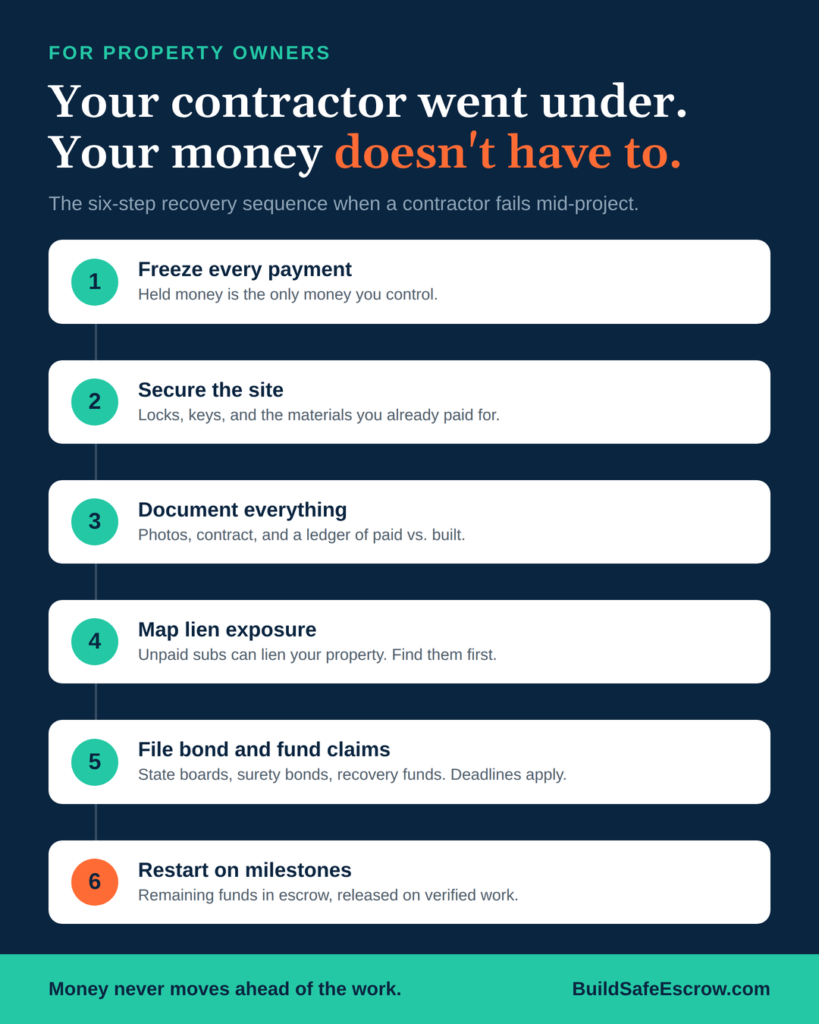
Table of Contents
- Why contractors go under mid-project
- 1. Stop every payment immediately
- 2. Secure the site and the materials
- 3. Document the state of the work
- 4. Map your lien exposure
- 5. Check bonds, insurance, and recovery funds
- 6. Restart with structure, not hope
- A short field example
- My contractor went out of business, what should I do first?
- How escrow removes this risk at the source
- FAQ
- Protect the restart
- References
First, breathe. A contractor going under is not the same as a contractor stealing from you. Most of the time nobody set out to hurt you; a business ran out of cash, and construction businesses run out of cash more often than almost any other kind.
That distinction changes your moves. You are not chasing a thief. You are running a recovery, which means protecting the money you have not yet spent, limiting the claims against your property, and then restarting the project in a way that cannot fail the same way twice.
Why contractors go under mid-project
Construction firms fail at unusually high rates, and the reason is almost always cash flow. Contractors float labor and materials for weeks before payment arrives. One slow-paying job or one repriced material order can mean a company that looked healthy on Monday cannot make payroll on Friday.
The uncomfortable part, for you as the owner: when a struggling contractor collects your deposit or a progress payment, that money often does not sit in a project account waiting for your job. It plugs holes on older jobs. So when the business finally folds, your money is gone, the work is unfinished, and the subcontractors and suppliers who worked on your property may still be unpaid.
That last piece is the trap most owners never see coming. In most states, unpaid subs and suppliers can file a mechanics lien against your property even though you already paid the contractor. Yes, you can end up paying twice for the same work. Which is why the sequence below starts with the money, not the tools, and why every step assumes your contractor went out of business owing money to people who touched your property.
1. Stop every payment immediately
The moment you learn your contractor went out of business (or even suspect it), freeze the money.
Cancel any scheduled transfers. If a check is out, ask your bank about a stop payment. If a payment is “due,” it is not due to a company that can no longer perform the contract, no matter how sympathetic the person on the phone sounds.
In a business failure, held money is the only money you control. Every dollar that leaves now is probably unrecoverable, and every dollar you hold is leverage for the restart.
2. Secure the site and the materials
Your contractor went out of business, but your site and your materials are still yours. Protect them physically.
Change or add locks if the contractor had access, and ask for your keys and garage codes back. If materials you paid for are on site, whether cabinets, fixtures, or lumber, photograph them and move them somewhere secure. Materials have a way of disappearing when a company is winding down and crews are owed wages.
If the site is open to weather, get it covered. A stalled project that takes on water becomes a much more expensive stalled project.
3. Document the state of the work
Before anyone touches anything, build the record of the project as it stood the day the contractor went out of business.
Photograph and video every room, every rough-in, every unfinished surface, with dates. Gather the contract, the invoices, the payment confirmations, and every text or email about scope and money, then make a plain ledger: what you agreed to pay, what you actually paid, what was actually built.
This record earns its keep three ways. It supports any bond or insurance claim. It defends you if liens appear. And it gives your replacement contractor an honest starting point, so the new bid prices the real remaining work instead of a guess.
4. Map your lien exposure
Now find out who else is unpaid.
Ask the failed contractor, or whoever is still answering, for a list of the subcontractors and suppliers used on your project. Check whether you received any preliminary notices, the documents many states require subs and suppliers to send owners to preserve lien rights. Then contact each one and ask, in writing, whether they have been paid for work on your property.
If unpaid parties surface, do not pay anyone in a rush. Payment against a potential lien should always be exchanged for a signed lien waiver, and a conditional waiver until the money clears. This is the point where a construction attorney earns their fee: lien deadlines and rules vary sharply by state, and moving wrong here is expensive.
5. Check bonds, insurance, and recovery funds
When a licensed contractor went out of business, you may have more protection than you think.
Many states require licensed contractors to carry a surety bond, and some run recovery funds that compensate owners harmed by a licensed contractor’s failure. Your state contractor licensing board’s website will show both. File promptly, because these claims carry deadlines and the pool of money is often shared among every harmed customer.
While you are at it, check your own homeowner’s policy and the contract’s insurance requirements. None of these routes makes you whole quickly, but together they can claw back real money.
6. Restart with structure, not hope
The last step decides whether this ever happens to you again.
You will hire a new contractor to finish the job, and you will do it while more anxious and less trusting than the first time. You are also more exposed than you feel, because a project stalled after a contractor went out of business attracts opportunistic bids. So do not restart on trust. Restart on structure.
Get the remaining work defined as clear milestones, each with a description of “complete,” a dollar amount, and a verification step. Then put the remaining funds in a neutral escrow account, released milestone by milestone as work is verified. Your new contractor is not being insulted by this. Good contractors like it, since the money is proven to exist and their pay is tied to their performance rather than your mood.
A short field example
Marcus was 60% through paying for a $190,000 addition when his contractor went out of business. The framing was up and the roof was on, but only about 40% of the work was done. He had paid for a fifth of a house that did not exist.
Then the second wave hit. A lumber supplier and a plumbing sub sent letters; together they were owed $23,000 for materials and work already inside Marcus’s walls. The contractor had used his progress payments to cover an older project.
Marcus stopped the next payment before it left, which saved him $19,000. He filed against the contractor’s bond, negotiated the supplier claims against conditional lien waivers with his attorney, and restarted the job with the remaining budget held in escrow. The new contractor finished on milestones, and the second half of the project ran without a single payment argument, because money never moved ahead of the work.
[MEDIA: Infographic, 4:5, placed here. Recovery sequence: freeze payments, secure site, document, map liens, file claims, restart on milestones. Alt text: “Six-step recovery sequence infographic for owners whose contractor went out of business mid-project.”]
My contractor went out of business, what should I do first?
If your contractor went out of business mid-project, first stop every remaining payment, then secure the site, document the work, and identify unpaid subcontractors before any more money moves.
When a contractor went out of business, money is the one thing still under your control, which is why the order matters. Work already lost is lost; payments not yet made are your entire recovery budget. Only after the money is frozen should you turn to the site, the paperwork, and the claims process. And when you restart, make the structure permanent: remaining funds held neutrally, released only on verified milestones.
How escrow removes this risk at the source
Look back at what actually hurt Marcus. Businesses fail; that part was never in his control. What hurt him was that his money was sitting inside the failing business when it went down.
Construction escrow changes where the money lives. Your project funds sit in a secure, FDIC-insured account held by a neutral third party instead of the contractor’s operating account, where they could be pulled into someone else’s crisis. Funds release in stages, only as each milestone is completed and verified.
Now run the failure again with that structure in place. The contractor went out of business at 40% built, and roughly 60% of your budget is still sitting safely in escrow, untouched, because it was never handed over. You hire the replacement, point the same escrow account at the new milestone schedule, and finish. A disaster shrinks into a delay.
The structure protects the contractor’s side too. Subs and suppliers on escrowed projects get paid on verified milestones, which is exactly why they are less likely to end up as lien claimants on your property. Money never moves ahead of the work, and money that has not moved cannot go down with the ship.
You can see how staged releases work on our escrow services page, or get answers to common questions in our construction escrow FAQs.
This article is general information, not legal or financial advice. Lien law, bond claims, and recovery funds vary by state, so consult a construction attorney for your specific situation.
FAQ
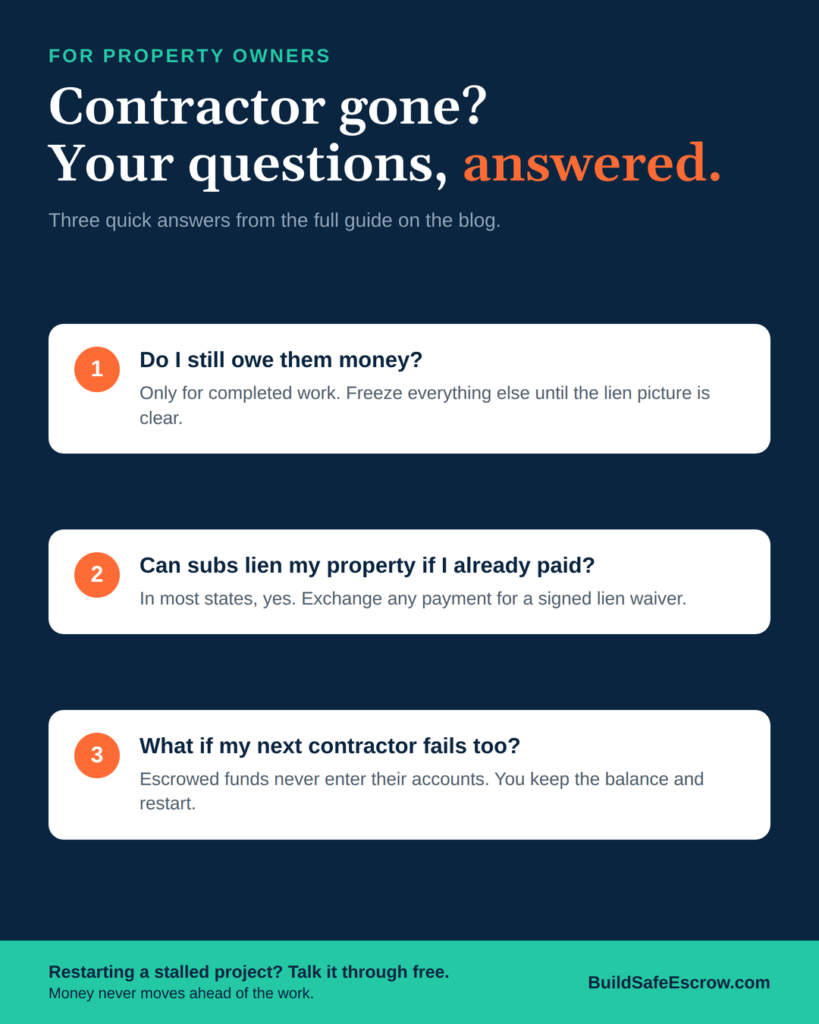
My contractor went out of business. Do I still owe them money? Generally you owe for work actually completed under the contract, not for unfinished work. Do not pay anything further until you understand the lien picture and have spoken with an attorney.
Can subcontractors lien my property if the contractor went out of business after I paid? In most states, yes. Unpaid subs and suppliers can often file a mechanics lien even though you paid the general contractor in full. This is the single biggest hidden risk when a contractor fails.
How do I find out if my contractor was bonded? Check your state contractor licensing board’s public lookup. It typically shows license status, bond details, and how to file a claim.
Should I hire the failed contractor’s crew to finish the job? Sometimes the crew is excellent and available. If you hire them, do it under a new written contract with a milestone payment schedule, never informally. The old contract died with the old company.
How does escrow protect me if my next contractor went out of business too? Unreleased funds never enter the contractor’s accounts, so a business failure cannot take them down. You keep the balance and restart with a new contractor on the same milestone structure.
Your contractor went out of business once. Do not let the restart cost you twice.
For everyone: Get one short read each Friday on how construction money actually moves: subscribe to The Build Brief.
For property owners: Before another dollar moves toward finishing your project, put structure around it. Schedule a free consultation and we will map the remaining milestones with you.
References
- Federal Trade Commission, Hiring a contractor (consumer guidance): https://consumer.ftc.gov/articles/hiring-contractor
- Contractors State License Board (California), bond and recovery information: https://www.cslb.ca.gov/
- Levelset, mechanics lien rules by state: https://www.levelset.com/mechanics-lien/
- FDIC, deposit insurance overview: https://www.fdic.gov/resources/deposit-insurance/