

Table of Contents
- The Allowance Is Real. The Timing Is the Problem.
- Why TI Money Arrives Last
- How does a tenant improvement allowance get paid out?
- Four Ways Tenants Get Squeezed
- The Fixes: Structuring the Allowance Before You Sign
- From the Field: Nate’s Clinic
- How Escrow Removes the Problem at the Source
- FAQ
- Open on Time, With the Money Where It Belongs
- References
The Allowance Is Real. The Timing Is the Problem.
A tenant improvement allowance escrow solves a problem most commercial tenants only discover halfway through their build-out. You negotiated a $60-per-square-foot TI allowance on a ten-year lease. It is written into the work letter. The landlord’s money is real.
Then you read the disbursement clause and realize the landlord pays you, after you pay the contractor, after the contractor delivers lien waivers, after the landlord’s representative inspects, within 30 days of a complete draw package. On a $480,000 build-out, that is you floating six figures for two to three months at a time while your contractor waits.
This article is for the business owner or tenant-side project lead who has a signed lease, a build-out to run, and a growing sense that the allowance is going to arrive after they needed it.
Why TI Money Arrives Last
Landlords are not being difficult. A landlord funding an allowance has two fears, and both are reasonable.
First, liens. In most states, an unpaid subcontractor can lien the building, not just the tenant’s leasehold interest. That is the landlord’s asset, so the landlord conditions every dollar on lien waivers from everyone who touched the space.
Second, tenant default. If the tenant funds half a build-out and then stops paying rent, the landlord has a half-finished space and a legal fight. So the allowance is held back until the work is verified and, in many leases, until the tenant is open for business.
Commercial leasing counsel generally advise landlords to condition each TI payment on lien waivers, an inspection confirming the work matches approved plans, permits, and confirmation that the tenant is not in default. That is sound protection for the landlord.
The cost lands on you, and it is the reason a tenant improvement allowance escrow exists. The allowance reimburses; it does not fund. Your contractor needs progress payments every 30 days. Your landlord reimburses 30 days after a complete package. That gap is a bridge loan you never agreed to make.
How does a tenant improvement allowance get paid out?
A tenant improvement allowance is typically paid out as a reimbursement: the tenant submits a draw request with paid invoices, lien waivers, and an inspection or architect’s certification, and the landlord pays the tenant (or the contractor directly) within a set period, often holding 10% retainage until final completion.
That is the standard mechanism, and it is worth reading your own work letter against it line by line. Whether you end up with a reimbursement clause or a tenant improvement allowance escrow, the variables that matter are whether the landlord pays you or your contractor, how often draws are allowed, what counts as a “complete” request, how long the landlord has to pay, and what happens to the last 10%.
Four Ways Tenants Get Squeezed
A reimbursement-style disbursement clause creates four predictable pressure points. A tenant improvement allowance escrow is built to remove each one.
- The float. Contractor is paid on day 30. Draw package goes to the landlord on day 35. Landlord pays on day 65. Repeat for the life of the project. On a six-month build-out you are carrying one to two full draws at all times.
- The rejected package. One missing lien waiver from a sub-subcontractor, or an invoice that does not match the schedule of values, and the landlord’s 30-day clock resets. Your contractor does not reset. They want to be paid.
- The retainage stack. The landlord holds 10% of the allowance until final. Your contractor holds 10% from their subs until final. If your own contract with the GC also has retainage, the final draw becomes a three-way reconciliation, and it happens the same week you are trying to open.
- The overage. The allowance is a cap. Costs above it are yours, and change orders on a build-out are common. Every dollar over the allowance is funded 100% by you, on the contractor’s schedule, with no landlord involvement at all.
Any one of these is manageable. Together, on a tight opening date, and without a tenant improvement allowance escrow, they are how a tenant ends up paying a contractor from a credit line while $200,000 of landlord money sits unreleased.
The Fixes: Structuring the Allowance Before You Sign
The lease is negotiable, and the work letter is the most negotiable part of it. Ask for these.
Direct-to-contractor disbursement. Ask the landlord to pay your general contractor directly against approved draws rather than reimbursing you. This removes the float entirely on the allowance portion. Many landlords accept it, because paying the contractor directly gives them tighter control over lien waivers.
A defined draw package. Write the checklist into the lease (it will become the release checklist if you move to a tenant improvement allowance escrow): pay application on AIA G702/G703 or equivalent, conditional lien waivers for the current draw, unconditional waivers for the prior draw, and the architect’s certification of percent complete. A defined package cannot be rejected for reasons that were never written down.
A hard payment clock with a remedy. Fifteen business days from a complete package, and rent abatement or interest if the landlord is late. Landlords negotiate this, but the ask sets the tone.
Retainage that mirrors the construction contract. One retainage, not two. If the landlord holds 10%, your contract with the GC should acknowledge it so the GC is not holding a second 10% from subs on top.
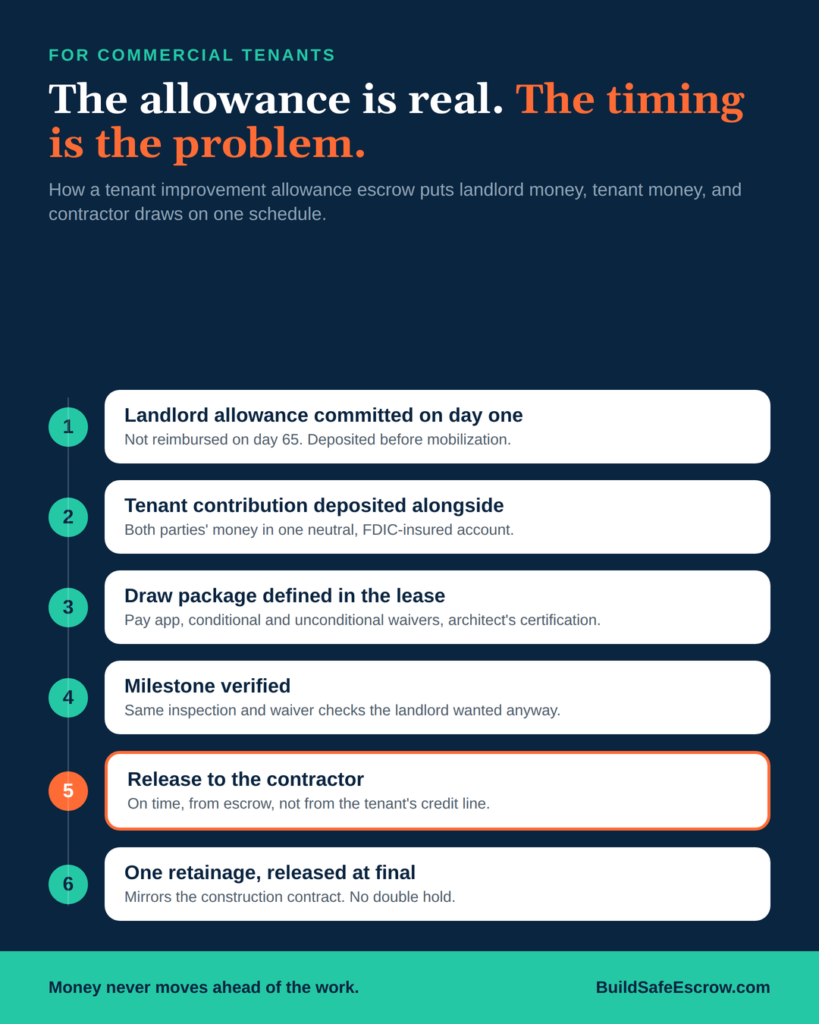
A tenant improvement allowance escrow for the combined budget. This is the structural fix. The landlord’s allowance and the tenant’s contribution are both deposited into a neutral escrow account at the start of the project. Draws release to the contractor against verified milestones, using the same lien-waiver and inspection conditions the landlord wanted anyway. The landlord gets the protection. The tenant stops floating the gap. The contractor gets paid on time.
Number five is the one that makes the first four stop mattering, because the money is no longer moving through anyone’s operating account.
From the Field: Nate’s Clinic
Nate signed a lease for a 4,000-square-foot physical therapy clinic in Doral with a $75-per-square-foot allowance: $300,000 from the landlord against a $410,000 build-out. Reimbursement structure, 30-day clock, 10% retainage, and no tenant improvement allowance escrow.
By month three he had paid the contractor $185,000 and received $92,000 back from the landlord. The second draw package had been returned twice, once for a missing waiver from the HVAC sub’s ductwork supplier, once because the pay app used a different schedule of values than the approved plans. His contractor was polite about it for about six weeks.
Nate went back to the landlord with one proposal: move the remaining $208,000 of allowance and his own remaining $110,000 into a tenant improvement allowance escrow, with releases tied to the same milestones and waiver requirements already in the lease. The landlord’s counsel reviewed it and agreed within a week. Their view was that a tenant improvement allowance escrow, with a neutral third party checking waivers, was stronger lien protection than the landlord’s property manager doing it between other jobs.
The remaining four draws released on schedule. The clinic opened eleven days late instead of the six weeks his contractor had been forecasting. Nate never touched his credit line again.
How Escrow Removes the Problem at the Source
Every squeeze in this article comes from the same design flaw: the landlord’s money and the tenant’s money are on different schedules, and the contractor is caught between them.
A tenant improvement allowance escrow puts both contributions on one schedule. The full build-out budget sits in a secure, FDIC-insured account held by a neutral third party. The release schedule is the milestone schedule. Each release is conditioned on the same things the landlord already cares about: work verified, waivers in hand, plans matched.
What changes for each party:
- The tenant stops bridging. Contractor draws come from the escrow account, not from operating cash, and the allowance is committed on day one rather than reimbursed on day 65.
- The landlord gets a stronger version of the protection the reimbursement clause was trying to provide, administered by a party whose only job is checking the conditions.
- The contractor sees a fully funded budget and knows exactly what triggers each payment. Fewer disputes, faster work.
Money never moves ahead of the work. The reimbursement model tries to enforce that rule by making the tenant carry the risk. A tenant improvement allowance escrow enforces it without making anyone carry the risk. You can see how milestone releases are set up on our escrow services page, and the construction escrow FAQs cover how disputed milestones are handled.
Trust is a feeling. Structure is protection. Escrow turns the feeling into the structure, and on a commercial build-out, structure is what gets you open on time.
FAQ
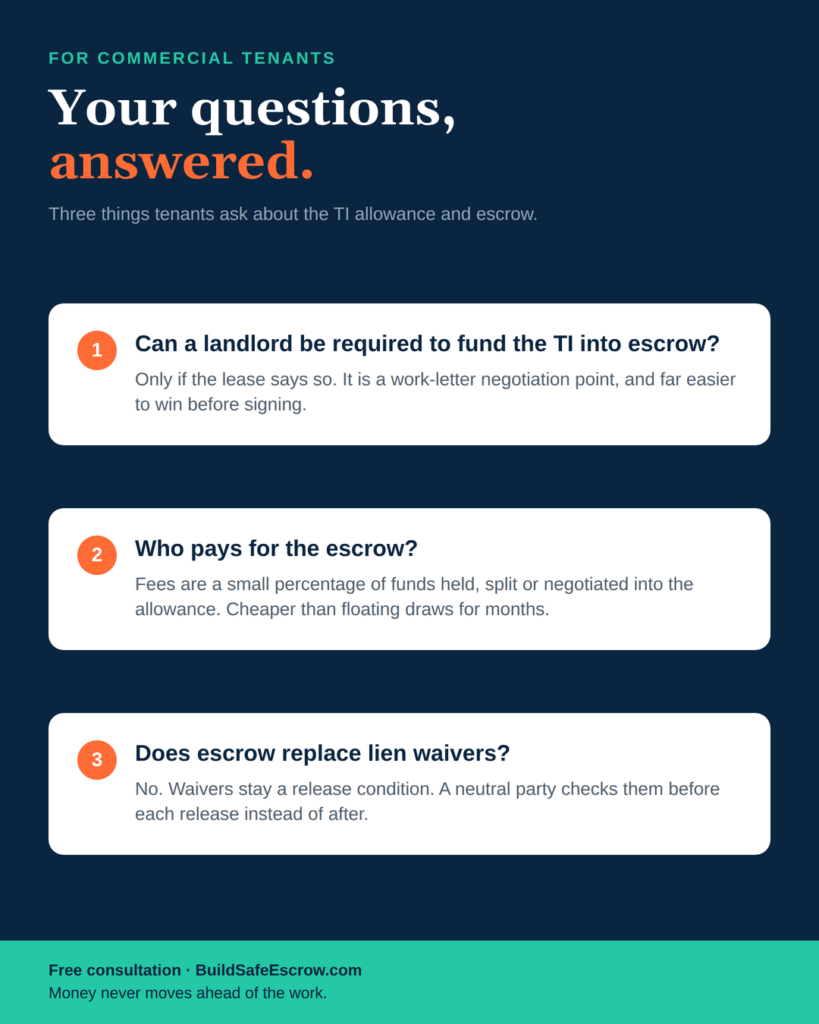
Can a landlord be required to fund the TI allowance into escrow? Only if the lease says so. It is a negotiation point like any other work-letter term, and it is far easier to win before signing than after. Landlords who already condition disbursement on waivers and inspections often accept escrow readily, because it performs those checks for them.
Who pays for a tenant improvement allowance escrow? Escrow fees are typically a small percentage of the funds held and can be split between landlord and tenant, paid by the tenant, or negotiated into the allowance itself. Compared to the carrying cost of floating draws for months, the fee is usually the cheaper option.
Does a tenant improvement allowance escrow replace lien waivers? No. Lien waivers remain a release condition. The difference is that a neutral party collects and checks them before each release, instead of the landlord rejecting a package after the contractor has already been paid.
What happens to the unused allowance? Whatever the lease says. Some landlords keep it, some allow it to be applied to rent or soft costs. Escrow does not change that term; it changes how the used portion is released.
Is a tenant improvement allowance escrow only for large build-outs? It scales. A $150,000 build-out with a reimbursement clause creates the same float problem as a $1.5 million one, just with fewer zeros. The decision point is whether you can afford to carry the gap, not the size of the project.
Open on Time, With the Money Where It Belongs
If you are negotiating a work letter now, or you are mid-build-out and the reimbursement gap is already biting, schedule a free consultation. We will walk through how a tenant improvement allowance escrow fits your lease terms and your contractor’s draw schedule.
Get one short read each Friday on how construction money actually moves. Subscribe to The Build Brief.
This article is information, not legal advice. Have your own attorney review your lease and work letter for your specific situation.
References
- Miller & Martin PLLC, “Tenant Improvement Allowances: Structuring Payment.” https://millermartin.com/?p=27404629
- Illinois State Bar Association, “Leasing 101: Tenant Improvement Allowances.” https://www.illinoislawyernow.com/2017/12/leasing-101-tenant-improvement-allowances/
- Law Insider, “Disbursement of Improvement Allowance” clause samples. https://www.lawinsider.com/clause/disbursement-of-improvement-allowance/_3
- The American Institute of Architects, AIA Contract Documents (G702/G703 payment applications). https://www.aiacontracts.com/