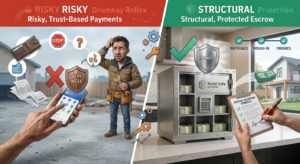
Your contractor asks how you want to handle payment. You say “whatever’s easiest.” That sentence has cost people a lot of money.
Table of Contents
- The question you get asked too casually
- What’s the safest way to pay a contractor?
- Every payment method, ranked by protection
- Why the safest way to pay a contractor is rarely the easiest
- How can I protect my money from contractor scams?
- Six habits that protect every payment you make
- A short field example
- How escrow makes the payment method almost irrelevant
- FAQ
- Pay on proof, not on trust
- References
The question you get asked too casually
The safest way to pay a contractor is a question most property owners answer in about four seconds, standing in a driveway, without thinking about it at all. Someone asks how you’d like to pay. You reach for whatever is fastest.
That reflex is the problem. Payment method is not a logistics detail. It is the single decision that determines whether you have recourse when a job goes wrong — and you make it before you know whether it will.
This piece ranks every common method by the protection it actually gives you, names the ones that offer none, and shows you the structure that settles the question for good.
What’s the safest way to pay a contractor?
The safest way to pay a contractor is through a neutral third-party escrow account that releases funds in stages as verified work is completed. If escrow is not available on your project, a credit card offers the most protection of the everyday methods, followed by a check. Cash, wire transfers, and peer-to-peer payment apps offer the least.
That is the answer in one paragraph. The reasoning is worth understanding, because the gap between the top and the bottom of that list is enormous.
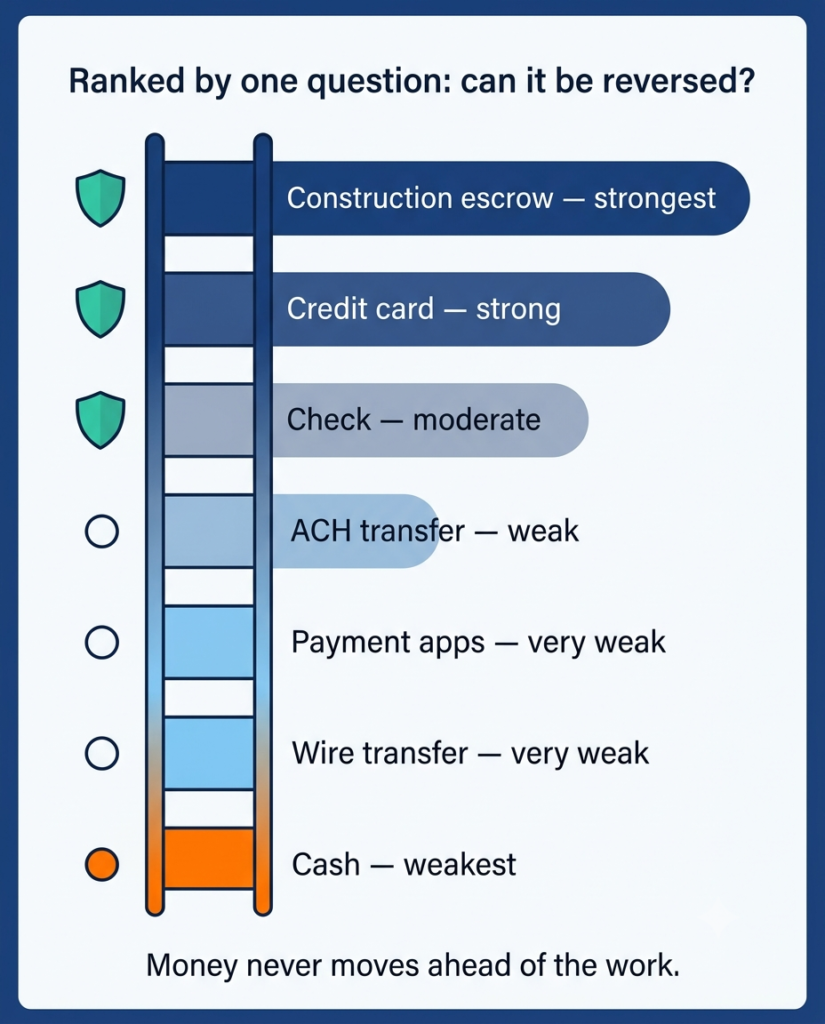
Protection comes down to one question: after the money leaves your hands, can anyone get it back? Escrow says yes, and it never left your side of the table in the first place. A credit card says yes, through a chargeback. A check says maybe, if it has not cleared. Cash, wire, and payment apps say no. Not “it’s difficult.” No.
That is why the safest way to pay a contractor almost never matches the most convenient way to pay a contractor.
Every payment method, ranked by protection
Here is the full ranking, strongest to weakest. Read it as a spectrum: the top is the safest way to pay a contractor, the bottom is a donation with extra steps.
1. Construction escrow — strongest. Funds sit in a neutral, FDIC-insured third-party account and release only when an agreed milestone is completed and verified. Your money is committed to the project but not surrendered to anyone. Neither party can move it unilaterally. This is the safest way to pay a contractor on any project large enough to hurt if it fails.
2. Credit card — strong. Of the everyday options, this is the safest way to pay a contractor. Card payments carry chargeback rights under federal law. If a contractor takes payment and never performs, you have a documented dispute path with real leverage. Many contractors add a 2–3 percent processing fee. On a meaningful payment, that fee is cheap insurance.
3. Check — moderate. A check creates a paper record and clears through a bank, and it can occasionally be stopped before it does. It gives you documentation, which matters enormously in a dispute. It does not give you a reversal mechanism after the fact.
4. ACH bank transfer — weak. Traceable, documented, and effectively final once settled. Better than cash because there is a record. Not a protection mechanism.
5. Peer-to-peer apps (Zelle, Venmo, Cash App) — very weak. Designed for sending money to people you already trust. Transfers are near-instant and treated as authorized once you send them, which means there is generally no reversal and no purchase protection. Some apps offer limited goods-and-services protections; bank-integrated transfers like Zelle typically do not.
6. Wire transfer — very weak. Fast, final, and a favorite of anyone running a scam. Once a wire settles, recovery usually requires law enforcement and the odds are poor.
7. Cash — weakest. No record, no trace, no recourse. If a contractor asks for cash to “save you the tax,” understand what you are actually buying: a discount in exchange for surrendering every protection you have.
Why the safest way to pay a contractor is rarely the easiest
Notice the pattern in that ranking. Protection and convenience run in opposite directions, and that is not an accident.
Speed removes the pause. Reversibility lives in the gap between sending money and its settling. Instant payment closes that gap on purpose. The feature is the vulnerability.
Trust-based tools get used on strangers. Zelle and Venmo were built for splitting dinner with a friend. The protections are thin because the assumption is that you know the person. A contractor you met three weeks ago is not that person, however much you like them.
No record means no case. Cash disputes come down to your word against theirs. Documentation is not paperwork for its own sake — it is the raw material of every remedy you might need.
The ask itself is a signal. Pressure toward cash, wire, or an app — especially combined with urgency, a discount for paying today, or a request to pay a personal account rather than a business — is one of the most consistent markers of a bad actor. Legitimate contractors accept checks and cards. It is a normal cost of running a business.
None of this means a contractor who prefers Zelle is dishonest. Most are not. It means the method strips your protection whether or not you end up needing it — and you cannot know in advance which jobs will. That uncertainty is why the safest way to pay a contractor has to be decided before the first payment, not after the first problem.
How can I protect my money from contractor scams?
You protect your money by never letting it get ahead of the work. Every construction scam, from the elaborate to the improvised, depends on the same mechanic: the owner pays for something before it exists.
That mechanic shows up in a handful of recognizable patterns.
The oversized deposit. A large payment demanded up front, often justified by materials that never get ordered.
The escalating draw. Work starts genuinely, then each request for money arrives slightly ahead of the progress that would justify it. By the time the gap is obvious, you are deep in.
The storm chaser. Unsolicited contact after severe weather, urgency, a deep discount for signing today, and a request for payment before permits.
The vanishing subcontractor. Your general contractor is paid in full. The subs and suppliers are not — and they can file a lien against your property for work you already paid for.
The personal account. Payment requested to an individual’s name rather than the business entity on the contract.
The remedy for all five is structural rather than psychological. You are not going to out-read a professional. You are going to make it impossible for money to move ahead of verified work — which is both the safest way to pay a contractor and the fastest way to become an unappealing target.
Six habits that protect every payment you make
1. Never pay by cash, wire, or app. This single rule eliminates most of your exposure. If someone insists, the insistence is your answer.
2. Pay the business, not the person. The payee on your check should match the entity on your contract and on the license. A mismatch is worth stopping over.
3. Never pay ahead of a milestone. Payments should follow completed, verifiable work — not a calendar, not a request, not a hardship story. The safest way to pay a contractor is always after something specific has been finished and confirmed.
4. Get lien waivers with every payment. A lien waiver is a signed document in which a contractor, subcontractor, or supplier gives up the right to file a claim against your property for that portion of work. A conditional waiver takes effect once payment clears. An unconditional waiver takes effect immediately. Collect them as you go, not at the end.
5. Keep the paper. Contract, change orders, invoices, receipts, waivers, and photos of completed work. This costs you a folder and saves you a case.
6. Verify before every escalation in exposure. License, insurance, and permit status before the first payment — and again before any unusually large one. The safest way to pay a contractor is to confirm who you are paying before the amount gets big.
A short field example
Desmond hired a roofing crew after a hailstorm. The contract was $31,000. The crew lead was friendly, showed up on time, and asked for the deposit by Zelle because “the office takes forever with checks.”
Desmond sent $12,000. Materials were delivered and tear-off started. Then the crew was pulled to an “emergency job” for four days, then eight. At day fourteen, the crew lead asked for another $10,000 to “hold the material price.”
Desmond said he’d write a check once the decking was done. The crew lead stopped answering.
He recovered nothing. His bank explained what he had begun to suspect: he authorized the transfer himself, it settled instantly, and there was no mechanism to claw it back. A second contractor finished the roof for $27,000 — so the hailstorm cost him $39,000 instead of $31,000. The difference was entirely a decision about the safest way to pay a contractor, made in a driveway in four seconds.
How escrow makes the payment method almost irrelevant
Every rule above is defensive. Escrow is the one structural change that puts you on offense.
A construction escrow account is a neutral, FDIC-insured third-party account holding the project funds before the work begins. Build Safe Escrow is not a lender, not a contractor, and not on either side. We hold the money and release it in stages as each agreed milestone is completed and verified.
Look at what that does to Desmond’s story. The $12,000 sits in escrow, not in a stranger’s account. Materials are delivered and verified, and the material portion releases. Tear-off is verified, and that portion releases. When the crew disappears at day fourteen, the remaining funds are still where they started — available to pay the second contractor rather than gone. That is the safest way to pay a contractor doing its job on the worst day of the project.
For the owner: money moves only against verified work, so the payment method stops being your only line of defense. For the contractor: the full budget is confirmed and committed on day one, so there is no chasing checks and no wondering whether the client is good for the back half.
That is the whole idea, and it does not change from project to project: money should never move ahead of the work. Trust is a feeling. Structure is protection.
Our escrow services page walks through how a milestone schedule gets built for a specific job, and our construction escrow FAQs cover the questions owners ask before their first project.
FAQ
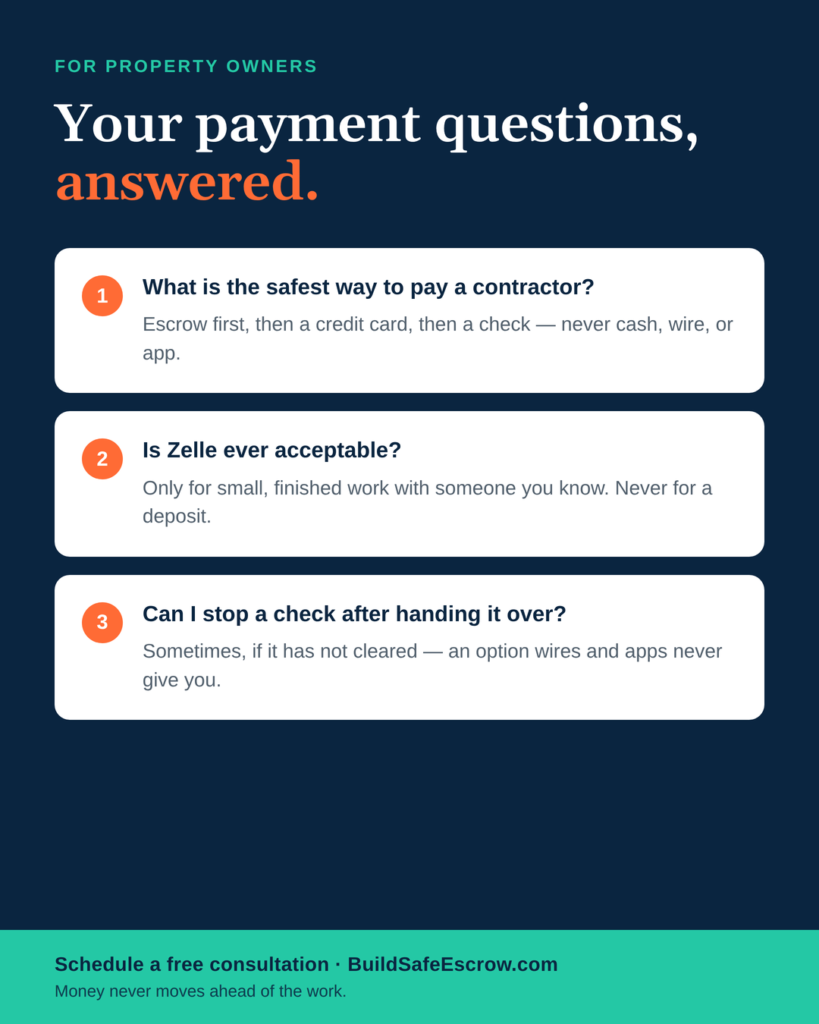
Is Zelle ever an acceptable way to pay a contractor? For a small, completed job with someone you have a long history with, it is a reasonable convenience. For a deposit, a draw, or any payment on work not yet finished, it removes every protection you have. It is not the safest way to pay a contractor on a project of any size.
If escrow isn’t available, what’s the safest way to pay a contractor? A credit card, then a check. A 3 percent processing fee on a $9,000 deposit is $270 for chargeback rights on $9,000 — inexpensive protection.
What if my contractor only accepts checks? Checks are fine. They create a record and clear through a bank. Write them to the business entity, note the milestone on the memo line, and collect a lien waiver.
Can I stop a check after I’ve handed it over? Sometimes, if you act before it clears and your bank supports a stop payment. It is not reliable and there is usually a fee, but it is a real option that wires and apps do not offer.
Is the safest way to pay a contractor also the slowest? No — escrow usually speeds things up. Funds are already deposited and verified, so releases happen on completion rather than whenever the owner gets to the bank. Contractors who have used escrow generally get paid faster.
Who pays the escrow fee? It is negotiable and often split. On most renovation projects, it is a small fraction of what a single unprotected payment puts at risk.
This article is general information, not legal or financial advice. Payment protections and remedies vary by state and by institution — consult your own attorney or financial professional about your specific situation.
Pay on proof, not on trust
You cannot tell a good contractor from a bad one by a handshake. You can make sure your money only moves against work that exists — which is, in the end, the whole of the safest way to pay a contractor.
Schedule a free consultation and we will map your payment schedule and show you exactly where your funds are exposed. → Schedule a free consultation
Get one short read each Friday on how construction money actually moves. → Subscribe to The Build Brief
References
- Federal Trade Commission — Hiring a Contractor
- Consumer Financial Protection Bureau — Fraud and Scams
- FBI Internet Crime Complaint Center (IC3)
- FDIC — Deposit Insurance