
Table of Contents
- Why paying cash to build a house removes your safety net
- If you are building a house and paying cash, how do you protect yourself?
- Six ways to stay in control when paying cash to build a house
- Field example: a $610,000 build, one draw at a time
- Should the deposit paid to a home builder be put in an escrow account?
- Escrow lets the money follow the work, step by step
- FAQ: paying cash to build a house
- Ready to plan your draws?
- References
If you are paying cash to build a house on your own land, you are about to write the biggest checks of your life. As a homeowner, you may be handing them to a builder you met a few months ago. The lot is cleared, the plans are approved, and the first invoice is sitting in your inbox.
That knot in your stomach makes sense. You are not alone, either. The U.S. Census Bureau counted 131,000 contractor-built single-family homes started in 2025, meaning houses built on the owner’s land under one general contractor. The median contract price was $404,000.
The good news: the anxiety points to a real gap, and the gap can be closed.
Why paying cash to build a house removes your safety net
Most people who build with a construction loan never notice the protection they get. The lender wants its money back, so it builds a process around every payment. That process protects the borrower as a side effect.
On a typical loan, the money goes out in draws: scheduled payments released as the house reaches stages like foundation, framing or drywall. Before each draw, the lender usually sends an inspector to confirm the work is done. Many lenders also collect lien waivers, signed statements from the builder and key suppliers saying they have been paid for that stage.
When you are paying cash to build a house, none of that happens unless you set it up. There is no bank inspector. You are the lender now, and you have to act like one.
This is not a judgment of your builder. Most builders want a clean process too, because it gets them paid on time without arguments. The risk comes from the missing structure, not from bad people.
If you are building a house and paying cash, how do you protect yourself?
Rebuild the lender’s process yourself: tie every payment to a written milestone, have the work checked by someone independent, collect conditional lien waivers before you pay, and let a neutral third party hold the funds.
Each of those pieces answers a specific risk. A written schedule stops the slow drift of paying ahead. An independent inspector tells you whether “framing complete” is true. Lien waivers help keep unpaid subcontractors or suppliers from turning into a claim against your home. A neutral holder makes sure the money exists and moves only when both sides agree it should.
The Federal Trade Commission’s consumer guidance makes a related point. It advises homeowners not to pay the full amount up front. It also notes that some states limit how much a contractor can ask for as a down payment. Ask your own attorney what applies where you are building.
Six ways to stay in control when paying cash to build a house
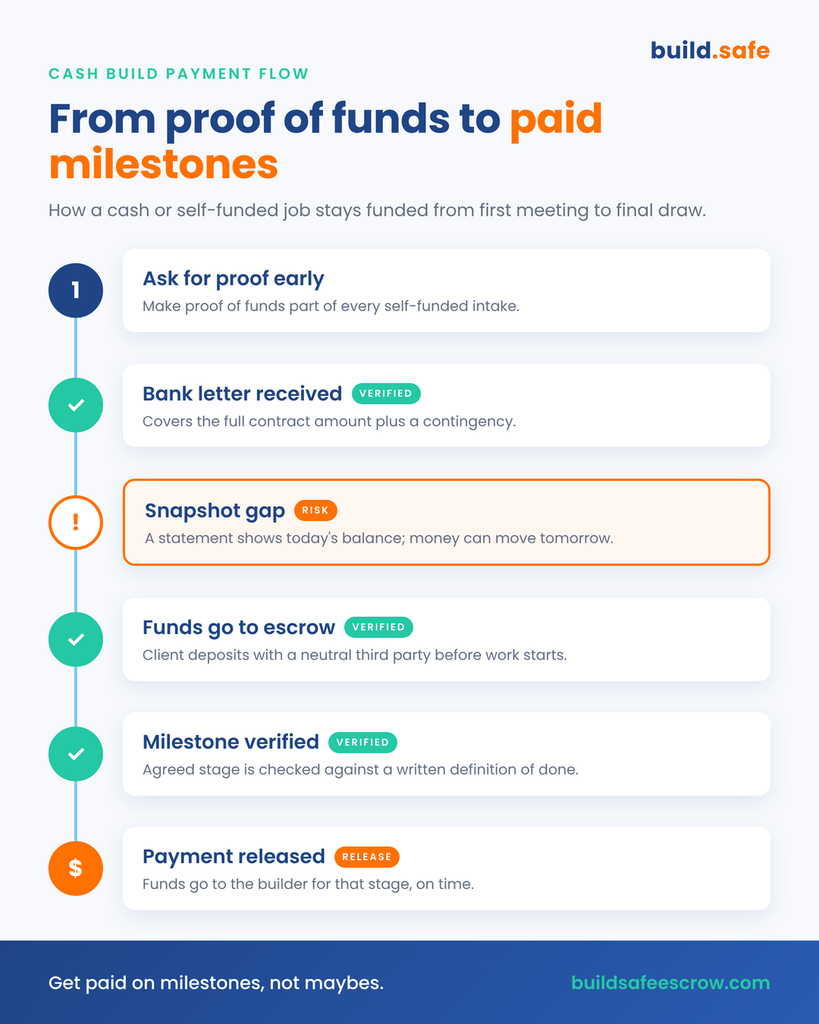
- Write a draw schedule tied to milestones you can see. List each stage, what “done” means, and the dollar amount released. “Roof dried in and inspected” works. “Month three” does not.
- Keep each payment close to the value of finished work. A draw should roughly match what is now standing on your lot. If you are paying cash to build a house, avoid large prepayments for work that has not started. The exception is a material order that needs a deposit you can document.
- Hire an independent inspector. Local building inspections check code compliance, not whether your contract was met. A third-party inspector or your architect can confirm progress before each release.
- Collect conditional lien waivers before each payment. A conditional lien waiver becomes effective only once the payment clears. An unconditional lien waiver is effective immediately, whether or not the money arrived. Take conditional waivers in exchange for progress payments, then unconditional ones after the funds clear. Waiver forms and rules vary by state, so confirm the details with an attorney. Our article on how to avoid a mechanics lien explains the basics.
- Put change orders in writing before the work happens. A change order is a signed amendment to the contract that adjusts scope, price or schedule. Verbal upgrades are where budgets break and friendships end.
- Use a neutral third party to hold the money. A construction escrow account holds your funds and releases each draw only when the agreed milestone is verified. Your builder knows the money is there. You know it will not move early.
Before paying cash to build a house, check the person you are hiring. Our guide on how to vet a home builder before signing a contract walks through licenses, references and insurance.
Field example: a $610,000 build, one draw at a time
This is a fictional scenario for illustration.
Renee Kowalski sold a business and decided to build a home outside Asheville, North Carolina. She had $610,000 set aside and no loan. Her builder, Tom, was well reviewed and easy to talk to.
Tom’s contract asked for 25% up front. Renee felt uneasy but did not want to start the relationship with suspicion. Her attorney suggested a middle path instead of a fight.
They agreed on seven draws tied to milestones, from foundation through final walkthrough. The full $610,000 went into a construction escrow account before work began. Tom could confirm the money was there on day one, which mattered to him more than a large deposit.
At framing, Renee’s inspector found a missing beam detail. Tom fixed it in two days, and the draw released the same week. At drywall, a supplier invoice was disputed, so the draw waited on a conditional waiver. It cleared in four days.
Nobody had to trust blindly. Each step had a rule both sides had agreed to in advance.
Should the deposit paid to a home builder be put in an escrow account?
Escrowing the deposit is worth considering: it proves the money is committed to your builder and keeps it protected until the first milestone is met.
A deposit is often the largest single payment with the least finished work behind it. That makes it the moment when your exposure is highest.
Builders have real reasons to ask for deposits. They order materials, book crews and turn down other jobs. An escrowed deposit answers their worry too: the funds are confirmed and waiting, held by someone who works for neither side. Talk with your attorney about how this fits your contract.
Escrow lets the money follow the work, step by step
Think back to what the lender did for loan borrowers. It held the money, checked the work, collected paperwork and only then paid. A construction escrow service rebuilds that sequence for owners paying cash to build a house.
Your protection is not trust. It is structure. You can like your builder and still want a system that does not depend on your mood on invoice day.
Here is how the threads tie together:
- Draw schedule: the escrow agreement spells out each milestone and amount.
- Verification: funds release only after the milestone is confirmed.
- Lien waivers: release can be conditioned on the right paperwork.
- Change orders: signed amendments update the schedule before money moves.
The rule underneath it all: cash follows finished work, never the other way around. Your builder gets paid on time for what is done. You never pay for what is still a promise.
Build Safe Escrow is a neutral, FDIC-insured construction escrow service. We are not a lender or a contractor. We hold the funds and release them in stages as each milestone is completed and verified. You can see how it works on our construction escrow services page or read the construction escrow FAQs.
FAQ: paying cash to build a house
Is paying cash to build a house riskier than using a construction loan?
It can be, because you lose the lender’s built-in checks. Rebuild them with milestones, inspections, lien waivers and a neutral funds holder.
How many draws should a custom home have?
There is no single right number. Choose stages you can verify on site, and agree on them in writing before work starts.
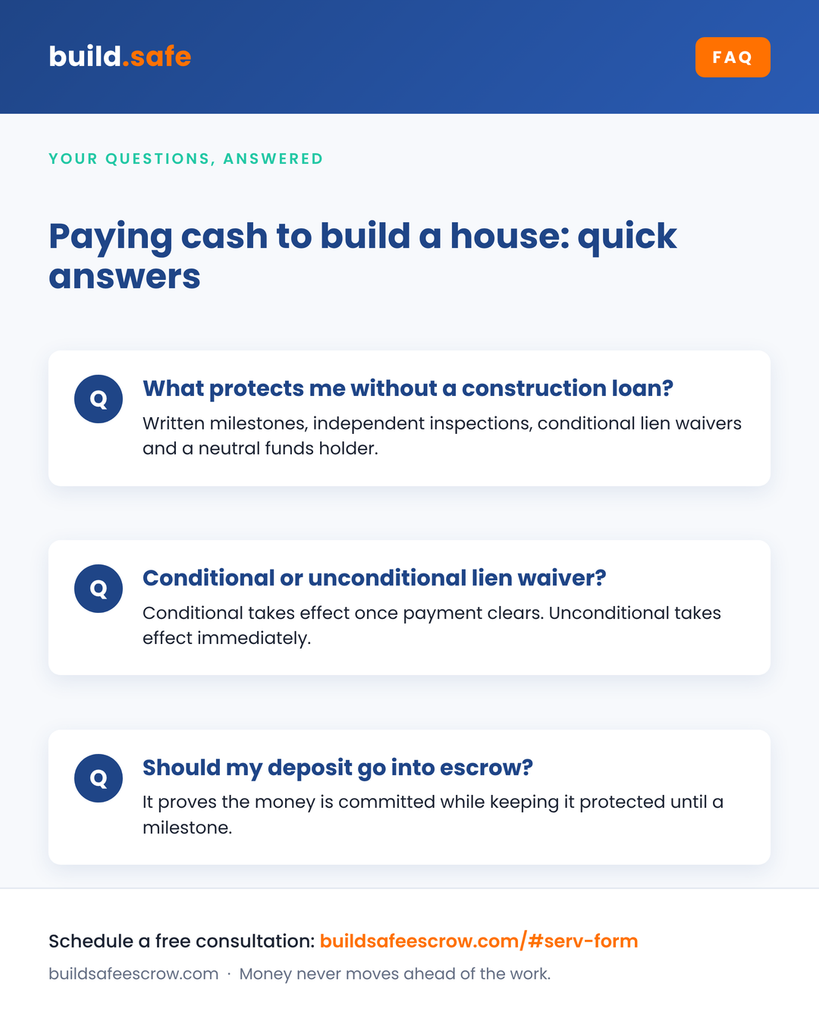
What is the difference between a conditional and an unconditional lien waiver?
A conditional waiver takes effect only once payment clears. An unconditional waiver takes effect immediately, so give it only after funds arrive.
Will my builder object to escrow when I am paying cash to build a house?
Some ask questions at first. Escrow answers their biggest one: is the money really there? It also pays them promptly as milestones are met.
Do I still need an attorney if I use escrow?
Yes. Escrow holds and releases funds. Your attorney reviews the contract and advises on your state’s rules.
Ready to plan your draws?
Get one short read each Friday on how construction money moves, written for owners and builders: subscribe to The Build Brief.
If you are paying cash to build a house and want every draw tied to verified work, schedule a free consultation.
References
- Highlights of 2025 Characteristics of New Housing, U.S. Census Bureau, 2026: source for 131,000 contractor-built single-family home starts in 2025 and the $404,000 median contract price.
- Survey of Construction Definitions, U.S. Census Bureau: defines contractor-built houses as built on the owner’s land under a single general contractor.
- How To Avoid a Home Improvement Scam, Federal Trade Commission, 2022: advises against paying the full amount up front and notes some states limit down payments.