
Table of Contents
- Deposits exist for real reasons, and so does client pushback
- Can a contractor start a job without a deposit?
- Should you pay a contractor up front?
- Six steps to working as a no deposit contractor who still gets paid
- From the field: a $62,000 pool build with no deposit and no gap
- Escrow puts the money in place before the first shovel
- No deposit contractor FAQ
- Get paid on milestones, not maybes
- References
Working as a no deposit contractor used to sound like a fast way to go broke. If you are a builder, a general contractor or a specialty trade (remodeling, fence, flooring, windows, pools), you have probably heard this line more often lately: “We don’t pay anything until you start.”
Meanwhile you need materials ordered and a crew booked. The client wants you to carry all of it on faith.
The work has not dried up. The Harvard Joint Center for Housing Studies projects annual homeowner spending on improvements and repairs at $519 billion through mid-2027 (Leading Indicator of Remodeling Activity, released July 23, 2026). The jobs are there. The open question is how they get paid.
Deposits exist for real reasons, and so does client pushback
Before you decide whether to become a no deposit contractor, look at what a deposit does. For most trades it covers three costs that land before any visible progress.
- Materials. Special-order windows, custom gate hardware, a flooring lot that has to match, pool equipment. Once ordered, much of it cannot go back.
- Mobilization. Crew time, equipment, permits, a dumpster, the first week of labor.
- Cash-flow risk. You float payroll and suppliers until the first payment arrives. If the client stalls, you are the bank.
Now look at it from the other side of the table. Homeowners read stories about contractors who took a deposit and vanished. Search phrases like “never pay a contractor up front” and “should you pay a fence contractor upfront” show what many of them are looking for: a reason to say no. Our own guide for owners, when a contractor asking for money upfront is normal, walks them through that exact worry.
Both fears are reasonable. You fear starting unfunded. They fear paying for work that never shows up. Some states and localities limit how much a contractor can collect up front; check your local rules.
Can a contractor start a job without a deposit?
Yes: a contractor can start without a deposit when the client funds the contract, or its first phase, into a neutral escrow account first, so you can confirm the money exists before you commit a crew.
Think about what a no deposit contractor has to replace. A deposit proves the client is serious. It proves the money is real. It pays for what you buy before anything is installed.
Escrow covers the first two without the client handing you cash. Escrow means a neutral third party holds the project funds and releases them by a written schedule. The client is not paying you up front. They are putting the money where neither of you can touch it until the work is verified.
The third job, paying for materials, is handled by how you design the schedule. That comes in the steps below.
Should you pay a contractor up front?
Many homeowners now say no to paying up front, and escrow gives them a way to fund the job without paying ahead of the work.
From your client’s seat, paying a large sum before any work is done feels like a gamble.
You cannot argue a homeowner out of that fear. A no deposit contractor removes the reason for it.
When the money sits in escrow, the client keeps control until each stage is verified. You keep proof that the money is there. Funded is not the same as paid, and that difference is the whole deal. It lets the client say yes without feeling exposed, and it lets you start without carrying the job on your own balance sheet.
Six steps to working as a no deposit contractor who still gets paid
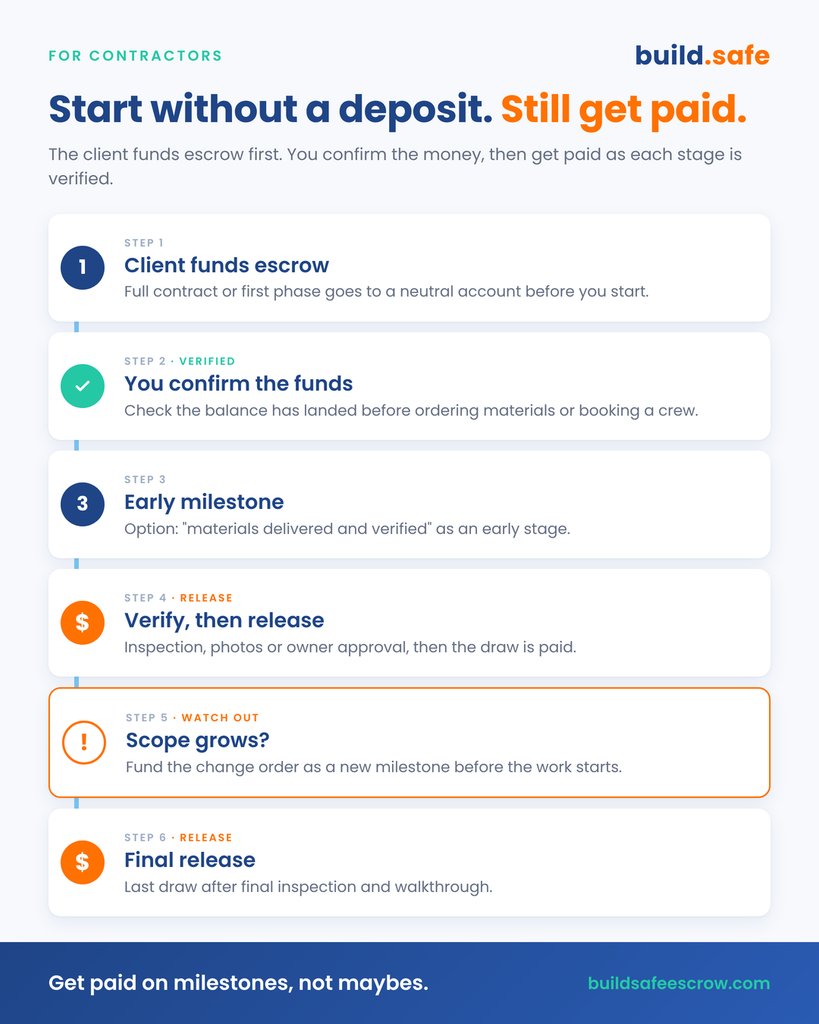
- Ask for funding, not a deposit. Every no deposit contractor needs this clause. Write it into the contract as a condition of mobilizing: the full contract amount, or the first phase on larger projects, goes into escrow before you start. Confirm with the escrow provider that the funds have landed. Do not order materials on a promise.
- Front-load early, verifiable milestones. A milestone is an observable stage with a dollar amount attached, such as “demolition complete” or “rough-in passed inspection.” One structure option is to make “materials delivered and verified” an early milestone, so the cost of special-order items is released once they are on site and checked. That is a term you and the client agree on in the schedule, not a guarantee from any escrow provider.
- Name fast, objective verification. Each payment, called a draw, moves only after its milestone is verified. The schedule names who verifies and how: a permit inspection sign-off, dated photos, a site visit or the owner’s written approval. Vague milestones like “framing mostly done” invite argument and delay.
- Trade lien waivers for draws. A lien waiver is a signed document giving up lien rights for the amount paid. Submit a conditional waiver with each draw request, then an unconditional waiver once the payment clears. Many clients read that as professionalism. Waiver forms and rules vary by state; confirm yours with your attorney.
- Fund change orders before you build them. When the client adds scope, write it up as a new milestone. Have it funded into escrow before the extra work starts. That one habit ends most “we’ll settle up at the end” disputes.
- Sell it in the bid. Once funding is confirmed, being a no deposit contractor is a selling point, not a concession. Something like: “No deposit. You fund escrow, and I get paid only when you can see the work.” Against a competitor asking for a big check on day one, that line can decide the job.
Some contracts call for retainage: a small percentage held back from each draw until final completion. If yours does, build it into the schedule from the start so nobody is surprised at closeout.
From the field: a $62,000 pool build with no deposit and no gap
Theo Grant is a pool builder who now works as a no deposit contractor (a fictional example). A client wanted a $62,000 pool but refused to put down a deposit after a friend lost money on a fence job.
Theo did not budge on getting paid. He moved the question. The client funded the full $62,000 into escrow, and Theo confirmed the balance before he scheduled excavation. The milestone schedule looked like this:
- Equipment and materials delivered and verified: $12,000
- Excavation and steel complete, photos submitted: $14,000
- Shell complete: $16,000
- Plumbing, electrical and decking complete, inspection passed: $12,000
- Finish, startup and final walkthrough: $8,000
Halfway through, the client asked for a spa spillover. Theo wrote it up as a new $4,500 milestone, and the client funded it before his crew touched it.
Two other bidders had asked for large deposits. The client said the escrow setup was why she signed. Theo never carried more than one stage of cost, and she never paid for work she could not see.
Escrow puts the money in place before the first shovel
Every piece of this traces back to one rule: money never moves ahead of the work, and work never starts ahead of the money.
For a no deposit contractor, the client funds first, so you are not working on faith. Each draw follows a verified milestone, so the client is not paying on faith either. Lien waivers move with the payments. Change orders get funded before they get built. If a project stops partway, unreleased funds stay in the account under the terms of the agreement instead of disappearing.
The funds sit with a neutral third party in an FDIC-insured account. The FDIC’s standard coverage is $250,000 per depositor, per insured bank, for each ownership category. On a larger job, ask the escrow provider how the balance is structured.
One caution. Escrow enforces the payment schedule written into your contract. It does not replace the contract, so have your own attorney review it, and talk to your accountant about how draws affect your books.
Trust is a feeling. Structure is protection. Build Safe Escrow sets up that structure for both sides; see how our construction escrow services work, or read more on construction escrow for contractors.
No deposit contractor FAQ
Is it risky to be a no deposit contractor?
It is risky when “no deposit” means “no funding.” When the client funds escrow before you start, you are working against money you have confirmed exists. Your exposure shrinks to the cost of the current milestone.
What if a client will not fund escrow before the job starts?
Being a no deposit contractor does not mean being an unfunded one. A client who will not put the money anywhere is telling you something about the job. Offer a smaller first phase if the full amount is a stretch.
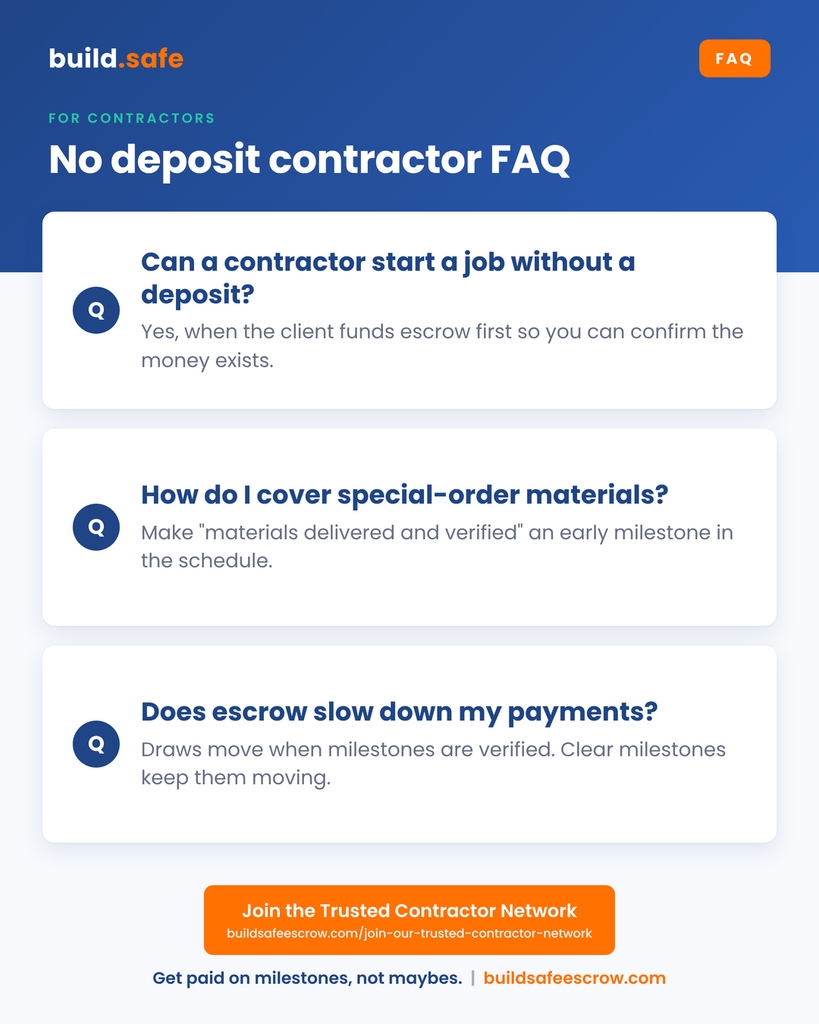
How do I cover special-order materials without a deposit?
Make “materials delivered and verified” an early milestone in the schedule. The client sees the materials on site, and that draw can be released once verification is done.
Does escrow slow down my payments?
Payments move when the milestone is verified, so speed depends on the schedule you write. Clear, photo-ready milestones and a named verifier keep draws moving. Ask your escrow provider for its standard release turnaround.
Who pays for the escrow account?
Build Safe Escrow charges a flat setup and administration fee that is known before the project starts. Ask how the fee is handled during setup, and put any agreement about who covers it in your contract.
Can a no deposit contractor still win against lower bids?
It can. Homeowners weigh risk as well as price. A bid with no deposit, and funds held neutrally until work is verified, answers the fear that stops many of them from signing.
Get paid on milestones, not maybes
Build trust. Win more projects. Get paid on milestones, not maybes. Join the free Trusted Contractor Network. Approved members may be recommended to property owners who want escrow-protected, milestone-based projects.
Get one short read each Friday on how construction money actually moves. Subscribe to The Build Brief.