
Three bids on the table. Yours is not the cheapest. You still get the job.
Table of Contents
- The bid you lost for the wrong reason
- What owners are actually deciding
- Why the lowest number keeps losing
- Seven ways escrow helps you win more construction bids
- How to bring it up in the proposal
- A short field example
- How escrow removes the objection at the source
- FAQ
- Get paid on milestones, not maybes
- References

The bid you lost for the wrong reason
If you want to win more construction bids, you have to understand what actually happens after you send your proposal. You are a general contractor or a specialty trade. Your number was fair. Your scope was thorough. Your references were solid. And you still lost.
Here is what most contractors assume: they went cheaper. Sometimes that is true. But often the owner picked someone else because that contractor made them feel safer. Not smarter. Safer.
Every owner sits down with your proposal carrying one quiet fear: what if I hand over a big deposit and something goes wrong? Whoever answers that fear best usually wins. That is the whole mechanism behind how contractors win more construction bids. This article is about answering it better than anyone else on the list — and getting paid faster in the process.
What owners are actually deciding
An owner reading three bids is not really comparing labor rates. They are making a risk decision with incomplete information.
They cannot verify your crew’s quality from a PDF. They cannot predict whether the schedule holds. What they can see is how much money they are being asked to hand over before any work exists — and how exposed that leaves them. Read that carefully if you want to win more construction bids.
The deposit is the scariest line in your proposal. It is the moment the owner’s money leaves their control and enters yours. Everything else on the page is a promise. That line is a transfer.
Understand this and the path to win more construction bids gets simple. You are not selling craftsmanship against craftsmanship. You are competing to be the least frightening option on the table. The contractor who removes the fear wins the work.
Why the lowest number keeps losing
Owners have been burned, or they have heard the stories. Their instincts are shaped by a handful of predictable failures.
The deposit that bought nothing. They read about a contractor who took 40 percent up front and disappeared. Now every large deposit request looks like that story starting again.
The job that stalled halfway. Money went out, work slowed, and the owner had no leverage because the funds were already spent. Payment ahead of progress removes every lever they have.
The lien they never saw coming. A mechanics lien is a legal claim filed against the property by a sub or supplier who was not paid. Owners have learned they can pay a contractor in full and still get a claim on their home.
No way to verify progress. The owner is asked to release the next draw because it is “about 60 percent done.” They have no idea whether that is accurate.
The cheap bid that got expensive. Low numbers often mean change orders later. Owners know this, which is exactly why the lowest bid does not automatically win — and why you can win more construction bids at a fair price.
Notice what all five have in common. Every one is about money moving ahead of the work. If your proposal is the only one that fixes that, you win more construction bids without touching your price.
Seven ways escrow helps you win more construction bids
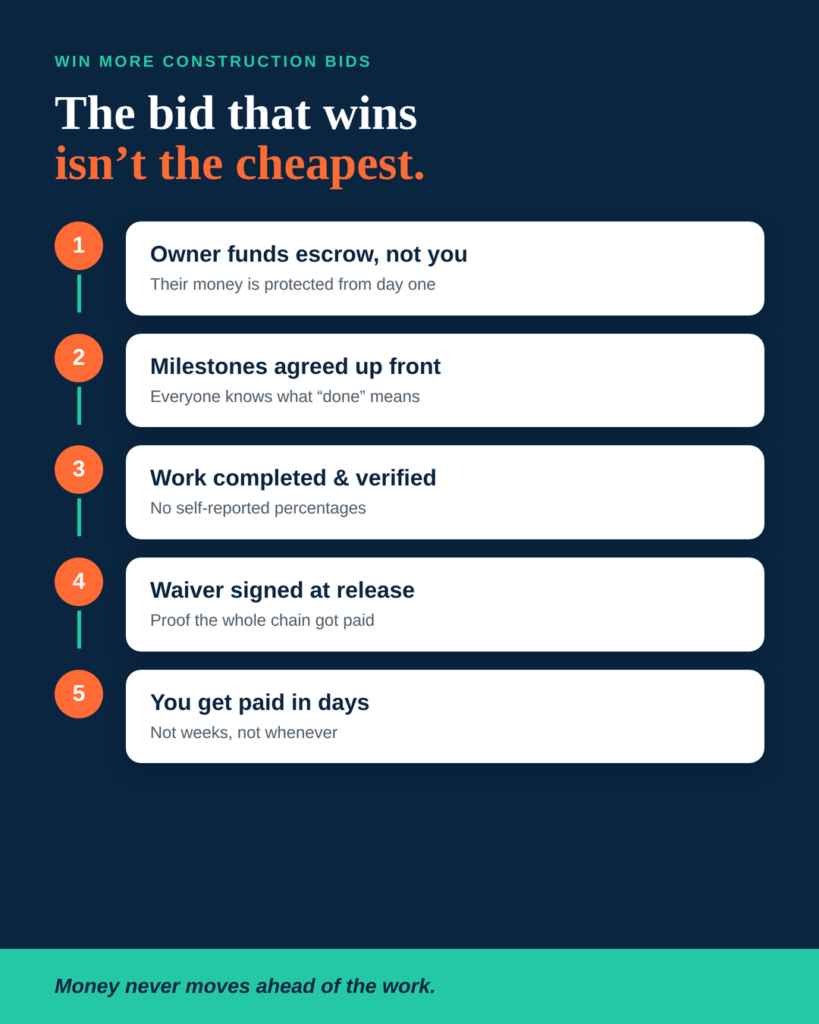
Escrow is a neutral, third-party account — FDIC-insured — that holds project funds before work begins and releases them in stages as each milestone is completed and verified. Build Safe Escrow is not a lender, not a contractor, and not on anyone’s side. Here is what that does for your proposal.
1. It removes the deposit objection entirely. The owner is no longer handing you a large sum. They are funding a neutral account. Their money is protected, your budget is confirmed. The scariest line in your proposal stops being scary, and that single change helps you win more construction bids immediately.
2. It proves the money exists before you start. This cuts both ways, and the second way is yours. You get confirmation the full budget is deposited and committed. No more financing a job on your own credit hoping the owner is good for it.
3. It makes you the professional in the room. Most contractors say “trust me.” You bring structure. Proposing escrow signals that you have run real projects and you take the owner’s capital seriously. That perception alone helps you win more construction bids against contractors who never mention it.
4. It kills the lien fear. Because waiver collection is built into each release, the owner has proof that subs and suppliers were actually paid. You are handing them the answer to the risk that scares them most.
5. It defines “done” before anyone argues. You and the owner agree on milestones up front — foundation, framing, rough-in, finish. Everyone knows what triggers each release. Disputes shrink because the goalposts were set in concrete.
6. It gets you paid faster. When a milestone is verified, funds release in days. You are not waiting on the owner’s bank, their mood, or their cash flow that month. Retainage — the percentage held back until the job is done — is defined and scheduled instead of parked indefinitely.
7. It lets you hold your price. This is the real payoff. When you are the safe choice, you stop competing purely on number. Contractors who win more construction bids on structure rather than discount protect their margin while they grow.
Seven benefits, one mechanism: the money is confirmed early and moves only on proof of work.
How to bring it up in the proposal
Structure only helps if the owner hears it. Keep it short and lead with their benefit, not the mechanics.
Put it in the payment section, not the fine print. One clear paragraph: project funds are held in a secure, FDIC-insured escrow account and released as each milestone is completed and verified.
Frame it as protection for them. “Your funds stay protected until the work is verified” lands better than a technical explanation of escrow administration.
Name the lien benefit out loud. Tell them waivers are collected at each release, so they have proof everyone on the job was paid. Most owners have never had a contractor offer that.
Offer it, do not demand it. Present escrow as how you prefer to run projects because it protects both sides. Confidence, not conditions.
Say the milestone schedule plainly. List the stages and what each release covers. Clarity reads as competence, and competence helps you win more construction bids.
Contractors who do this consistently win more construction bids because they are the only bidder who addressed the owner’s actual anxiety.
A short field example
Consider a general contractor — call her Renata. A whole-home renovation, three bidders, a nervous first-time client.
Renata came in about nine percent above the low bid. The client liked all three contractors and was genuinely stuck. The low bidder asked for 35 percent down before demolition.
Renata’s proposal had one paragraph the others did not. The full project budget would be deposited into a neutral, FDIC-insured escrow account. Four milestones. Funds release on verification, with signed lien waivers collected at every release. The client would never hand Renata a large check on faith.
She got the job at her number. The client later said the decision took about ten minutes once she read that paragraph — she stopped worrying about losing her money and started thinking about her kitchen. Renata financed nothing, hit four verified milestones, and got paid within days each time.
That is what it looks like to win more construction bids without discounting. She did not have the lowest number. She had the only structure.
How escrow removes the objection at the source
Trust is a feeling. Structure is protection. The reason bids get decided on fear is that money is normally allowed to move ahead of the work.
Escrow fixes the sequence. The funds are deposited and confirmed before you start. Each milestone is completed, verified, and waived. Then the money moves. Money never moves ahead of the work — and you never move ahead of the money.
Read that from both sides of the table, because that is the whole selling point. The owner cannot lose funds to a job that stalls. You cannot be left financing someone else’s cash-flow gap. Neither of you is asked to trust the other on faith, which is precisely why the deal closes faster — and why contractors who use it win more construction bids.
Our escrow services exist to move the money question to the front of the job, where it belongs. Want the mechanics in detail? Our construction escrow FAQs break down verification, milestones, and waivers step by step.
FAQ
Will proposing escrow make me look like I distrust the client? No — it reads as the opposite. You are protecting their money, not guarding against them. Most owners hear it as professionalism.
Does escrow delay my payments? It usually speeds them up. Funds are pre-deposited, so once a milestone is verified the release happens in days rather than waiting on the owner’s bank.
Who pays for the escrow service? That is negotiable and should be stated in the contract. Many contractors build it into the project cost; some owners cover it outright.
What if the owner has never heard of construction escrow? Explain it in one sentence: a neutral third party holds the funds and releases them as verified work is completed. That sentence closes deals.
Does this work for small jobs, or only big builds? Both. Any project where a meaningful deposit changes hands benefits from structure — remodels, additions, and full builds alike.
Can escrow really help me raise my close rate? Yes. It is one of the few changes that reliably helps you win more construction bids. It removes the owner’s single biggest objection. When you are the only bidder answering the deposit fear, you compete on value instead of price.
This article is information and structure, not legal or financial advice. Talk to your own attorney or accountant about your specific contracts and projects.
Get paid on milestones, not maybes
If you write checks or chase them, one habit changes everything: put the money in front of the work.
Get one short read each Friday on how construction money actually moves — subscribe to The Build Brief.
Contractors and specialty trades: stop competing on price alone. Join the free Trusted Contractor Network. Build trust. Win more projects. Get paid on milestones, not maybes.
References
- Associated General Contractors of America (AGC): https://www.agc.org/
- Levelset / Procore — Construction Payment & Lien Resources: https://www.levelset.com/ (verify the specific report URL before publishing)
- U.S. Small Business Administration — Managing Your Business Finances: https://www.sba.gov/
- FDIC — Deposit Insurance: https://www.fdic.gov/resources/deposit-insurance/