
A pay when paid clause is one sentence buried in your subcontract, and it decides when, and sometimes whether, you get paid for finished work. This guide is for specialty trades and subcontractors who sign these clauses every season, usually without reading them twice. You should read this one twice.
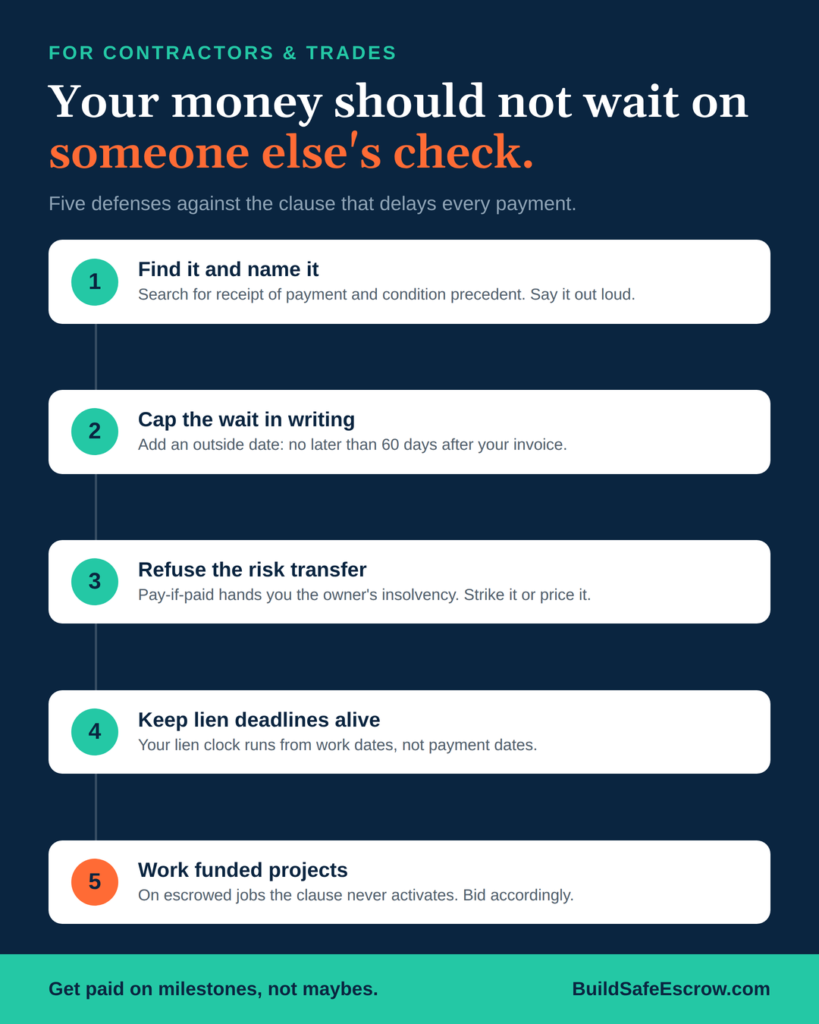
Table of Contents
- What the clause actually says
- Pay-when-paid vs. pay-if-paid
- 1. Find it and name it before you sign
- 2. Cap the wait in writing
- 3. Push back on risk transfer
- 4. Keep your lien clock running
- 5. Sidestep the clause entirely with escrow
- A short field example
- What does a pay when paid clause mean?
- How escrow removes the problem at the source
- FAQ
- Get paid on milestones, not maybes
- References
[MEDIA: Feature image, 16:9 hero, placed above the fold. Alt text: “Subcontractor reviewing a pay when paid clause in a subcontract before signing.”]
The work is yours. The schedule is yours. The payroll on Friday is definitely yours. But under that one sentence, the timing of your money belongs to a transaction you are not even part of: the owner paying the general contractor.
You hung the drywall in March. The GC bills the owner in April. The owner disputes an unrelated line item until July. Under a pay when paid clause, your March money arrives in August, and everyone involved can honestly say they followed the contract.
What the clause actually says
Every pay when paid clause shares the same skeleton: “Payment to Subcontractor shall be made within X days of Contractor’s receipt of payment from Owner.”
Read it slowly. Your payment is not triggered by your work being done. It is triggered by someone else’s check clearing. Your invoice can be perfect, your work approved, your warranty active, and the clock on your money has not even started, because the clock belongs to the owner and the GC.
GCs do not write these clauses out of malice. They write them because they carry the same squeeze one level up: they front the project and wait on the owner. The clause passes that wait down the chain to the party least able to absorb it. Industry payment surveys find the same thing year after year: subcontractors wait the longest of anyone in construction, and slow owner-to-GC payment is a leading reason why.
Pay-when-paid vs. pay-if-paid
Two versions of the pay when paid clause look nearly identical on the page and mean radically different things. Learn to tell them apart.
Pay-when-paid is a timing clause. Courts in most states read it as a delay: the GC can wait a reasonable time for the owner’s payment, but ultimately owes you regardless. Annoying, survivable.
Pay-if-paid is a risk-transfer clause. Language like “payment by Owner is a condition precedent to any obligation to pay Subcontractor” means that if the owner never pays, you may never be paid, for work you fully performed. The owner’s insolvency becomes your loss.
The stakes explain why the wording matters so much. Some states, California and New York among them, refuse to enforce pay-if-paid provisions; others enforce them if the language is explicit. You do not need to memorize fifty jurisdictions. You need to recognize the phrase “condition precedent” as a flare going up, and treat it accordingly.
1. Find it and name it before you sign
Every subcontract gets a payment-terms read before signature. Not a skim. Search for “receipt of payment,” “condition precedent,” and “paid by Owner,” and when you find the clause, name it out loud in negotiation: “Section 4.2 is a pay when paid clause. Let’s talk about it.”
Naming it does two things. It signals you read the contract, which changes the tenor of everything after. And it moves the clause from fine print to open topic, where it can actually be negotiated. Most subs lose this fight by never starting it.
2. Cap the wait in writing
If the pay when paid clause stays, bound it. The standard fix is an outside date: “Payment shall be made within 10 days of Contractor’s receipt of payment from Owner, but in no event later than 60 days after Subcontractor’s invoice.”
That single amendment converts an open-ended wait into a defined one. The GC keeps breathing room for the normal owner payment cycle. You get a ceiling you can plan payroll around. Reasonable GCs accept caps far more often than subs expect, because the ask is fair on its face and refusing it says something they would rather not say.
3. Push back on risk transfer
Timing is negotiable. Absorbing the owner’s credit risk should not be.
Where you see condition-precedent language, push to convert it to pay-when-paid, or strike it. The argument is simple: you did not underwrite the owner, you cannot see the owner’s finances, and you had no seat at the table when the prime contract was signed. The party who chose the owner should carry the owner’s risk.
Where the law already voids pay-if-paid, know it and say so. Where it does not, price the risk if you must accept it. Carrying someone else’s insolvency exposure for free is how thin trades get thinner.
4. Keep your lien clock running
A pay when paid clause slows the GC’s obligation to you. It does not pause your mechanics lien deadlines, and this mismatch catches subs constantly. Preliminary notice windows and lien filing deadlines run from your work dates in most states, not from anyone’s payment dates. Wait politely through a 90-day clause and you can wait yourself right past your own protection.
So run the clocks separately. Send preliminary notices on every job as routine paperwork, not as an escalation. Diary your lien deadlines from day one. And at every payment, exchange conditional lien waivers only, drafted so you never release rights for money still stuck upstream.
5. Sidestep the clause entirely with escrow
Every fix above makes the pay when paid clause less painful. One structure makes it irrelevant.
A pay when paid clause exists because the money’s location is unknown. Nobody downstream can see whether the owner has funded anything, so everyone passes the uncertainty to the next party. Project escrow removes the uncertainty at the source: the owner funds the project into a neutral, FDIC-insured account up front, and releases follow verified milestones.
On a funded project, your payment does not wait on the owner’s check clearing the GC, because the question the clause exists to manage, “is the money real?”, was answered before you mobilized. Hit your milestone, pass verification, get released. When you bid, ask whether the project is escrow-funded, and when you have a choice of jobs, weight the funded one. Your payment terms are only ever as good as the money behind them.
A short field example
Rafael runs a drywall crew of nine. On a mid-rise fit-out, he signed a subcontract with a payment clause he never read closely. His crew finished level-five finish work in March, invoice approved, no defects. The owner and GC then spent the spring disputing a curtain-wall change order that had nothing to do with drywall. Rafael’s money sat inside that fight for 94 days. He floated payroll on a credit line at 11 percent and turned down a school job because he could not fund two mobilizations at once.
The next fit-out he bid was escrow-funded, and he learned about it in the bid documents. The owner had placed the construction budget in neutral escrow; sub payments released on verified milestones. Same trade, same crew, same city. His three draws arrived in 9, 11, and 8 days. The pay when paid clause was still printed in that subcontract too. It just never mattered, because the money was already there.
[MEDIA: Infographic, 4:5, placed here. Two payment paths compared vertically: clause path (work done, GC bills owner, owner pays, then you) versus funded path (escrow funded, milestone verified, release). Alt text: “Infographic comparing a pay when paid clause payment path against an escrow-funded milestone path.”]
What does a pay when paid clause mean?
A pay when paid clause means your general contractor’s obligation to pay you is tied to their receipt of payment from the owner, so your money waits on a transaction you are not part of; in its harsher pay-if-paid form, it can shift the owner’s nonpayment risk onto you entirely.
The practical translation: finished work does not start your payment clock. Someone else’s check does. That is why the defenses run in order: find the clause, cap the wait, refuse the risk transfer, keep your lien deadlines alive independently, and, wherever possible, work on projects where the funds are escrowed up front, because a funded project has already answered the question the clause exists to dodge.
How escrow removes the problem at the source
Follow the pay when paid clause upstream and you find the real defect: on an unfunded project, nobody in the chain can prove the money exists, so everyone contracts around the doubt. The GC hedges against the owner. You absorb the hedge. The wait rolls downhill and lands on the party doing the actual work.
Construction escrow attacks the doubt instead of the symptoms. The budget is committed to a neutral account before work begins, visible and verifiable. Releases follow completed, verified milestones, not the choreography of checks clearing between other parties. The GC stops needing the hedge. You stop financing everyone above you.
We are not on the GC’s side or the sub’s side. We are the referee that makes the clause unnecessary. Get paid on milestones, not maybes, and let the fine print gather dust.
See how staged releases work on our escrow services page, or read how the same structure rescues your extras in change order payment.
This article is general information, not legal advice. Enforceability of payment clauses and lien rules vary sharply by state, so have a construction attorney review your specific contract.
FAQ
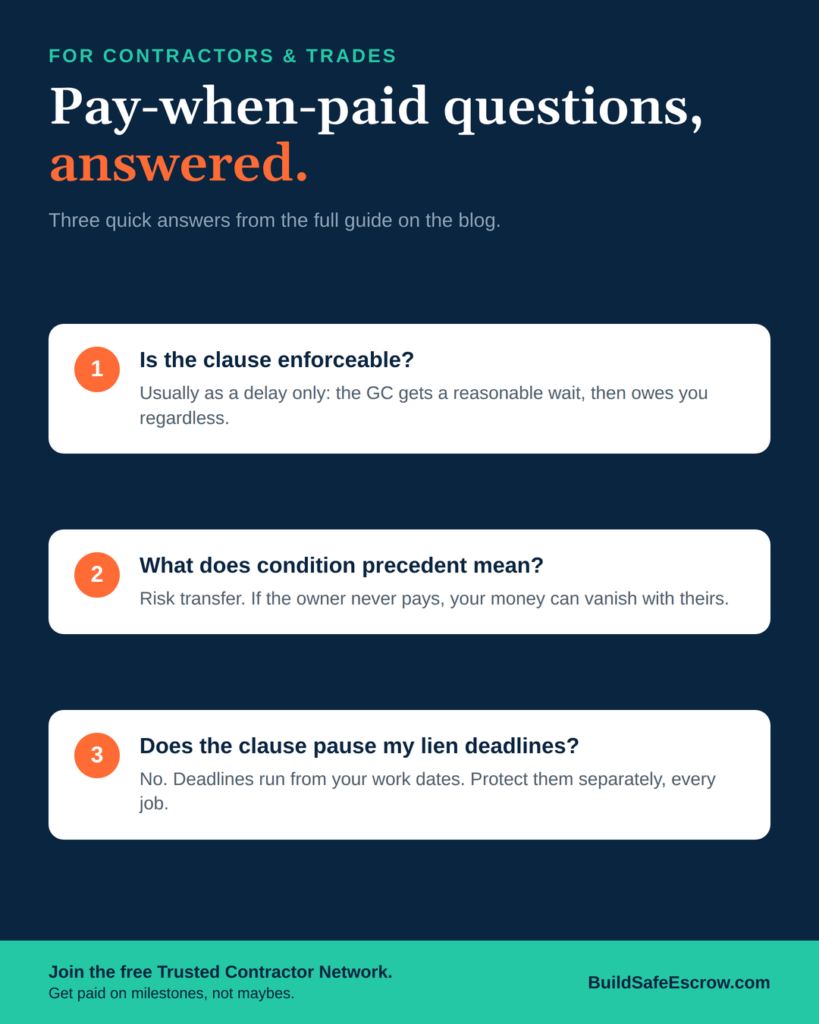
Is a pay when paid clause enforceable? In most states, yes, as a timing provision: the GC gets a reasonable wait, then owes you regardless. Pay-if-paid language is different; some states void it entirely, others enforce it when explicit. State law controls, so verify yours.
How do I know if my contract has a pay when paid clause? Search the payment terms for “receipt of payment from Owner,” “paid by Owner,” and “condition precedent.” The last phrase is the dangerous one; it signals risk transfer, not just delay.
Can I refuse to sign a pay-if-paid provision? You can negotiate anything before signature. Convert it to pay-when-paid, add an outside payment date, or price the risk. Your leverage is highest before you sign and lowest after your work is in the wall.
Does a pay when paid clause pause my lien deadlines? No, and this is the trap. Notice and lien deadlines run from your work dates in most states, regardless of what the contract says about payment timing. Protect the deadlines separately.
How does escrow help if the clause is already in my contract? On an escrow-funded project the clause rarely activates, because releases follow verified milestones instead of upstream checks. When choosing between jobs, the funded one pays faster with the identical contract language.
Get paid on milestones, not maybes
You already carry the labor, the materials, and the schedule. The owner’s payment risk was never supposed to be yours too.
For everyone: Get one short read each Friday on how construction money actually moves: subscribe to The Build Brief.
For contractors and specialty trades: Build trust. Win more projects. Get paid on milestones, not maybes. Join our free Trusted Contractor Network.
References
- American Subcontractors Association, contract and payment resources: https://www.asaonline.com/
- Levelset, pay-when-paid and pay-if-paid guides by state: https://www.levelset.com/
- Associated General Contractors of America: https://www.agc.org/
- FDIC, deposit insurance overview: https://www.fdic.gov/resources/deposit-insurance/