

The job is done. The homeowner is happy. The last check is somehow still not here.
Table of Contents
- The last ten percent is the hardest ten percent
- How can I make sure I get my final payment from a homeowner?
- Why contractor final payment stalls
- Eight ways to secure your contractor final payment
- A short field example
- How escrow guarantees the last draw
- FAQ
- Get paid on milestones, not maybes
- References
The last ten percent is the hardest ten percent
Contractor final payment is where good jobs go to die. You are a general contractor or a specialty trade, the work is complete, the homeowner has moved back into the kitchen — and the last draw is three weeks late with no clear reason why.
You have been here. Every contractor has. The first payment came easily because the owner was excited. The middle draws came because the work was visibly progressing. The last one has no momentum behind it at all. The owner already has what they wanted, and your leverage is gone the moment the job is done.
This is not a relationship problem. It is a sequencing problem, and sequencing problems have fixes you can put in your next contract.
How can I make sure I get my final payment from a homeowner?
You secure your final payment by defining “complete” in writing before you start, documenting it the day you finish, and — ideally — having the funds already deposited in escrow so the last draw releases on verification rather than on the homeowner’s willingness to write a check.
That is the whole answer. Three moves, all of which happen before the problem shows up.
Everything else — the follow-up calls, the polite emails, the eventual demand letter, the lien filing — is damage control after you have already lost the position. The contractors who reliably collect their contractor final payment are not better at collections. They set the job up differently on day one.
Here is what that setup looks like, and why the stall happens without it.
Why contractor final payment stalls
The delay is predictable. It comes from a short list of causes, and naming them is most of the cure.
Your leverage inverts at completion. Through the whole job, you hold something the owner wants: unfinished work. On the day you finish, you hand it over. Now they hold something you want and you hold nothing. Every other cause on this list is downstream of that single reversal.
“Done” was never defined. If the contract says “upon completion” without specifying what completion means, then completion means whatever the homeowner decides it means — and it can keep moving.
The punch list becomes infinite. A legitimate punch list is a finite set of items identified at substantial completion. An undefined one grows every time you finish an item. Each new item is small enough that arguing feels petty, and together they hold your contractor final payment indefinitely.
Retainage was never scheduled. Retainage is the portion of each payment withheld until the job is complete, typically 5 to 10 percent. If your contract does not say precisely when and on what conditions retainage releases, it does not release. It just sits.
The owner spent it. Sometimes the money is genuinely gone — into change orders, into overruns, into something else entirely. If the budget was never confirmed and set aside, the last draw depends on the owner’s cash position months after they signed.
The paperwork isn’t closed. Missing lien waivers from your subs, an open permit, a certificate the owner needs for their insurer. These are real blockers, and they are usually solvable in a day if you know about them early — and invisible until they cost you three weeks.
Every one of these is structural. Structure problems have structural fixes.
Eight ways to secure your contractor final payment
1. Define substantial completion in the contract. Write the specific, observable condition that triggers the last draw: final inspection passed, certificate of occupancy issued, systems operational, punch list delivered. Not “when the owner is satisfied.” Satisfaction is not a milestone. A verifiable event is.
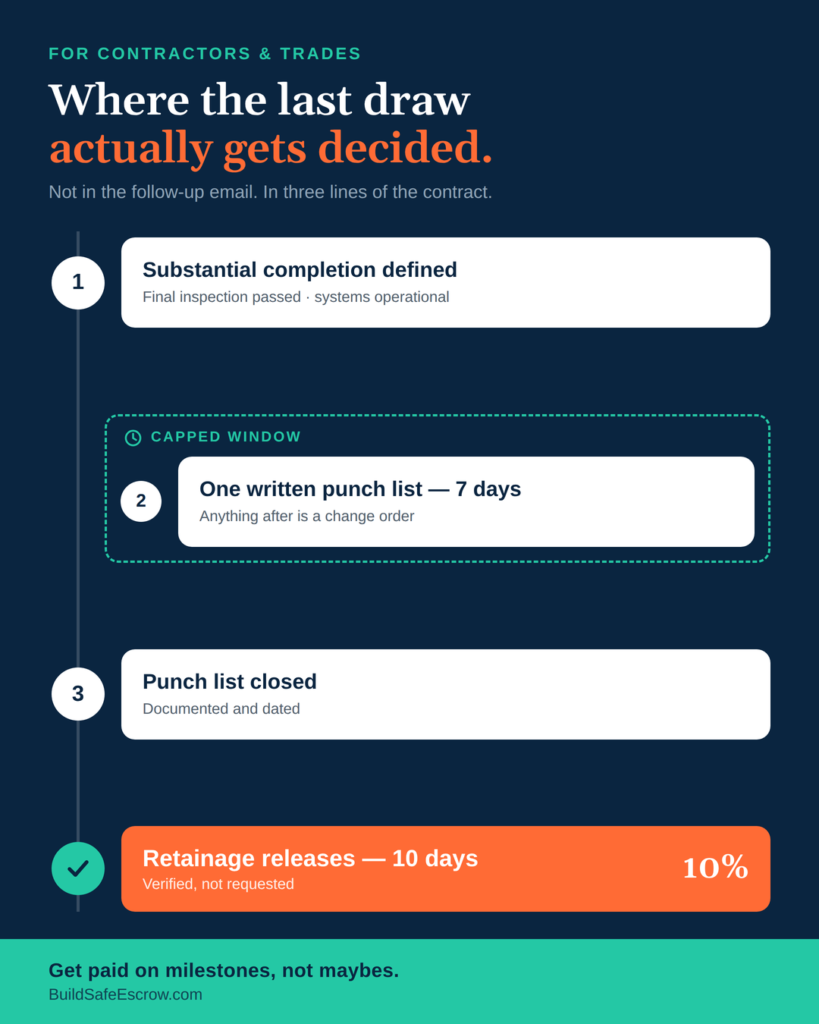
2. Cap the punch list in time and scope. The contract should say the owner has a set window — 5 to 10 days after substantial completion — to produce one written punch list, and that items outside that list are handled as change orders. This single clause protects contractor final payment more than any other sentence in your agreement.
3. Schedule retainage release explicitly. Name the amount, the trigger, and the deadline: “10 percent retainage releases within 10 days of punch list completion.” Vague retainage is the most common place a contractor final payment goes to sleep.
4. Do a documented walkthrough the day you finish. Walk the job with the owner. Photograph everything. Send a same-day written summary listing what was completed and what remains. If a dispute arises in week six, the contemporaneous record is the difference between a conversation and a fight.
5. Collect lien waivers from every sub and supplier as you go. Owners frequently hold the last draw because they are worried about a lien from someone downstream of you. Handing over a clean waiver package the day you finish removes their best reason to wait. A conditional waiver takes effect when payment clears; an unconditional waiver takes effect immediately.
6. Know your lien deadlines before you need them. Mechanics lien rights are the strongest collection tool you have, and they expire — often within 60 to 120 days of last furnishing labor or materials, with preliminary notice requirements that start much earlier. Deadlines vary by state and by role. Knowing yours is not pessimism; it is the reason a polite email works.
7. Invoice the last draw the day of substantial completion. Do not wait for the punch list to close. The invoice starts the clock on every term in your contract and on your statutory prompt-payment protections. A contractor final payment you have not formally invoiced is not late — it is simply not requested.
8. Make sure the money exists before you break ground. The strongest position is confirming the full budget is funded before mobilization. Then contractor final payment is not a request against the owner’s cash flow months from now. It is a release against money already committed.
Notice that seven of these are documentation. The eighth changes where the money physically sits — which is why it does the most work.
A short field example
Yusuf runs a six-person framing and finish crew. He took a $96,000 addition with a 10 percent retainage clause and a payment schedule ending “upon completion.”
The work went well. Substantial completion hit in late April. The homeowner produced a punch list — then another one nine days later, then a third that included a paint color she had approved in writing back in February.
Yusuf had $9,600 outstanding and a $14,000 payroll on Friday. He had no dated walkthrough record, no written definition of completion, and no waivers packaged from his two subs. Every conversation was his memory against hers.
He collected in early July, after a demand letter and a preliminary lien notice. Ten weeks late, on a job that finished on schedule.
On his next contract, Yusuf changed three lines: substantial completion defined as passed final inspection, one written punch list within seven days, retainage released within ten days of punch completion. He also asked the owner to fund the project through escrow — and framed it as protection for her, which is exactly what it is.
That job’s contractor final payment released four days after the punch list closed. He did not have to ask twice.
How escrow guarantees the last draw
Here is the part most contractors get wrong about escrow: they assume it is a tool that protects owners from contractors, and that it slows their money down.
Look at it from your side of the table.
A construction escrow account is a neutral, FDIC-insured third-party account holding the project funds before the work begins. Build Safe Escrow is not a lender, not a contractor, and not on anyone’s side. We hold the money and release it in stages as each agreed milestone is completed and verified.
Which means: your contractor final payment is already deposited before you swing the first hammer. It is not sitting in the homeowner’s checking account waiting on her mood, her bank, or her next bonus. It is committed, confirmed, and scheduled against a milestone you both defined in advance.
Your contractor final payment stops being a request and becomes a release. Nobody has to be persuaded. The milestone is verified and the funds move.
There is a second benefit that contractors discover after their first escrow job: it wins work. When you propose escrow to a nervous homeowner, you are handing her exactly the reassurance she has been looking for and did not know how to ask for. You become the professional in the room — the one who brought structure instead of a handshake.
That is the principle, and it runs both directions: money should never move ahead of the work. Trust is a feeling. Structure is protection.
Our escrow services page shows how a milestone schedule gets built for a specific job, and our construction escrow FAQs answer what contractors ask before their first escrow project.
FAQ
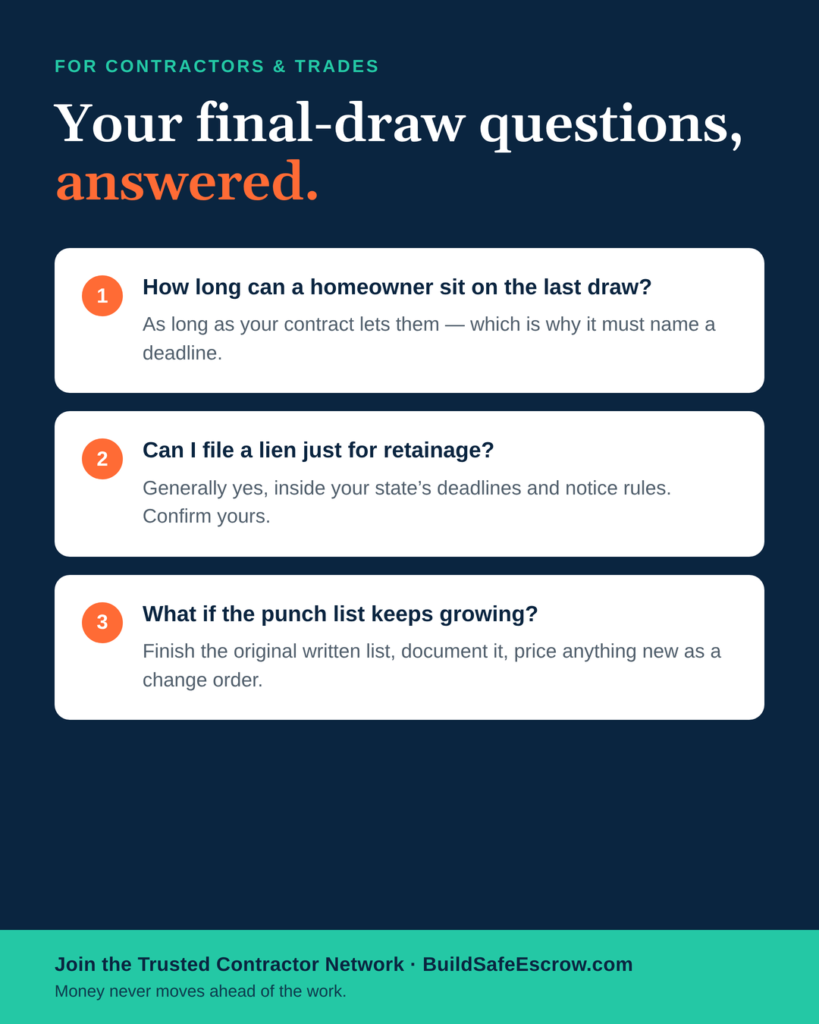
How long should a homeowner take to release contractor final payment? Whatever your contract says — which is why the contract has to say something specific. Absent a stated term, most states have prompt-payment statutes with default deadlines, but relying on a statute is far worse than naming a deadline yourself.
Can I file a lien just for retainage? Generally yes, if you are within your state’s deadlines and have met the preliminary notice requirements. Retainage is earned money that has not been paid. Deadlines and notice rules vary significantly by state, so confirm yours with a construction attorney before you rely on it.
What if the homeowner keeps adding punch list items? Complete the items on the original written list, document completion, and treat anything new as a change order with its own price and timeline. Without a capped list in your contract, this is difficult — which is the argument for putting one in your next contract.
Should I stop work over a late progress payment? Sometimes, and it depends heavily on your contract and your state’s rules. Improper suspension can put you in breach. Get advice before you demobilize — the wrong move here converts a collection problem into a legal one.
Does escrow mean I get paid more slowly? The opposite, in practice. The funds are already deposited, so release happens on verification rather than on the owner’s schedule. Most contractors find contractor final payment arrives faster on escrow jobs than on conventional ones.
Who pays the escrow fee? It is negotiable and often split. Compared with ten weeks of carrying a five-figure receivable, it is generally the cheapest line on the job.
This article is general information, not legal advice. Lien rights, notice requirements, retainage rules, and prompt-payment statutes vary by state and by project type — consult a construction attorney about your specific situation.
Get paid on milestones, not maybes
Contractor final payment should not be the hardest part of the job. It is only hard because of when the money shows up — and that is something you can change on your next contract.
Join the free Trusted Contractor Network. Build trust. Win more projects. Get paid on milestones, not maybes. → Join the Trusted Contractor Network
Get one short read each Friday on how construction money actually moves. → Subscribe to The Build Brief
References
- Associated General Contractors of America
- American Subcontractors Association
- Levelset — Construction Payment and Lien Resources
- FDIC — Deposit Insurance