
You showed up. You did the work clean and on time. Then the GC said the words every sub dreads: “The owner hasn’t paid me yet.”
Table of Contents
- Last in line, first to get stiffed
- Why subcontractors get paid last
- Six ways subcontractor payment protection actually works
- A short field example
- How escrow protects subcontractors at the source
- FAQ
- Get paid on milestones, not maybes
- References
Last in line, first to get stiffed
Subcontractor payment protection is the difference between doing the work and actually keeping the money you earned. If you are a specialty trade — electrical, plumbing, HVAC, tile, concrete, framing — you already know the pattern. You are last in line to get paid and first to get stiffed when the money runs short upstream.
You are not the problem, and you are not alone. The problem is that most construction payments still run on a handshake and a chain of trust you are at the bottom of. The handshake is a liability. This post gives you a better mechanism: subcontractor payment protection through escrow, which ties your money to verified work so a shortfall upstream stops being your emergency. Subcontractor payment protection puts the money in front of the work, where you can see it.
Let’s walk through why the check goes missing — and how structure fixes it.
Why subcontractors get paid last
The wait is not random. It is built into the payment chain. Name the breakdowns, and you can design around them.
Money flows top-down. The owner pays the GC. The GC pays you. If the money slows or stops at any point above you, your payment is the first to freeze — even when your work is done and approved.
“Pay-when-paid” clauses. Many subcontracts say the GC pays you only after the owner pays them. So the owner’s cash-flow problem becomes yours, contractually, through no fault of your own.
A dispute two levels up freezes your money. The owner and GC argue over something that has nothing to do with your scope. Payments stop across the board. You did nothing wrong and still don’t get paid.
Retainage sits on your profit. Retainage is the portion of each payment held back — often 5 to 10 percent — until the whole job is done. On a long project, your profit can be parked in someone else’s account for months.
Slow paper, slow pay. Lien waivers, invoices, and approvals bounce between inboxes. Every handoff adds days to a check you already earned.
The money genuinely runs out. Sometimes the funds were never fully committed. By the time it surfaces, you have already bought the materials and paid your crew.
Every one of these is a structure problem, not a character problem. Structure problems have structural fixes. That is exactly what subcontractor payment protection provides.
Six ways subcontractor payment protection actually works
Here is the practical core. Subcontractor payment protection through escrow gives you six concrete advantages, each one a reason to ask for it on your next job.
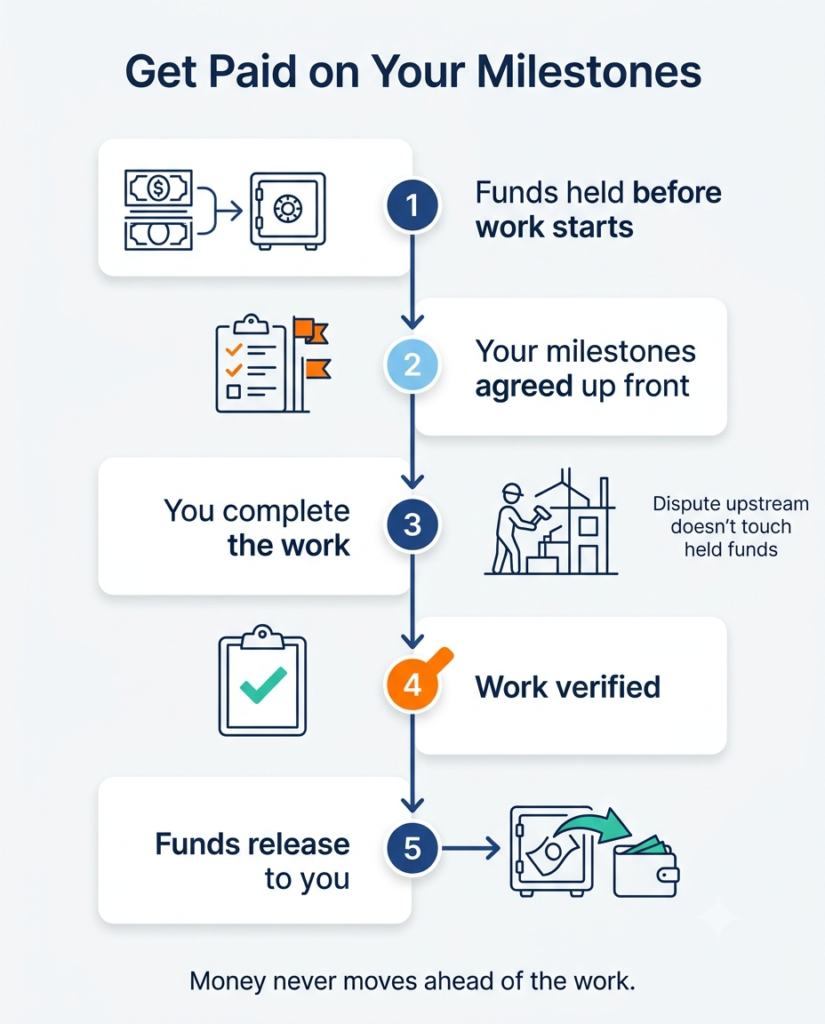
1. The money is funded before you start. The project funds are deposited into a secure, FDIC-insured account before work begins. The money exists and is committed. You are no longer betting your materials and payroll on whether the cash upstream is real.
2. Releases are tied to your verified milestones. You and the parties agree on milestones up front. When your milestone is completed and verified, funds release — on your work, not on someone else’s calendar. You get paid on milestones, not maybes.
3. A shortfall upstream stops being your problem. This is the heart of subcontractor payment protection. Because the funds for the job are already held in escrow, a dispute or cash crunch two levels above you does not drain the account your payment comes from. The money for verified work is already there.
4. Retainage is defined and held neutrally. Instead of vanishing into the GC’s account for months, retainage is documented, held by a neutral party, and scheduled for release on clear terms. Your profit stops being someone else’s float.
5. Fewer disputes, faster resolution. Because scope and milestones are documented up front, there is far less to argue about. When your work is verified, the money moves — it doesn’t get held hostage to an argument you’re not even part of.
6. Cleaner paperwork, built in. Waivers, approvals, and verification live in one process instead of scattered inboxes, so there are fewer delays between “done” and “deposited.” Our escrow services put that whole flow in one place.
Notice the pattern. Every advantage points the same direction: the money is confirmed early and moves on proof of your work. That is the whole idea.
A short field example
Subcontractor payment protection is easiest to see in one real situation. Consider an electrical sub — call her Priya. Solid crew, clean installs, a good reputation. She takes on a commercial job under a GC she has worked with before.
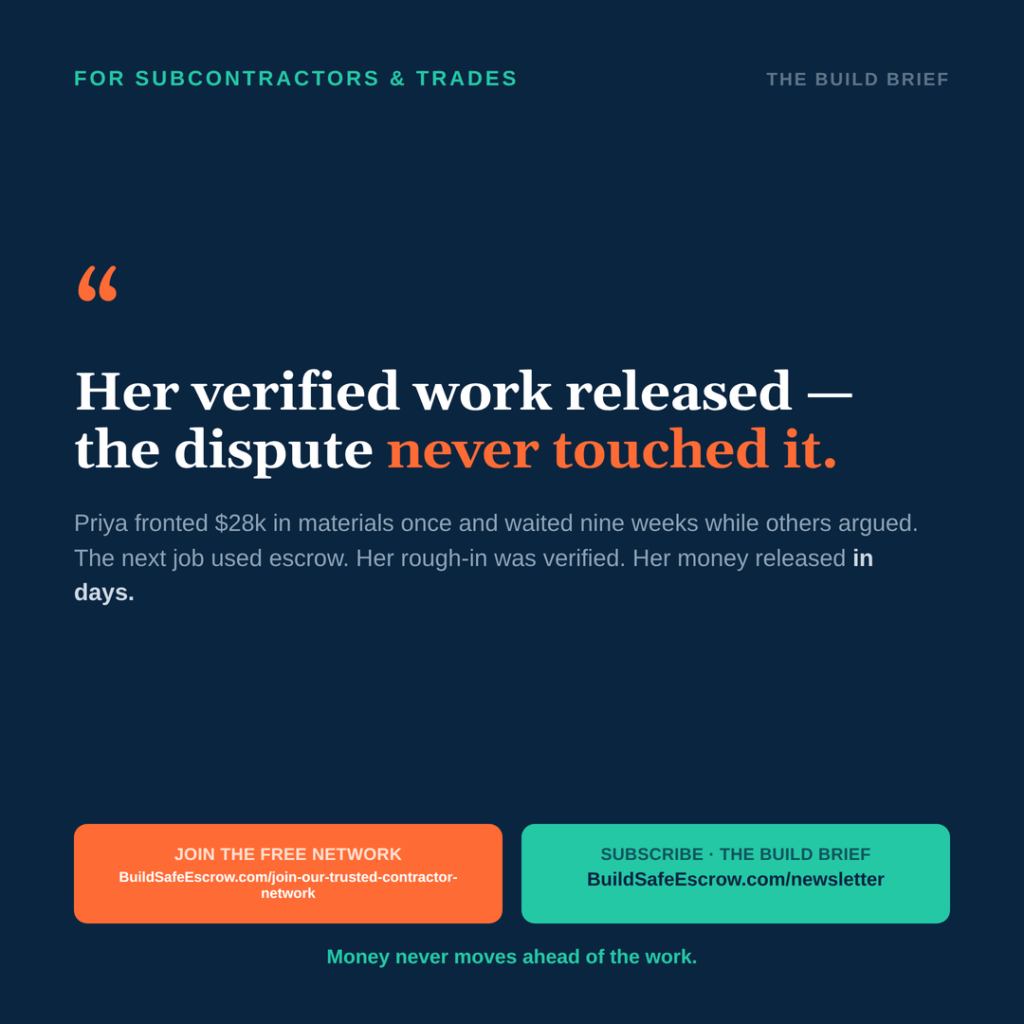
Priya used to run it the old way. Do the work, invoice the GC, and wait. On an earlier job, the owner and GC got into a dispute over a change order that had nothing to do with her scope. Payments froze across the whole project. Priya had already paid her crew and fronted $28,000 in materials. She carried it for nine weeks while two other parties argued. She got paid eventually. The interest and the stress she never got back.
This time, the job used escrow. The project funds were deposited into a secure, FDIC-insured account before work began, with milestones defined for each trade. Priya completed her rough-in, it was verified, and her funds released in days. When the owner and GC hit a disagreement later, it stayed contained to that item — Priya’s verified work had already released, because the money for it was held neutrally the whole time.
Priya financed nothing. She got paid on her milestones. That is subcontractor payment protection doing exactly what it should.
How escrow protects subcontractors at the source
Trust is a feeling. Structure is protection. The reason subs get stiffed is that money is allowed to move ahead of the work — or the work is allowed to move ahead of the money. Real subcontractor payment protection reverses that.
Escrow fixes both by fixing the sequence. Money should never move ahead of the work — and you should never move ahead of the money. With escrow, the funds are deposited and verified before you start. From your side, the protection is simple: the money is already there, held by a neutral party, released the moment your milestone is verified.
You stop being the bank for a chain of parties above you. You stop absorbing an owner’s or GC’s cash-flow problems as your own risk. The account holds the money, a neutral third party verifies the work, and the funds release to you. That is the entire mechanism, and it runs in your favor.
Want the mechanics in detail? Our construction escrow FAQs break down verification, milestones, and release timing step by step.
FAQ
Does escrow slow down my payments? No — it usually speeds them up. Subcontractor payment protection deposits the money before work starts. Once your milestone is verified, funds release in days. You are no longer waiting on a check to travel down the chain.
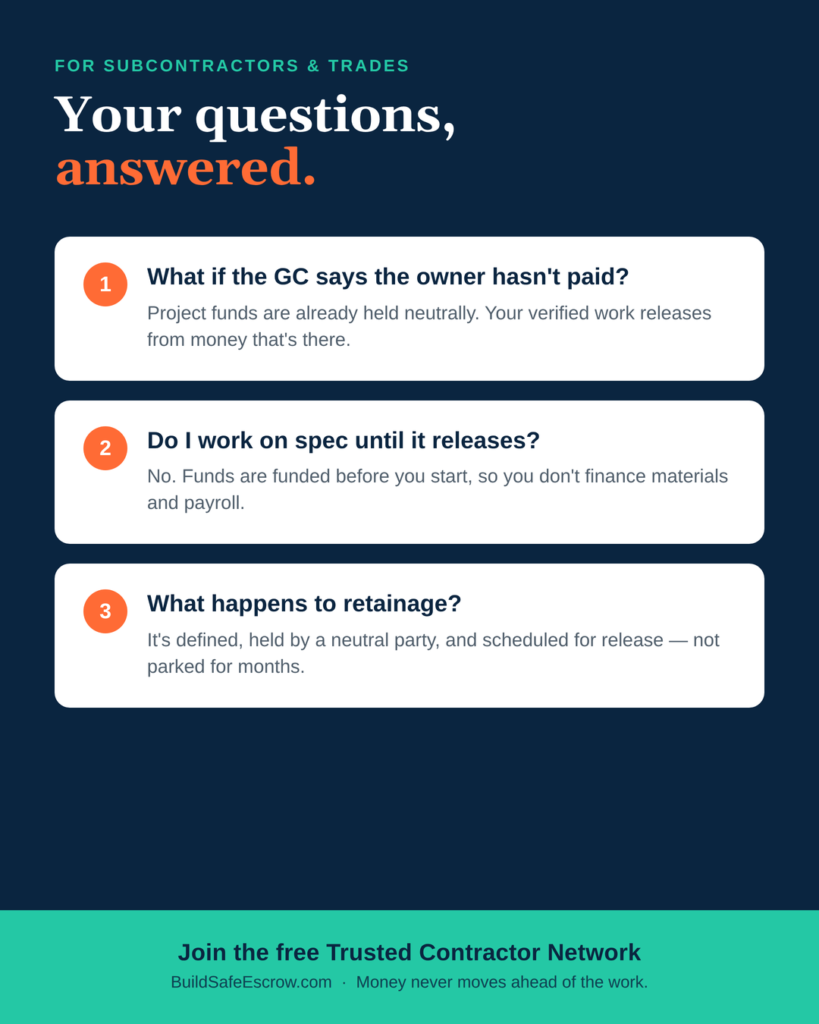
What if the GC says the owner hasn’t paid? With escrow, the project funds are already held in a neutral account. Your verified work releases from money that is already there — a shortfall upstream doesn’t drain it.
Do I still have to work on spec until it releases? No. The funds are confirmed and held before you start, so you are not financing materials and payroll on your own credit while you wait.
What happens to retainage? It is defined, held by a neutral third party, and scheduled for release on clear terms — not parked indefinitely in someone else’s account.
Is my money actually safe in escrow? Funds are held in a secure, FDIC-insured account by a neutral third party. Released only on verified milestones.
How do I get owners and GCs to use escrow? Propose it as protection for everyone — the owner knows funds release only on verified work, and you know you’ll be paid. Joining the Trusted Contractor Network signals you work this way.
This article is information and structure, not legal or financial advice. Talk to your own attorney or accountant about your specific contracts and lien rights.
Get paid on milestones, not maybes
If you are last in the payment chain, one change moves you to the front: tie your money to verified work held by a neutral party. That is what subcontractor payment protection does.
Get one short read each Friday on how construction money actually moves — subscribe to The Build Brief.
Specialty trades and subcontractors: stop working on spec. Join the free Trusted Contractor Network. Build trust. Win more projects. Get paid on milestones, not maybes.
References
- Levelset / Procore — Construction payment & mechanics lien resources: https://www.levelset.com/
- American Subcontractors Association (ASA): https://www.asaonline.com/
- U.S. Small Business Administration — managing business cash flow: https://www.sba.gov/
- FDIC — Deposit Insurance: https://www.fdic.gov/resources/deposit-insurance/