
Table of Contents
- Why big projects strain the trust between owners and managers
- What is a capital improvement in property management?
- How should property managers pay contractors for capital improvements?
- Seven fixes that make every capital project defensible
- Field example: a $186,000 roof and HVAC replacement
- How capital improvement escrow removes the problem at the source
- FAQ
- Start your next project on structure
- References
The roofer wants 40% up front, the owners want proof, and you sit in the middle wondering whether capital improvement escrow is worth the setup. If you are one of the property managers running a roof, an HVAC changeout or a parking lot overlay with someone else’s money, you know the feeling. Every dollar you release is a dollar you will have to explain later.
That pressure is the job. You steward capital that is not yours. When an owner asks “where did the money go?”, the answer has to be a document, not a memory.
Why big projects strain the trust between owners and managers
Routine work runs on autopilot. A plumber fixes a leak, sends an invoice, and you pay it from the operating account. Nobody calls a meeting.
Capital projects break that rhythm. The checks are larger, the timelines are longer, and more people touch the money. A few root causes show up again and again:
- Large deposits. Contractors often ask for a big payment before mobilizing. If they stall or fail, that money is hard to recover.
- Approval gaps. The management agreement may let you spend up to a threshold without asking. Capital work blows past it, and the paper trail for owner sign-off gets thin.
- Commingling risk. Moving reserve dollars through the wrong account, even briefly, blurs the line between owner funds and company funds.
- Vendor overbilling. Without a fixed schedule of values (a line-by-line breakdown of what each part of the job costs), invoices can drift upward.
- Change orders without owner sign-off. A crew finds rot, a supervisor says “go ahead,” and the owners learn about it on the next statement.
- Contractor failure mid-project. A sub walks off. The general contractor runs short of cash. Work stops with your owners’ money already spent.
None of this requires bad intent. It happens because money moves faster than verification, and that gap is what capital improvement escrow is built to close.
What is a capital improvement in property management?
A capital improvement is work that makes a property better, restores a major component, or adapts it to a new use, as opposed to routine repairs that keep it running as is.
Think of a full roof replacement, a new boiler, a repaved lot or a building envelope upgrade. Repairs are the patch, the service call, the replaced filter.
The IRS draws a similar line for tax purposes. Its tangible property regulations say a unit of property is improved only if the amounts paid are for a betterment, restoration or adaptation. Restoration includes the “replacement of a major component or substantial structural part.” If the work is not an improvement, the IRS says the amounts “generally are deductible as repairs and maintenance.”
Tax treatment depends on the facts and on each owner’s situation. Have the owners’ accountant classify each project. Your role is to make sure the money and the records are clean enough for that accountant to do the job.
Capital work is usually funded from owner reserves or a capex budget (capital expenditure budget) that owners approve annually. Either way, the money belongs to the owners, and every release needs a reason they can see. A capital improvement escrow puts that reason in writing.
How should property managers pay contractors for capital improvements?
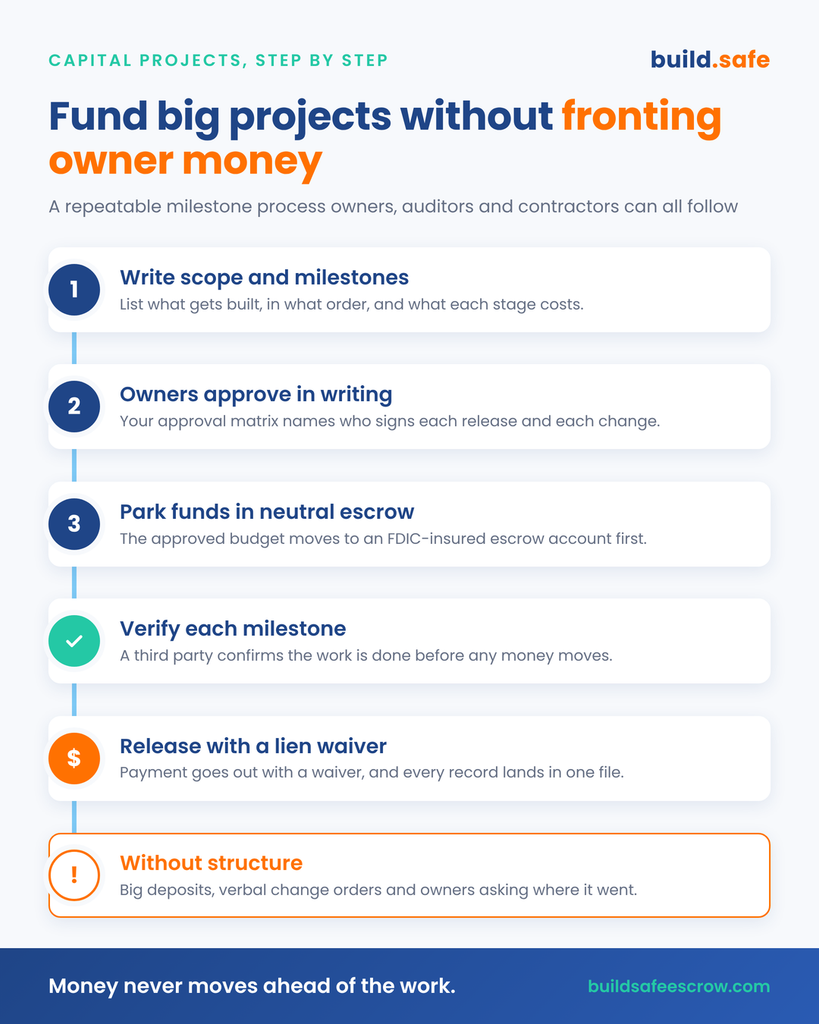
Property managers should pay contractors for capital improvements in verified milestones, from funds parked in a neutral account before work starts, with owner approval and a lien waiver tied to every release.
That one sentence is capital improvement escrow in practice. Funds are confirmed first, so the contractor knows the money exists. Releases follow proof, so the owners know the work exists. Paperwork follows each payment, so the auditor can trace it.
Compare that with the common alternative: a large deposit, then progress invoices paid on trust. The deposit leaves before anything is built, and each invoice is a judgment call. If the project goes sideways, you are the one holding the explanation.
The IREM Code of Professional Ethics frames the duty in clear terms. Members “shall at all times serve as a fiduciary for the client” and “shall not commingle personal or company funds with the funds of a client.” The same code calls for “accurate, auditable financial and business records.” A milestone structure makes that standard easier to meet on a six figure project.
Trust between you and a good contractor is a feeling. Structure is protection. Capital improvement escrow is how you turn one into the other.
Seven fixes that make every capital project defensible
You do not need a new software stack. You need a repeatable process you can run on every project, whether it costs $40,000 or $400,000.
- Write the scope and the milestone schedule first. Before anyone signs, list what will be built, in what order, and what each stage costs. Tie each payment to a visible result: materials delivered, tear-off complete, equipment set, final inspection passed.
- Build an owner approval matrix. Decide who approves what, in writing. For example: the asset manager approves each milestone release, and two owners must sign any change above an agreed amount. Put it in the project file before work starts.
- Park the funds in a neutral account before mobilization. Move the approved project budget out of reserves into a dedicated, FDIC-insured escrow account held by a third party. Your operating account never touches it. This is the heart of capital improvement escrow: owner money stays separate and visible.
- Verify before every release. Someone other than the contractor confirms each milestone is done. Photos, a site walk, an inspector’s sign-off. No verification, no release.
- Collect a lien waiver with each payment. A lien waiver is a document in which a contractor or supplier gives up the right to file a mechanics lien (a legal claim against the property for unpaid work) for the amount paid. A conditional waiver takes effect when payment is actually received. Collect waivers from subs and major suppliers too, not only the general contractor. Rules vary by location, so confirm forms with your attorney.
- Treat change orders as new approved milestones. When scope changes, price it, add it to the schedule as its own milestone, get owner sign-off under your matrix, and fund it before the crew starts. No verbal go-aheads.
- Keep one documentation trail. Contract, schedule, approvals, verification reports, payment confirmations and lien waivers, all in one place per project. When an owner or auditor asks, you send a folder, not a reconstructed story.
Capital improvement escrow also protects contractors. A roofer who sees funds confirmed in escrow before mobilizing knows the money is real. That certainty is worth more to many contractors than a big deposit.
Field example: a $186,000 roof and HVAC replacement
Illustrative example. Names and figures are fictional.
Priya Nandakumar manages a mid-size multifamily property for a group of four owners. The roof is at the end of its life, and three rooftop HVAC units are failing. The owners approve a $186,000 project from reserves.
The roofer asks for a 35% deposit. Priya proposes capital improvement escrow instead. The full $186,000 goes into a neutral account before anyone climbs a ladder, and the contractor gets written confirmation that the money is there.
The milestone schedule looks like this:
| Milestone | Release |
|---|---|
| Roofing materials delivered and verified | $46,500 |
| Tear-off and new roof installed | $55,800 |
| HVAC equipment delivered and set | $37,200 |
| HVAC installed, started and tested | $37,200 |
| Final inspection and punch list closed | $9,300 |
During tear-off, the crew finds rotted decking. The contractor prices the fix at $7,400. Priya writes it up as a new milestone, two owners sign under the approval matrix, and the owners add the funds to the capital improvement escrow before the decking work begins.
Each release follows a site verification and a conditional lien waiver. At year end, the owners’ accountant gets one file with every approval, photo, payment and waiver. Nobody asks where the money went, because the answer is already on the page.
How capital improvement escrow removes the problem at the source
Every risk in this article comes from the same gap: money leaving before the work is proven. Close that gap and most of the risks shrink.
Large deposits go away, because funds are confirmed rather than handed over. Commingling stops being a worry, because owner money sits in its own insured account. Approval gaps close, because nothing releases without the sign-off your matrix requires. Overbilling has nowhere to hide when payments match a fixed schedule. Change orders become new milestones with their own approvals. And if a contractor fails mid-project, the unspent balance is still sitting in escrow, not in their bank account.
With capital improvement escrow, money never moves ahead of the work.
Capital improvement escrow works because the holder is neutral. A third party holds the funds and releases them only when the agreed milestone is verified. That protects your owners from paying for work that never happens. It also protects the contractor from finishing work and then waiting on a payment that was never set aside. Neither side has to rely on the other’s good intentions.
FDIC deposit insurance adds another layer. According to the FDIC, “The standard insurance amount is $250,000 per depositor, per insured bank, for each account ownership category.” Ask any escrow provider how coverage applies to your project’s structure.
If you manage several properties, our guide to construction escrow for property managers covers how to roll this out across a portfolio. You can also see how our milestone-based escrow services work step by step.
FAQ
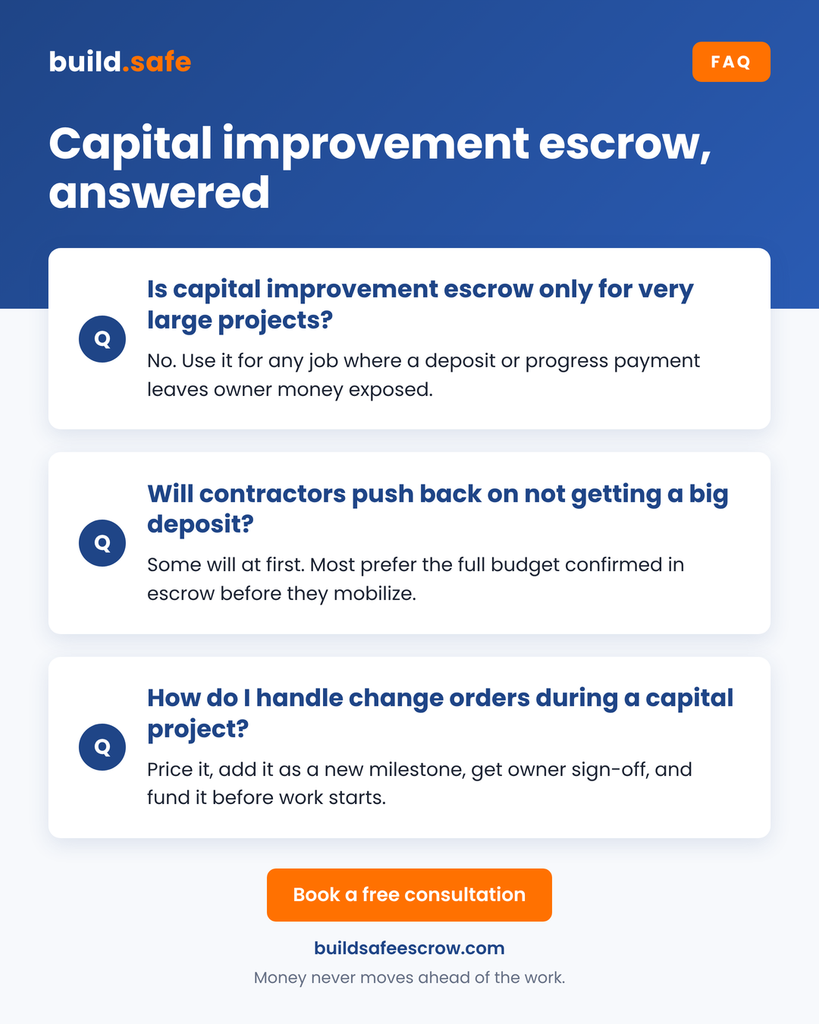
Is capital improvement escrow only for very large projects?
No. It fits any project where a deposit or progress payments would leave owner money exposed. Many managers set a threshold, such as any job above their spending authority, and use escrow from that point up.
Does escrow replace my management agreement or approval process?
No. Escrow enforces the approvals you already have. Your management agreement and owner approval matrix still decide who signs. The escrow holds funds until those signatures and the milestone verification are in place.
Will contractors push back on not getting a big deposit?
Some will at first. Most come around once they see the full budget confirmed in a capital improvement escrow before they mobilize. For a contractor, verified funds are often better than a deposit that covers only part of the job.
How do I handle change orders during a capital project?
Price the change, add it as a new milestone, get owner approval under your matrix, and fund it in the capital improvement escrow before the work starts. That keeps the paper trail unbroken.
Who decides whether a project is a capital improvement for taxes?
The owners’ accountant. The IRS guidance on improvements versus repairs depends on the facts of each project. Your job is to keep clean records so that decision is easy to support.
For more answers, see our construction escrow FAQs.
Start your next project on structure
Get one short read each Friday on how construction money actually moves. Subscribe to The Build Brief.
Planning a roof, HVAC or envelope project for your owners? Build Safe Escrow can walk you through a milestone schedule and a capital improvement escrow setup for your next project. Schedule a free consultation.
References
- IRS: Tangible property final regulations
- IREM: Code of Professional Ethics
- FDIC: Deposit Insurance At A Glance
- Levelset: Conditional vs. Unconditional Lien Waivers