
Table of Contents
- Why construction escrow fees feel hard to pin down
- How much does construction escrow cost?
- What construction escrow fees actually pay for
- Seven questions that turn a fee schedule into a clear number
- Red flags in a fee schedule worth pausing on
- Compare the fee to the cost of paying ahead of the work
- Field example: one homeowner, one written fee schedule
- How escrow keeps money from moving ahead of the work
- FAQ
- Put a written fee schedule behind your next project
- References
You searched for construction escrow fees because a contractor wants a deposit and your stomach dropped a little. If you are a homeowner planning a renovation, that feeling is normal. You want protection, but you also want to know what it costs.
This guide covers how the fees are usually structured, what they buy, and which questions to ask before you sign.
Why construction escrow fees feel hard to pin down
Most homeowners hire a contractor a few times in their life, if that. You have no baseline. When you look up escrow (a neutral third party holding funds until agreed conditions are met), you find plenty about the concept and very little about price.
A few reasons explain the gap.
- Every project is shaped differently. A bathroom remodel with three payments and an addition with twelve are different jobs to administer.
- Verification needs vary. Some agreements release funds on a signed approval. Others ask for photos, an inspection report, or lien waivers first.
- Providers price in different ways. Some charge flat fees, some a percentage, and many combine the two.
So construction escrow fees rarely fit on a sticker. Nobody is hiding anything. You need a written quote built around your project.
How much does construction escrow cost?
Construction escrow fees are usually a flat setup fee, per-draw (disbursement) fees, a percentage of funds held, or a mix, set by project size, number of draws and verification needs, so get a written fee schedule before you sign.
Build Safe Escrow does not publish a price list, and this article will not guess at one. The company’s FAQ is direct: “Yes, there are fees for using escrow services.” It adds, “We provide a transparent fee structure, and we’ll discuss the costs with you before setting up the account.”
A fair quote should reflect three things:
- Project size. The total amount held in escrow.
- Number of draws. A draw is one scheduled release of money to the contractor. More draws mean more requests to review.
- Verification steps. Each release is tied to whatever proof the parties agree on in the Escrow Agreement.
For contractors, the FAQ describes “flat fees or percentage-based rates depending on the size and complexity of the project.” The same logic applies on the owner side.
What construction escrow fees actually pay for
A fee is easier to judge once you see the work behind it. With construction escrow fees, you are paying for a structure that sits between your money and the job site.
- A neutral holder. Build Safe Escrow is not a lender and not a contractor. It is the referee, not a player, and it protects both parties at once.
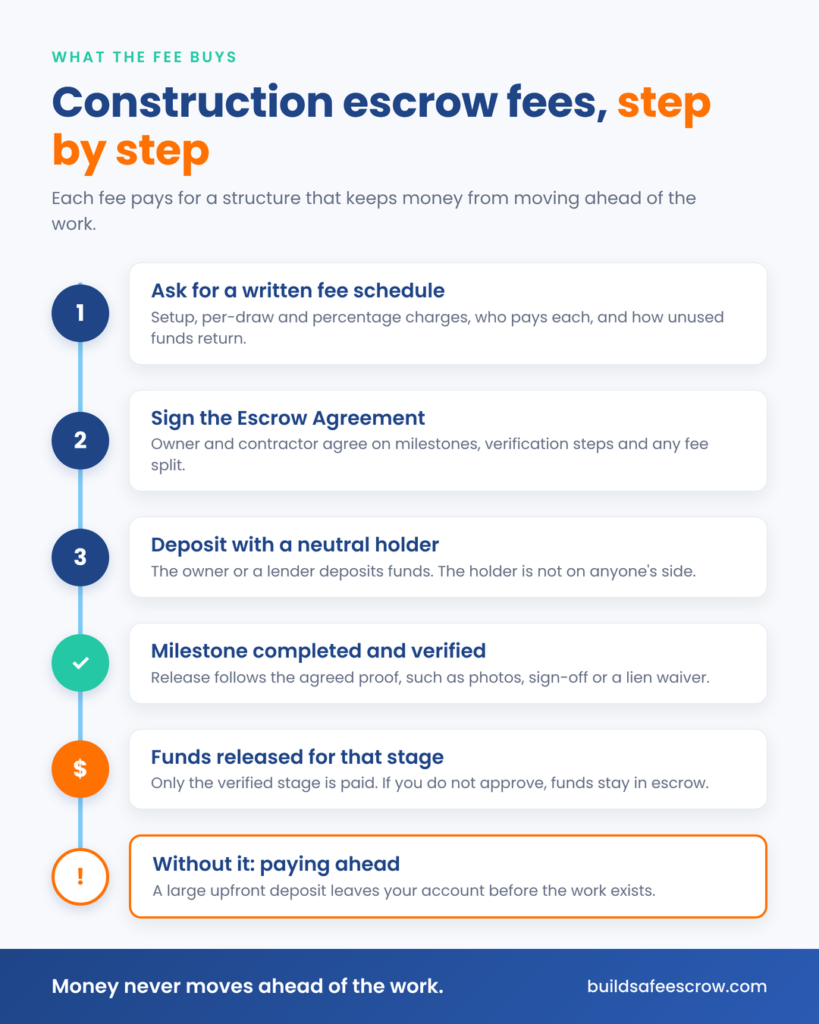
- Staged releases. Funds go out in stages, only as each agreed milestone is completed and verified, per the Escrow Agreement.
- A paper trail. Every request, approval and release is documented.
- A dispute path. If you do not approve a payment request, the funds stay in escrow. The Escrow Agreement sets up a dispute-resolution process that aims to avoid litigation, and either party can bring in a third-party mediator.
Nobody on that list is choosing sides. Your contractor gets a clear rule for getting paid, and you get a clear rule for when money leaves.
Seven questions that turn a fee schedule into a clear number
A fee schedule is the written list of every charge, when it applies, and who pays it. Ask for one, then work through these.
- Who pays? The owner, the contractor, or both. Many projects use a 50/50 fee split, or a split that matches who benefits most.
- Is there a setup fee? Find out whether a one-time setup charge covers opening the account and drafting the Escrow Agreement.
- What does each draw cost? Multiply any per-draw fee by your planned number of draws. Fewer milestones may cost less, though each release gets bigger.
- Is any charge a percentage? Ask what the percentage applies to: the total deposit, the amount released, or the balance held.
- How are change orders handled? A change order is a written change to scope or price. Ask whether adding funds or editing milestones triggers a new fee.
- What happens to unused funds? Ask how the account closes, how leftover funds are refunded, and whether there is a closing charge.
- Does the account earn interest? Ask who receives any interest and how it is reported.
If you split fees with your contractor, write the split into your construction contract too. Tax and legal treatment can vary, and rules vary by state, so confirm the details with your attorney or accountant.
Red flags in a fee schedule worth pausing on
Most providers are clear about construction escrow fees. A few patterns still deserve a second look.
- No written schedule. If fees are only described on a call, ask for them on paper.
- Vague “administrative” charges with no trigger or amount.
- Fees that appear only at the end, such as a closing charge you never saw up front.
- Unclear dispute costs. Know in advance whether pausing a draw or bringing in a mediator adds cost, and who bears it.
- A holder tied to one party. The holder should be neutral, so ask how conflicts are handled.
None of these rules anyone out. They are prompts for better questions, and a good provider answers them easily.
Compare the fee to the cost of paying ahead of the work
The useful comparison puts the fee next to a different cost: the risk of money leaving your account before the work exists.
The Federal Trade Commission is plain about it: “Don’t pay the full amount for the project up front.” It warns that scammers “ask you to pay for everything up front or only accept cash.” It also says to “never make the final payment until the work is done and you’re satisfied with it” (FTC, How To Avoid a Home Improvement Scam, updated 2025). The FTC also notes that some states limit down payments. Those limits differ, so check with your attorney.
Staged payment is a familiar idea. The Consumer Financial Protection Bureau says construction loan money “is typically provided in a series of advances as the construction progresses” (CFPB, What is a construction loan?, reviewed 2024). Escrow gives a cash-paying homeowner a similar rhythm.
Build Safe Escrow is also an FDIC-insured construction escrow service. The FDIC states that deposit insurance “covers $250,000 per depositor, per FDIC-insured bank, for each account ownership category” (FDIC, Understanding Deposit Insurance, updated 2024). That insurance protects insured deposits if a bank fails. It does not settle a disagreement about the work, which is the job of the Escrow Agreement.
Field example: one homeowner, one written fee schedule
Renee Calloway is a fictional homeowner planning a $92,000 kitchen and bath renovation. Her contractor asked for half, $46,000, before demolition. She liked the contractor. She did not like $46,000 leaving her account before a cabinet came off the wall.
She requested a written fee schedule and sat down with her contractor and the seven questions above.
- They agreed to split construction escrow fees evenly and wrote it into the contract.
- They set five milestones instead of eight, which kept per-draw charges down.
- Each release required photos and Renee’s sign-off, plus a lien waiver before the final draw.
- They confirmed in writing how unused funds would be refunded if the scope shrank.
Renee deposited the full $92,000 into escrow. The contractor could see the money was there, which made scheduling crews easier. Renee could see it would move only when the work did.
How escrow keeps money from moving ahead of the work
Trust is a feeling. Structure is protection. Escrow turns the feeling into the structure, and construction escrow fees are what keep that structure running.
Each piece ties back to one rule: money never moves ahead of the work.
- The setup fee builds the Escrow Agreement that defines each milestone.
- The per-draw fee pays for a release that happens only after verification.
- The dispute path keeps a paused draw safely in escrow.
- The written schedule tells you your cost before you commit.
Seen that way, construction escrow fees are the price of a clear rulebook you and your contractor both follow. To see the process from deposit to final release, read about our escrow services. If a contractor is pushing for a large deposit now, read what to do when a contractor asks for money upfront.
FAQ
Are construction escrow fees paid by the homeowner or the contractor?
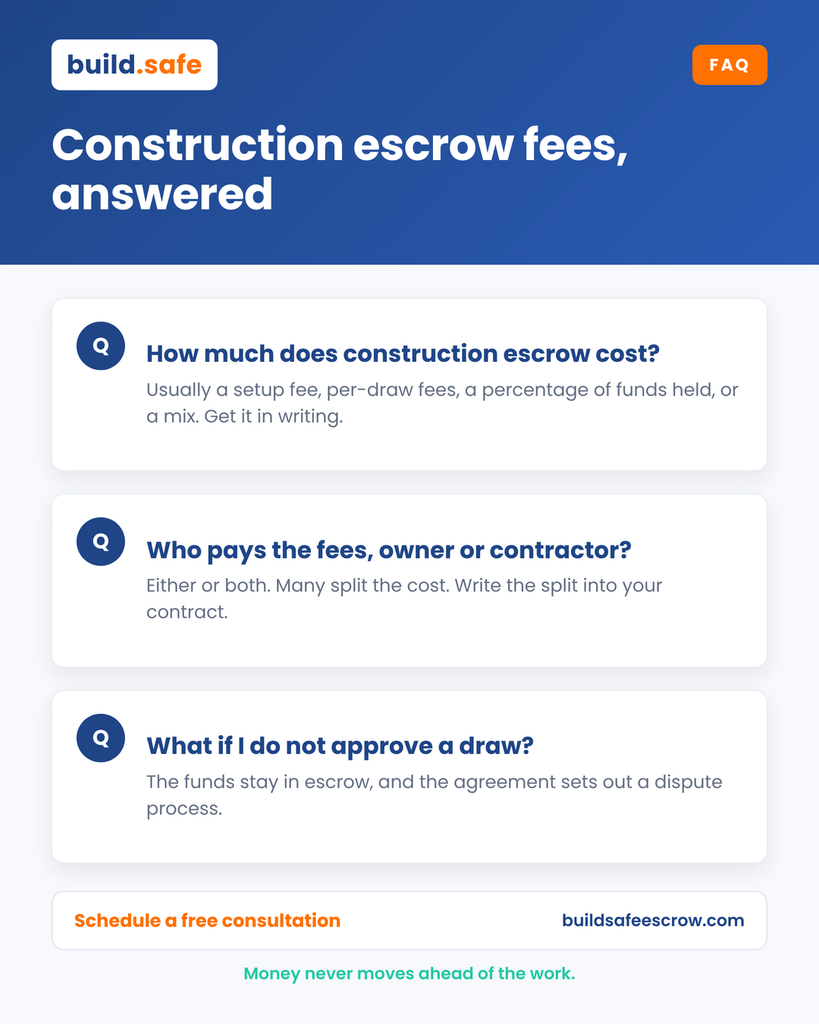
Either, or both. Many owners and contractors split the cost. Write the arrangement into your contract and the Escrow Agreement.
Do construction escrow fees depend on the size of the project?
Usually, yes. Project size, number of draws and verification needs all shape the total. Ask for a written quote built on your scope.
What happens to my money if I do not approve a draw?
The funds stay in escrow. The Escrow Agreement sets up a dispute-resolution process, and either party can bring in a third-party mediator.
Can I get unused funds back at the end?
Ask before you sign. A clear fee schedule explains how the account closes and how leftover funds return to the depositor.
For more answers, browse our construction escrow FAQs. This article is general information, not legal or financial advice. Consult your own attorney or accountant.
Put a written fee schedule behind your next project
You do not have to guess at cost or hand over a large deposit on faith.
- Talk it through: schedule a free consultation and get your questions about construction escrow fees answered before you commit.
- Keep learning: get one short read each Friday on how construction money actually moves. Subscribe to The Build Brief.
References
- Federal Trade Commission, Consumer Advice. “How To Avoid a Home Improvement Scam.” Page updated December 2025. https://consumer.ftc.gov/articles/0242-hiring-contractor
- Consumer Financial Protection Bureau. “What is a construction loan?” Last reviewed September 2024. https://www.consumerfinance.gov/ask-cfpb/what-is-a-construction-loan-en-108/
- Federal Deposit Insurance Corporation. “Understanding Deposit Insurance.” Updated April 2024. https://www.fdic.gov/resources/deposit-insurance/understanding-deposit-insurance