
Table of Contents
- Why cash jobs leave you guessing about the money
- How can a builder make sure they get paid during a cash home build?
- What is the risk for the builder if the client is paying cash without a bank?
- Seven ways to turn proof of funds for construction into real payment protection
- Field example: a cash custom home in Boise
- How escrow makes proof of funds for construction stick
- FAQ
- Get paid on milestones, not maybes
- References
Asking for proof of funds for construction feels awkward the first time, so most builders skip it until a draw is already late. If you are a residential custom builder or remodeler, you know the scene: the work is done, the inspection passed, and your client has stopped answering texts. You did your part. Now you are chasing the check.
Why cash jobs leave you guessing about the money
On a bank-financed job, a lender has already done the hard part. Someone underwrote the borrower, approved a loan amount, and set up a draw schedule. The money exists before you pour a footing.
A cash client skips all of that. Nobody outside the household has checked the budget. The client may be solid, yet you are now the only person verifying the money, and you are not a bank.
The U.S. Census Bureau reports that 131,000 contractor-built single-family homes were started in 2025. The Census defines a contractor-built house as one built for owner occupancy on the owner’s land under a single general contractor. That is your world. When that owner pays cash, no lender stands in the middle.
Three things tend to go wrong:
- The budget was a hope, not a number.
- The money was real on day one, then moved to cover something else entirely.
- A dispute over one item becomes a reason to hold every payment.
None of these needs a bad actor. Good intentions, a loose structure and enough time will do it.
How can a builder make sure they get paid during a cash home build?
Confirm the funds before you start, tie every payment to a verified milestone, and keep the money committed with a neutral party until each stage is done.
Each part covers a gap the other two leave open. Proof of funds for construction tells you the money exists. A milestone schedule tells everyone when it moves. A neutral holding arrangement makes sure it is still there when the milestone arrives.
Most builders stop at the first part. They glance at a bank statement, feel better, and sign. The statement answers “does this person have money?” It does not answer “will this money still be here in month five?”
What is the risk for the builder if the client is paying cash without a bank?
The main risk is that the money you saw at signing is gone when your invoice arrives, after you have already fronted labor and materials.
Subs want their draws, suppliers want their invoices paid, and your crew wants Friday’s payroll. If the client’s account dips, you become the lender nobody approved.
A bank statement is a snapshot, not a commitment. It shows a balance on one date. Nothing stops the client from moving that money the next morning for a business deal, a family need or a second project, often with no harm intended.
Disputes are the other half of the risk. With no lender inspecting progress, the only judges of “done” are you and the owner. When you disagree, payment stalls.
Seven ways to turn proof of funds for construction into real payment protection
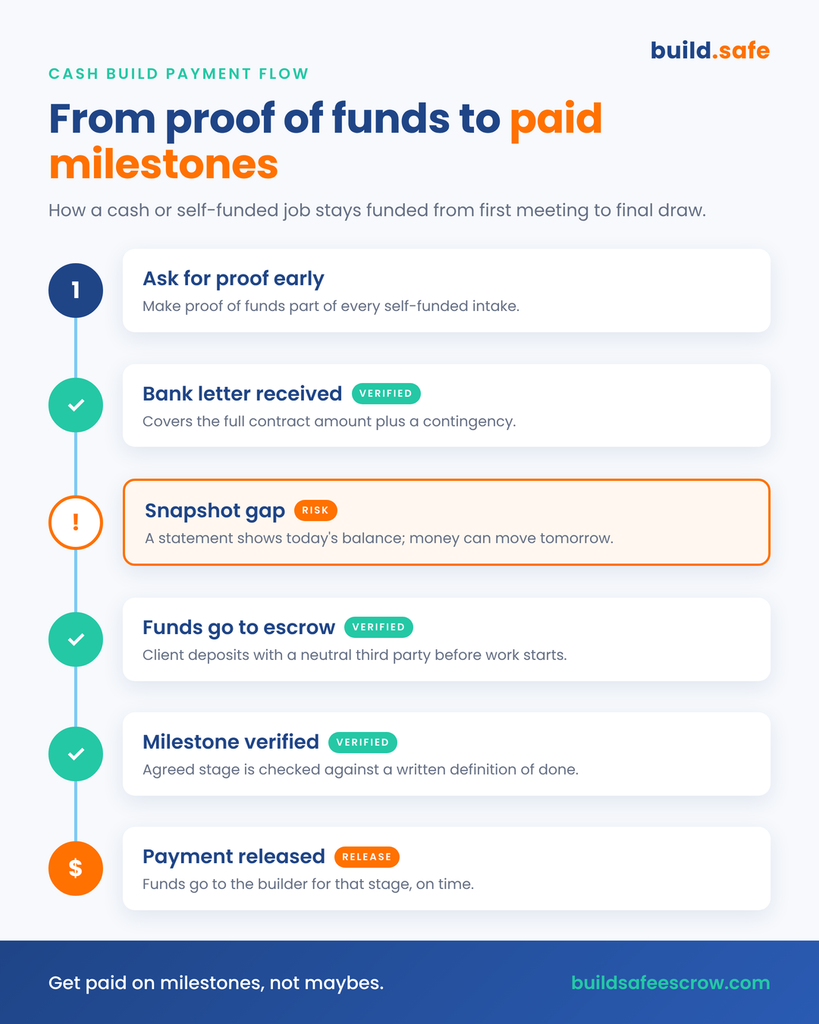
Pick what fits, and confirm legal details with your own attorney.
1. Ask early, and make it routine
Put proof of funds for construction on your standard intake checklist, right next to the survey and the plans. When it is part of your process, nobody takes it personally. Try: “On every self-funded build, we confirm funding before scheduling. It protects your timeline as much as mine.”
Ask before you price the job in detail. You will save hours on estimates for projects that were never funded.
2. Know the difference between a statement and a letter
A bank statement shows a past balance. A proof of funds letter is a signed letter from the client’s bank confirming that funds are available, usually dated and on letterhead. The letter carries more weight because the bank is speaking, not the client.
Neither one locks the money in place. Treat any proof of funds for construction as a moment in time, then build your protection around that gap.
3. Match proof of funds for construction to the full contract value
A balance that covers the deposit is not enough. Ask for proof that covers the full contract amount plus a contingency. Change orders on custom homes add up.
4. Build a milestone payment schedule
A milestone payment schedule ties each payment to a defined stage: foundation, framing, dry-in, rough-ins, drywall, finishes. Each stage gets a written description of “complete” that you both sign.
Keep each payment close to the value of that stage. You are never far ahead of your money, and the owner is never far ahead of the work.
5. Understand your mechanics lien rights and deadlines
A mechanics lien is a legal claim against the property for unpaid work or materials. It can be a strong backstop, but only if you follow your state’s rules exactly. Many states require a preliminary notice (an early written notice to the owner) and set firm deadlines to record a lien.
California is one example. Its Contractors State License Board explains that a subcontractor or supplier can give preliminary notice up to 20 days after starting work, and that a lien generally must be recorded within 90 days of completion, with shorter windows in some cases. Other states use different forms and timelines. Check your state’s statute with a construction attorney before you rely on any deadline. Our post on how to avoid a mechanics lien shows how liens look from the owner’s side.
A lien is a last resort: slow, costly, and hard on relationships. Solid proof of funds for construction plus a clear schedule should keep you far from one.
6. Use conditional lien waivers at each draw
A lien waiver is a document giving up lien rights for a payment. A conditional waiver takes effect only once the payment clears. An unconditional waiver takes effect when signed, paid or not.
Hand over conditional waivers when you request a draw. Swap in unconditional ones after the funds land. The owner gets proof the job is clean, and you never sign away rights for money you have not received.
7. Ask for a funded escrow account
Funded escrow means the client deposits the construction money with a neutral third party before work starts. Funds go out to you stage by stage as each milestone is completed and verified.
This closes the snapshot gap. Once deposited, the money is set aside for the project and cannot drift to something else. For the broader playbook on cash clients, see how to protect yourself when a client pays cash for construction.
Field example: a cash custom home in Boise
The following is a fictional scenario for illustration.
Marcus Hale runs a four-person custom building company in Boise, Idaho. A retired couple wants a $640,000 home on a lot they already own, paid in cash from the sale of their previous home.
Marcus asks for proof of funds for construction at the first meeting, as he does with every self-funded client. The couple sends a bank letter covering the full amount plus a cushion.
Then Marcus proposes a funded escrow account with seven milestones. The couple hesitates, then agrees once they see their own side of it: no payment leaves the account until a stage is verified.
In month four, their adult son asks to borrow money for a down payment. Without escrow, that request might have pulled $80,000 out of the build budget. With escrow, the construction funds are already committed. The loan comes from somewhere else, and Marcus’s drywall draw arrives on time.
How escrow makes proof of funds for construction stick
Every fix above circles one problem. Proof of funds for construction shows the money existed. Escrow keeps it there until you earn it.
Trust between you and an owner is real, and it matters. It is not protection. It is a feeling. Structure is what holds when that feeling gets tested, and escrow converts a good handshake into an arrangement both sides can count on.
The rule underneath all of this: payment should never get out in front of the work. You should not be building on credit you never agreed to give, and the owner should not pay for walls that are not standing yet.
Build Safe Escrow acts as the neutral third party. It holds construction and renovation funds in an FDIC-insured account and releases them in stages as each agreed milestone is completed and verified. Build Safe Escrow is not a lender and takes no side: the referee, not a player. See our construction escrow services page.
For you, that means:
- Proof of funds for construction backed by money committed before you break ground.
- Faster releases, because “done” is defined before work starts.
- Fewer disputes, since an independent check settles most questions about whether a stage is complete.
Offering escrow on a cash job also shows a client you are organized, which can help you win more bids against builders who only ask for a deposit.
FAQ
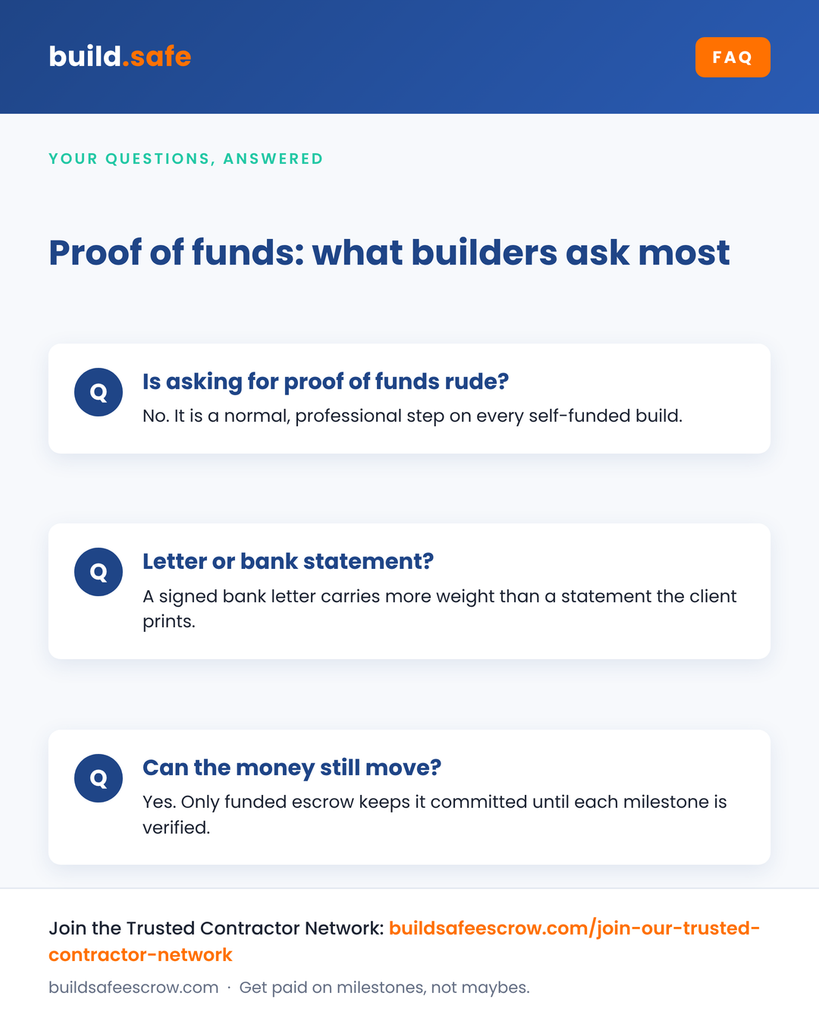
Is it rude to ask for proof of funds for construction?
No. It is a normal, professional step on any self-funded build. Present it as standard process that protects the owner’s schedule too.
What counts as acceptable proof of funds for construction?
A signed letter from the client’s bank is stronger than a statement. It should cover the full contract plus a contingency.
Can a client move the money after showing proof of funds for construction?
Yes. A statement or letter shows funds at one point in time. Only an arrangement like funded escrow keeps the money committed.
Do I still need lien rights if I use escrow?
Escrow lowers the odds you will need them, but it does not replace them. Keep your notices current and ask a construction attorney about your state’s rules.
Does escrow help the homeowner too?
Yes. The owner pays only for verified work and gets a neutral record of every release. More answers are on our construction escrow FAQs page.
Get paid on milestones, not maybes
Get one short read each Friday on how construction money actually moves: subscribe to The Build Brief.
Build trust. Win more projects. Get paid on milestones, not maybes. Join the free Trusted Contractor Network.
References
- Characteristics of New Housing: Highlights, U.S. Census Bureau, 2025: reports 131,000 contractor-built single-family homes started in 2025.
- Survey of Construction Definitions, U.S. Census Bureau: defines contractor-built houses.
- A Homeowner’s Guide to Preventing Mechanics Liens, California Contractors State License Board, 2016: supports the California notice and 90-day recording example and conditional releases.