
Table of Contents
- Why build-out money is more exposed than any other construction dollar
- What is a tenant buildout, and who actually pays for it?
- Who should hold the build-out money: landlord, GC, or you?
- Five ways to protect your build-out dollars before demolition starts
- Commercial real estate escrow account providers for large projects: fees and documentation
- From the field: Nadia in Chicago
- How commercial build-out escrow removes the risk at the source
- FAQ
- Keep your build-out dollars tied to the work
- References
Commercial build-out escrow exists because of a problem that only commercial tenants have: you are paying to build something inside a space you do not own, on a schedule you do not fully control, with a landlord and a general contractor who both have reasons to want your money sooner rather than later. If you are a business owner signing a lease with a build-out attached, this is the piece to read before the first deposit leaves your account.
The exposure is real but it is also fixable, and commercial build-out escrow is the structural fix rather than a legal one. By the end you will know who should hold the money, what to put in writing, and what to expect from an escrow provider on a larger project.

Why build-out money is more exposed than any other construction dollar
A homeowner who overpays a contractor still owns the house. A tenant who overpays for a build-out owns nothing. The walls, the ceiling grid, the HVAC modifications: all of it becomes the landlord’s property the day it is installed. That is standard in nearly every commercial lease.
Add the timing problem. Most tenant improvement allowances are paid as a reimbursement, after the work is done and lien waivers are collected. So the tenant fronts the construction cost, carries it through the build, and gets the landlord’s contribution back at the end. If the GC stalls or a sub walks, you are out of pocket on someone else’s building while rent commencement gets closer.
Then the lien problem. A subcontractor who does not get paid by your GC can file a mechanics lien (a legal claim against the property for unpaid construction work) against the landlord’s building. Most leases make you responsible for clearing it. You paid the GC, the GC did not pay the sub, and the lien lands on you anyway.
Three exposures, one root cause. The money moved ahead of the work. Commercial build-out escrow addresses all three.
What is a tenant buildout, and who actually pays for it?
A tenant buildout is the construction that turns a leased commercial shell into a usable space, and it is usually paid for by a combination of a landlord’s tenant improvement allowance and the tenant’s own capital, with the tenant covering every dollar above the allowance. The allowance is quoted per square foot and negotiated in the lease. It is not free money; it is priced into your rent.
Who manages the work depends on the lease. In a landlord-controlled build-out, the landlord’s team picks the contractor and runs the project. In a tenant-controlled build-out, you hire the GC, run the schedule, and draw against the allowance. Tenant control gives you the space you want. It also puts your money at the front of the line.
Who should hold the build-out money: landlord, GC, or you?
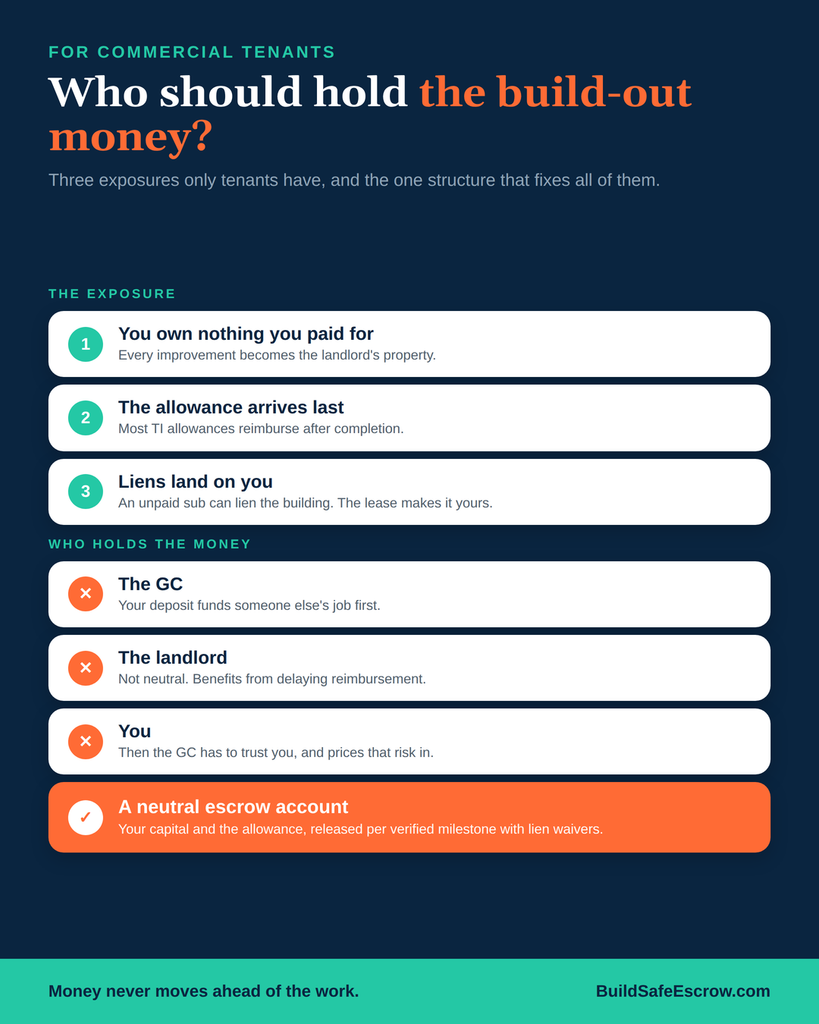
None of the three should hold it. Build-out funds belong in a neutral account that releases each payment only after the milestone it covers is finished and verified. Every other arrangement puts one party’s cash under another party’s control.
Consider each option:
- The GC holds it. A large deposit funds the GC’s other jobs before it funds yours. Even an honest contractor is tempted to smooth cash flow with your money.
- The landlord holds it. Landlords are not neutral. They benefit from delaying reimbursement until every lien waiver is in hand and the certificate of occupancy is issued. Some lease clauses even let the landlord withdraw from a construction account to clear liens without your consent.
- You hold it. Better than the other two, but the GC now has to trust that you will pay on time, and a GC who does not trust the money will price that risk into the bid or slow the schedule.
A commercial build-out escrow account is the fourth option. (For the basics of how tenant improvement escrow holds and releases funds, start there; this piece is about who should control the money and what to negotiate.) It holds both your capital and, where the landlord agrees, the allowance itself, and it pays out on verified milestones. The landlord sees the work funded, the GC sees the money is real, and you stop being the bank.
Five ways to protect your build-out dollars before demolition starts
1. Negotiate the allowance as a funded deposit, not a reimbursement. Ask the landlord to deposit the tenant improvement allowance into commercial build-out escrow at lease signing, or at least in tranches tied to milestones. A landlord who will not fund the allowance up front is telling you something about how the reimbursement will go.
2. Tie every draw to a document. Each release from commercial build-out escrow should require something a third party can check: an inspection sign-off, a set of photos against the drawings, and a conditional lien waiver from the GC and the major subs for the amount being released. Never accept “phase complete” as a release condition.
3. Get lien waivers from the trades, not just the GC. The GC’s waiver protects you from the GC. It does nothing about the electrician the GC forgot to pay. Ask for waivers from every sub above a dollar threshold before each draw.
4. Fund change orders before the work. Build-outs generate change orders: a landlord requirement surfaces, a code official wants a different fire rating, the mechanical engineer finds a surprise above the ceiling. Each one should be priced, signed, and funded into the account before the crew touches it.
5. Put rent commencement and the build-out schedule side by side. Most leases start rent on a fixed date or on substantial completion, whichever is first. Your milestone schedule should show whether the build finishes before rent starts. If it does not, negotiate the commencement date or add liquidated damages for GC delay, and have your attorney review both documents together. This article is information, not legal advice.
Commercial real estate escrow account providers for large projects: fees and documentation
For a large commercial build-out or development, expect an escrow provider to charge a flat setup fee plus a per-draw or percentage fee, and to require a signed escrow agreement, the construction contract, a milestone schedule with release conditions, and lien waivers with each draw. Providers range from bank trust departments (which handle very large development escrows and often require institutional minimums) to specialist construction escrow companies that serve build-outs from a few hundred thousand dollars up.
Ask any commercial build-out escrow provider five things: Is the account segregated and FDIC-insured? Who verifies a milestone before release, and how? How many days does a release take once the documents are in? Can the landlord, the GC, and the tenant all see the account status? And what happens to the funds if the parties dispute a draw?
On fees, compare the provider’s number to the cost of one delayed draw. On a $1.2 million fit-out, a two-week slip on a single release can cost more in lost opening days than the escrow fee for the whole project. Build Safe’s construction escrow services are priced flat and disclosed before the account opens, and the fee can be split between the parties.
From the field: Nadia in Chicago
Nadia signed a ten-year lease for a 3,200-square-foot dental practice in a Chicago medical office building. The landlord offered a $55-per-foot allowance as a reimbursement on completion. Her GC asked for 40 percent down on a $640,000 build-out.
Four months in, the plumbing sub filed a lien against the building for $38,000. The GC had been paid for the rough-in draw and had not paid the sub. Under the lease, Nadia had 15 days to clear it. She paid the sub directly, the GC disputed the double payment, and the landlord froze the reimbursement until the lien was released and a final waiver was in hand. Her opening slipped six weeks, and rent had already commenced.
On her second location she used commercial build-out escrow. The landlord agreed to fund the allowance into the account at lease signing. Each draw required a conditional waiver from every sub above $5,000. Rough-in to certificate of occupancy took 19 weeks, no liens, no double payment, and the last draw released the same day the inspector signed off.
How commercial build-out escrow removes the risk at the source
Every exposure in this piece comes from money sitting in the wrong hands at the wrong time. Commercial build-out escrow moves it to a neutral, FDIC-insured account and ties each release to finished, verified work.
For the tenant, that means your capital and the landlord’s allowance only leave the account for milestones that passed inspection and cleared lien waivers. For the GC, it means the money is real before the first order goes in, which is why good contractors welcome it. For the landlord, it means the building is not going to end up with a lien, and the allowance is spent on what it was negotiated for. Three parties with different interests, one structure that serves all of them.
If you are planning a build-out in the next year, the construction escrow FAQs cover how funding, releases, and disputes work in detail.
Trust is a feeling. Structure is protection. Money should never move ahead of the work, and on a build-out it should never leave your control until the work has been seen.
FAQ
What is commercial build-out escrow?
Commercial build-out escrow is a neutral, FDIC-insured account that holds a commercial tenant’s build-out funds, and often the landlord’s allowance, and releases each payment to the contractor only after the milestone it covers is completed and verified.
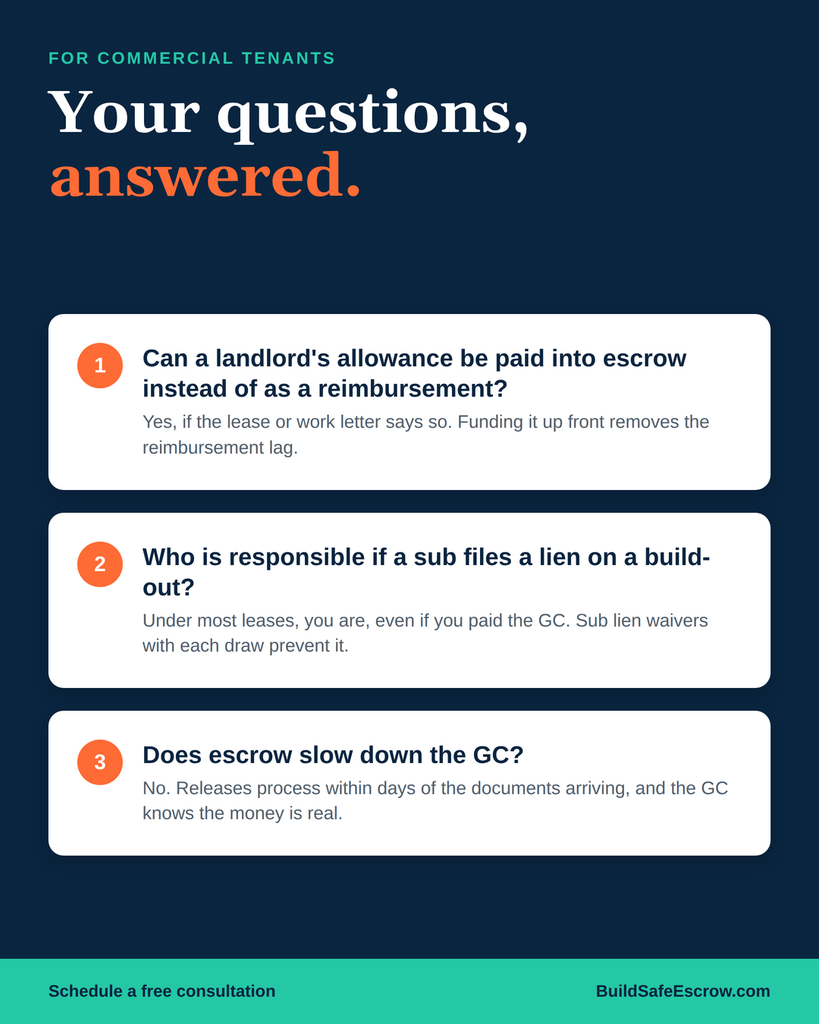
Can a landlord’s allowance be paid into commercial build-out escrow instead of as a reimbursement?
Yes, if the landlord agrees in the lease or work letter. Funding the allowance up front removes the reimbursement lag and shows the GC the full project is funded.
Who is responsible if a subcontractor files a lien on a commercial build-out?
Under most commercial leases, the tenant must clear any lien arising from its work, even if the tenant already paid the GC. Requiring sub lien waivers with each escrow draw prevents this.
Does commercial build-out escrow slow down the GC?
No. Releases are typically processed within days of the documents arriving, and the GC gets certainty that the money exists. Most delays come from missing waivers, which escrow forces you to collect anyway.
How much does commercial build-out escrow cost?
Fees vary by provider and project size, typically a flat setup fee plus a per-draw charge. Compare it to the cost of one delayed opening week.
Keep your build-out dollars tied to the work
Get one short read each Friday on how construction money actually moves. Subscribe to The Build Brief.
Planning a build-out? Schedule a free consultation and we will map a commercial build-out escrow schedule to your lease and construction contract.
References
- J.P. Morgan, “Escrow Services: Real Estate and Construction Guide” (tenant/developer construction escrow example): https://JPMorgan.com/content/dam/jpm/treasury-services/documents/jpmorgan-escrow-real-estate-guide-2023-ada-compliant.pdf
- LoopNet, “Tenant Improvement Allowance (TIA) in Commercial Real Estate”: https://www.loopnet.com/cre-explained/finance/tenant-improvement-allowance-tia/
- Law Insider, “Construction Escrow Clause Samples” (tenant build-out escrow clauses): https://www.lawinsider.com/clause/construction-escrow
- Luther Lanard PC, “Tenant improvement allowances and what they cover”: https://franchiseelawyer.com/blog/tenant-improvement-allowances-and-what-they-cover/