
Table of Contents
- Why a big check to a near stranger feels so risky
- Where can I hire a contractor with escrow payment?
- Six steps to hire a contractor with escrow payment
- What a yes, a maybe, and a no tell you
- Milestones that work for both of you
- Funded escrow makes you the client good contractors want
- Field example: Marisol’s $86,000 kitchen and addition
- How escrow removes the risk at the source
- FAQ: hiring a contractor with escrow payment
- References
Finding a contractor with escrow payment is the question a lot of homeowners and property owners ask right before they sign. You found someone you like, the bid looks fair, and now they want a deposit that could cover a used car. You have met this person twice.
That knot in your stomach is normal. It is also preventable. You do not need blind faith in a near stranger. You need a payment structure that holds the money until the work is done.
[Feature image: see media placement notes]
Why a big check to a near stranger feels so risky
Most renovation payments run on trust. You pay a deposit, the contractor starts, and you pay more as the job moves. If something goes wrong, the money is already gone.
The root causes are plain:
- Front-loaded payments. Many contracts ask for a large share before much work is visible. Your leverage drops with every check.
- No neutral party. You and the contractor each judge progress on your own. Disputes have no referee.
- Thin history. You picked this contractor from reviews, a referral, and a couple of site visits. That is a small sample for a five or six figure decision.
The Federal Trade Commission is blunt about the first point: “Don’t pay the full amount for the project up front.” Its guidance adds that you should “never make the final payment until the work is done and you’re satisfied with it.” Good advice. The hard part is building it into the deal.
If a contractor is already pushing for a big upfront payment, our guide on what to do when a contractor asks for money upfront walks through your options.
Where can I hire a contractor with escrow payment?
You usually do not need a special kind of contractor: most licensed contractors will work with a neutral third-party escrow if you propose it before the contract is signed, and you can also start from a network of contractors who already work with escrow, such as the Build Safe Escrow Trusted Contractor Network.
The search for a contractor with escrow payment comes down to timing and framing.
Escrow is an account held by a neutral third party. You deposit the project funds. The escrow holder releases money to the contractor in stages, as each agreed milestone is completed and verified. Neither side can move the money alone.
Contractors do not have to change how they build. They still send draw requests (a draw is a payment request tied to completed work). The only difference is who holds the cash in between.
You have two good starting points:
- Your current shortlist. Ask the contractors you already like. Most licensed pros have heard of escrow, and many have used it on larger jobs.
- A network that already says yes. The Build Safe Escrow Trusted Contractor Network lists contractors who are familiar with escrow-held funds and milestone draws.
Either way, the escrow itself should sit with a neutral provider. Not the contractor, and not anyone who works for one side.
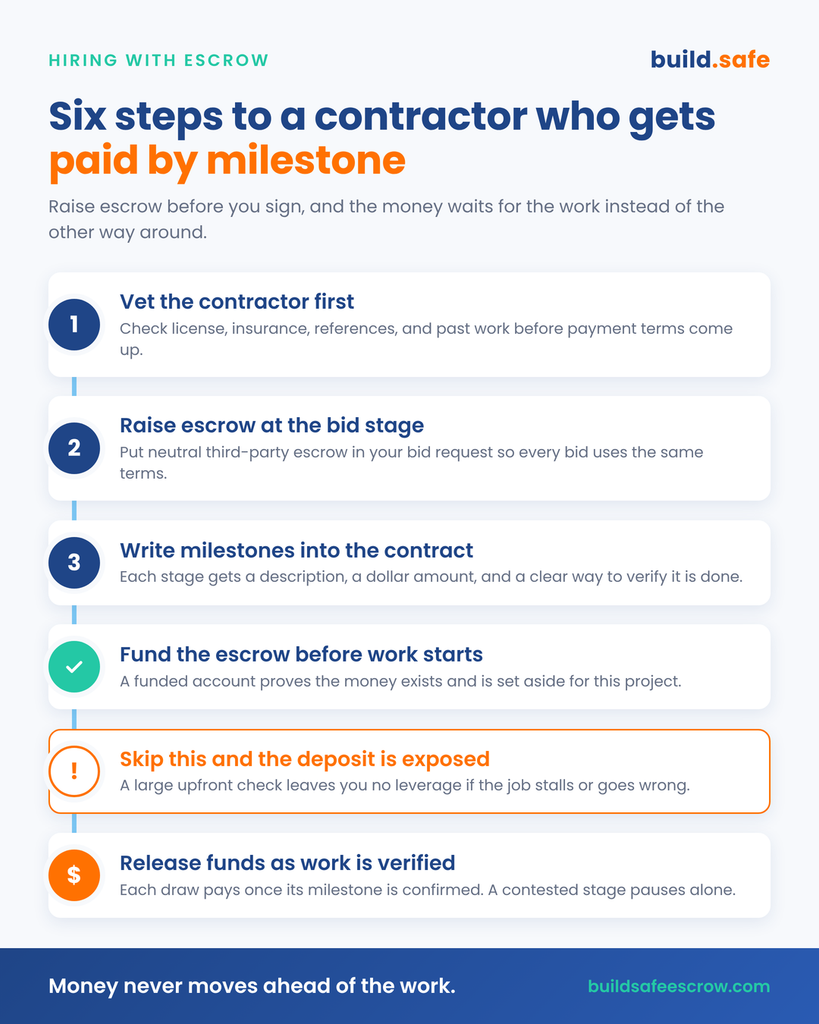
Six steps to hire a contractor with escrow payment
These steps fit inside a normal hiring process. They add a few questions and one document.
- Vet first, then talk money. Check license, insurance, references, and past work before payment terms come up. Our guide on how to properly vet a contractor covers the checklist.
- Raise escrow at the bid stage. Mention it when you request bids, not after you pick a winner. A line in your bid request works: “Funds for this project will be held in a neutral third-party escrow and released by milestone.”
- Ask clear questions. Have you worked with escrow before? What milestones would you propose? How fast do you need payment after a milestone is verified? What deposit do you need to order materials?
- Write the milestones into the contract. Each one needs a description, a dollar amount, and a way to verify it is done. Vague milestones cause most draw disputes.
- Fund the escrow before work starts. A funded account is proof the money exists. It also starts the clock on the contractor’s schedule.
- Agree on how disputes pause money. If a milestone is contested, the funds for that stage stay put until it is resolved. Everything else keeps moving.
Put escrow in writing on day one, and hiring a contractor with escrow payment becomes part of your standard terms.
[Infographic: see media placement notes]
What a yes, a maybe, and a no tell you
How a contractor reacts to escrow tells you a lot about how the job will go.
A fast yes is a good sign. It usually means the contractor bills against real progress and expects to get paid on time. Many will tell you they like it, since escrow proves your funds are there.
A maybe is common and fine. The contractor may want to see the escrow terms, ask about release timing, or adjust the deposit for materials. Those are fair business questions. Answer them, and share how the provider verifies milestones.
A hard no deserves a follow-up question, not an instant verdict. Ask why. Some small firms have cash-flow limits and need a larger first draw for materials. That can be solved inside escrow with a bigger first milestone.
Be careful if the no comes with pressure: cash only, the full amount up front, or a deadline to sign today. The FTC lists “pay for everything up front or only accept cash” as a warning sign of a home improvement scam.
Milestones that work for both of you
Good milestones protect the homeowner and the contractor at the same time. A contractor with escrow payment wants to know each stage pays promptly. You want to know each stage is done before money moves.
Keep milestones:
- Tied to visible work. “Rough plumbing inspected” beats “Phase 2.”
- Sized to the work. The dollar amount should roughly match the value of what was completed, plus materials ordered.
- Verifiable. Name how completion is confirmed: photos, a passed inspection, a walkthrough, or a sign-off from both sides.
When you hire a contractor with escrow payment for a typical remodel, expect five to seven stages. A common set: materials deposit, demolition, rough-in, inspection, finishes, and the final punch list. Rules on deposits and retainage vary by state, so confirm the structure with your attorney before you sign.
Want more on the mechanics? Our page on how our escrow services work shows the full release flow.
Funded escrow makes you the client good contractors want
It is easy to think of escrow as a protection only for you. Contractors see it differently.
Rabbet’s 2025 Construction Payments Report found that “91% of GCs factor an owner’s payment reputation into bids.” The same report found “88% declined to bid in the last year due to slow-pay reputations.” Good contractors screen owners, too.
As a homeowner, you have no payment track record they can look up. Hiring a contractor with escrow payment terms fills that gap. It shows the money is real, set aside, and ready to release the moment work is verified.
That changes the conversation. A contractor with escrow payment in the contract knows the risk of chasing late payments is low. You stop being an unknown and become a client worth saying yes to.
Field example: Marisol’s $86,000 kitchen and addition
Marisol Grant (a fictional homeowner) planned an $86,000 kitchen remodel with a small rear addition. Her favorite bidder asked for $30,000 up front.
She liked his work but did not want a third of her budget out the door before demolition. So she asked whether he would work as a contractor with escrow payment, released by milestone. He said maybe, and asked how fast draws would release.
They settled on six milestones. The first was $14,000 for materials and demolition. Rough framing, rough-in, and inspection followed, then finishes, then a final $8,000 held until the punch list was signed off.
When the cabinet delivery slipped, only that stage paused. The contractor was paid within days of each verified milestone. Marisol never wrote a check ahead of the work, and he never chased an invoice.
How escrow removes the risk at the source
Trust between you and your contractor still matters. Escrow does not replace it. It backs it up.
The real problem is timing: money moving before the work it pays for. Escrow fixes that in the structure itself. Funds sit with a neutral holder. They move only when a milestone is completed and verified. Money never moves ahead of the work.
That protects you from paying for work that never happens. It protects the contractor from finishing work and waiting months to get paid. Neither side holds the other’s money hostage.
Funds with Build Safe Escrow are held in FDIC-insured accounts. Per the FDIC, coverage is “$250,000 per depositor, per FDIC-insured bank, for each account ownership category.” Ask any escrow provider how your funds are held and insured.
Trust is a feeling. Structure is protection. Escrow turns the feeling into the structure. Finding a contractor with escrow payment then becomes a matter of writing good terms.
Work in the trades? Our companion guide for contractors who work with escrow is pending publication.
FAQ: hiring a contractor with escrow payment
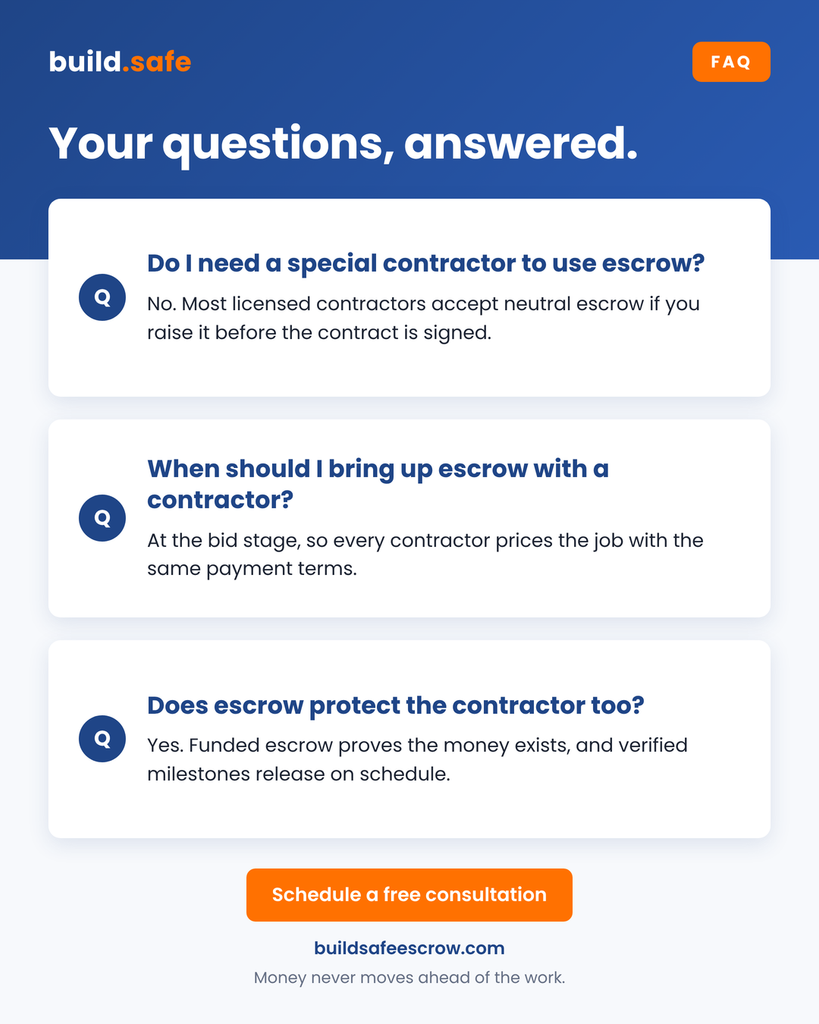
Do I need to find a special contractor with escrow payment experience?
No. Most licensed contractors will accept a neutral escrow if you raise it before the contract is signed. A network of contractors who already use escrow can shorten your search.
When should I bring up escrow with a contractor?
At the bid stage. Put it in your bid request so every contractor prices the job with the same payment terms.
Will a contractor with escrow payment cost me more?
Escrow has a service fee, which varies by provider and project size. Many owners weigh it against the cost of a failed deposit or a stalled job. Ask for the fee in writing.
What if my contractor refuses escrow?
Ask why. A cash-flow concern can often be solved with a larger first milestone for materials. Pressure to pay everything up front or in cash is a warning sign.
Does escrow protect the contractor too?
Yes. A funded escrow proves the money exists, and verified milestones release on schedule. The contractor does not have to chase payment.
Is escrow legal advice or a loan?
Neither. Escrow is a neutral holding and release service. Rules vary by state, so review your contract with your own attorney or accountant.
Start your project with the money in the right place
Get one short read each Friday on how construction money actually moves: subscribe to The Build Brief.
Ready to set up milestones before you sign? Schedule a free consultation with Build Safe Escrow. We will walk through your bids and a release schedule that works for you and your contractor.
References
- Rabbet, 2025 Construction Payments Report
- Federal Trade Commission, Consumer Advice: How To Avoid a Home Improvement Scam
- FDIC, Understanding Deposit Insurance