

If you are about to evaluate a home builder for a new build, an addition, or a major remodel, this guide is for you. You are the property owner, the check is yours, and the contract you sign in the next few weeks will decide whether the next twelve months feel like progress or like a hostage negotiation.
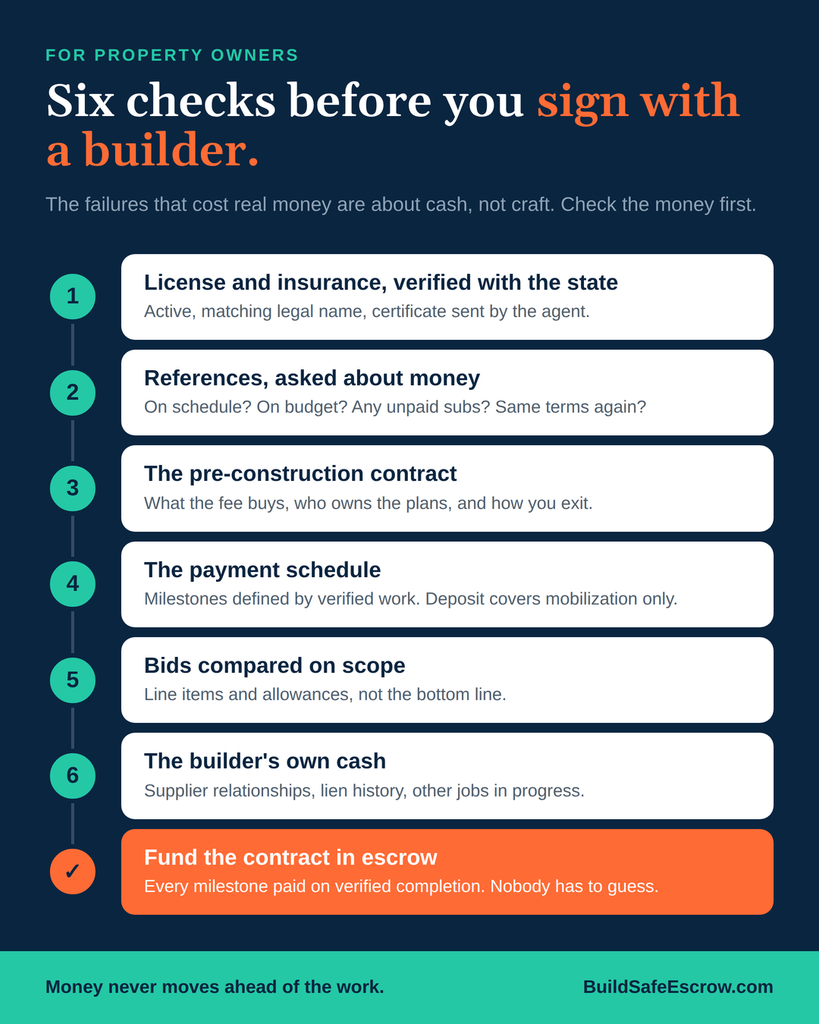
Table of Contents
- How to evaluate a home builder before signing a contract
- Why builder problems show up late
- 1. Verify the license and the insurance yourself
- 2. Read the references for money, not for compliments
- 3. Vet a home builder before a pre-construction contract
- 4. Ask how the money will move
- 5. Compare bids on scope, not on the bottom line
- 6. Check the builder’s own financial footing
- Things homeowners should never accept from remodeling contractors
- A short field example
- How escrow removes the risk at the source
- FAQ
- Protect your build before it starts
- References
How to evaluate a home builder before signing a contract
To evaluate a home builder before signing a contract, verify the license and insurance directly with the state, call references about money and schedule rather than finish quality, compare bids line by line on scope, and confirm the payment schedule ties every dollar to a completed and verified stage of work.
That is the whole method in one sentence. The rest of this guide explains each step, tells you what a good answer sounds like, and names the terms you should refuse no matter how much you like the builder.
One framing before the checklist. Most homeowners evaluate a builder the way they would evaluate a restaurant: portfolio, personality, reviews. Those matter. But when you evaluate a home builder, the failures that cost real money are almost never about craftsmanship. They are about cash. A builder who does beautiful work and runs out of money in month four leaves you with the same half-finished house as one who never knew what he was doing.
So the checks below lean toward the money. How the builder handles yours, and how the builder handles his own.
Why builder problems show up late
Building a home is a long, front-loaded transaction. You commit to a price and a person before a single footing is poured. By the time you can judge the work, a large share of the money has already left your account.
That timing is the root of nearly every builder horror story you have heard, and it is why you evaluate a home builder on cash before craft.
Deposits go out on faith. A 20, 30, or 50 percent deposit is common in residential construction. It is paid before the work exists, so there is nothing to inspect. If the builder is stretched, that deposit may cover his last job rather than yours.
Progress payments follow the calendar, not the work. Many contracts release money on dates or on rough phases (“framing 30%”) with no definition of complete. Once the check clears, you have no leverage to fix what was rushed.
The builder’s own cash flow is invisible to you. Subcontractors and suppliers extend credit to the builder, not to you. When the builder falls behind on them, they can file a lien on your property even though you paid in full.
Verbal promises do not survive a change of mood. “We’ll work that out later” is the most expensive sentence in construction.
None of these are character flaws. They are structure gaps, and every one of them can be closed before you sign.
1. Verify the license and the insurance yourself
The first step to evaluate a home builder is boring on purpose. Look up the license directly with your state’s licensing board. Do not accept a photo of a card. In Florida that means the DBPR license search; other states have an equivalent. Confirm the license is active, matches the legal business name on the bid, and covers the class of work you are hiring for.
Then ask for a certificate of insurance sent to you by the insurance agent, not by the builder. You want general liability and workers’ compensation, both current, both naming the builder’s legal entity. A builder who resists this step has told you something.
Check for complaints and disciplinary actions on the same licensing site. One old complaint that was resolved is not disqualifying. A pattern is.
2. Read the references for money, not for compliments
Every builder can produce three happy clients, which is why references alone will not evaluate a home builder. The trick is what you ask them.
Skip “were you happy with the work.” To evaluate a home builder through his past clients, ask instead:
- Did the project finish on the schedule in the contract, and if not, by how much?
- Did the final cost match the contract, and what drove the changes?
- How were payments structured, and did you ever feel you had paid ahead of the work?
- Did any subcontractor or supplier contact you about unpaid bills?
- Would you use the same payment terms again?
The last question is the one that opens people up. Owners who felt exposed will tell you, and they will tell you exactly where.
To evaluate a home builder properly, ask for a reference from a project that had a problem. Every job has one. A builder who says none of his ever did is either new or not being straight with you.
3. Vet a home builder before a pre-construction contract
You should vet a home builder before a pre-construction contract with the same rigor as the build contract, because the pre-construction agreement often locks in the deposit, the plans, and the right to walk away.
A pre-construction agreement is the contract many builders use for design, permitting, and pricing before the main construction contract is signed. It can be a useful step. It can also be a trap if you sign it as a formality.
Read it for four things.
What the fee buys. Design hours, surveys, permit applications, and a fixed bid should be listed. If the fee is described as a “deposit toward construction,” ask where it is held and whether it is refundable if you never proceed.
Who owns the plans. If you pay for drawings, you should be able to take them to another builder. Some agreements assign the plans to the builder, which means walking away costs you the design work.
Whether the bid is binding. A pre-construction phase that ends in a “preliminary estimate” has not delivered what you paid for. The output should be a fixed or clearly bounded price.
The exit. You should be able to end the relationship at the end of pre-construction without penalty beyond the agreed fee.
If you can evaluate a home builder well at this stage, the main contract becomes much easier. You already know how he prices, how he communicates, and how he handles a small amount of your money.
4. Ask how the money will move
This is the question that does the most to evaluate a home builder. It separates a builder who has thought about your risk from one who has only thought about his.
Ask for the proposed payment schedule in writing before you negotiate price. You are looking for three qualities:
- Milestones are defined by completed work, not by dates. “Rough plumbing and electrical passed inspection” is a milestone. “Week eight” is not.
- Each milestone has a verification step. An inspection, a walkthrough, dated photos, or a signed lien waiver from the subs on that phase.
- The deposit is proportionate. Enough to cover mobilization and any custom-order materials, no more. Ten percent is common in many markets; anything approaching half should be tied to specific non-returnable purchases.
Then ask the follow-up: “Would you be comfortable having the funds held by a neutral escrow and released per milestone?” A confident, well-capitalized builder usually says yes, because it guarantees his money is real and waiting. A builder who needs your deposit to fund last month’s payroll will find a reason to say no.
That answer tells you more than any portfolio. Nothing else you do to evaluate a home builder is as revealing.
5. Compare bids on scope, not on the bottom line
Three bids, three numbers, and the lowest one wins. That is how most homeowners choose, and it is how most budgets blow up.
Bids differ mostly in what they leave out, and that is where a bid helps you evaluate a home builder. To evaluate a home builder fairly, line the bids up section by section: site work, foundation, framing, roofing, windows, mechanical, electrical, plumbing, insulation, drywall, finishes, allowances. Ask each builder to confirm what is excluded.
Pay special attention to allowances, the placeholder amounts for items you have not selected yet (tile, fixtures, appliances, cabinets). A low bid with low allowances is not a low bid. It is a deferred one.
Ask how change orders are priced; it is another quick way to evaluate a home builder’s habits. Cost plus a stated markup, in writing, is normal. “We’ll figure it out” is not.
6. Check the builder’s own financial footing
You cannot audit a builder’s books, but you can evaluate a home builder’s finances from the outside. You can ask the questions that a lender would.
- How many projects are you running right now, and at what stage?
- Who are your main subs and suppliers, and how long have you worked with them?
- May I speak to one supplier about your payment history?
- Have you ever had a lien filed on a client’s property by one of your subs?
- How do you handle a client’s funds between milestones?
A builder with steady supplier relationships and no lien history will answer easily. Hesitation on the supplier question is the one to notice. Suppliers know before anyone else when a builder is falling behind.
Things homeowners should never accept from remodeling contractors
Homeowners should never accept a large unconditioned deposit, a payment schedule based on dates instead of completed work, a verbal change order, a contract without a defined scope and completion standard, or a builder who refuses to have funds held and released by a neutral third party.
A shorter list for the refrigerator, useful whenever you evaluate a home builder or a remodeler:
- A deposit above what covers mobilization and custom orders. If the number is large, ask what it buys and where it sits.
- “Pay me Friday” on an unfinished phase. The phase is done when it is verified, not when payroll is due.
- Cash payments with no receipt. You lose every trace of the transaction and most of your leverage.
- Verbal changes. Every change gets a written order with a price and a milestone.
- Contracts without a lien waiver process. You want conditional waivers from subs with each progress payment and unconditional waivers when the money clears.
- A builder who will not name his subs. You are entitled to know who will be on your property and who could lien it.
Red flags before signing a sunroom contract
Sunrooms and small additions deserve their own note, because owners rarely evaluate a home builder for a small job because they attract high-pressure, one-visit sales. Watch for a “today only” price, a contract that names a sales company rather than a licensed contractor, a permit that is “not needed,” and a deposit above a third with no defined milestones. Any one of those is reason to slow down. Two is reason to walk.
A short field example
Lena and her husband were adding a second story to a 1970s ranch in Fort Myers. Two builders bid within five percent of each other. One wanted 35 percent down and progress payments every three weeks. The other wanted 10 percent down, with the balance released at five inspected milestones, and volunteered that he was fine with a third-party escrow holding the funds.
Lena chose the second builder, partly for the terms and partly for what the terms said about his cash position. They set up escrow with the full contract amount funded at signing. Each milestone released only after the county inspection passed and the framing and roofing subs signed conditional lien waivers.
In month five the builder’s cabinet supplier changed its terms and demanded prepayment. The builder asked Lena for an early release. Because the escrow agreement tied release to the cabinet install milestone, the answer was already written: the supplier could be paid directly from escrow against a delivery receipt. Nobody had to trust anybody. The cabinets arrived, the receipt was verified, the money moved. The relationship never got tense, because the structure had already answered the question.
How escrow removes the risk at the source
Every check you use to evaluate a home builder is a way of predicting whether a builder will handle your money well. Construction escrow removes the need to predict.
A neutral third party holds the project funds in an FDIC-insured account. The payment schedule you negotiated is written into the escrow agreement. When a milestone is completed and verified, the funds for that milestone are released to the builder. Until then, they stay put.
For you, that means the deposit is never a leap of faith. For the builder, it means every dollar of the contract is funded, visible, and waiting, which is why good builders tend to like it. It also removes the leverage games in both directions: you cannot hold a completed milestone hostage, and the builder cannot demand money ahead of the work.
Trust is a feeling. Structure is protection. Escrow turns the feeling into the structure, and it does so before the first footing is poured. You can read more about how our escrow services work, or review the construction escrow FAQs for the mechanics of releases and verification.
Money never moves ahead of the work.
FAQ
How do I evaluate a home builder if all three bids look similar? Compare the payment schedules and the allowances rather than the totals. The builder whose milestones are defined by verified work and whose allowances are realistic is usually the safer choice, even at a slightly higher price.
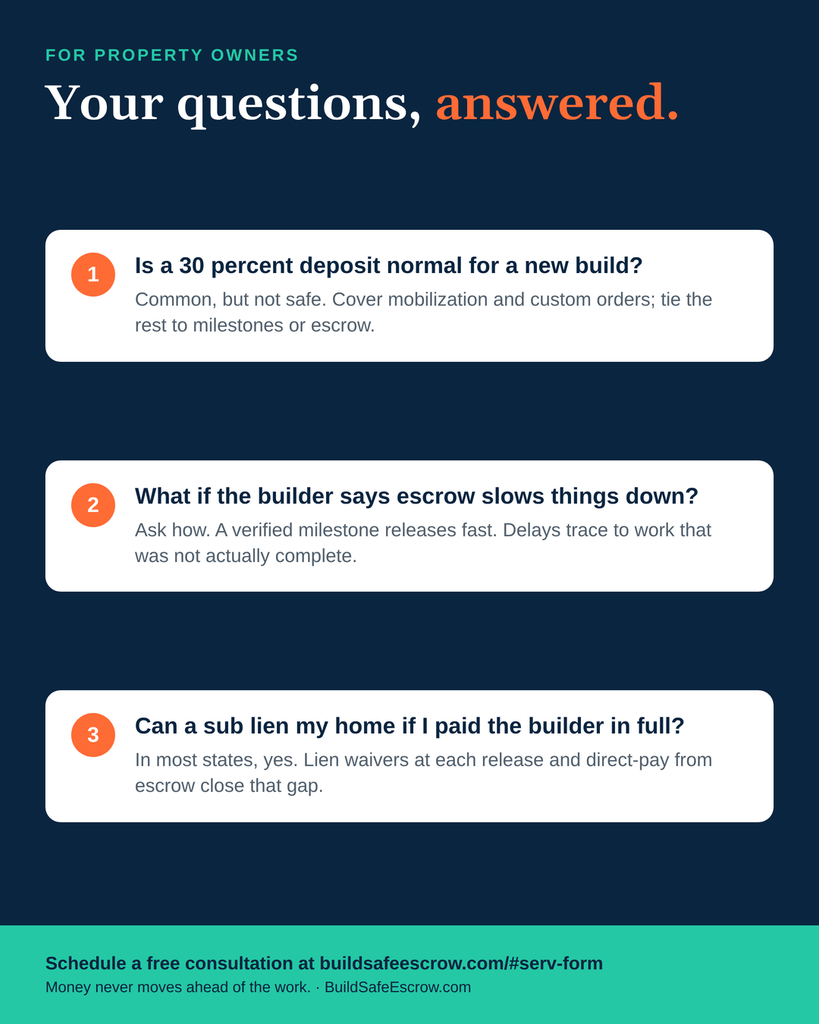
Is a 30 percent deposit normal for a new home build? It is common, but common is not the same as safe. A deposit should cover mobilization and non-returnable custom orders. Beyond that, tie the money to milestones or have it held in escrow.
Does the contract matter when I evaluate a home builder? Yes. Read the builder’s contract carefully and have your own attorney review it. Standard industry forms exist, and a builder who uses one is usually a good sign. Whichever you use, the payment schedule and the definition of completion for each milestone are the sections that matter most.
What if the builder says escrow will slow the project down? Ask how. Milestone releases can be processed quickly once verification is submitted. A builder who has done the work and documented it gets paid faster, not slower. Delays in escrow almost always trace to a milestone that was not actually complete.
Can a subcontractor put a lien on my home if I paid the builder in full? In most states, yes. That is why lien waivers from subs are part of a sound payment schedule, and why funds held in escrow can be released directly to subs and suppliers when needed.
Does this apply to remodels, or only new construction? Everything here applies whether you evaluate a home builder for new construction or a remodeler for a project large enough to have phases. Remodels over roughly $25,000 benefit from the same milestone structure.
Protect your build before it starts
Get one short read each Friday on how construction money actually moves. Subscribe to The Build Brief.
If you have done the work to evaluate a home builder and want the payment side handled by a neutral party, schedule a free consultation. We will walk through your contract’s payment schedule and show you how escrow would hold and release each milestone.
This article is for information only and is not legal or financial advice. Consult your own attorney or advisor about your specific contract.
References
- Florida Department of Business and Professional Regulation, License Search: https://www.myfloridalicense.com/wl11.asp
- Federal Trade Commission, Hiring a Contractor: https://consumer.ftc.gov/articles/hiring-contractor
- National Association of Home Builders, Contracts and Hiring a Builder: https://www.nahb.org/other/consumer-resources/hiring-a-builder
- American Institute of Architects, Contract Documents (owner-contractor agreements): https://www.aiacontracts.com/