
Understanding Florida’s New Laws, Rising Costs, and How Construction Escrow Can Help
If you live in a Florida condo or HOA community, chances are you’ve noticed your monthly fees climbing and fast. Across Miami-Dade, Broward, and beyond, residents are seeing double-digit increases in their HOA dues, special assessments for building repairs, and tighter financial requirements that didn’t exist just a few years ago.
Why is this happening? And more importantly; what can you do to protect yourself, your neighbors, and your financial future?
Let’s break it down.
What’s Driving the Spike in HOA Fees?
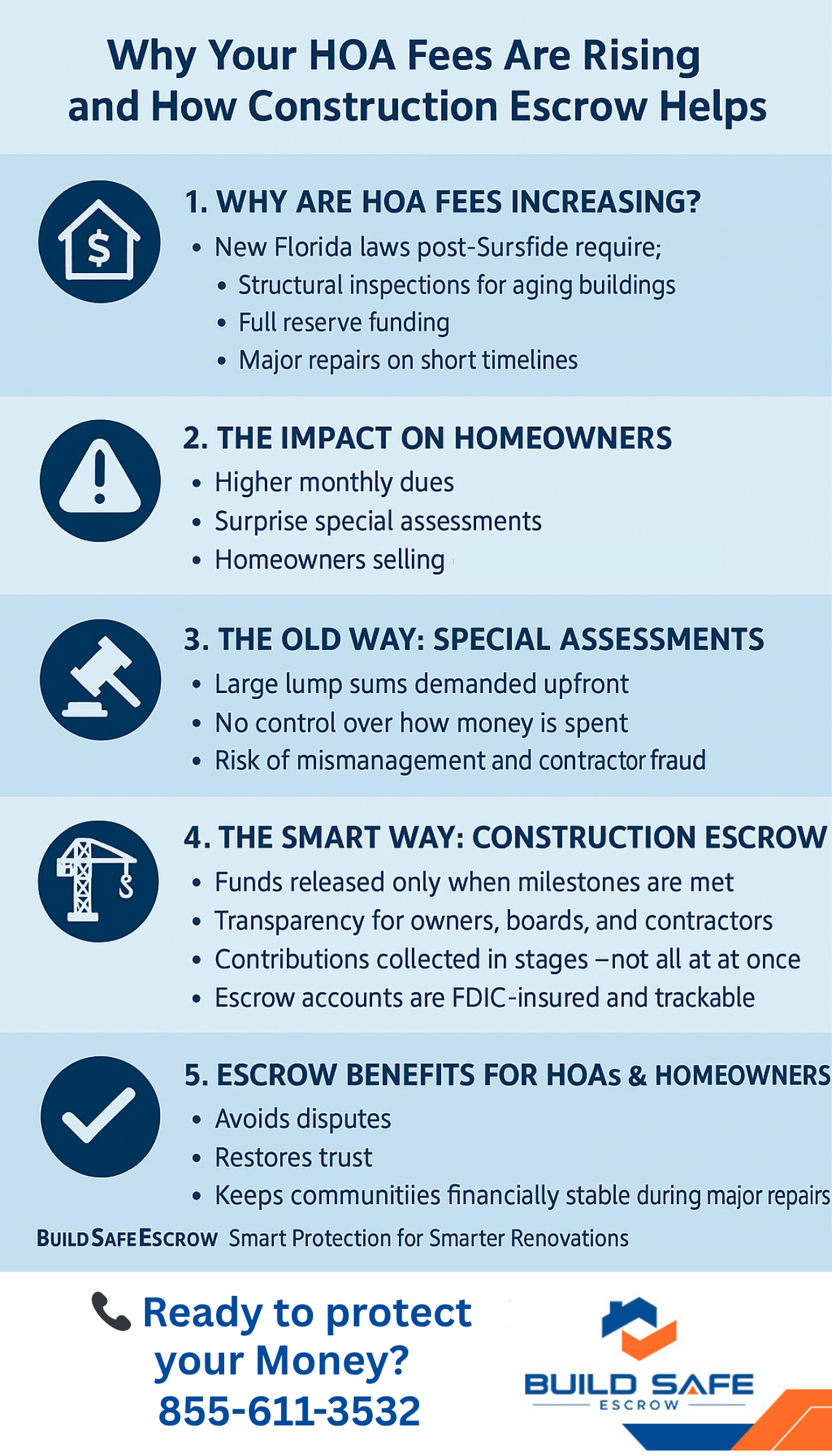
In the wake of the tragic Surfside condo collapse in 2021, Florida lawmakers moved swiftly to introduce reforms that would make aging buildings safer. That includes:
- Mandatory structural inspections for condos 30 years and older (or 25 years if near the coast)
- New reserve funding requirements—associations can no longer waive reserves
- Increased pressure to complete deferred maintenance and safety upgrades
While the intent of these changes is clearly justified, the financial impact has been massive; especially for communities with outdated buildings and underfunded budgets.
Many HOAs are now scrambling to fund millions of dollars in repairs they can no longer delay.
The Problem With Traditional Special Assessments
Historically, when major repairs came due, HOAs issued special assessments; large one-time payments demanded from homeowners. But in today’s economy, that approach is no longer sustainable.
Here’s why:
- Many residents can’t afford surprise $10K–$50K bills
- Assessments lead to delinquency, legal battles, or forced sales
- Lack of transparency creates mistrust: “Where’s the money going?”
In short, the current system often adds financial stress to already overwhelmed homeowners—without providing the transparency they deserve.
The Smart Alternative: Construction Escrow
Here’s where construction escrow comes in—and why forward-thinking HOAs are adopting it as a best practice.
🔐 What Is Construction Escrow?
Construction escrow is a neutral third-party service that holds project funds in a secure, FDIC-insured account and only releases money when pre-approved milestones are met.
This means:
- Property owners fund their portion in stages, not all at once
- Contractors are paid only when verified work is completed
- All parties (board members, homeowners, contractors) can track progress and disbursements in real time
Read our blog https://buildsafeescrow.com/what-is-construction-escrow-and-why-do-you-need-it/
Real Example: Avoiding Financial Chaos in Biscayne Park
In one Biscayne Park HOA, a $3.5M restoration was needed for structural concrete, roofs, and balconies. Instead of levying massive assessments and hoping for the best, the board opted to:
- Break the project into phased milestones
- Use Build Safe Escrow to manage funds tied to each milestone
- Allow homeowners to fund their portion month by month, as the project progressed
The result?
- No payment disputes
- No accusations of fund misuse
- A safer, better building—and a community still intact
How Escrow Makes Your Money Work Smarter
Let’s compare the old way and the escrow way:
| 🔴 Old Way | ✅ Escrow Way |
| Large lump-sum assessments | Pay in milestones as work progresses |
| No control over how funds are used | Funds released only after verification |
| Delays and trust issues | On-time progress with full transparency |
| Risk of contractor fraud or walk-offs | Payments tied to completed work only |
What You Can Do as a Homeowner
You’re not powerless in this process. Here’s how you can take action:
1. Attend HOA Meetings
Ask direct questions:
- What repairs are planned?
- Are we using escrow to protect funds?
- How are vendors being selected?
2. Review Your Community’s Budget and Reserve Study
Make sure your board has up-to-date projections—and is not pushing emergency assessments as a substitute for planning.
3. Advocate for Escrow Use
Tell your board: “We want construction escrow for transparency and protection.” This one change could save thousands in disputes, delays, and lost trust.
4. Connect With Neighbors
The more homeowners understand how escrow works, the more pressure the board will feel to adopt it.
A Final Word: It’s Not Just About Fees; It’s About Trust
Yes, fees are rising. Yes, regulations are tightening. But these changes are also an opportunity for Florida HOAs and condo boards to rethink how money moves, how projects are managed, and how trust is built.
Construction escrow offers a simple but powerful promise:
👉 No more paying for work that hasn’t been done.
👉 No more guessing where the money went.
👉 No more financial surprises.
In a world where every dollar counts—and every homeowner matters—this is the standard we should all expect.
Disclaimer: The information presented here is for educational purposes only. Please note that community names and examples may have been changed to respect client confidentiality. At Build Safe Escrow, we take privacy seriously.
👉 Ready to see how Construction Escrow works for your building?
[Schedule a free consultation today] and learn how we can help your HOA or condo association protect funds, prevent disputes, and plan smarter.
- ADU Construction Escrow: How Investors Fund a Backyard Build Only as the Work Gets Done
 Funding an ADU you rarely get to visit? ADU construction escrow ties every draw to a verified stage, from permits to final inspection, so your capital becomes a finished, rentable unit.
 - No Deposit Contractor? How to Start Work Without a Deposit and Still Get Paid
 Clients keep refusing big deposits, and starting unfunded is a risk no builder should carry. Here is how to skip the deposit, have the client fund escrow first, and get paid on verified milestones.
 - How to Set Up a Construction Escrow Account: A Homeowner’s Step-by-Step Guide
 Before you wire a renovation deposit, settle seven decisions, gather your documents and ask any provider five questions. This homeowner guide shows how to set up a construction escrow account in the right order.
 - HOA Roof Replacement Escrow: How Property Managers Protect Reserve Funds on the Biggest Job
 A roof is often the biggest check a board writes. Here is how property managers use milestone-based escrow to protect reserve funds, keep the roofer paid on time, and document every release.
 - Paying Cash to Build a House? How Homeowners Keep Control of Every Draw
 No construction loan means no bank inspector checking your draws. This guide shows how homeowners paying cash rebuild that structure, so money never moves ahead of the work.
 - Proof of Funds for Construction: How Builders Confirm the Client Can Pay Before Breaking Ground
 A bank statement shows the money today, not on draw day. Learn how builders ask for proof of funds early, tie payments to milestones, and keep cash-client funds committed in escrow.
 - Contractor Payment Process for Property Managers: How to Build One That Survives an Audit.
 Sooner or later an owner asks who approved that payment. This guide gives property managers five controls and a simple payment file that make every contractor invoice audit-ready.
 - Construction Draw Verification: How Investors Know Their Capital Went Into the Build.
 Monthly photos show activity, not proof. This guide shows passive investors the six checks that tie every construction draw to verified work, plus the one test that catches a budget running short.
 - What Is Retainage in Construction? A Subcontractor’s Guide to Getting the Last 10% Paid
 Retainage is money you already earned, held until someone else says the job is done. This guide shows subcontractors what state law now limits and seven contract moves that get the last 10% paid sooner.
 - Commercial Build-Out Escrow: Who Should Hold the Money, and Who Should Not
 Commercial tenants pay to build inside a space they do not own. Here is who should hold the build-out money, how to stop a lien landing on you, and what to expect from an escrow provider on a large project.
 - How to Vet a Home Builder Before Signing a Contract: A Homeowner’s Guide
 Seven checks that catch a builder who is talented and broke at the same time, the things you should never agree to, and how escrow removes the consequences of guessing wrong.
 - Paying Contractors Upfront: A Homeowner’s Guide to Deposits, State Rules, and Safer Alternatives
 How much deposit is normal, which states cap it, what the money legally covers, and the structure that lets owners fund a project without paying ahead of the work.
 - Home Renovation Cost in 2026: What Owners Should Budget, State by State
 What a renovation really costs in 2026, why the same kitchen is priced differently in Texas and New York, and how owners keep every dollar tied to finished work.
 - Construction Escrow for Contractors: How It Works and How You Get Paid
 Escrow from the contractor’s seat: proof the money exists before you start, a milestone schedule you help write, and payment that arrives on verification instead of on a promise.
 - How Construction Escrow Works: A Simple Guide for Property Owners
 A plain walkthrough of how construction escrow works for homeowners funding a renovation or build: where the money sits, when it moves, and what happens if a contractor stops.
 - Construction Escrow for Property Managers: How It Works, Simplified
 A plain walkthrough of construction escrow for property managers: how funds are held, how milestones get verified, and how the whole thing becomes a report your owners can read.
 - Property Manager Vendor Payments: How to Pay Contractors Across a Portfolio Without Carrying the Risk
 A property manager’s guide to paying contractors and vendors across a portfolio without becoming the one who absorbs the risk: verified releases, lien protection, and a structure that keeps owner funds separate and accountable.
 - Tenant Improvement Allowance Escrow: Who Holds the Money, and When It Releases
 A commercial tenant’s guide to the TI allowance: why the money usually arrives last, what that does to your build-out, and how escrow puts the landlord’s contribution and your contractor’s draws on the same verified schedule.
 - Before Signing a Construction Contract: 9 Checks Every Homeowner Should Make
 A homeowner’s checklist for the hour before you sign: the nine things to verify in a construction contract, and the one clause that decides whether your deposit is ever at risk.
 - How to Evaluate a Home Builder Before Signing a Contract: A Homeowner’s Guide
 Most builder problems are visible before the contract is signed, if you know where to look. Here is how to evaluate a home builder on licensing, money, and structure, plus the terms no homeowner should accept.
 - Verify Construction Progress Remotely: A Proven Playbook
 Your money is in one state and your project is in another. A verification stack that tells you what is actually built, and a payment structure that acts on it.
 - Pay When Paid Clauses: The Sentence in Your Contract That Delays Every Check
 One sentence in your subcontract decides when you get paid, and most subs sign it without reading twice. What a pay when paid clause really means, and the structure that makes it irrelevant.
 - Home Renovation Payment Schedule: The Smart Way to Stage Every Payment
 The payment schedule decides who carries the risk on your renovation. Structure it around verified milestones and the biggest check of your year stops being a leap of faith.
 - Change Order Payment: Proven Ways to Stop Losing Money
 The work that wasn’t in the contract is the work you’re least likely to get paid for. Here are five fixes that turn every change order payment from an argument into a scheduled release.
 - How Should an HOA Pay a Contractor (HOA boards)
 Board members ask how should an HOA pay a contractor because the money is not theirs. It belongs to every homeowner in the community. Here is the payment structure that protects it.
 - Contractor Went Out of Business? Smart Recovery Steps
 When your contractor went out of business mid-project, panic is natural — but there is a clear sequence of moves that protects your money, your property, and your restart. Here it is.
 - Retainage in Construction: Stop Losing 10% of Every Job to a Waiting Game
 On a 10% margin, 10% retainage means you finished the job and haven’t earned a dollar yet. Here’s how to negotiate it down, track it like the receivable it is, and get it released on verification instead of goodwill.
 - Contractor Asking for Money Upfront? When It’s Normal — and When to Walk
 An upfront request isn’t automatically a scam — but it isn’t automatically safe, either. Here’s the number that’s normal, the signs that mean walk, and the structure that protects every dollar.
 - Contractor Final Payment: How to Make Sure You Get the Last Check
 The last ten percent is the hardest ten percent. Here is how contractor final payment actually gets released, why it stalls, and the structure that ends the wait.
 - The Safest Way to Pay a Contractor (And Why Zelle Isn’t It)
 Some payment methods can be reversed. Most cannot. Here is the safest way to pay a contractor, ranked by how much protection each method actually gives you.
 - Contractor Deposit Protection: How Much Should You Really Pay Up Front?
 There is a safe deposit number, and there is a safer structure. Here is how contractor deposit protection works, what your state may already cap, and how escrow keeps your money tied to completed work.
 - Commercial Construction Escrow: Protect Every Draw
 On a commercial build, one unverified draw can cascade into liens and stalled work. Here is how commercial construction escrow ties every dollar to verified progress.
 - Win More Construction Bids: The Proven Escrow Edge
 You do not have to be the cheapest bid to be the chosen one. Here is how contractors win more construction bids by removing the owner’s biggest fear — and getting paid faster doing it.
 - How to Avoid a Mechanics Lien: A Smart Owner’s Guide
 A mechanics lien can attach to your home even after you have paid. Here is how to avoid a mechanics lien with waivers, verification, and escrow that pays only for finished work.
 - Escrow for Property Managers: Protect Owner Capital Across Every Vendor
 You steward other people’s money across many projects and vendors. Escrow for property managers turns that responsibility into a repeatable, defensible, audit-ready process.
 - Subcontractor Payment Protection: Get Paid on Milestones, Not Maybes
 Last to get paid, first to get stiffed. Subcontractor payment protection through escrow ties your money to verified work — so a shortfall upstream stops being your problem.
 - Tenant Improvement Escrow: Tie Your Build-Out Funds to Completed Work
 You’re funding a build-out in a space you don’t own, on someone else’s timeline. Tenant improvement escrow makes sure your dollars only pay for finished, verified work.