
If you’re planning a renovation or a custom build, you’ve probably been asked to hand over a large deposit before any work begins — and felt that flicker of doubt. What if the contractor takes the money and disappears? What if the job stalls halfway and your budget is already gone? That worry is exactly what construction escrow is designed to eliminate. So what is construction escrow, and how does it protect the money you’re about to spend? This guide breaks it down in plain language for homeowners.
What is construction escrow, exactly?
Construction escrow is a neutral, third-party arrangement that holds your renovation or construction funds and releases them to your contractor in stages — only as each agreed milestone is completed and verified. Instead of paying a contractor directly and hoping the work follows the money, you deposit the project budget (or a phase of it) into a secure escrow account managed by a neutral party such as a dedicated escrow company, a title company, or an attorney. The funds stay protected until real, inspected progress is made.
The underlying idea isn’t new. As Investopedia explains, escrow is any arrangement where a neutral third party holds money or assets until specific conditions are met — the same mechanism that protects earnest money in a home purchase. Construction escrow simply applies that protection to the build itself. Industry platform Procore describes a construction escrow account as a holding account that guarantees funds are available for a project and released to the contractor as work is completed, giving everyone confidence that the money is there and will be paid out fairly.
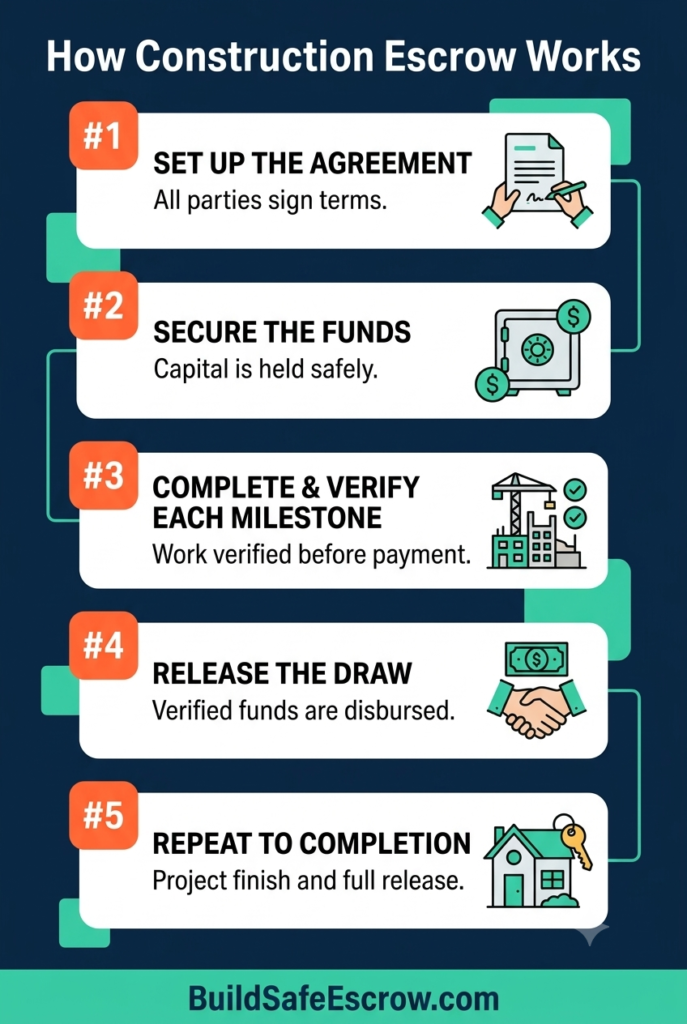
How construction escrow works, step by step
The process is straightforward, and it follows the same rhythm on a single-room remodel or a full custom home:
- Set up the escrow agreement. You, your contractor, and the escrow agent sign an agreement that spells out the scope of work, the project milestones, and the payment schedule tied to each one.
- Secure the funds. The project budget — all of it, or phase by phase — is deposited into the neutral escrow account before work begins.
- Complete and verify each milestone. When a stage is finished (framing, rough-in, drywall, and so on), a draw request is submitted and the work is confirmed through photos, inspection, or your approval.
- Release the draw. Once the milestone is verified, the escrow agent releases that portion of the funds to the contractor.
- Repeat to completion. The cycle continues, milestone by milestone, until the project is finished and the funds are fully and fairly disbursed.
You can see a fuller walk-through of the mechanics in our guide to construction escrow accounts. The key point for a homeowner is simple: money never moves ahead of the work.
What construction escrow protects you from
Understanding what is construction escrow becomes a lot clearer when you look at the specific risks it removes. Traditionally, homeowners hand over upfront deposits and keep writing checks as work progresses — which means at almost every stage, you’ve paid for more than you can see. Escrow flips that exposure. Because funds are released only after verified progress, you are protected from:
- The vanishing contractor: A contractor can’t disappear with a deposit that was never released to them.
- Paying for unfinished work: Each draw maps to a completed, verified milestone, so you never pay ahead of what’s actually done.
- Mid-project disputes: If a disagreement arises, the money stays safely in escrow until it’s resolved, rather than already being gone.
- Budget blowouts from mismanagement: Funds are earmarked for your project and released against progress, adding a layer of financial discipline.
Construction escrow vs. paying your contractor directly
When you pay a contractor directly, trust is doing all the work. You trust that the deposit will turn into progress, that the next payment is fair, and that the final check will match the finished job. When any of those assumptions breaks, your money is already in someone else’s account and you’re left chasing it.
With construction escrow, no one has to rely on trust. Your contractor can confirm the funds are secured before they start — which is why good contractors often welcome it — and you can confirm that nothing is released until work is verified. The arrangement is neutral by design, so it protects both sides equally. That’s a fundamentally different footing than a handshake and a large upfront check.
Who uses construction escrow?
Escrow scales to the project. Homeowners commonly use it for major undertakings — a whole-home remodel, a new custom build, an accessory dwelling unit (ADU), or a pool — where the sums are large enough that protecting them matters. But it’s just as useful on a single-room renovation where you simply want the peace of mind of milestone-based payments.
It isn’t only for homeowners, either. Contractors use it to guarantee they’ll be paid, developers use it to control funds across multi-unit projects, and HOAs and condo associations use it to protect reserve and assessment dollars on major repairs. The common thread is any project where a large sum needs to move safely between parties over time.
What to look for in a construction escrow service
Not all escrow arrangements are equal. A lender-based escrow tied to a construction loan can involve heavy paperwork and slow disbursement, while an independent construction escrow service is often more flexible and faster to work with. As you compare options, a few things separate a smooth experience from a frustrating one:
- Construction-specific expertise: An escrow agent who understands milestones, draw requests, and inspections will move faster and catch problems a generalist would miss.
- A clear, customized agreement: The escrow agreement should be tailored to your project’s scope and milestones — not a generic template.
- Transparent fees: Costs should be disclosed up front, with the option to split them between the parties.
- Prompt, well-documented disbursements: The whole point is releasing funds quickly once a milestone is verified, with a clean record of every draw.
You can dig into the specifics of how these agreements are structured in our overview of construction escrow agreements, which walks through each component in detail.
Is construction escrow worth the cost?
Escrow services charge a fee for managing the account and handling disbursements, and that fee is disclosed up front — often it can be split between the parties. Weighed against what it protects, the math is usually easy. A single lost deposit, a stalled job, or a payment dispute can cost far more than the escrow fee, in both money and stress. Think of it the way you’d think of any sensible safeguard: you don’t use it because you expect the worst, but because the protection is there when the unexpected happens.
So, what is construction escrow in the end? It’s the difference between hoping your renovation money is safe and knowing it is. By holding your funds neutrally and releasing them only for completed, verified work, escrow turns the riskiest part of a renovation — the money — into the most predictable. Whether you’re refreshing a bathroom or building from the ground up, it’s worth treating escrow not as an extra cost, but as essential protection for your investment.
Frequently Asked Questions
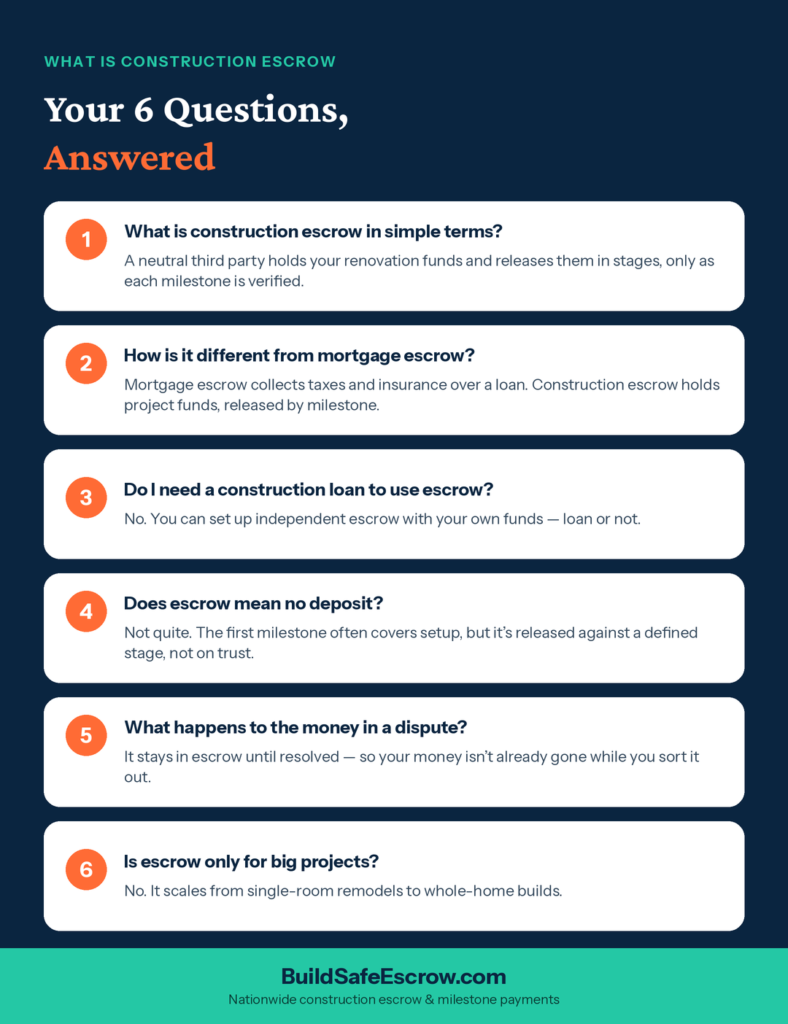
What is construction escrow in simple terms?
Construction escrow is a neutral third party holding your renovation or construction funds and releasing them to your contractor in stages, only as each milestone is completed and verified. It protects your money by making sure payments follow real, inspected progress instead of going out ahead of the work.
How is construction escrow different from a mortgage escrow account?
A mortgage escrow account collects money for property taxes and insurance over the life of a loan. Construction escrow is project-based: it holds the funds for a specific build or renovation and releases them in draws as work is completed. They share the neutral-third-party concept but serve entirely different purposes.
Do I need a construction loan to use escrow?
No. While escrow is common on lender-financed projects, a homeowner can set up an independent construction escrow account whether or not there’s a loan involved. You simply deposit your own project funds and have them released against milestones.
Does escrow mean I don’t pay any deposit?
Not necessarily. The first milestone often covers mobilization or setup costs, so the contractor is still paid early in the project. The difference is that even that first payment is released through the escrow structure against a defined milestone, rather than handed over on trust.
What happens to the money if there’s a dispute?
The funds stay in the escrow account until the disagreement is resolved. Because the milestones and expectations are defined in the escrow agreement up front, most disputes can be settled by revisiting what was agreed — and the money isn’t already gone while that happens.
Is construction escrow only for big projects?
No. Escrow structures scale from single-room remodels to whole-home builds. Any project where you want your funds protected and released against verified work is a candidate — the size just determines how the milestones are set.
References
- Investopedia — What Is Escrow and How Does It Work?
- Procore — Construction Escrow Accounts: What Contractors & Suppliers Need to Know
- Vergo — What Does Escrow Account Mean in Construction?
Protect your renovation money from the very first payment. Build Safe Escrow holds your funds in a secure, neutral account and releases them only for completed, verified work — nationwide. Learn more at BuildSafeEscrow.com or schedule a free consultation.