
Every contractor has lived some version of it: the work is done, the invoice is out, and suddenly the client goes quiet, questions a line item, or “isn’t happy” with something nobody mentioned until payment came due. Payment disputes are the single most expensive, relationship-souring, cash-flow-killing part of running a construction business — and the hard truth is that most of them are preventable. If you want to avoid payment disputes on every job, the work starts long before the final invoice. It starts the moment you write the contract, and it continues through every change order, every draw, and every signature along the way.
This guide walks through the specific, practical steps that keep disagreements from turning into standoffs — and shows how a neutral payment structure can remove the biggest source of conflict entirely.
Why payment disputes happen in the first place
Almost every payment dispute traces back to one of a handful of root causes: a vague scope of work, undocumented changes, unclear payment timing, or a simple breakdown in trust once real money is on the table. A client who feels uncertain about what they are paying for — or when — will hesitate, withhold, or nitpick. And on the contractor’s side, a job that was priced on a handshake and adjusted verbally along the way leaves you with no clean record to point to when the client’s memory of the deal differs from yours.
The pattern is remarkably consistent. Industry attorneys and lien specialists point to the same culprits again and again, and one of the most common is the verbal change order. In one widely cited example from Associated Builders and Contractors, a contractor completed roughly $150,000 in change-order work that the owner had approved out loud during site meetings but never signed off on in writing. When the final invoice arrived, the owner disputed the extras — and 90 days of failed negotiation followed before the contractor had to file a lien just to protect the claim. Every dollar of that fight was avoidable with a signature.
The first way to avoid payment disputes: a contract that leaves nothing to interpretation
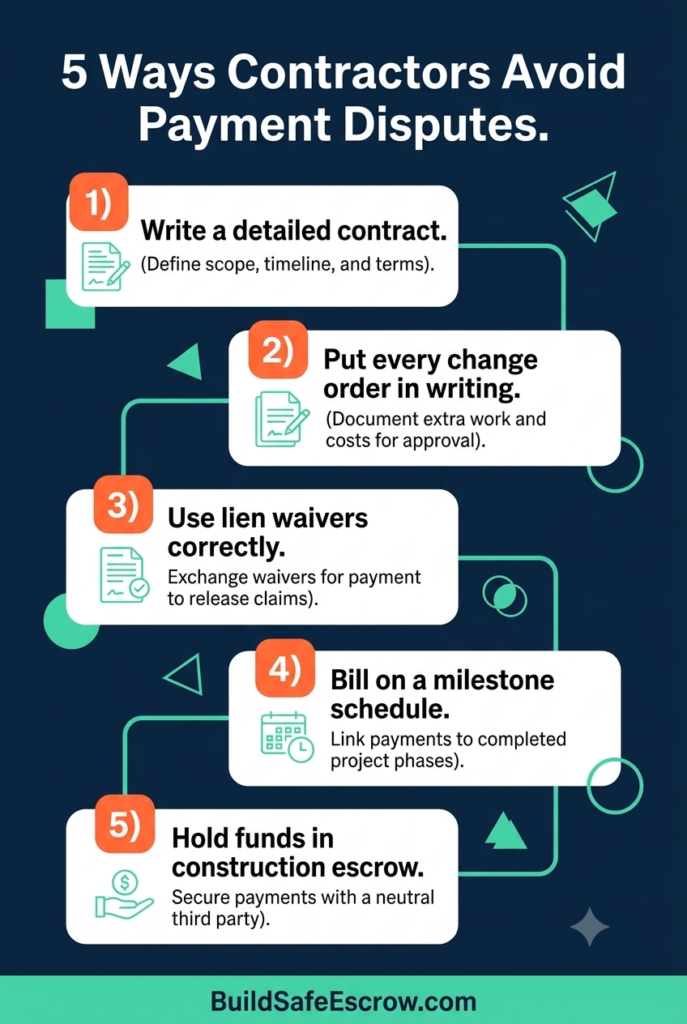
Your contract is your single best tool to avoid payment disputes, because it is the document everyone comes back to when there is a disagreement. A strong construction contract does more than state a price. It defines the exact scope of work, spells out what is and is not included, sets a clear payment schedule tied to defined milestones, and lays out the process for handling changes and disagreements before they arise.
At a minimum, your contract should nail down these elements in writing:
- Detailed scope of work: exactly what you will do, the materials and finishes included, and — just as important — what falls outside the job.
- A milestone-based payment schedule: how much is due and when, tied to defined stages of completion rather than vague dates.
- A written change-order process: how changes get priced, approved, and signed before the work happens.
- Terms for retainage, final payment, and completion: what “done” means and what triggers the last payment.
When expectations are documented this clearly, there is far less room for the “I thought that was included” conversation that derails final payment. The contract becomes a shared reference instead of a battleground.
Put every change in writing — no exceptions
Changes are inevitable on almost every job. The problem is never the change itself; it is the undocumented change. A client asks you to upgrade the tile, move a wall, or add a fixture while you are on site, you agree, you do the work — and weeks later, when it shows up on the invoice, they don’t remember approving the cost. Now it is your word against theirs, and you are the one holding the unpaid balance.
The fix is simple and non-negotiable: every change gets a written change order, priced and signed before the work proceeds. If a client directs a change verbally and you need to keep moving, follow up immediately in writing — even a short email confirming “per our conversation today, you’ve directed us to add X at a cost of Y” creates the paper trail that protects you. A documented change order turns a future argument into a settled fact.
Use lien waivers correctly at every payment
Lien waivers are one of the most powerful — and most misunderstood — tools for keeping payments clean. A lien waiver acts as a receipt: when a contractor, subcontractor, or supplier signs one, they acknowledge they have been paid for a defined amount of work and give up their right to file a mechanics lien for it. Exchanged properly, waivers keep the whole payment chain honest and give everyone confidence that the money is flowing as it should. According to AIA Contract Documents, contractors are often contractually required to submit waivers as a condition of each payment, and lenders frequently require them before releasing a draw.
The critical distinction is between conditional and unconditional waivers. A conditional waiver only takes effect once payment actually clears; an unconditional waiver takes effect the moment it is signed, regardless of whether the money ever arrives. As Levelset’s guide to lien waivers warns, signing an unconditional waiver before funds have cleared — or signing one with broad language that waives more than lien rights — has cost contractors real money. The safe practice is straightforward: use conditional waivers tied to each progress payment, reserve unconditional waivers for cleared final payments, and read every waiver for language that reaches beyond lien rights into your contractual claims.
Bill on a clear schedule and document the work
Ambiguity around timing is its own dispute generator. When a client isn’t sure when the next payment is due or what it covers, the payment gets slow-walked. Billing against a defined draw schedule — where each invoice maps to a completed, agreed milestone — removes the guesswork. The client knows exactly what they are paying for and can see the corresponding work in place.
Back that schedule with documentation. Dated progress photos, signed milestone approvals, inspection sign-offs, and a clear paper trail of communication all serve the same purpose: they turn “is this really done?” into a question with an obvious, evidenced answer. Contractors who bill on a rhythm and document as they go rarely find themselves arguing about whether a stage was finished, because the record already settles it.
How construction escrow removes the dispute at its source
Every strategy above reduces the odds of a fight. Construction escrow goes a step further and removes the most common trigger altogether: the question of whether the money is actually there and will actually be released. With escrow, the client’s project funds are deposited into a secure, neutral third-party account before the work begins. You can confirm the money is committed before you lift a tool, and it is released to you in draws — automatically tied to milestones as each stage is completed and verified.
That structure quietly resolves the things that usually spark disputes. The client can’t claim the money isn’t coming, because it is already held and committed. You aren’t chasing a payment that keeps slipping, because the draw releases on a verified milestone rather than a mood. And because a neutral third party is administering the schedule everyone agreed to, there is no ambiguity about who owes what and when. Construction escrow takes the emotion and the guesswork out of payment and replaces them with a documented, milestone-based process — which is exactly what it takes to avoid payment disputes before they start.
Combine it with the fundamentals — a detailed contract, written change orders, correct lien waivers, and disciplined billing — and you build a business where getting paid is predictable rather than adversarial. Disputes stop being a cost of doing business and start being the rare exception.
Frequently Asked Questions about how to avoid payment disputes with construction eswcrow
What is the best way for contractors to avoid payment disputes?
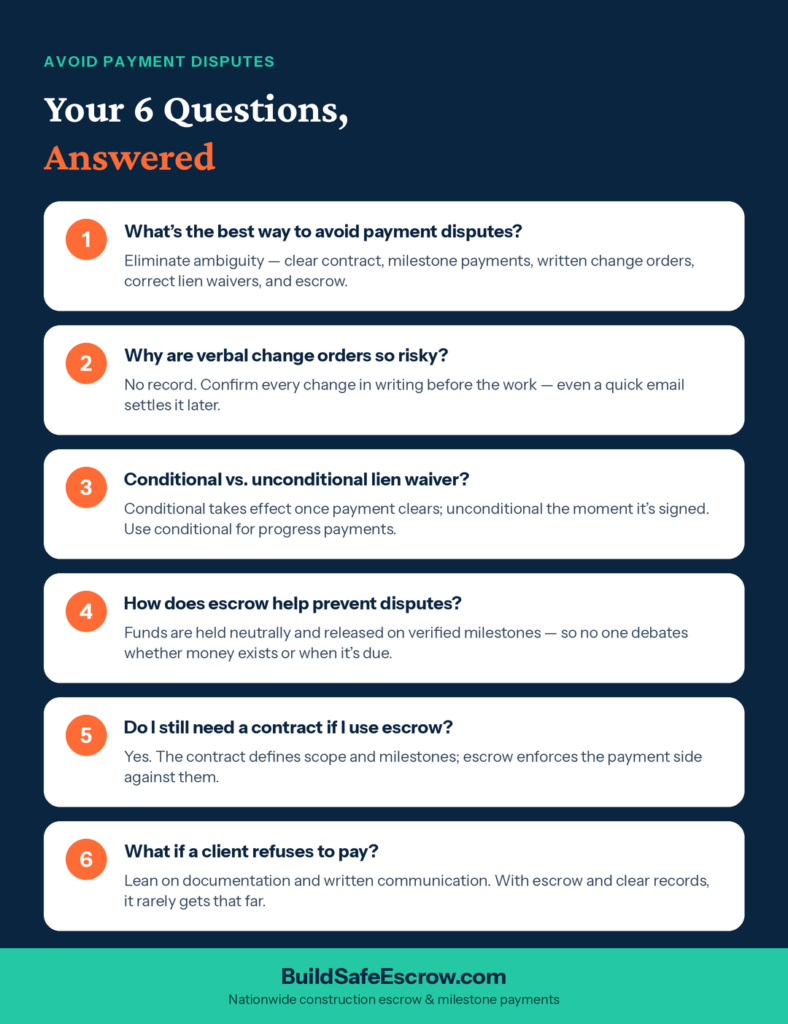
The most reliable way to avoid payment disputes is to eliminate ambiguity: a detailed written contract with a clear scope and milestone-based payment schedule, a written change-order process, correctly executed lien waivers, and disciplined billing backed by documentation. Adding construction escrow removes the biggest trigger by holding funds neutrally and releasing them on verified milestones.
Why are verbal change orders so risky?
Because they leave no record. When a client approves extra work out loud and later disputes the cost, it becomes your word against theirs — and courts and arbitrators often side with the written contract. Confirming every change in writing before the work proceeds, even with a quick follow-up email, turns a potential argument into a settled fact.
What is the difference between a conditional and unconditional lien waiver?
A conditional waiver only takes effect once payment actually clears, while an unconditional waiver takes effect the moment it is signed regardless of whether payment arrives. The safe practice is to use conditional waivers for progress payments and reserve unconditional waivers for final payments that have already cleared.
How does construction escrow help prevent payment disputes?
Escrow holds the client’s project funds in a neutral third-party account and releases them in draws as each milestone is completed and verified. That removes the two biggest dispute triggers — uncertainty about whether the money exists and disagreement over when it should be released — because the funds are confirmed up front and released on an agreed, documented schedule.
Do I still need a solid contract if I use escrow?
Yes. Escrow and a strong contract work together. The contract defines the scope, milestones, and change process; escrow enforces the payment side by holding and releasing funds against those milestones. Together they close nearly every gap a dispute could slip through.
What should I do if a client refuses to pay despite a clear contract?
Start with documentation: gather your contract, signed change orders, progress records, and payment history. Communicate in writing, flag the issue early, and try to resolve it directly. If that fails, mechanics lien rights and other remedies exist to protect your claim — but with escrow and clear documentation in place, it rarely reaches that point.
References
- AIA Contract Documents — The Basics of Waivers and Releases of Lien or Payment Bond Rights
- Levelset — The Ultimate Guide to Lien Waivers
- Associated Builders and Contractors (SoCal) — General Contractor Lien Rights, Deadlines and Risk Management
Make getting paid the predictable part of the job. Build Safe Escrow holds your client’s funds in a neutral account and releases them in draws as each milestone is completed and verified — so disputes have nowhere to start. Learn more at BuildSafeEscrow.com or schedule a free consultation.
Do you want to win more jobs and get paid in full and on time every time? Join our free Escrow Friendly Network.