
The Limits of Trust in Construction
Let’s be honest: in construction, “trust” has become a dangerous assumption. It’s not that contractors or homeowners are inherently untrustworthy—it’s that building projects, by nature, are complex, expensive, and vulnerable to miscommunication, delays, and financial mismanagement.
Too many projects begin with handshakes and high hopes, only to end in disputes, lawsuits, or worse—unfinished homes and depleted savings.
This is the problem construction escrow was designed to solve.
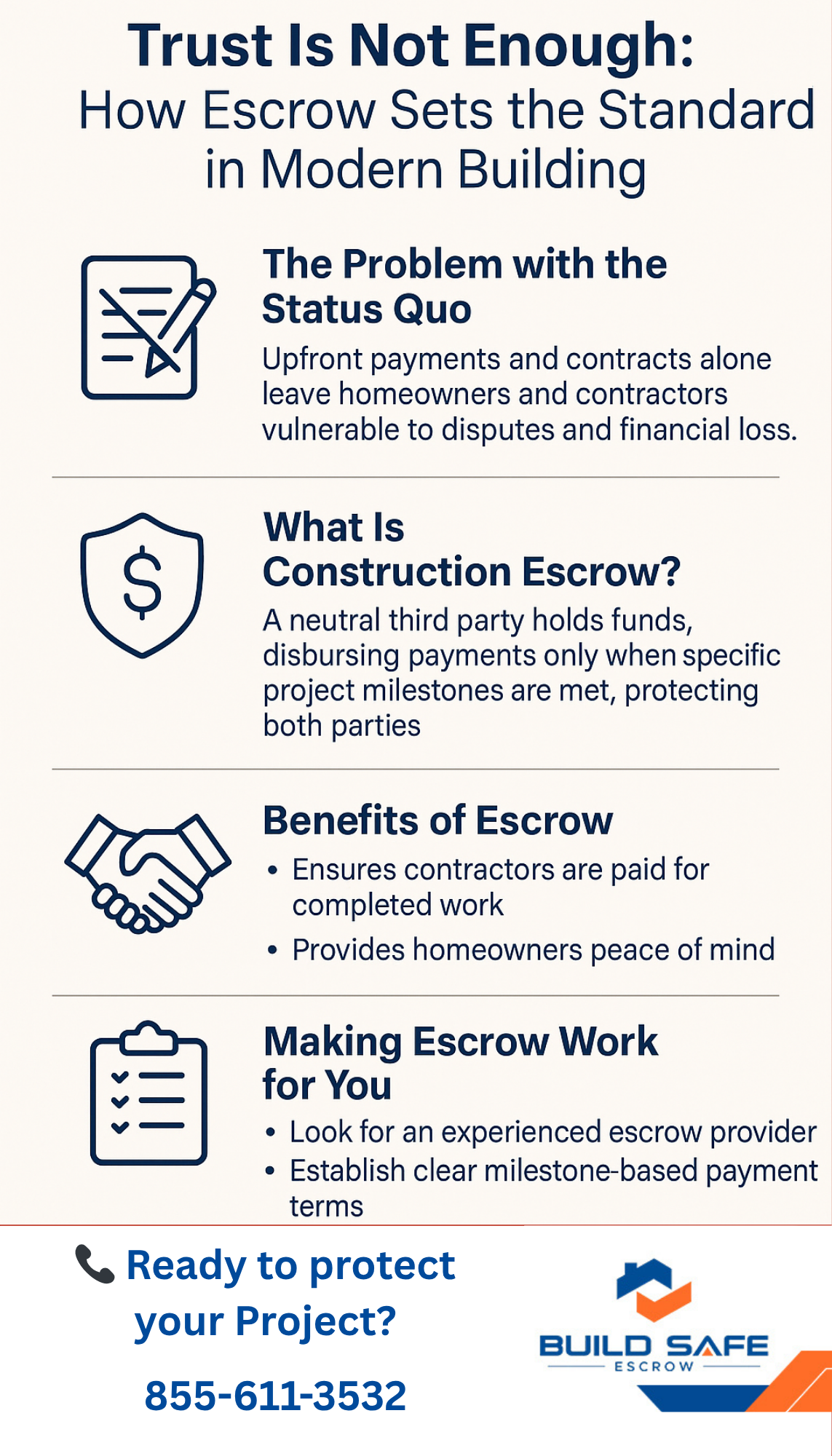
The Problem with the Status Quo
1.1: A Broken System of Blind Faith
Imagine paying for half a kitchen remodel before the first tile is laid, only to have your contractor disappear, go over budget, or delay the job by months. It happens more often than most care to admit. According to the Better Business Bureau, contractor-related complaints consistently rank in the top five annually.
Trust is not a plan. It’s a gamble.
1.2: Why Contracts Alone Don’t Cut It
Many homeowners believe a written contract is enough to protect them. It’s a good start—but unless there’s a mechanism to enforce it in real time, it’s little more than paper. Even with “payment upon completion” clauses, contractors often ask for large upfront sums to “buy materials” or “secure the schedule,” leaving property owners vulnerable.
There’s a reason contractors still chase final payments and homeowners fear scams: there’s no neutral party holding the money and the timeline accountable.
What is Construction Escrow?
2.1: Definition and Basics
Construction escrow is a financial agreement where project funds are held by a neutral third party—an escrow company—until specific project milestones are completed and approved by all parties.
It ensures:
- Homeowners don’t overpay for incomplete work.
- Contractors get paid promptly once work is verified.
- Disputes are drastically reduced through clear, milestone-based payments.
2.2: Why Escrow Is Different
Construction escrow introduces what most projects lack: financial accountability that matches project progress. Instead of trusting someone to “do the right thing,” everyone agrees in advance to when, how, and why payments are released.
Read our blog: The #1 Smart Way to Protect Your Renovation Budget with Construction Escrow
Escrow in Action – A Tale of Two Projects
3.1: Without Escrow: The Lopez Family’s Kitchen Disaster
Maria and Daniel Lopez saved for years to remodel their Miami home. They hired a contractor, paid 50% upfront, and assumed the best. But after some demolition and a few cabinets installed, the contractor vanished—along with their $35,000.
They sued, but recovery was nearly impossible. Their kitchen sat gutted for nine months. Trust, once broken, couldn’t rebuild the walls.
3.2: With Escrow: How George Protected His Investment
George, a data engineer, was no stranger to risk mitigation. When he bought a duplex to renovate and rent out, he knew better than to release funds blindly. He used construction escrow.
Every payment—from demo to roofing to final paint—was tied to completed, verified work. The contractor never had to chase checks, and George never worried about fraud. The job was done on time, on budget, and without sleepless nights.
The Benefits of Construction Escrow
4.1: For Homeowners and Developers
- No upfront payment pressure: You can fund the escrow account in full or in phases—but payments don’t release until milestones are met.
- Financial protection: If a contractor walks off the job or goes bankrupt, unused funds remain untouched.
- Peace of mind: You’re not managing payment logistics; your escrow company is.
4.2: For Contractors
- Guaranteed payment: Once you hit a milestone, the funds are ready.
- Builds credibility: Offering escrow shows clients you’re confident and transparent.
- Eliminates cash flow stress: No more fighting for deposits or final checks.
Read our blog: The Renovation Playbook: 7 Financial Rules Every Homeowner Must Follow
Why Escrow Is Becoming the New Industry Standard
5.1: The Rise of Smart, Tech-Savvy Consumers
Homeowners today aren’t just writing checks—they’re doing research. They expect digital contracts, payment apps, and project transparency. Construction escrow fits that mindset perfectly.
5.2: Lenders and Insurance Companies Are Catching On
Many lenders now require draw inspections and escrow-like controls to protect their investment. Escrow aligns with those expectations and can even expedite financing approvals.
5.3: Contractors Want Fewer Headaches
Good contractors don’t want to chase payments or get into fights. Escrow reduces admin time, prevents cash gaps, and fosters trust without blind faith.
Making Escrow Work For You
6.1: What to Look for in a Construction Escrow Provider
- A licensed and insured third-party
- Clear construction escrow agreement outlining milestones
- Online portal access for all parties
- Transparent fee structure
- Experience handling residential and commercial projects
At Build Safe Escrow, we do all of this—and more. We tailor each escrow to the project, whether you’re renovating a kitchen, building an ADU, or managing a large-scale condo rehab.
6.2: How to Get Started
- Get a contract or project quote from your contractor.
- Set up your construction escrow account—you can fund it all at once or in stages.
- Agree on milestones (with help from our team if needed).
- Work begins only after funds are secured.
- Payments release only after both parties confirm milestone completion.
It’s that simple.
Conclusion: Why Escrow Is the New Trust
Trust, in construction, is no longer a matter of faith—it’s a system. And construction escrow is the backbone of that system.
It doesn’t replace trust; it enhances it. By aligning expectations, securing payments, and preventing disputes, escrow transforms the construction experience—from chaotic and risky to calm and professional.
Whether you’re a homeowner protecting your savings, a contractor protecting your time, or a developer protecting your investment, one thing is clear:
In modern building, trust is not enough. Escrow is the standard.
Read our blog: Protecting Your Renovation Funds: Why Construction Escrow is Essential
Final Thoughts: It’s Time to Build Smarter
Trust may start the project—but construction escrow is what finishes it. It’s not just a safety net; it’s a smart financial tool that brings order, transparency, and protection to a process that’s too often driven by uncertainty.
In a world where one misstep can cost thousands, don’t settle for wishful thinking. Whether you’re a property owner, contractor, developer, or architect, escrow is the easiest way to make sure your hard work—and your money—is protected.
✅ Ready to stop gambling with your renovation or build?
👉 Set up a free consultation with Build Safe Escrow today.
We’ll walk you through the process, help you define clear milestones, and give you the peace of mind that your project—and your payments—are in safe hands.
🔗 Schedule your free consultation now
Let’s build with confidence. Let’s build safe.
- ADU Construction Escrow: How Investors Fund a Backyard Build Only as the Work Gets Done
 Funding an ADU you rarely get to visit? ADU construction escrow ties every draw to a verified stage, from permits to final inspection, so your capital becomes a finished, rentable unit.
 - No Deposit Contractor? How to Start Work Without a Deposit and Still Get Paid
 Clients keep refusing big deposits, and starting unfunded is a risk no builder should carry. Here is how to skip the deposit, have the client fund escrow first, and get paid on verified milestones.
 - How to Set Up a Construction Escrow Account: A Homeowner’s Step-by-Step Guide
 Before you wire a renovation deposit, settle seven decisions, gather your documents and ask any provider five questions. This homeowner guide shows how to set up a construction escrow account in the right order.
 - HOA Roof Replacement Escrow: How Property Managers Protect Reserve Funds on the Biggest Job
 A roof is often the biggest check a board writes. Here is how property managers use milestone-based escrow to protect reserve funds, keep the roofer paid on time, and document every release.
 - Paying Cash to Build a House? How Homeowners Keep Control of Every Draw
 No construction loan means no bank inspector checking your draws. This guide shows how homeowners paying cash rebuild that structure, so money never moves ahead of the work.
 - Proof of Funds for Construction: How Builders Confirm the Client Can Pay Before Breaking Ground
 A bank statement shows the money today, not on draw day. Learn how builders ask for proof of funds early, tie payments to milestones, and keep cash-client funds committed in escrow.
 - Contractor Payment Process for Property Managers: How to Build One That Survives an Audit.
 Sooner or later an owner asks who approved that payment. This guide gives property managers five controls and a simple payment file that make every contractor invoice audit-ready.
 - Construction Draw Verification: How Investors Know Their Capital Went Into the Build.
 Monthly photos show activity, not proof. This guide shows passive investors the six checks that tie every construction draw to verified work, plus the one test that catches a budget running short.
 - What Is Retainage in Construction? A Subcontractor’s Guide to Getting the Last 10% Paid
 Retainage is money you already earned, held until someone else says the job is done. This guide shows subcontractors what state law now limits and seven contract moves that get the last 10% paid sooner.
 - Commercial Build-Out Escrow: Who Should Hold the Money, and Who Should Not
 Commercial tenants pay to build inside a space they do not own. Here is who should hold the build-out money, how to stop a lien landing on you, and what to expect from an escrow provider on a large project.
 - How to Vet a Home Builder Before Signing a Contract: A Homeowner’s Guide
 Seven checks that catch a builder who is talented and broke at the same time, the things you should never agree to, and how escrow removes the consequences of guessing wrong.
 - Paying Contractors Upfront: A Homeowner’s Guide to Deposits, State Rules, and Safer Alternatives
 How much deposit is normal, which states cap it, what the money legally covers, and the structure that lets owners fund a project without paying ahead of the work.
 - Home Renovation Cost in 2026: What Owners Should Budget, State by State
 What a renovation really costs in 2026, why the same kitchen is priced differently in Texas and New York, and how owners keep every dollar tied to finished work.
 - Construction Escrow for Contractors: How It Works and How You Get Paid
 Escrow from the contractor’s seat: proof the money exists before you start, a milestone schedule you help write, and payment that arrives on verification instead of on a promise.
 - How Construction Escrow Works: A Simple Guide for Property Owners
 A plain walkthrough of how construction escrow works for homeowners funding a renovation or build: where the money sits, when it moves, and what happens if a contractor stops.
 - Construction Escrow for Property Managers: How It Works, Simplified
 A plain walkthrough of construction escrow for property managers: how funds are held, how milestones get verified, and how the whole thing becomes a report your owners can read.
 - Property Manager Vendor Payments: How to Pay Contractors Across a Portfolio Without Carrying the Risk
 A property manager’s guide to paying contractors and vendors across a portfolio without becoming the one who absorbs the risk: verified releases, lien protection, and a structure that keeps owner funds separate and accountable.
 - Tenant Improvement Allowance Escrow: Who Holds the Money, and When It Releases
 A commercial tenant’s guide to the TI allowance: why the money usually arrives last, what that does to your build-out, and how escrow puts the landlord’s contribution and your contractor’s draws on the same verified schedule.
 - Before Signing a Construction Contract: 9 Checks Every Homeowner Should Make
 A homeowner’s checklist for the hour before you sign: the nine things to verify in a construction contract, and the one clause that decides whether your deposit is ever at risk.
 - How to Evaluate a Home Builder Before Signing a Contract: A Homeowner’s Guide
 Most builder problems are visible before the contract is signed, if you know where to look. Here is how to evaluate a home builder on licensing, money, and structure, plus the terms no homeowner should accept.
 - Verify Construction Progress Remotely: A Proven Playbook
 Your money is in one state and your project is in another. A verification stack that tells you what is actually built, and a payment structure that acts on it.
 - Pay When Paid Clauses: The Sentence in Your Contract That Delays Every Check
 One sentence in your subcontract decides when you get paid, and most subs sign it without reading twice. What a pay when paid clause really means, and the structure that makes it irrelevant.
 - Home Renovation Payment Schedule: The Smart Way to Stage Every Payment
 The payment schedule decides who carries the risk on your renovation. Structure it around verified milestones and the biggest check of your year stops being a leap of faith.
 - Change Order Payment: Proven Ways to Stop Losing Money
 The work that wasn’t in the contract is the work you’re least likely to get paid for. Here are five fixes that turn every change order payment from an argument into a scheduled release.
 - How Should an HOA Pay a Contractor (HOA boards)
 Board members ask how should an HOA pay a contractor because the money is not theirs. It belongs to every homeowner in the community. Here is the payment structure that protects it.
 - Contractor Went Out of Business? Smart Recovery Steps
 When your contractor went out of business mid-project, panic is natural — but there is a clear sequence of moves that protects your money, your property, and your restart. Here it is.
 - Retainage in Construction: Stop Losing 10% of Every Job to a Waiting Game
 On a 10% margin, 10% retainage means you finished the job and haven’t earned a dollar yet. Here’s how to negotiate it down, track it like the receivable it is, and get it released on verification instead of goodwill.
 - Contractor Asking for Money Upfront? When It’s Normal — and When to Walk
 An upfront request isn’t automatically a scam — but it isn’t automatically safe, either. Here’s the number that’s normal, the signs that mean walk, and the structure that protects every dollar.
 - Contractor Final Payment: How to Make Sure You Get the Last Check
 The last ten percent is the hardest ten percent. Here is how contractor final payment actually gets released, why it stalls, and the structure that ends the wait.
 - The Safest Way to Pay a Contractor (And Why Zelle Isn’t It)
 Some payment methods can be reversed. Most cannot. Here is the safest way to pay a contractor, ranked by how much protection each method actually gives you.