
Home renovations are exciting. They promise a fresh start, increased property value, and the joy of finally living in a space that reflects your style. But beneath the surface of paint swatches and tile samples is a financial reality many homeowners underestimate. Mismanaging home renovation payments can quickly turn your dream project into a costly nightmare.
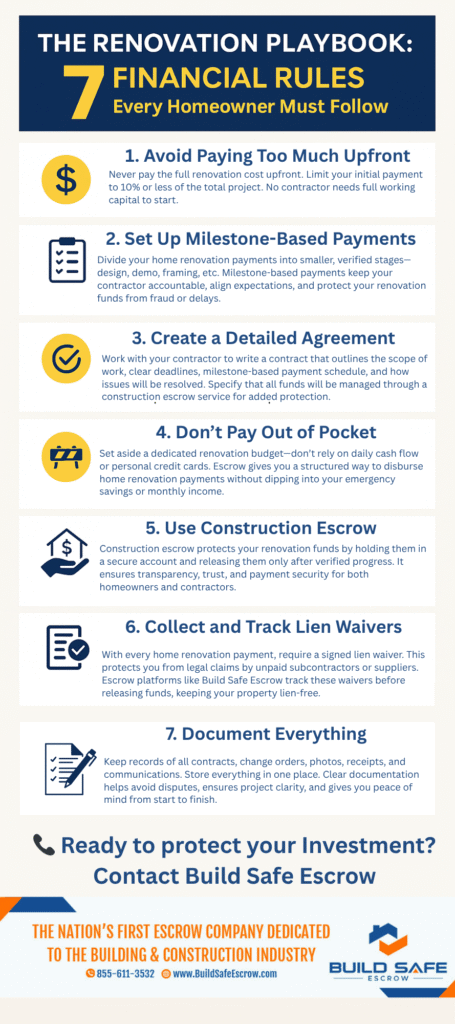
If you’re planning a renovation, it’s crucial to have a smart financial game plan. In this guide, we break down the 7 financial rules every homeowner must follow to protect their renovation funds and ensure smooth progress from demo day to final walkthrough. These rules aren’t just for peace of mind—they’re the foundation of a financially secure renovation experience.
Rule 1: Don’t Pay Everything Upfront
Let’s start with the biggest mistake homeowners make: paying the contractor too much upfront. It might seem like a gesture of trust, but in reality, it puts you at risk. If a contractor disappears, delays the project, or delivers subpar work, your money is already gone.
You should never pay for the entire renovation upfront. In fact, we recommend not paying more than 20% of the total project cost before work begins. No reputable contractor needs that much working capital to start a job. A modest deposit is reasonable—but large upfront payments open the door to potential abuse.
This is especially true when you’re dealing with high-value renovations. Whether it’s a kitchen remodel, bathroom upgrade, or full-home overhaul, starting off with too large a payment is a common way homeowners lose control of their funds.
Construction escrow is the smarter solution. With escrow, funds are held by a neutral third party and only released when agreed-upon milestones are met. This system keeps your contractor motivated and ensures you maintain financial control throughout the renovation.
Home renovation payments should be structured as milestone-based payments, not lump sums. You wouldn’t hand over a check for a house before it’s built—so why do it for a renovation?
Rule 2: Use Milestone-Based Payments
Milestone-based payments divide your renovation into logical phases: design, demolition, framing, plumbing, finishes, etc. At each stage, a portion of your funds is released once the work is verified as complete.
This payment structure:
- Encourages accountability and quality work
- Protects against delays and fraud
- Keeps both parties aligned on expectations
- Prevents front-loading of payments for incomplete work
For example, instead of paying 50% of the total cost after demo, you could break it into 10-15% increments as each phase is finished. With this method, you know that the funds are working for you, not sitting in someone else’s account with no leverage.
Construction escrow services like Build Safe Escrow specialize in milestone-based payment systems that ensure funds are only disbursed when progress is verified. It’s an added layer of professionalism and security that homeowners deserve.
Rule 3: Put Everything in Writing
A solid renovation contract isn’t just about the scope of work—it should clearly outline your home renovation payment schedule, key deliverables, deadlines, and how issues will be resolved.
Make sure your contract includes:
- A breakdown of costs per milestone
- Timelines tied to each payment
- A clause that funds are held in construction escrow
- Requirements for lien waivers with each payment
Don’t rely on verbal agreements or email chains alone. Your contract should also include terms for handling change orders, delays, and unforeseen conditions. Having these details in writing minimizes disputes and keeps everyone on the same page.
If you’re unsure what should be in the contract, consult a construction attorney or use a template from a trusted escrow provider like Build Safe Escrow.
Rule 4: Vet Your Contractor Thoroughly
Before spending a single dollar, do your due diligence. Look for red flags such as vague estimates, lack of insurance, or a demand for full payment upfront. Renovations often go wrong not because of materials or design—but because of poor hiring decisions.
Ask for:
- References from recent renovation clients
- Proof of license and insurance
- Portfolio of recent projects
- A willingness to work with milestone-based payments through an escrow service
Also check their online reviews, Better Business Bureau rating, and litigation history if available. A contractor who values transparency and accountability will support using construction escrow as part of the process.
Rule 5: Protect Your Renovation Funds with Construction Escrow
We can’t stress this enough: using construction escrow is one of the most effective ways to protect renovation funds.
Escrow ensures:
- Your money is held safely by a neutral third party
- Payments are only made when progress is confirmed
- Both homeowner and contractor are protected from financial missteps
- There is a written agreement on when and how money is released
It’s like having a financial referee in your corner—ensuring that each side upholds their part of the deal. Homeowners gain peace of mind, and contractors benefit from clear, reliable payment structures.
With over 10 years of experience managing escrow accounts, Build Safe Escrow has helped homeowners avoid thousands in potential losses and complete their renovations with confidence.
Rule 6: Request and Track Lien Waivers
Every time you make a home renovation payment, you should receive a signed lien waiver. This document proves that the contractor or subcontractor has been paid and waives their right to file a lien against your property.
Failing to secure lien waivers can lead to legal nightmares—even if you’ve already paid. Unpaid subcontractors or suppliers can still file liens against your home, jeopardizing your finances and your title.
Using a construction escrow service simplifies this process. At Build Safe Escrow, for example, lien waivers are uploaded, reviewed, and tracked through our platform before any funds are released. This automation ensures your protection without paperwork headaches.
Rule 7: Communicate and Document Everything
Renovations are dynamic, and scope changes are common. That’s why it’s essential to keep a clear record of communications, change orders, approvals, and updated estimates.
Pro tip: Use a platform or shared folder to store all renovation documents—including home renovation payment receipts, signed contracts, milestone verification photos, and lien waivers.
Also, conduct weekly check-ins with your contractor to review progress, flag any issues early, and stay aligned. Good communication is the secret to keeping stress low and your project on time.
Real-World Scenario: Why These Rules Matter
Meet Lisa, a first-time homeowner who wanted to modernize her 1970s kitchen. She hired a contractor referred by a neighbor and paid $30,000 upfront. After demo day, the contractor became unresponsive. Deadlines were missed, corners were cut, and eventually, the contractor walked off the job halfway through.
Lisa was devastated. The funds were gone. She had no written milestones, no lien waivers, and no way to recover what she lost.
Fast forward to her second renovation: this time, she used construction escrow. Payments were tied to clear project milestones, and each payout was released only after verified completion and signed lien waivers. The result? A stress-free, on-time, on-budget kitchen she now proudly shows off to friends.
Her biggest takeaway? “I finally felt like I was in control. I knew my money was safe, and the project stayed on track because we had a system.”
FAQs: Home Renovation Payments & Escrow
Q: Should I pay my contractor upfront?
A: Never pay everything upfront. Use milestone-based payments and hold funds in construction escrow for protection.
Q: What are milestone payments in construction?
A: Payments made after specific phases of work are completed and verified. They align incentives and reduce risk.
Q: How does construction escrow protect renovation funds?
A: It ensures your money is held by a third party and only released when milestones are met, preventing fraud or incomplete work.
Q: What if my contractor refuses to use escrow?
A: That’s a red flag. Contractors who value transparency and accountability will welcome escrow as a fair, protective tool.
Q: Can I still use escrow for small projects?
A: Yes. Even for smaller renovations, escrow ensures that every dollar is released only after verified work. It’s scalable and flexible.
Final Thoughts
Your home is likely your most valuable asset. Treat your renovation project like a business transaction, not a handshake deal. With construction escrow and milestone-based payments, you protect yourself, your investment, and your peace of mind.
The financial rules above aren’t just best practices—they’re essential safeguards for anyone planning a remodel. By following this playbook, you can enjoy the excitement of transformation without the fear of financial chaos.
Take control. Protect your renovation funds. Pay smart.
About Build Safe Escrow
Build Safe Escrow is a third-party construction escrow company helping homeowners, contractors, and developers secure their projects with milestone-based payment systems. With over 10 years of experience, we make home renovation payments safer, clearer, and conflict-free.
Ready to Renovate with Confidence?
Whether you’re in the planning phase or already mid-project, it’s never too late to bring in a referee.
Partner with Build Safe Escrow and secure your renovation with milestone-based payments and third-party fund protection. Contact us today to open your construction escrow account and build with peace of mind.
Build Safe Escrow – Trust at every milestone.
📩 Contact us today to schedule your free consultation and explore how construction escrow can simplify and secure your next project.
📞 Call us at (855) 611-3532
🌐 Visit www.buildsafeescrow.comContact us to learn more about how construction escrow can work for your renovation.