
If you’ve ever worked in construction—on either side of the contract—you’ve probably experienced the stress that comes with money. Payments that arrive late. Disputes over what’s considered “finished.” Clients who suddenly vanish. Contractors walking off the job. In the middle of blueprints and progress photos, what truly causes most construction relationships to fail isn’t quality—it’s payment.
The construction industry has long operated under a system of handshake agreements, ambiguous payment schedules, and reactive problem-solving. But the tide is turning. A growing number of property owners, contractors, and developers are shifting toward a new standard—construction escrow. And with it, they’re not only protecting their money, but reducing conflict, preventing lawsuits, and transforming the entire payment process.
This is a closer look at how escrow is becoming the quiet revolution behind more successful builds—and why it might be time to reimagine the way payments are handled on your next project.
A Contractor’s guide to Construction Escrow
The Problem with Traditional Payments in Construction
Let’s set the stage. In most home or commercial renovation projects, payments are loosely structured into three phases:
- A deposit or upfront payment (often 30–50% of the total job)
- A second payment when the work is “about halfway done”
- A final payment at project completion
Sounds reasonable. Until reality hits.
What counts as halfway? Who decides if the work is truly done? What happens if the contractor feels underpaid—or the client feels overcharged? And worst of all, what recourse does either party have if the other backs out?
These scenarios play out every day across the country, and they’re not small hiccups. According to multiple consumer reports and industry studies, construction-related disputes are one of the top causes of small claims and civil litigation in the United States. Legal costs, delays, and broken relationships are far too common.
In most cases, disputes arise from the same root issue: lack of structure and accountability around payments. It’s not that the contractor is dishonest or the property owner is unreasonable—it’s that the system is fundamentally flawed.
What Is Construction Escrow?
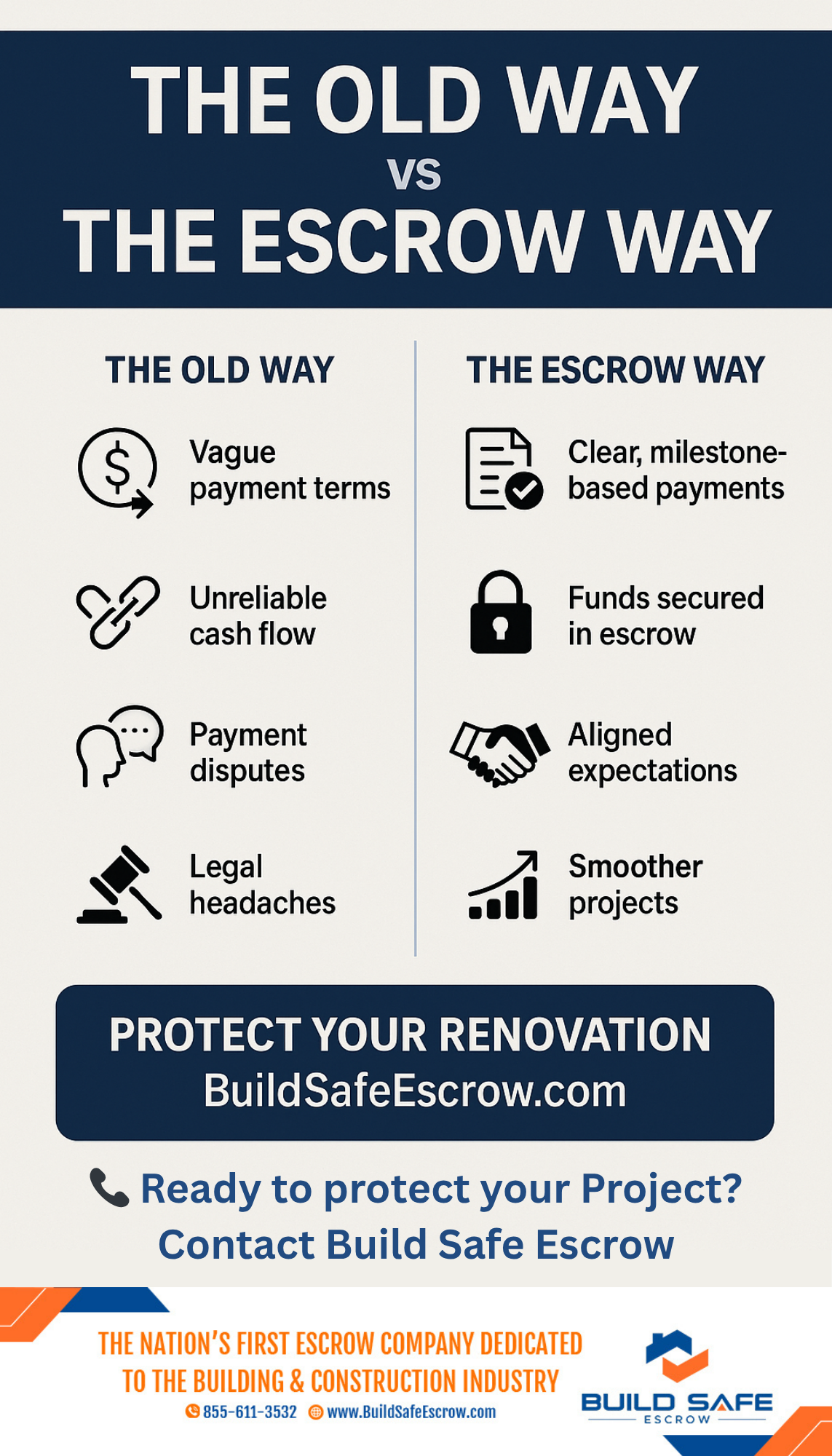
Construction escrow replaces the traditional, vague system with a milestone-based payment structure managed by a neutral third party.
Here’s how it works:
- Step 1: The property owner and contractor agree on a set of project milestones, each tied to a specific payment amount.
- Step 2: Funds are deposited into a secure, FDIC-insured escrow account—either all at once or in stages.
- Step 3: As each milestone is completed and verified, the escrow provider releases the corresponding funds to the contractor.
At no point is either party relying on “good faith” to move money. The terms are clear. The process is structured. And the outcome is far more predictable.
This is how construction escrow transforms contractor payments—not by making them complicated, but by making them clear.
A Real-Life Example: From Dispute to Done
Consider the case of Sarah and James, a couple in Austin who hired a contractor to renovate their aging kitchen and outdated master bathroom. The total project cost was $85,000. Without escrow, they paid 40% upfront. Demolition began quickly, but the timeline started to slip. Materials were delayed. The contractor stopped returning calls regularly. By the time half the project was supposedly done, another payment was requested—but little progress was visible.
Unsure of what to do, Sarah and James pushed back. The contractor walked off the job, claiming nonpayment. A legal dispute followed. It took nearly 6 months and thousands in attorney fees before they could resolve it—and restart the project with someone else.
Now compare that to a recent client of ours, Carlos, a general contractor in Miami. On a recent $110,000 residential buildout, he used Build Safe Escrow to manage milestone-based payments with his client. The project was divided into six milestones, and each payment was released only after completion and approval.
What changed? No delays. No fights. No legal threats. Just smooth progress. Carlos reported higher client satisfaction—and noted that the structure of escrow actually helped him better manage his subcontractors and timeline.
Why Contractors Benefit Most from Escrow
There’s a common misconception that escrow only protects the property owner. In reality, the greatest long-term benefits are often experienced by contractors.
Here’s why:
1. Guaranteed Payment (If the Work Is Done Right)
Once funds are in escrow, they’re no longer hypothetical. The money is real, secured, and waiting for disbursement. Contractors don’t have to worry about bounced checks or excuses.
2. Fewer Payment Delays
Escrow eliminates the need for awkward payment follow-ups. Contractors don’t have to chase down clients or re-negotiate midway. The rules are already in place, and the release of funds follows completion.
3. Dispute Prevention and Documentation
If issues arise, the escrow agreement serves as a central, binding reference. This greatly reduces ambiguity and finger-pointing.
4. Enhanced Professional Image
Contractors who use escrow present themselves as serious professionals. This appeals especially to high-end clients, investors, and out-of-state property owners who prioritize safety and transparency.
The Legal Angle: Fewer Lawsuits, Fewer Surprises
In traditional contracts, the gray areas around payment and performance often create fertile ground for litigation. When timelines shift, budgets swell, or expectations don’t align, each party clings to their interpretation of fairness.
With escrow in place, many of these variables are removed.
- The funds are no longer in the contractor’s or client’s control—only the escrow provider releases them, based on previously agreed-upon benchmarks.
- Any change orders or scope adjustments can be addressed with addendums, preserving clarity.
- Most importantly, the potential for withheld payments or abandoned work is dramatically reduced.
Escrow doesn’t just improve outcomes—it often prevents the need for lawyers altogether.
Milestone Payments in Action
Here’s a basic example of what a milestone-based payment schedule might look like:
| Milestone | Description | Amount |
| Initial Deposit | Contract signing, permits pulled | $15,000 |
| Demolition + Site Prep | Demo, debris removal, site ready | $10,000 |
| Rough Plumbing + Electrical | Infrastructure in place, inspections passed | $20,000 |
| Framing + Drywall | Walls up, structural framing complete | $18,000 |
| Cabinets, Fixtures, Flooring | Visible finish work begins | $22,000 |
| Final Walkthrough | Punch list completed, satisfaction signed | $15,000 |
Each of these milestones can be verified through photos, walkthroughs, or city inspection approvals. Once approved, the funds for that milestone are released.
The benefit is clear: accountability becomes baked into the build.
Escrow for HOAs, Developers, and Designers
Construction escrow isn’t just for homeowners and contractors. We’ve seen growing adoption across:
- HOAs and Condo Boards: Transparency is essential when using shared funds. Escrow keeps members informed and protected.
- Developers: Especially in projects involving investor capital or EB-5 visa programs, escrow adds credibility and financial discipline.
- Architects and Designers: Recommending escrow protects their vision and ensures the client finishes what was started.
No matter the project size, the structure that escrow brings is universally valuable.
Is Construction Escrow Right for Your Project?
If you’ve ever dealt with late payments, contractor disputes, or scope changes that turned into standoffs—yes, it is.
If you’re a contractor who wants to operate more professionally, get paid faster, and build a reputation for integrity—absolutely, yes.
And if you’re a property owner investing your life savings into a renovation—you owe it to yourself to protect those funds.
Construction escrow is not just for “big” jobs. It’s for any project where trust matters—and where clear financial boundaries can mean the difference between completion and catastrophe.
How to Get Started
At Build Safe Escrow, we make it easy to integrate escrow into your project:
- Share your contractor agreement or proposal
- We help create a milestone schedule tailored to your project
- Funds are deposited into escrow (in full or stages)
- Payments are released as work is completed and approved
Our team works with property owners, contractors, HOAs, architects, and developers nationwide. Whether you’re remodeling a bathroom or building a multifamily unit—we’re here to make sure your project is safe, structured, and drama-free.
If you’re ready to move forward with a smarter way to build, we invite you to
👉 Schedule a free consultation and learn how Build Safe Escrow can protect your next project.
Let’s build something better—together.
- Home Renovation Cost in 2026: What Owners Should Budget, State by State
 What a renovation really costs in 2026, why the same kitchen is priced differently in Texas and New York, and how owners keep every dollar tied to finished work.
 - Construction Escrow for Contractors: How It Works and How You Get Paid
 Escrow from the contractor’s seat: proof the money exists before you start, a milestone schedule you help write, and payment that arrives on verification instead of on a promise.
 - How Construction Escrow Works: A Simple Guide for Property Owners
 A plain walkthrough of how construction escrow works for homeowners funding a renovation or build: where the money sits, when it moves, and what happens if a contractor stops.
 - Construction Escrow for Property Managers: How It Works, Simplified
 A plain walkthrough of construction escrow for property managers: how funds are held, how milestones get verified, and how the whole thing becomes a report your owners can read.
 - Property Manager Vendor Payments: How to Pay Contractors Across a Portfolio Without Carrying the Risk
 A property manager’s guide to paying contractors and vendors across a portfolio without becoming the one who absorbs the risk: verified releases, lien protection, and a structure that keeps owner funds separate and accountable.
 - Tenant Improvement Allowance Escrow: Who Holds the Money, and When It Releases
 A commercial tenant’s guide to the TI allowance: why the money usually arrives last, what that does to your build-out, and how escrow puts the landlord’s contribution and your contractor’s draws on the same verified schedule.
 - Before Signing a Construction Contract: 9 Checks Every Homeowner Should Make
 A homeowner’s checklist for the hour before you sign: the nine things to verify in a construction contract, and the one clause that decides whether your deposit is ever at risk.
 - How to Evaluate a Home Builder Before Signing a Contract: A Homeowner’s Guide
 Most builder problems are visible before the contract is signed, if you know where to look. Here is how to evaluate a home builder on licensing, money, and structure, plus the terms no homeowner should accept.
 - Verify Construction Progress Remotely: A Proven Playbook
 Your money is in one state and your project is in another. A verification stack that tells you what is actually built, and a payment structure that acts on it.
 - Pay When Paid Clauses: The Sentence in Your Contract That Delays Every Check
 One sentence in your subcontract decides when you get paid, and most subs sign it without reading twice. What a pay when paid clause really means, and the structure that makes it irrelevant.
 - Home Renovation Payment Schedule: The Smart Way to Stage Every Payment
 The payment schedule decides who carries the risk on your renovation. Structure it around verified milestones and the biggest check of your year stops being a leap of faith.
 - Change Order Payment: Proven Ways to Stop Losing Money
 The work that wasn’t in the contract is the work you’re least likely to get paid for. Here are five fixes that turn every change order payment from an argument into a scheduled release.
 - How Should an HOA Pay a Contractor (HOA boards)
 Board members ask how should an HOA pay a contractor because the money is not theirs. It belongs to every homeowner in the community. Here is the payment structure that protects it.
 - Contractor Went Out of Business? Smart Recovery Steps
 When your contractor went out of business mid-project, panic is natural — but there is a clear sequence of moves that protects your money, your property, and your restart. Here it is.
 - Retainage in Construction: Stop Losing 10% of Every Job to a Waiting Game
 On a 10% margin, 10% retainage means you finished the job and haven’t earned a dollar yet. Here’s how to negotiate it down, track it like the receivable it is, and get it released on verification instead of goodwill.
 - Contractor Asking for Money Upfront? When It’s Normal — and When to Walk
 An upfront request isn’t automatically a scam — but it isn’t automatically safe, either. Here’s the number that’s normal, the signs that mean walk, and the structure that protects every dollar.
 - Contractor Final Payment: How to Make Sure You Get the Last Check
 The last ten percent is the hardest ten percent. Here is how contractor final payment actually gets released, why it stalls, and the structure that ends the wait.
 - The Safest Way to Pay a Contractor (And Why Zelle Isn’t It)
 Some payment methods can be reversed. Most cannot. Here is the safest way to pay a contractor, ranked by how much protection each method actually gives you.
 - Contractor Deposit Protection: How Much Should You Really Pay Up Front?
 There is a safe deposit number, and there is a safer structure. Here is how contractor deposit protection works, what your state may already cap, and how escrow keeps your money tied to completed work.
 - Commercial Construction Escrow: Protect Every Draw
 On a commercial build, one unverified draw can cascade into liens and stalled work. Here is how commercial construction escrow ties every dollar to verified progress.
 - Win More Construction Bids: The Proven Escrow Edge
 You do not have to be the cheapest bid to be the chosen one. Here is how contractors win more construction bids by removing the owner’s biggest fear — and getting paid faster doing it.
 - How to Avoid a Mechanics Lien: A Smart Owner’s Guide
 A mechanics lien can attach to your home even after you have paid. Here is how to avoid a mechanics lien with waivers, verification, and escrow that pays only for finished work.
 - Escrow for Property Managers: Protect Owner Capital Across Every Vendor
 You steward other people’s money across many projects and vendors. Escrow for property managers turns that responsibility into a repeatable, defensible, audit-ready process.
 - Subcontractor Payment Protection: Get Paid on Milestones, Not Maybes
 Last to get paid, first to get stiffed. Subcontractor payment protection through escrow ties your money to verified work — so a shortfall upstream stops being your problem.
 - Tenant Improvement Escrow: Tie Your Build-Out Funds to Completed Work
 You’re funding a build-out in a space you don’t own, on someone else’s timeline. Tenant improvement escrow makes sure your dollars only pay for finished, verified work.
 - Construction Escrow for Investors: Protect Every Dollar in the Build
 You wired the funds and trusted the sponsor. Construction escrow for investors turns that trust into structure — releasing capital only as verified work is completed.
 - 1 Contractor Payment Protection: Why You Get Paid Faster With Escrow
 Escrow is not a brake on your cash flow — it is a guarantee. Here is how contractor payment protection gets you paid faster, on verified work, with fewer disputes.
 - 5 Ways Milestone Payments Prevent Construction Payment Disputes
 Most construction payment disputes trace back to one thing: money moving before the work is verified. Here are five milestone-based fixes that protect owners and contractors at the same time.
 - What Is Construction Escrow? A Plain-English Guide for Homeowners
 A plain-English guide to construction escrow for homeowners — how milestone-based fund releases keep your renovation money protected until the work is actually done.
 - Construction Escrow for Pool Builders
 Construction escrow for pool builders secures the customer’s money up front and releases it phase by phase as you build — so you get paid through the busy season with your cash flow, and your reputation, protected.
 - What Is Construction Escrow? A Homeowner’s Guide to Protecting Your Money
 What is construction escrow? It’s a neutral third party that holds your renovation funds and releases them only for completed, verified work — so your money never moves ahead of the job. Here’s the plain-language homeowner’s guide.
 - How Contractors Can Avoid Payment Disputes on Every Job
 Avoid payment disputes before they start. A clear contract, written change orders, the right lien waivers, and milestone-based escrow make getting paid predictable — not adversarial. Here’s the contractor’s playbook.