
Let’s be honest: most people don’t enjoy reading contracts. They’re long, filled with dense language, and often designed to intimidate more than to inform. But if you’re planning a renovation or hiring a contractor, there’s one agreement you should read—and can understand without calling your attorney.
It’s called a Construction Escrow Agreement, and it might just be the smartest document you’ll ever sign.
In this article, we’ll break down what it is, why it matters, and how this simple agreement can protect your renovation from fraud, delays, payment disputes, and sleepless nights.
First Things First: What Is a Construction Escrow Agreement?
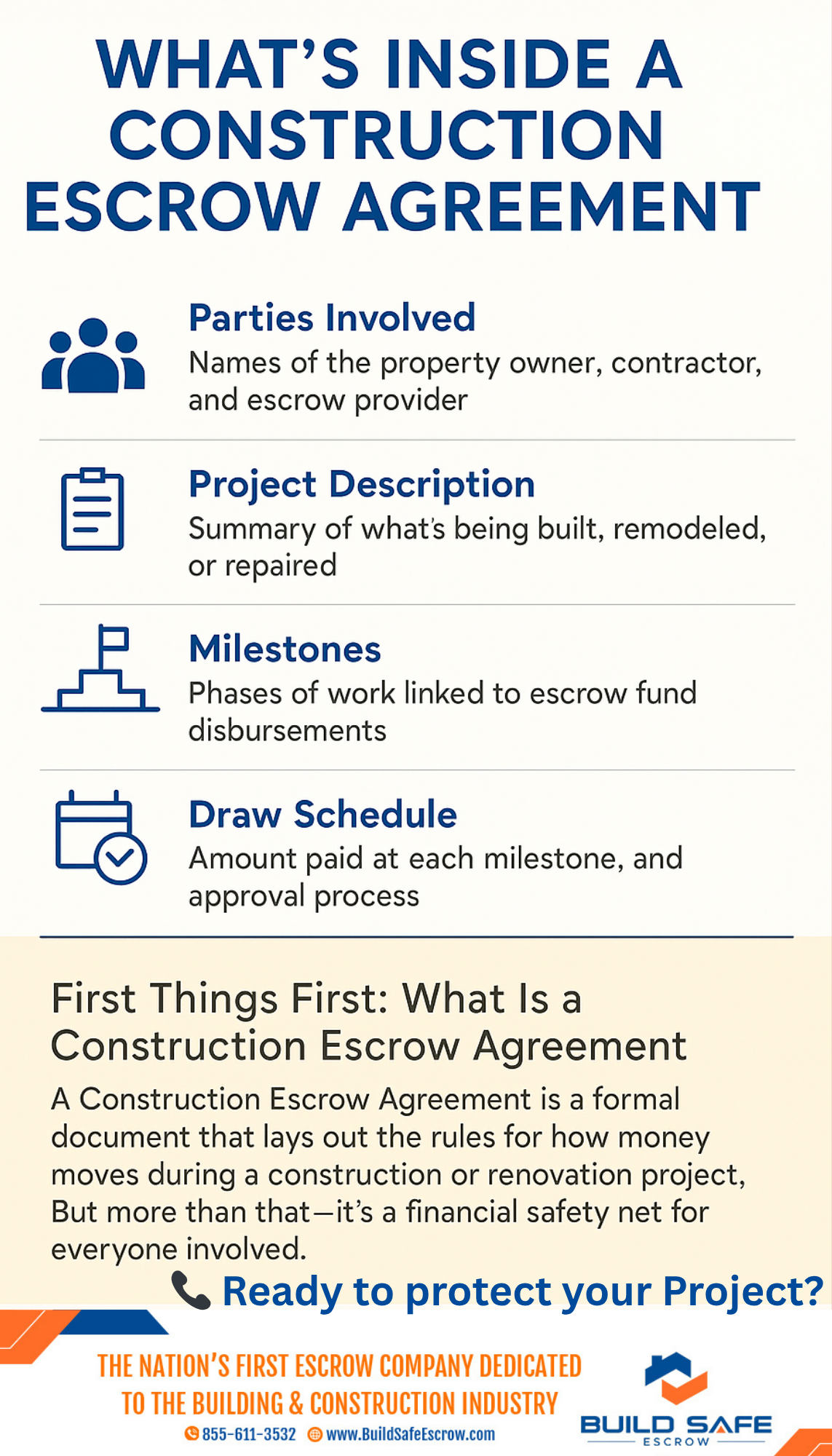
A Construction Escrow Agreement is a formal document that lays out the rules for how money moves during a construction or renovation project. But more than that; it’s a financial safety net for everyone involved.
At its core, this agreement ensures that:
- The property owner doesn’t pay for work that hasn’t been done yet
- The contractor gets paid fairly and on time once progress is made
- The escrow company acts as a neutral third party to hold and release funds only when agreed-upon conditions are met
Think of it as a checks-and-balances system for construction payments.
Instead of sending large lump-sum payments directly to the contractor based on trust alone, the property owner deposits the full—or partial—project funds into a secure escrow account. These funds are released in parts (called draws) based on the completion of specific milestones, which are clearly outlined in the agreement.
For example, if the milestone is “rough electrical completed and passed inspection,” then the contractor only gets paid for that phase once that condition is met—and verified.
What sets a construction escrow agreement apart from a standard contract is that it controls the money. And when the money is managed correctly, everything else—from communication to accountability—improves.
Here’s what the agreement does, practically speaking:
- It defines the scope of the project (what’s being done)
- It spells out the milestone schedule
- It clarifies who approves the work at each stage
- It details the disbursement rules (when and how the contractor gets paid)
- It includes a plan for resolving disagreements, should they arise
Unlike dense legal contracts that can feel overwhelming, a construction escrow agreement is designed to be readable and actionable. Its goal isn’t to confuse or intimidate—it’s to create alignment and trust.
Whether you’re remodeling a bathroom or overseeing a commercial buildout, this agreement gives both sides a clear path forward. That’s it. No legalese. No hidden traps. Just clarity, structure, and protection for everyone involved.
Why You Should Care About This Agreement
If you’ve ever watched a renovation reality show, you know how fast things can go sideways. But in real life, there’s no camera crew—or safety net—when your contractor disappears with your deposit.
The construction escrow agreement is that safety net.
It protects your renovation in 3 major ways:
1. It Stops the Money From Leaving Too Soon
Without escrow, a contractor can ask for 40–50% upfront—and walk off the job after demolition. With escrow, funds are locked in. Payments are released only when real progress is made and approved.
2. It Creates Accountability
Both sides agree upfront on what counts as “progress.” This removes misunderstandings, vague expectations, or “I thought you meant…” moments.
3. It Reduces Disputes and Delays
With milestone-based payments written into the agreement, everyone has a roadmap. If something goes wrong, the solution is already in the contract.
What’s Inside the Agreement (And Why You Can Actually Understand It)
Think of the escrow agreement as a playbook for how your money moves during the project. Here’s what you’ll typically find:
• Parties Involved
The names of the property owner, contractor, and escrow provider.
• Project Description
A short summary of what’s being built, remodeled, or repaired.
• Milestones
This is the heart of the agreement. Each payment is tied to a phase of work—like “demo complete,” “electrical rough-in,” or “tile installed.” It’s all written clearly.
• Draw Schedule
How much is paid at each milestone, and who approves it.
• Disbursement Terms
What happens when a milestone is met. Some agreements even allow photo verification or inspection.
• Dispute Resolution
How issues will be handled if either side disagrees.
It’s not a legal trap. It’s a transparency tool. Most of our clients say they feel more confident after reading it—not more confused.
True Story: Why Daniel Trusted the Agreement—Not the Smile
Daniel was renovating a duplex in Tampa. The contractor seemed great—friendly, affordable, and ready to start “as soon as you send the deposit.” But Daniel had read about construction scams and asked to use Build Safe Escrow instead.
The contractor ghosted him.
Later, Daniel discovered the company had 3 complaints with the state and a trail of unfinished projects. That agreement? It saved him from losing $150,000.
Common Myths About Escrow Agreements
Let’s bust a few misconceptions:
Myth 1: It’s Only for Big Jobs
False. Escrow works for everything from $5,000 bathroom upgrades to multi-unit developments.
Myth 2: It’s Complicated
False. The agreement is easy to read and even easier to follow.
Myth 3: Contractors Will Refuse It
The good ones won’t. Escrow ensures they get paid on time, without chasing checks. The best contractors use it to win more clients.
🔒 Why This One Agreement Changes Everything
If you’ve ever:
- Paid a contractor who didn’t finish the job
- Felt unsure when to send the next check
- Worried about protecting your savings
- Lost sleep over vague contracts or rushed timelines
Then this agreement is your answer.
It creates structure without confusion, safety without confrontation, and trust without guesswork.
It’s not just a piece of paper. It’s a system that makes your renovation smarter.
Final Word: You Don’t Need to Be a Lawyer—Just Smart
You don’t need a law degree to read a construction escrow agreement.
You just need a desire to protect your renovation and avoid the chaos that so many others fall into.
At Build Safe Escrow, we create agreements in plain language. We guide you through every section. And we make sure your project starts—and ends—with your money safe and your mind at ease.
✅ Want to See What a Construction Escrow Agreement Looks Like for your project?
We’ll send you a free sample or walk you through how it works in under 10 minutes.
Because a renovation should end with a celebration—not a courtroom.
👉 Schedule Your Free Consultation
📞 Call us at 855-611-3532
📧 Email info@buildsafeescrow.com
🌐 Visit www.buildsafeescrow.com
- Contractor Payment Process for Property Managers: How to Build One That Survives an Audit.
 Sooner or later an owner asks who approved that payment. This guide gives property managers five controls and a simple payment file that make every contractor invoice audit-ready.
 - Construction Draw Verification: How Investors Know Their Capital Went Into the Build.
 Monthly photos show activity, not proof. This guide shows passive investors the six checks that tie every construction draw to verified work, plus the one test that catches a budget running short.
 - What Is Retainage in Construction? A Subcontractor’s Guide to Getting the Last 10% Paid
 Retainage is money you already earned, held until someone else says the job is done. This guide shows subcontractors what state law now limits and seven contract moves that get the last 10% paid sooner.
 - Commercial Build-Out Escrow: Who Should Hold the Money, and Who Should Not
 Commercial tenants pay to build inside a space they do not own. Here is who should hold the build-out money, how to stop a lien landing on you, and what to expect from an escrow provider on a large project.
 - How to Vet a Home Builder Before Signing a Contract: A Homeowner’s Guide
 Seven checks that catch a builder who is talented and broke at the same time, the things you should never agree to, and how escrow removes the consequences of guessing wrong.
 - Paying Contractors Upfront: A Homeowner’s Guide to Deposits, State Rules, and Safer Alternatives
 How much deposit is normal, which states cap it, what the money legally covers, and the structure that lets owners fund a project without paying ahead of the work.
 - Home Renovation Cost in 2026: What Owners Should Budget, State by State
 What a renovation really costs in 2026, why the same kitchen is priced differently in Texas and New York, and how owners keep every dollar tied to finished work.
 - Construction Escrow for Contractors: How It Works and How You Get Paid
 Escrow from the contractor’s seat: proof the money exists before you start, a milestone schedule you help write, and payment that arrives on verification instead of on a promise.
 - How Construction Escrow Works: A Simple Guide for Property Owners
 A plain walkthrough of how construction escrow works for homeowners funding a renovation or build: where the money sits, when it moves, and what happens if a contractor stops.
 - Construction Escrow for Property Managers: How It Works, Simplified
 A plain walkthrough of construction escrow for property managers: how funds are held, how milestones get verified, and how the whole thing becomes a report your owners can read.
 - Property Manager Vendor Payments: How to Pay Contractors Across a Portfolio Without Carrying the Risk
 A property manager’s guide to paying contractors and vendors across a portfolio without becoming the one who absorbs the risk: verified releases, lien protection, and a structure that keeps owner funds separate and accountable.
 - Tenant Improvement Allowance Escrow: Who Holds the Money, and When It Releases
 A commercial tenant’s guide to the TI allowance: why the money usually arrives last, what that does to your build-out, and how escrow puts the landlord’s contribution and your contractor’s draws on the same verified schedule.
 - Before Signing a Construction Contract: 9 Checks Every Homeowner Should Make
 A homeowner’s checklist for the hour before you sign: the nine things to verify in a construction contract, and the one clause that decides whether your deposit is ever at risk.
 - How to Evaluate a Home Builder Before Signing a Contract: A Homeowner’s Guide
 Most builder problems are visible before the contract is signed, if you know where to look. Here is how to evaluate a home builder on licensing, money, and structure, plus the terms no homeowner should accept.
 - Verify Construction Progress Remotely: A Proven Playbook
 Your money is in one state and your project is in another. A verification stack that tells you what is actually built, and a payment structure that acts on it.
 - Pay When Paid Clauses: The Sentence in Your Contract That Delays Every Check
 One sentence in your subcontract decides when you get paid, and most subs sign it without reading twice. What a pay when paid clause really means, and the structure that makes it irrelevant.
 - Home Renovation Payment Schedule: The Smart Way to Stage Every Payment
 The payment schedule decides who carries the risk on your renovation. Structure it around verified milestones and the biggest check of your year stops being a leap of faith.
 - Change Order Payment: Proven Ways to Stop Losing Money
 The work that wasn’t in the contract is the work you’re least likely to get paid for. Here are five fixes that turn every change order payment from an argument into a scheduled release.
 - How Should an HOA Pay a Contractor (HOA boards)
 Board members ask how should an HOA pay a contractor because the money is not theirs. It belongs to every homeowner in the community. Here is the payment structure that protects it.
 - Contractor Went Out of Business? Smart Recovery Steps
 When your contractor went out of business mid-project, panic is natural — but there is a clear sequence of moves that protects your money, your property, and your restart. Here it is.