
You paid your contractor. Then a subcontractor you never met filed a claim against your home.
Table of Contents
- The claim you never saw coming
- What a mechanics lien actually is
- Why mechanics liens happen
- How to avoid a mechanics lien: seven protections
- A short field example
- How escrow removes lien risk at the source
- FAQ
- Protect your project before the first payment
- References

The claim you never saw coming
Knowing how to avoid a mechanics lien is the difference between a renovation that ends clean and one that follows you for months. If you are a property owner or homeowner funding a construction or remodel project, this is the risk almost nobody warns you about until it is too late.
Here is the part that shocks people. You can pay your general contractor in full, on time, every dollar — and still get a lien filed against your property. All it takes is one subcontractor or supplier the contractor forgot to pay. Their claim does not attach to the contractor. It attaches to your house. That is exactly why knowing how to avoid a mechanics lien matters before the first check clears.
You are not powerless here. This is a structure problem, and structure problems have structural fixes. Let’s walk through what a mechanics lien is, why it happens, and exactly how to avoid a mechanics lien on your next project.
What a mechanics lien actually is
A mechanics lien is a legal claim filed against your property by someone who worked on it or supplied materials for it and did not get paid. It can come from a subcontractor, a material supplier, or a laborer — not just the contractor you hired and paid directly.
Think of it as a flag planted on your title. Until the claim is resolved, that flag can block you from selling or refinancing, and in the worst cases it can lead to a forced sale to satisfy the debt. The people who did the work have a right to be paid, and the law gives them the property itself as security. So how to avoid a mechanics lien is really a question about the money reaching the right hands.
That is why it feels so unfair to owners. You held up your end. You paid. But the law cares whether everyone on the job got paid, not just whether you wrote your checks. Learning how to avoid a mechanics lien means closing the gap between “I paid the contractor” and “everyone on my project got paid.”
Why mechanics liens happen
Liens are not random bad luck. They come from a handful of predictable breakdowns. Name them, and you can design around every one.
The money stopped somewhere in the chain. You pay the general contractor. The contractor is supposed to pay the subs and suppliers. If that money gets spent, delayed, or diverted before it reaches them, they file against your property to recover it.
You never knew who was on the job. Contractors bring in subs and order from suppliers you may never meet. If you do not know who has a potential claim, you cannot confirm they were paid.
Payments ran ahead of the work. A large deposit or an early draw puts your cash in someone’s hands before the labor and materials are locked in. When money moves ahead of the work, it can leave the job without paying the people who earned it.
No waivers were collected. A lien waiver is a signed document in which a contractor, sub, or supplier gives up their right to file a lien for the payment they just received. Skip these, and you have no paper trail proving anyone was paid.
The contractor went under mid-project. If your contractor fails or disappears, the unpaid subs still have a claim — and you are the one holding the property.
Every one of these is preventable. That is the good news, and it is the whole point of knowing how to avoid a mechanics lien before you sign anything.
How to avoid a mechanics lien: seven protections
This is the practical core. Seven concrete habits, each one a lever you control.
1. Collect a lien waiver with every payment. Never release a dollar without the matching waiver. Learn the two kinds. A conditional waiver takes effect only once the payment actually clears — the safe one to give in exchange for a check. An unconditional waiver takes effect immediately, whether or not the money arrives. As the owner, you want conditional waivers on progress payments and unconditional waivers once final funds have cleared. This single habit is the backbone of how to avoid a mechanics lien.
2. Know exactly who is on your job. Ask your contractor for a full list of every subcontractor and supplier before work starts, and keep it updated. In many states, subs and suppliers send a preliminary notice — an early heads-up that they have the right to lien if unpaid. Do not panic when one arrives. It is not a lien; it is information. It tells you precisely who needs to be paid and waived.
3. Never pay ahead of the work. Resist the big upfront deposit. Tie every payment to work that is actually completed and verified. When your money only moves after the labor and materials are in place, there is far less room for funds to vanish before the people who earned them get paid. This one rule sits at the center of how to avoid a mechanics lien.
4. Use joint checks or pay key parties directly. When a single subcontractor or supplier represents a large share of the budget, consider a joint check made out to both the contractor and that party, or arrange to pay them directly. It guarantees the money reaches the person who could otherwise lien your home.
5. Put the project funds in escrow. This is the structural fix that ties the others together. A neutral, third-party escrow account holds your money and releases it in stages, only as milestones are verified — with waiver collection built into each release. More on this below, because it is the cleanest answer to how to avoid a mechanics lien.
6. Verify before you release. Do not take “it’s done” on faith. Confirm the milestone — an inspection, a walkthrough, photos, or a neutral verification — before funds move. Verified work is paid work, and paid work does not become a lien.
7. Keep everything in writing. Scope, schedule, and especially change orders belong on paper. A change order is a written, signed modification to the original contract. Verbal add-ons are where disputes and unpaid balances hide. A clean paper trail is quiet protection.
Notice the pattern. Every protection points the same way: know who is owed, pay only for verified work, and prove payment with waivers. That is how to avoid a mechanics lien in one sentence.
A short field example
Consider a homeowner — call her Dana. A full kitchen and bath remodel, a reputable general contractor, a fair price.
Dana did it the trusting way. She paid a 40 percent deposit, then paid each invoice as it came, no questions asked. Two months after the job wrapped, a tile supplier filed a mechanics lien against her home for $9,000. The contractor had collected Dana’s money but never paid the supplier. Dana had already paid for that tile — once. Now she was being asked to pay for it again to clear her own title.
Her neighbor ran the next remodel differently. He deposited the full budget into a secured, FDIC-insured escrow account before demolition. Payments released on four verified milestones. Every release required a signed lien waiver from the contractor and each sub before the money moved. When the same supplier’s invoice came due, the waiver confirmed it was paid, and the release documented it.
Same contractor. Same trades. One owner learned how to avoid a mechanics lien the hard way. The other never had a flag on his title, because no dollar left the account without proof the right people got paid.
How escrow removes lien risk at the source
Trust is a feeling. Structure is protection. A mechanics lien exists because money was allowed to move ahead of the work, or to reach the wrong hands before the right ones.
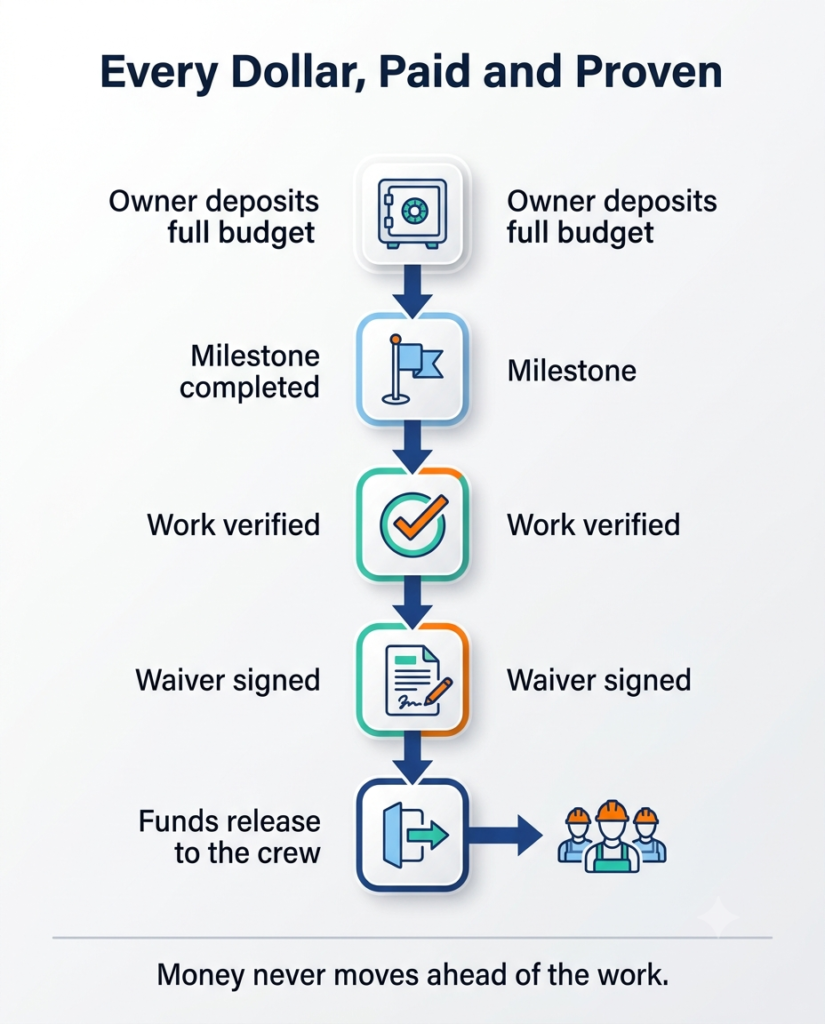
Escrow fixes the sequence. Build Safe Escrow is a neutral, third-party service — not a lender, not a contractor, not on anyone’s side. We hold the project funds in a secure, FDIC-insured account and release them in stages, only as each agreed milestone is completed and verified. Waiver collection is built into every release, so payment and proof-of-payment move together.
Read that from your side of the table. The money never moves ahead of the work. It cannot skip a sub. It cannot vanish into a contractor’s cash-flow gap. Each release is documented, verified, and tied to a waiver. That is what turns “I hope everyone got paid” into “I have proof everyone got paid.” For most owners, that proof is the simplest answer to how to avoid a mechanics lien.
Our escrow services exist to move the money question to the front of the job, where it belongs — so a lien never becomes a surprise at the end. Want the mechanics in detail? Our construction escrow FAQs break down verification, milestones, and waivers step by step. And if you would rather just talk it through, contact us and we will walk you through it.
FAQ
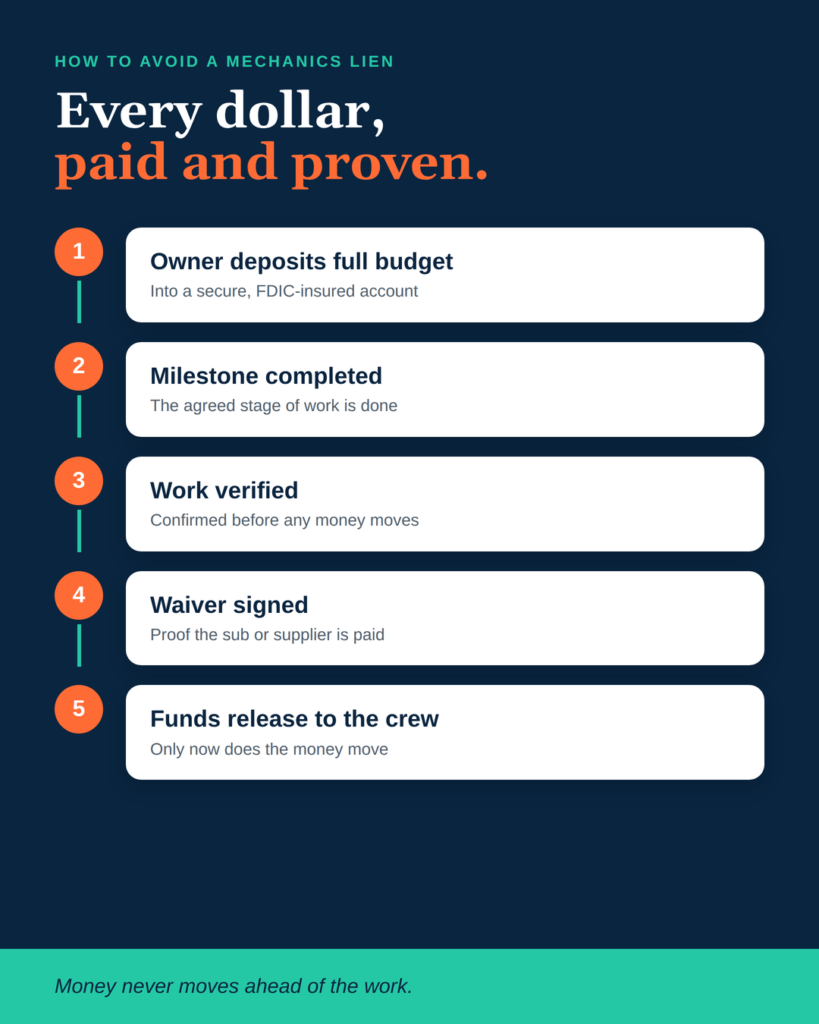
Can a subcontractor lien my home if I already paid my contractor? Yes. If your contractor did not pass your payment down to a sub or supplier, that party can still file against your property. Waivers and escrow are how you prevent it.
What is the difference between a conditional and unconditional lien waiver? A conditional waiver only takes effect once the payment clears. An unconditional waiver takes effect immediately, paid or not. Give conditional on progress payments; unconditional only after funds clear.
Is a preliminary notice the same as a lien? No. A preliminary notice is an early notice that a party could lien if unpaid. It is information, not a claim. Use it to confirm who needs to be paid and waived.
Does escrow really prevent a mechanics lien? Escrow removes the root cause: money moving ahead of the work. Funds release only on verified milestones with signed waivers, so the people who earned payment actually receive it. That is how to avoid a mechanics lien without policing every invoice yourself.
How long does a contractor have to file a lien? It varies by state, often measured in weeks to a few months after work ends. Check your state’s deadline, and do not assume a job is “safe” the day it wraps.
This article is information and structure, not legal or financial advice. Talk to your own attorney or accountant about your specific project, contracts, and state lien laws.
Protect your project before the first payment
If you are funding a renovation, one habit changes everything: never let the money move ahead of the work. That is how to avoid a mechanics lien for good.
Get one short read each Friday on how construction money actually moves — subscribe to The Build Brief.
Ready to protect your project? Schedule a free consultation and we will show you how milestone-based escrow keeps a lien off your title from day one.
References
- Cornell Legal Information Institute — Mechanic’s Lien: https://www.law.cornell.edu/wex/mechanic%27s_lien
- Levelset / Procore — Mechanics Lien Guides: https://www.levelset.com/mechanics-lien/ (verify the specific state page before publishing)
- FDIC — Deposit Insurance: https://www.fdic.gov/resources/deposit-insurance/
- U.S. Small Business Administration — Managing Your Business Finances: https://www.sba.gov/