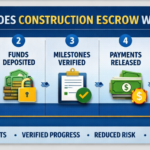

You set a $75,000 kitchen renovation budget. You get a quote for $68,000. You feel good. Then change orders start arriving — $3,200 for unexpected plumbing, $1,800 for a structural beam, $2,500 for upgraded fixtures your contractor ‘recommends.’ By the end, you’ve spent $91,000. This is not bad luck. This is the standard renovation experience — and it’s preventable.

Why Renovation Budgets Spiral: The Three Root Causes
Budget overruns in home renovation almost always trace back to one of three causes:
- Scope creep: Small additions and upgrades that seem reasonable in the moment add up to thousands
- Undefined allowances: Your contract says ‘fixtures included’ but doesn’t specify which ones — and the contractor’s baseline is $200 while you’re picturing $800
- No change order discipline: Verbal approvals for extra work become invoice surprises at the end
| Key insight: The solution to all three is the same: a written, milestone-based agreement that defines exactly what is included, what costs extra, and how changes must be approved before they’re executed. |
How Milestone Payments Create Built-In Budget Accountability
When payments are tied to specific milestones rather than percentages of time or loosely defined phases, budget accountability becomes structural. Each milestone payment is a checkpoint — an opportunity to assess whether the project is on track before releasing the next tranche of funds.
- Before milestone 2 payment: ‘Is demo complete as agreed? Were any surprises encountered?’
- Before milestone 3 payment: ‘Was the change order for the beam documented and approved?’
- Before milestone 4 payment: ‘Did the fixtures installed match what was specified in the contract?’
Each payment gate creates a natural conversation about scope and budget. Problems surface early — not at the final invoice.
The Change Order Rule That Saves Thousands
A change order is any modification to the original scope of work — additions, substitutions, or deletions. It should be documented in writing before the work happens, with a clear cost impact and your written approval.
This sounds obvious. It rarely happens in practice. Contractors ask verbally. Homeowners agree verbally. Work gets done. The invoice arrives and the number doesn’t match.
| Important: Your contract must include this clause: ‘No change to the scope of work shall be performed or invoiced without a signed Change Order detailing the modification, cost, and impact on project timeline.’ Any contractor who won’t agree to this clause is a contractor you shouldn’t hire. |
Construction Escrow as Your Budget’s Enforcement Mechanism
Having a detailed contract and change order process is necessary. But who enforces it when the contractor pushes back?
Construction escrow creates an enforcement mechanism that removes the emotional component from budget disputes. When funds are held by a neutral third party:
- You never have to argue directly with your contractor about whether an invoice is justified
- Disputed charges are held in the escrow account while the disagreement is resolved
- You’re never pressured to pay for unapproved work to avoid a work stoppage
- The escrow agreement — which both parties signed — is the reference document for every dispute
This doesn’t make your contractor your enemy. It makes the agreement the authority — which is exactly what both parties agreed to at the start.
What a Well-Protected Renovation Actually Feels Like
Homeowners who use construction escrow consistently report the same thing: the renovation felt more professional, calmer, and less emotionally draining than any project they’d done before.
The contractor showed up on time because payment depended on it. Change orders were documented because that’s how the process worked. The final invoice matched the contract because every addition had been approved in writing.
That’s not a coincidence. That’s what happens when you build the right structure from the start.
| Ready to get started? Build Safe Escrow holds your renovation budget securely and releases payments only when milestones are verified. Change orders, disputes, and budget surprises become manageable — not disasters. Free consultation at buildsafeescrow.com/contact. |
Frequently Asked Questions About Renovation Budget Overruns and Construction Escrow
Why do renovation projects almost always go over budget?
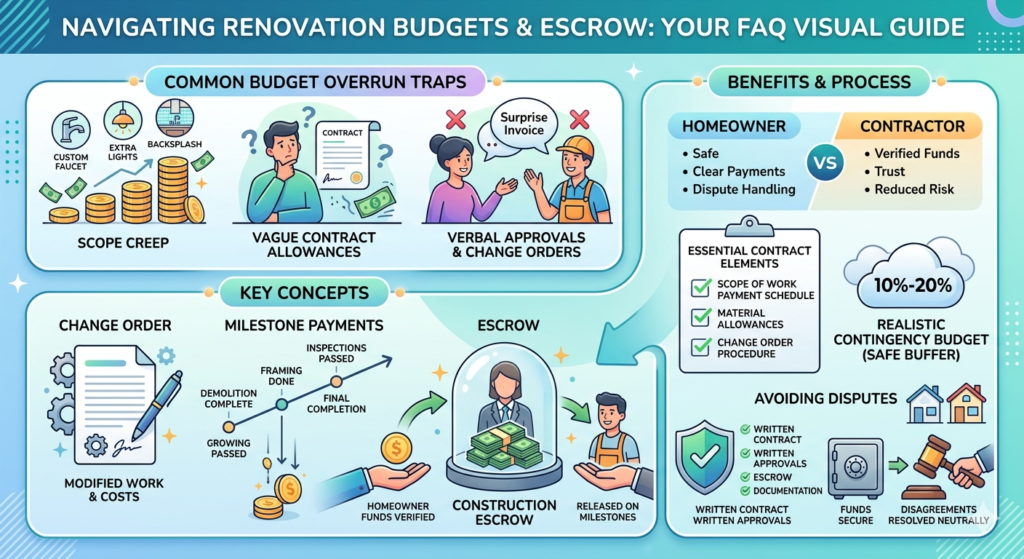
Most renovation projects go over budget because of scope creep, vague allowances in contracts, and undocumented change orders. Small upgrades, unexpected site conditions, and verbal approvals can quickly add thousands to the final cost if there is no structured payment and approval process in place.
What is scope creep in a renovation project?
Scope creep happens when additional work, upgrades, or design changes are added throughout the project without properly adjusting the budget and timeline. Even small changes — upgraded fixtures, added electrical work, or layout modifications — can significantly increase renovation costs over time.
What is a change order?
A change order is a written document that modifies the original scope of work in a construction contract. It outlines the requested change, the additional cost (or savings), and any impact on the project timeline. Change orders should always be approved and signed before the work is performed.
Why are verbal approvals risky during a renovation?
Verbal approvals create confusion and disputes because there is no clear written record of what was agreed upon. Homeowners often believe a change is minor, while contractors may treat it as billable extra work. Written approvals protect both parties and prevent surprise invoices later.
What are milestone payments in construction?
Milestone payments are payments released only after specific portions of work are completed and verified. Instead of paying based on time or large upfront deposits, funds are tied to measurable project stages such as demolition, framing, inspections, or final completion.
How do milestone payments help control renovation budgets?
Milestone payments create accountability throughout the project. Before each payment is released, the homeowner can verify completed work, review any approved changes, and confirm the project is still aligned with the agreed budget and scope.
What is construction escrow?
Construction escrow is a secure financial arrangement where renovation funds are held by a neutral third party and released according to agreed project milestones. It protects both homeowners and contractors by creating transparency and reducing payment disputes.
How does construction escrow protect homeowners?
Construction escrow helps homeowners avoid paying too much too early, prevents unauthorized payment requests, and ensures funds are only released when milestone requirements are met. It also provides a structured process for handling disputes and change orders.
Does construction escrow benefit contractors too?
Yes. Contractors benefit because funds are verified and reserved before work begins. This reduces payment uncertainty, builds client trust, and creates a more professional project structure with clear expectations for both sides.
What should be included in a renovation contract to prevent budget disputes?
A strong renovation contract should clearly define:
Scope of work
Payment schedule
Material allowances
Timeline expectations
Change order procedures
Inspection requirements
Dispute resolution process
The contract should also state that no additional work will be performed without a signed written change order.
What is a realistic contingency budget for renovations?
Most professionals recommend setting aside 10%–20% of the total renovation budget for unexpected conditions, especially in older homes where hidden plumbing, electrical, or structural issues are common.
Is construction escrow only for large projects?
No. Construction escrow can be used for kitchen remodels, bathroom renovations, additions, roofing projects, full-home remodels, and commercial construction projects. Any project involving milestone payments and significant funds can benefit from escrow protection.
How can I avoid renovation payment disputes?
The best way to avoid disputes is to:
Use a detailed written contract
Approve all changes in writing
Tie payments to milestones
Keep clear documentation
Use construction escrow to manage disbursements
These systems create clarity before problems arise.
What happens if there is a disagreement during the project?
When construction escrow is used, disputed funds can remain securely held while the issue is reviewed according to the escrow agreement. This helps prevent emotional conflicts, work stoppages, and rushed payment decisions.
Why is construction escrow becoming more common in renovations?
Homeowners and contractors are increasingly looking for ways to reduce risk, improve trust, and create financial transparency in construction projects. Construction escrow provides a structured system that protects both sides while keeping projects organized and accountable.