

It is not your money. That is exactly why every dollar has to be defensible. You answer to owners, and “trust me” is not a report you can hand them.
Table of Contents
- The weight of spending money that isn’t yours
- Why owner capital slips through the cracks
- Five ways escrow for property managers protects owner capital
- A short field example
- How escrow for property managers removes the risk at the source
- FAQ
- Build a payment process you can defend
- References
The weight of spending money that isn’t yours
Escrow for property managers exists for one reason: you steward other people’s capital across many projects and many vendors, and every release has to be defensible. When you approve a renovation payment, you are spending an owner’s money on work you have to stand behind. If a contractor disappears or a job goes sideways, the first question is not “what happened?” It is “why did you release the funds?”
That is the quiet pressure of the job. You are responsible for capital that isn’t yours, spread across turnovers, capital improvements, and repairs, often with vendors you did not personally vet. Escrow for property managers turns that responsibility into a repeatable, documented process that protects the owner and protects you.
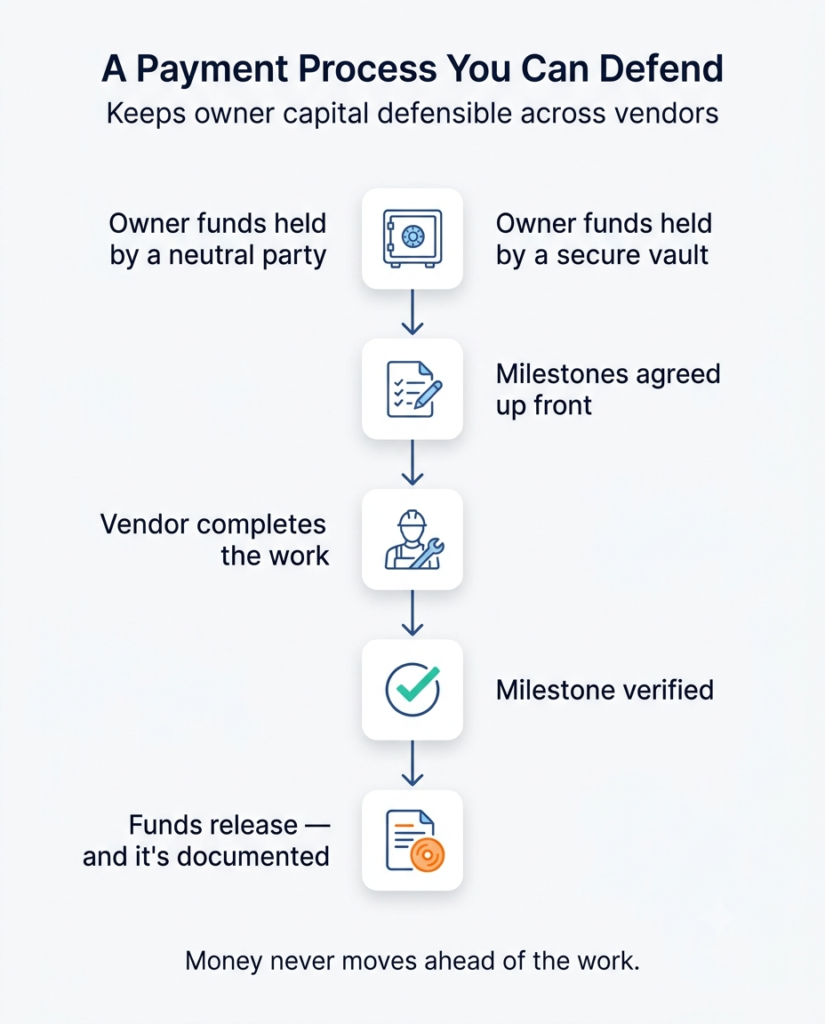
It is a neutral, third-party account that holds project funds and releases them in stages — only as each agreed milestone is completed and verified. Build Safe Escrow is not a lender, not a contractor, and not on anyone’s side. We hold the money and release it as the work earns it, and we document every step.
Let’s walk through where owner capital slips — and how structure closes the gap.
Why owner capital slips through the cracks
The risk is not carelessness. It comes from the structure of the job: many properties, many vendors, many payments, all moving at once. Name the gaps, and you can design around them.
Deposits go out on trust. A vendor asks for money up front to “cover materials.” You pay it to keep the schedule. Now the owner’s capital is in a contractor’s account before any work exists.
Progress payments run on invoices, not proof. With a dozen jobs in flight, you approve payments on paperwork. Verifying every one in person is not realistic, so some money moves ahead of the work.
Vendors vary wildly. You have vetted some contractors for years. Others are new, chosen for availability. The newer the vendor, the higher the risk on an unstructured payment.
A disappearing contractor becomes your problem. If a vendor takes a deposit and vanishes, the owner lost money on your approval. The reputational damage lands on you.
The paper trail is thin. When an owner or an audit asks where the money went, scattered invoices and email approvals are not a clean answer. You need documentation, not a memory.
Every one of these is a structure problem, not a character problem. Structure problems have structural fixes. That is exactly what escrow for property managers provides.
Five ways escrow for property managers protects owner capital
Here is the practical core. Escrow for property managers delivers five concrete protections, each one a reason to route vendor payments through escrow.
1. A neutral third party holds the funds. The project money sits in a secure, FDIC-insured account controlled by neither you nor the vendor. No deposit disappears into a contractor’s account before work exists. The owner’s capital waits where it can’t be misused.
2. Releases are tied to verified milestones. Funds move only when a defined milestone is completed and verified. You are no longer approving payment on an invoice and hoping — every release answers one question: was the work actually done? That is protection you can stand behind.
3. Every dollar is documented. Each deposit, milestone, and release is recorded. When an owner asks where their capital went, or an audit reviews the file, you hand over a clean, defensible record instead of a stack of emails. This is the audit-ready process the job demands.
4. New vendors get de-risked. With escrow, you can work with a new contractor without betting the owner’s deposit on their honesty. The money releases only on verified work, so an unknown vendor carries far less risk to the capital you steward.
5. One repeatable process across every property. This is where escrow for property managers earns its place. Instead of improvising payment terms job by job, you run the same structured flow everywhere — deposit held, milestones verified, funds released, everything documented. Consistency is what makes it defensible at scale. See how our escrow services standardize milestone releases across a portfolio.
Notice the pattern. Every protection points the same direction: the owner’s money is confirmed early and moves only on proof of work.
A short field example

Escrow for property managers is easiest to see in one real situation. Consider a property manager — call him Andre — running renovations across a portfolio of rental units for several owners. Turnovers, capital improvements, the occasional full gut. Many vendors, many payments, one reputation on the line.
Andre used to run it the old way. Deposits on trust, progress payments on invoice, approvals in email. On one turnover, a newer contractor took a 40 percent deposit for a unit renovation and stopped showing up. The owner lost the deposit. The awkward conversation, and the doubt about Andre’s judgment, lasted a lot longer than the refund never came.
Now Andre routes vendor payments through escrow. On a recent capital improvement, the owner’s funds went into a secure, FDIC-insured account, released against defined milestones. When a new vendor’s early work came in behind schedule, no money had moved ahead of it — the deposit was safe, and the release simply waited on verification. Every payment came with a clean record Andre could forward to the owner without a second thought.
Andre stopped gambling other people’s capital on trust. Every release was defensible. That is escrow for property managers doing exactly what it should.
How escrow for property managers removes the risk at the source
Trust is a feeling. Structure is protection. Owner capital slips because money is allowed to move ahead of the work — often on your approval, under deadline pressure.
Escrow fixes that by fixing the sequence. Money should never move ahead of the work. With escrow in place, it can’t. The funds are held by a neutral party and released only when a milestone is verified. From your seat, the protection is twofold: the owner’s capital is safe, and every decision you make is documented and defensible.
You stop approving payments on faith. You stop absorbing a vendor’s risk as your own liability. You stop scrambling for a paper trail when an owner asks. A neutral third party holds the money, verifies the work, releases the funds, and records all of it. That is the entire mechanism, and it runs in your favor.
Want the mechanics in detail? Our construction escrow FAQs break down verification, milestones, and release timing step by step.
FAQ
What is escrow for property managers? It is a neutral, third-party account that holds an owner’s project funds and releases them only as milestones are completed and verified — giving you a documented, defensible payment process across every vendor.
Who controls the money? With escrow for property managers, a neutral third party controls it. Not you, not the vendor, not the owner. Funds sit in a secure, FDIC-insured account and release only on verified milestones.
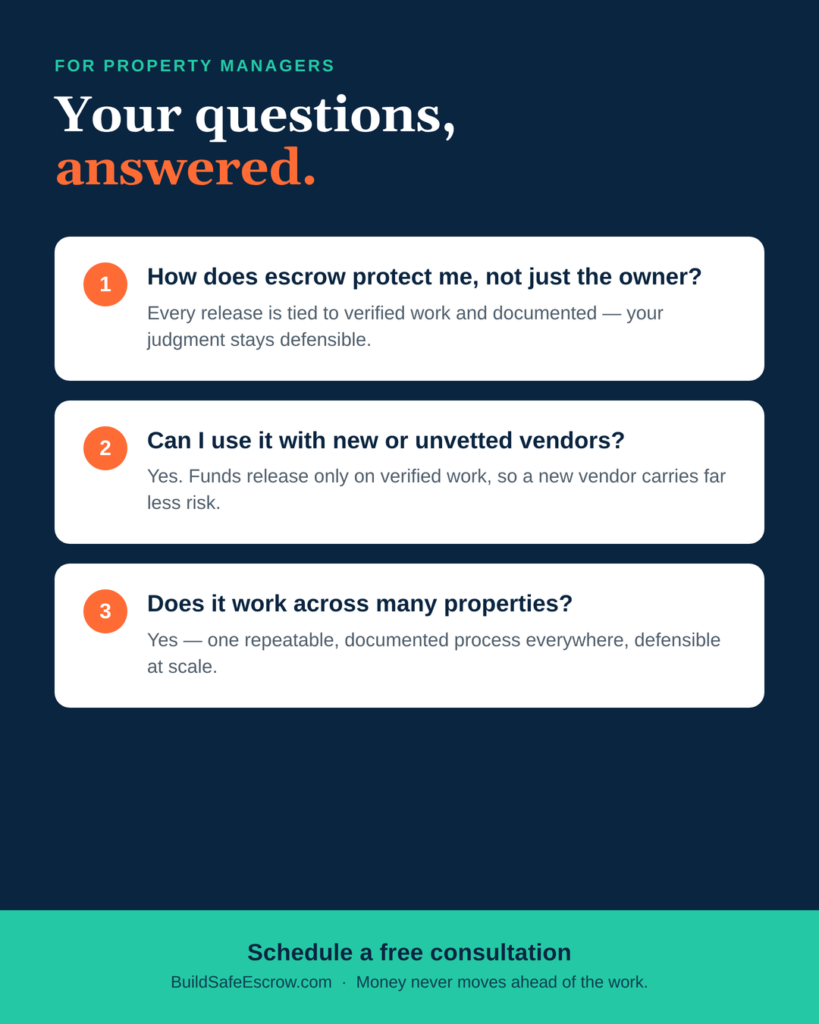
Does this help across multiple properties and vendors? Yes. That is the point. You run one repeatable, documented process everywhere instead of improvising terms job by job, which is what makes it defensible at scale.
How does escrow protect me, not just the owner? Every release is tied to verified work and recorded. When an owner or an audit asks where the capital went, you hand over a clean record instead of scattered emails — your judgment is defensible.
Can I use it with new or unvetted vendors? Yes. Because funds release only on verified work, a new vendor carries far less risk to the owner’s deposit. Escrow lets you work with them without betting the capital on trust.
Is the money safe while it waits? It is held in a secure, FDIC-insured account by a neutral third party — not commingled with a vendor’s operating account. Released only on verified milestones.
This article is information and structure, not legal or financial advice. Talk to your own attorney or accountant about your specific management agreements and vendor contracts.
Build a payment process you can defend
If you spend money that isn’t yours, one habit protects everyone: put the owner’s capital where it can’t move ahead of the work.
Get one short read each Friday on how construction money actually moves — subscribe to The Build Brief.
Ready to make every vendor payment defensible? Schedule a free consultation and see how escrow for property managers protects owner capital across your whole portfolio.
References
- FDIC — Deposit Insurance: https://www.fdic.gov/resources/deposit-insurance/
- Institute of Real Estate Management (IREM): https://www.irem.org/
- National Association of Residential Property Managers (NARPM): https://www.narpm.org/
- Levelset / Procore — construction payment & lien resources: https://www.levelset.com/