
The board meeting was supposed to be routine.
The agenda was short. The contractor had submitted an invoice. The project was “mostly on track.” Then one question shifted the room:
“Why did we release payment before the inspection passed?”
Silence followed.
For HOA and condo managers, moments like this aren’t rare. They’re the quiet pressure points of a role that sits between responsibility and risk. Managing construction and renovation projects isn’t just about timelines; it’s about safeguarding association funds, protecting fiduciary duty, and maintaining trust among boards, residents, and vendors.
This is where construction escrow for HOA projects changes everything.
The Unique Risk HOA and Condo Managers Carry
Unlike private homeowners, HOA and condo managers don’t manage their own money. They manage other people’s funds; collected through assessments; scrutinized by boards; and governed by fiduciary obligations.
Every construction decision carries weight:
- Release funds too early and the association loses leverage
- Release funds too late and work may stall or disputes escalate
- Release funds incorrectly and liability questions arise
The challenge isn’t bad actors; it’s unstructured risk.
Construction escrow for HOA projects introduces structure where uncertainty usually lives.
Why Traditional Payment Methods Fall Short
Most HOA construction projects still rely on a familiar pattern:
- A deposit is paid upfront
- Progress payments are issued as invoices arrive
- Final payment becomes the most contentious moment
This system relies heavily on trust and interpretation; not verification.
When issues arise—delays, incomplete work, permit holdups—the payment process becomes reactive. Managers are forced into uncomfortable positions; explaining decisions; calming residents; and documenting after the fact.
Construction escrow for HOA projects replaces reaction with process.
What Construction Escrow for HOA Projects Actually Does
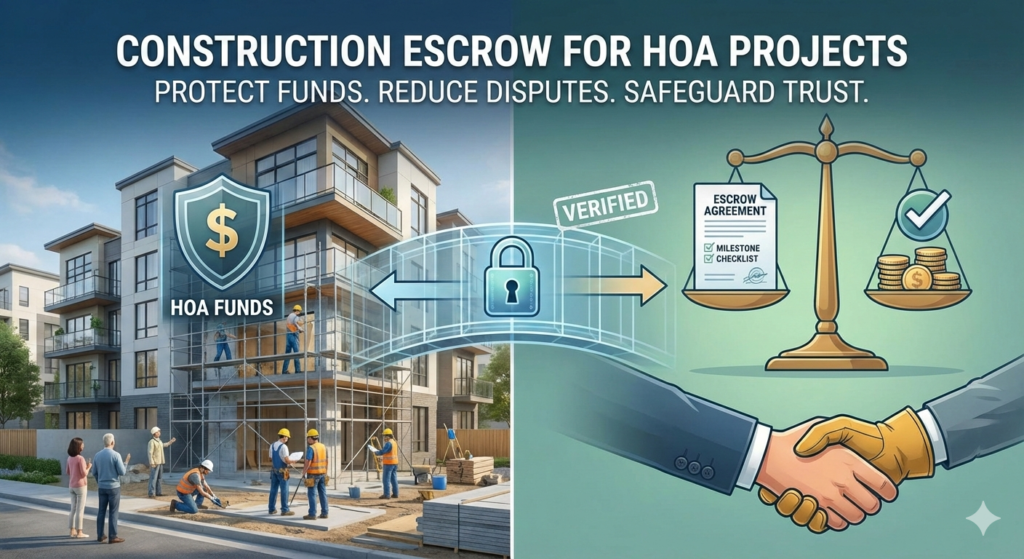
At its core, construction escrow for HOA projects creates a neutral financial structure that separates money from emotion.
Here’s how it works in practice:
- Association funds are held in a secure escrow account
- Payments are tied to clearly defined project milestones
- Funds are released only after each milestone is verified
- Documentation accompanies each disbursement
This structure protects everyone involved; without slowing progress.
How Escrow Protects HOA Funds During Renovations
1. Payments Are Connected to Progress
Escrow ensures money moves only when work moves.
Instead of paying based on promises or pressure, payments follow completion:
- Work completed
- Verification obtained
- Funds released
This alignment reduces disputes and reinforces accountability.
2. Managers Gain Built-In Financial Guardrails
Construction escrow for HOA projects creates a documented, third-party-managed system.
For managers, this means:
- Clear justification for payment timing
- Neutral oversight of funds
- Reduced exposure to accusations of mismanagement
The process becomes defensible; not personal.
3. Boards Receive Transparency Without Micromanagement
Boards want visibility; not chaos.
Escrow provides:
- Clear milestone schedules
- Payment records
- Consistent documentation
Instead of questioning every invoice, boards review a structured plan already in motion.
Reducing Contractor Disputes Before They Begin
Most construction disputes don’t start with conflict; they start with misalignment.
Construction escrow for HOA projects prevents common triggers:
- Early payment requests without completed work
- Confusion over what constitutes “done”
- Disagreements at the final payment stage
By defining expectations upfront, escrow minimizes friction later.
Contractors also benefit:
- They know funds are secured
- They know payment is guaranteed upon completion
- They face fewer payment delays caused by internal debates
This balance strengthens professional relationships.
Protecting Fiduciary Responsibility
HOA and condo managers operate under fiduciary standards that demand:
- Prudence
- Documentation
- Risk mitigation
Construction escrow for HOA projects supports these obligations by:
- Demonstrating proactive fund protection
- Providing third-party oversight
- Creating a clear audit trail
If questions arise months—or years—later, the record tells a clear story.
When Escrow Becomes Essential; Not Optional
Construction escrow for HOA projects is especially valuable when:
- Managing large capital improvement projects
- Coordinating multiple contractors or phases
- Handling resident-sensitive renovations
- Working under tight regulatory or permitting requirements
In these scenarios, escrow isn’t an extra layer; it’s the stabilizing foundation.
The Emotional Relief Managers Rarely Talk About
Beyond finances, escrow offers something rarely acknowledged: peace of mind.
Managers no longer carry the full emotional burden of:
- Payment timing disputes
- Board pressure
- Resident accusations
The system speaks for itself.
Money moves when work is complete. Period.
Final Thoughts; A Smarter Standard for HOA Projects
HOA and condo managers aren’t looking for complexity. They’re looking for clarity.
Construction escrow for HOA projects provides:
- Financial protection
- Dispute reduction
- Fiduciary confidence
- Trust across all stakeholders
In an environment where scrutiny is constant and margins for error are thin, escrow transforms risk into structure; and uncertainty into control.
Ready to Protect Your Association’s Funds with Confidence?
If you manage HOA or condo renovation projects, construction escrow for HOA projects gives you a safer, more defensible way to handle association funds; reduce disputes; and protect your fiduciary responsibility.
Whether you’re planning a capital improvement, preparing for a board vote, or navigating a complex renovation, having a neutral escrow structure in place can make all the difference.
Talk with our team about setting up construction escrow for your next HOA project.
📞 Call: 855-611-3532
📧 Email: info@buildsafeescrow.com
Build Safe Escrow works with HOA and condo managers nationwide to create clear, milestone-based payment structures that protect funds; support transparency; and bring calm back to construction projects.
Construction escrow for HOA projects Frequently Asked Questions
What is construction escrow for HOA projects?
Construction escrow for HOA projects is a financial arrangement where association funds are held by a neutral third party and released only when specific construction milestones are completed and verified. Instead of paying contractors upfront or based on invoices alone, payments are tied directly to progress, documentation, and agreed-upon project stages. This structure protects HOA funds while keeping projects moving forward.
Why should an HOA or condo association use construction escrow?
HOA and condo associations use construction escrow to reduce financial risk, prevent disputes, and fulfill fiduciary responsibilities. Construction escrow for HOA projects ensures funds are not released prematurely, provides transparency to boards and residents, and helps managers demonstrate prudent financial oversight during renovations or capital improvements.
Does construction escrow protect HOA managers personally?
Yes. Construction escrow for HOA projects helps protect HOA and condo managers by creating a documented, third-party-managed payment process. This reduces personal exposure to claims of mismanagement, favoritism, or improper payment timing. Every disbursement is tied to verified work, creating a clear audit trail that supports fiduciary decision-making.
How are payments released in construction escrow for HOA projects?
Payments in construction escrow for HOA projects are released based on pre-defined milestones, not on pressure or informal requests. Once a milestone is completed and verified according to the agreement, funds are released from escrow. This approach keeps expectations clear for contractors, boards, and residents while minimizing disputes over timing or scope.
Is construction escrow only for large HOA renovation projects?
No. While construction escrow for HOA projects is especially valuable for large capital improvements, it can also be used for smaller renovations where financial protection and accountability matter. Any project involving shared funds, board oversight, or heightened scrutiny can benefit from escrow-based milestone payments.
More Resources from Build Safe Escrow:
- ADU Construction Escrow: How Investors Fund a Backyard Build Only as the Work Gets Done
 Funding an ADU you rarely get to visit? ADU construction escrow ties every draw to a verified stage, from permits to final inspection, so your capital becomes a finished, rentable unit.
 - No Deposit Contractor? How to Start Work Without a Deposit and Still Get Paid
 Clients keep refusing big deposits, and starting unfunded is a risk no builder should carry. Here is how to skip the deposit, have the client fund escrow first, and get paid on verified milestones.
 - How to Set Up a Construction Escrow Account: A Homeowner’s Step-by-Step Guide
 Before you wire a renovation deposit, settle seven decisions, gather your documents and ask any provider five questions. This homeowner guide shows how to set up a construction escrow account in the right order.
 - HOA Roof Replacement Escrow: How Property Managers Protect Reserve Funds on the Biggest Job
 A roof is often the biggest check a board writes. Here is how property managers use milestone-based escrow to protect reserve funds, keep the roofer paid on time, and document every release.
 - Paying Cash to Build a House? How Homeowners Keep Control of Every Draw
 No construction loan means no bank inspector checking your draws. This guide shows how homeowners paying cash rebuild that structure, so money never moves ahead of the work.