
Table of Contents
- Why a bad agreement is worse than no agreement
- What is a construction escrow agreement?
- The nine clauses that decide whether you get paid
- Who signs a construction escrow agreement?
- How a construction escrow agreement differs from a construction contract
- From the field: Marcus in Denver
- How the agreement turns trust into a release schedule
- FAQ
- Get paid on milestones, not maybes
- References
A construction escrow agreement is the document that decides whether your next draw arrives on Friday or sits in someone’s inbox for three weeks. If you are a contractor and a client has proposed escrow for the first time, this is the page to read before you sign.
Most contractors treat the agreement as paperwork the escrow company handles. That is a mistake. The agreement is where you set the conditions for release, and the conditions for release are the difference between getting paid for finished work and arguing about it.
Why a bad agreement is worse than no agreement
Without escrow, a contractor at least knows the risk. You do the work, you send the invoice, and you find out whether the client pays. Slow, but familiar.
A poorly written agreement adds a third party and a set of rules, but leaves the rules vague. “Funds released upon satisfactory completion of framing” sounds fine until the client decides framing is not satisfactory. Now your money is locked in an account, the escrow agent cannot release it without a clear condition being met, and nobody wrote down what the condition was.
The fix is not to avoid escrow. The fix is to write the release conditions so tightly that satisfaction is not a matter of opinion.
What is a construction escrow agreement?
A construction escrow agreement is a signed contract between the property owner, the contractor, and a neutral escrow agent that sets out how much money goes into the escrow account, which milestones must be completed and verified before each release, and who has to approve each draw. It sits alongside the construction contract, and the construction contract still governs the scope, price, and schedule of the work.
The agent holds the funds in a segregated, FDIC-insured account. Neither the owner nor the contractor controls the money once it is deposited. The agent releases each draw only when the release conditions in the agreement have been met and documented. That is the whole mechanism, and everything below is about making it work in your favor.
The nine clauses that decide whether you get paid
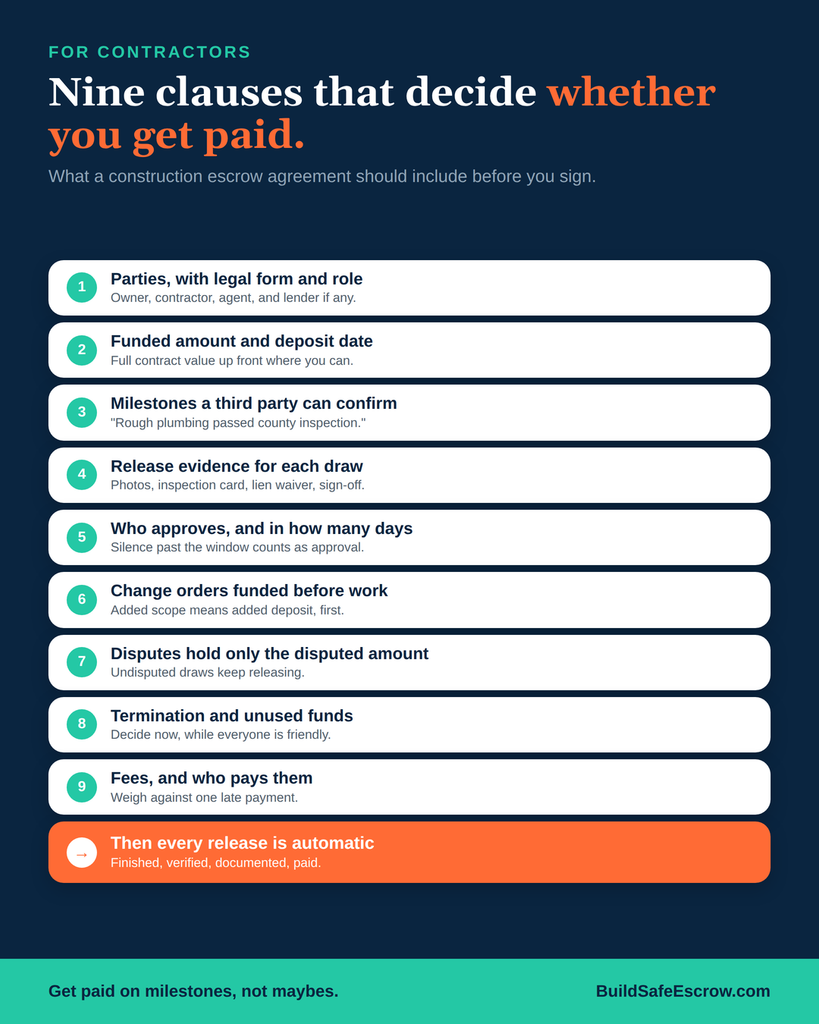
1. Identification of the parties. Every party is named with its legal form (sole proprietor, LLC, corporation) and its role. If a lender is funding the job, the lender is named too, along with what the lender can and cannot approve.
2. Funded amount and deposit timing. The construction escrow agreement should state the total to be deposited, whether it is deposited in full or in stages, and the date the first deposit is due. Ask for the full contract value up front where you can. A fully funded account is proof the client can pay for the whole job, and that proof is worth more than any credit check.
3. The milestone schedule. Each milestone is described in enough detail that a third party could confirm it. “Rough plumbing complete and passed county inspection” works. “Plumbing phase” does not. Match the milestones to your cash needs: material-heavy stages should trigger a release before you order, not after.
4. Release conditions and evidence. For every milestone, the agreement lists what must be submitted to trigger the release: photos, an inspection card, a signed lien waiver (a document giving up the right to claim against the property for the amount being paid), or an architect’s sign-off. This clause is the one to spend the most time on. Vague evidence requirements are where disputes live.
5. Who approves, and how fast. Name the person who confirms each milestone and the number of days they have to respond. Include what happens if they go silent. A deemed approval clause (the release proceeds if no objection is raised within the window) protects you from a client who stalls.
6. Change orders. State how a change to scope or price is documented and how it changes the funded amount. If a change order adds $18,000 of work, the agreement should require the client to fund that amount before the work starts, not after.
7. Dispute handling. If the owner objects to a release, the agreement should say what happens next: a defined cure period, then mediation or arbitration, with the disputed amount held and the undisputed amounts still released. That last part matters. A dispute over one milestone should not freeze the whole account.
8. Termination and unused funds. If the project ends early, who gets the balance, and how are completed but unreleased milestones handled? Write this down while everyone is friendly.
9. Fees. The agreement states the escrow fee, who pays it, and whether it can be split. Compare the fee to what a single late payment costs you in interest, time, and stalled crews.
Nine clauses, one job: make every release automatic once the work is done.
Who signs a construction escrow agreement?
The property owner, the contractor, and the escrow agent all sign a construction escrow agreement, and a lender signs when loan proceeds are being deposited. Subcontractors usually do not sign the main agreement, though the release conditions may require their lien waivers before a draw.
If you run a larger job with several trades, ask whether the escrow account can pay subs directly on a joint-check basis. It removes you from the middle of the money and removes the “the GC has been paid, why haven’t I” call from your week.
How a construction escrow agreement differs from a construction contract
Contractors sometimes assume one document replaces the other. It does not.
- The construction contract sets scope, price, schedule, warranties, and what happens if the work is defective.
- The construction escrow agreement sets where the money sits and the mechanics of releasing it.
The two must agree with each other. If your contract says “30 percent on completion of rough-in” and the escrow agreement says “25 percent,” the escrow agent follows the escrow agreement. Read them side by side before you sign either one, and ask your attorney to check that the milestone language matches. This article is information, not legal advice; your attorney can tell you what applies in your state.
From the field: Marcus in Denver
Marcus runs a six-person remodeling company in Denver, Colorado. A client on a $210,000 whole-house remodel proposed escrow, and Marcus agreed because it meant the money was real.
The agreement the client’s attorney drafted said each release required “owner approval of the completed phase.” Marcus signed it. The first two draws went fine. On the third, the client was traveling, then wanted to walk the house with her designer, then asked for a punch list before approving. The cabinets were paid for and installed. The release took 26 days.
On the next job he brought his own construction escrow agreement to the table. Each milestone named the inspection or document that triggered release, the owner had five business days to object in writing, and silence counted as approval. Six draws, none later than four days. Same client base, same crew, different paperwork.
How the agreement turns trust into a release schedule
A handshake says the client will pay. A funded account with a written release schedule proves it, and proves it before you order a single sheet of drywall.
That is why escrow protects contractors at least as much as owners. The owner gets assurance the money only moves for finished work. You get assurance the money exists and that the trigger for releasing it is written down, not felt. When both sides can see the escrow account and milestone schedule, the payment conversation stops being a negotiation at the end of every phase.
Many of the contractors in our network now propose escrow themselves on jobs over a certain size. It closes nervous clients faster, and it means the last check is already sitting in the account when the final inspection passes. If you want to see the mechanics before you propose it, the construction escrow FAQs cover funding, releases, and disputes step by step.
Trust is a feeling. Structure is protection. Money should never move ahead of the work, and with the right agreement it never lags behind it either.
FAQ
Who writes the construction escrow agreement?
The escrow company usually supplies a standard construction escrow agreement, and the parties adjust the milestone schedule and release conditions to fit the job. Either side’s attorney can review it. Bring your own milestone list to that conversation.
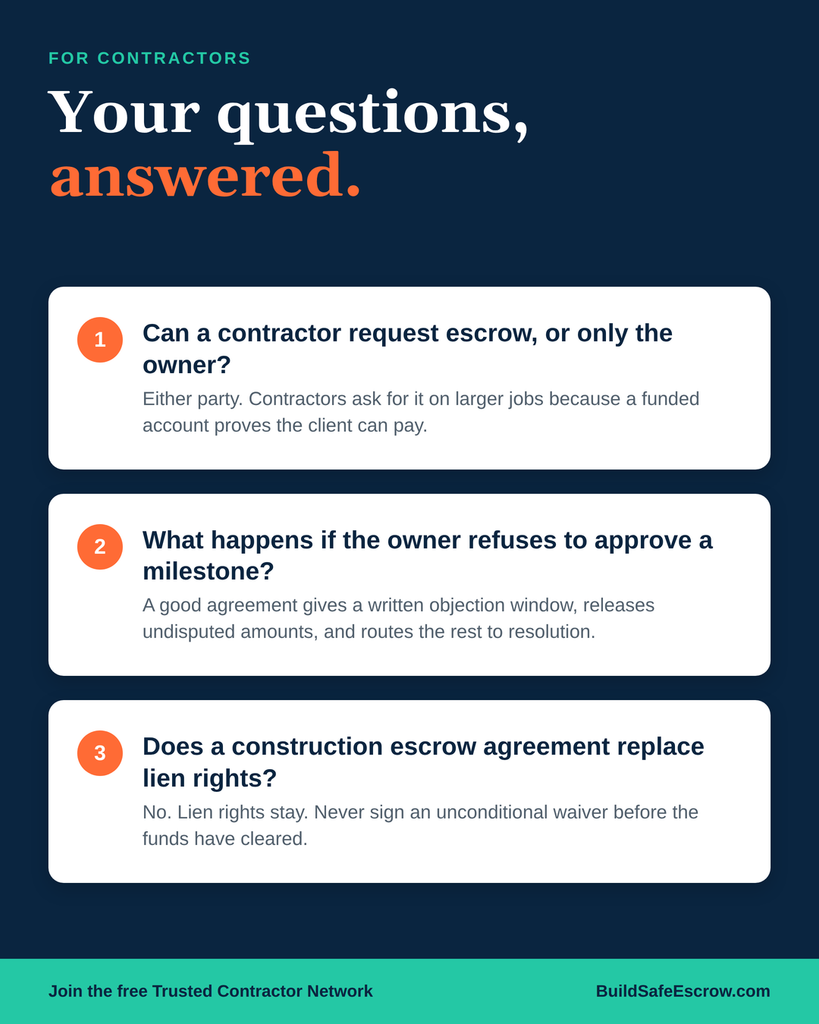
Can a contractor request escrow, or only the owner?
Either party can propose it. Contractors increasingly ask for escrow on larger jobs because a funded account proves the client can pay before materials are ordered.
What happens if the owner refuses to approve a milestone?
It depends on the agreement. A well-written one gives the owner a set number of days to object in writing, releases undisputed amounts, and sends the disputed portion to a defined resolution process. Without those terms, the money can sit.
Does a construction escrow agreement replace lien rights?
No. Your lien rights come from state law and remain in place. Most agreements require a lien waiver for each release, so keep track of conditional versus unconditional waivers and never sign an unconditional waiver before the funds have cleared.
How much does a construction escrow agreement cost?
Fees vary by provider and project size. The agreement states the fee and who pays it, and the parties can split it. Weigh the fee against the cost of one late payment on the same job.
Get paid on milestones, not maybes
Get one short read each Friday on how construction money actually moves. Subscribe to The Build Brief.
Build trust. Win more projects. Get paid on milestones, not maybes. Join the free Trusted Contractor Network and bring a construction escrow agreement to your next bid.
References
FDIC, “Deposit Insurance”: https://www.fdic.gov/resources/deposit-insurance/
J.P. Morgan, “Escrow Services: Real Estate and Construction Guide”: https://JPMorgan.com/content/dam/jpm/treasury-services/documents/jpmorgan-escrow-real-estate-guide-2023-ada-compliant.pdf
Levelset, “Lien Waivers: The Ultimate Guide”: https://www.levelset.com/lien-waivers/
Law Insider, “Construction Escrow Clause Samples”: https://www.lawinsider.com/clause/construction-escrow