Every construction project involves two things in large supply: money and uncertainty. Materials get delayed. Scope changes. Contractors and property owners interpret agreements differently. And somewhere in the middle of all of it, significant sums of money change hands — often without much structural protection for either party.
Construction escrow exists to change that. It is one of the most practical tools available for managing the financial risk that comes with any remodel, renovation, or new build — and yet many contractors, homeowners, and property managers have never used one, or are not sure exactly how they work.
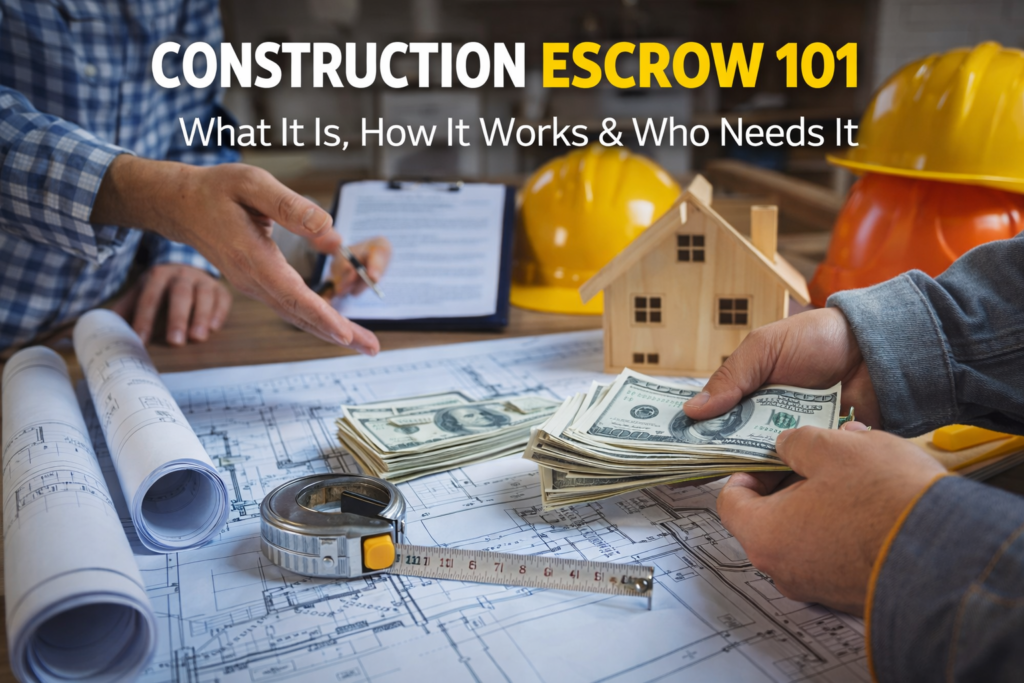
This guide breaks it down clearly: what construction escrow is, how the process works from start to finish, and who benefits from using it.
What Is Construction Escrow?
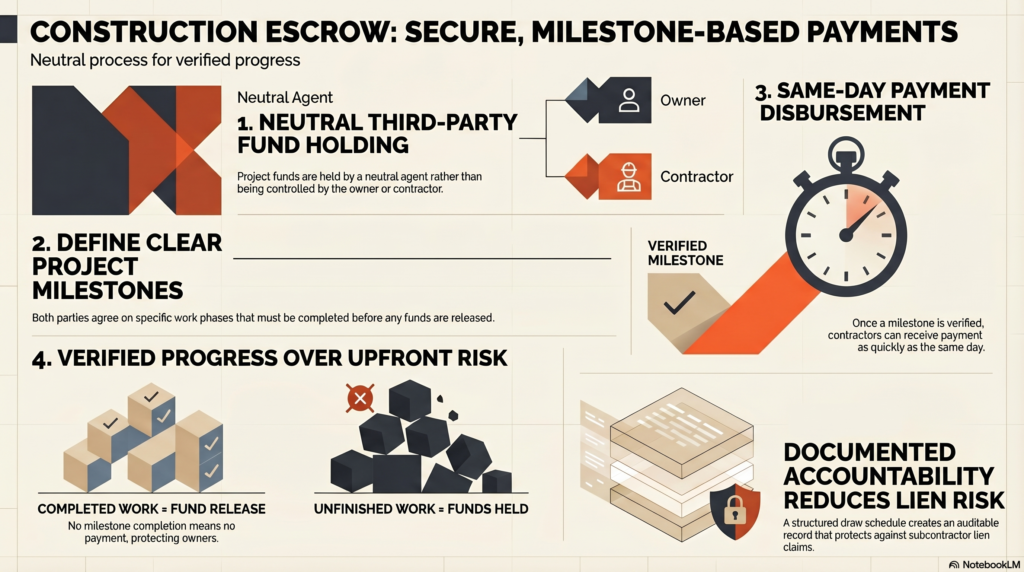
Construction escrow is a financial arrangement in which project funds are held by a neutral third party and released to a contractor only when agreed-upon milestones have been completed and verified. Rather than paying a contractor in full upfront — or attempting to manage payments informally as work progresses — both parties agree to a structured disbursement schedule tied to actual project progress.
The escrow account functions as a holding structure: the property owner deposits funds, the contractor completes defined phases of work, and disbursements are made only once those phases are confirmed. No milestone, no payment.
This model differs from general real estate escrow, which most people encounter during a home purchase. In that context, escrow handles the transfer of ownership. Construction escrow handles the transfer of funds throughout an active building process — a dynamic, ongoing arrangement with multiple disbursement points. As Procore notes in their construction escrow guide, escrow accounts serve as a guarantee that funds will be available for the project, giving contractors the confidence that payment is committed before work begins.
In Florida specifically, construction escrow carries added significance. Under Chapter 713 of the Florida Statutes, escrow accounts serve as a guarantee that funds will be available for the project, giving contractors the confidence that payment is committed before work begins.
Across the country, construction lien laws give unpaid subcontractors and material suppliers the right to file claims against a property — even when the owner has already paid the general contractor in full. The specifics vary by state, but the exposure is real everywhere. Escrow adds a layer of documented financial accountability that helps all parties reduce that risk, regardless of where the project is located.
How Does Construction Escrow Work?
The process follows a clear sequence, though the specifics vary by project size, escrow provider, and the agreement between the parties.
Step 1: The Agreement Is Established
Before any work begins, the contractor and property owner agree on a scope of work, a payment schedule, and the conditions that must be met for each disbursement. These conditions — the milestones — are documented in a formal Construction Escrow Agreement. Examples might include completion of demolition, rough framing inspection, installation of plumbing and electrical rough-ins, or final walkthrough and punch list sign-off.
A well-drafted escrow agreement identifies each party and their role, outlines the underlying transaction, specifies deposit amounts and payment methods, and establishes the exact conditions that trigger each disbursement. For a deeper look at what goes into that document, see our guide to understanding construction escrow agreements.
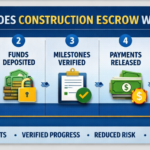
Step 2: Funds Are Deposited
The property owner deposits the project funds — or a portion of them — into the escrow account. This step removes the money from the owner’s direct control and places it in a neutral position. The contractor knows the funds are available and committed; the owner knows the funds will only be released when work is done.
Step 3: Work Proceeds by Milestone
The contractor completes the first milestone. Once both parties confirm the work meets the agreed standard — sometimes involving an inspection, a signed approval, or documented review — the escrow agent releases the corresponding disbursement. The contractor is paid for what was completed; the remaining balance stays protected until the next phase is finished.
Step 4: Disbursements Continue Through Project Completion
This process repeats through each phase of the project. Each milestone triggers a disbursement; each disbursement is tied to verified progress. By the time the final payment is released, the full scope of work has been completed and confirmed.
For added security, reputable escrow managers employ rigorous fund verification steps. According to Construction Dive, the strongest escrow processes use a three-step approval protocol: gathering disbursement instructions in writing, verifying by direct phone call, and confirming delivery after transfer. This protects against both disputes and cybercrime.
Step 5: Disputes Are Resolved Within the Structure
If a disagreement arises — the owner believes a phase is incomplete; the contractor believes it meets the agreed standard — the escrow structure creates a process for resolving the dispute before funds are released. This is one of the most underappreciated benefits of escrow: it does not just protect money; it creates accountability before a project derails.
Who Benefits from Construction Escrow?
Construction escrow is not a one-sided arrangement. It is designed to give all parties something meaningful.
Property Owners
For homeowners and property owners, escrow addresses one of the most common anxieties in any renovation: paying for work that is never completed. Paying a contractor in full upfront offers little leverage if the project stalls or the work is substandard. Escrow changes that dynamic entirely. Funds are only disbursed when milestones are met, giving the owner meaningful control throughout the project.
In Florida, this protection carries legal weight — and the same is true in every other state. Construction lien laws across the U.S. allow unpaid subcontractors and suppliers to file claims against a property even if the owner already paid the general contractor. Escrow’s documented milestone system reduces the risk of those payment gaps occurring in the first place, no matter where the project is located.
Contractors
For contractors, escrow solves a different but equally real problem: payment uncertainty. Many contractors have completed work and waited — sometimes indefinitely — for payment. Escrow confirms that funds are available and committed before a single nail is driven. It also positions contractors as professionals who operate with financial transparency, which is a meaningful differentiator when competing for clients.
Any general contractor can request that a customer set up an escrow account, even without a construction loan involved, as Procore’s construction escrow guide confirms. The owner funds the account; an independent party manages disbursements. It is a straightforward way to establish trust before work begins.
HOA and Condo Managers
Associations overseeing common area renovations or building improvements face an additional layer of complexity: fiduciary responsibility to their community. Using escrow for contractor payments provides a documented, structured process that protects reserve funds and demonstrates sound financial management to boards and residents. Whether the community is navigating new building safety requirements, aging infrastructure upgrades, or a major capital improvement project, escrow creates the payment accountability that protects both the association and the contractors it hires.
Construction Escrow vs. Other Payment Methods
It helps to understand what escrow is not.
- Paying upfront gives contractors full access to funds before work is verified — removing the owner’s leverage entirely.
- Paying after completion shifts all risk to the contractor, who has no assurance of payment until the project is done.
- Informal draw schedules rely on goodwill and verbal agreements, with no neutral party managing disbursements.
Escrow occupies a different position. Unlike bank guarantees or traditional insurance, escrow agents can typically release funds quickly — often within two business days — once milestone conditions are confirmed, as noted by Lexology’s analysis of escrow services in construction. This speed and structure is what makes milestone-based escrow the preferred model for serious projects.
Frequently Asked Questions About Construction Escrow
Is construction escrow only for large or commercial projects?
No. While escrow is common on large commercial builds, it is increasingly used on residential renovations of all sizes. Any project where a significant sum is changing hands — a kitchen remodel, a bathroom addition, a full home renovation — can benefit from the structure escrow provides. There is no minimum project size.
Does escrow slow down the construction process?
Not in practice. Well-structured escrow agreements define milestones clearly enough that disbursements happen smoothly as work progresses. The upfront investment in clarity — defining what “completed” means for each phase — is precisely what prevents the delays and disputes that slow projects down far more than any administrative step.
Who serves as the escrow agent?
The right choice depends on project size, complexity, and the level of oversight both parties want. Specialized construction escrow providers like Build Safe Escrow, typically offer more granular milestone tracking and disbursement documentation than a general title company.
Can a contractor request the use of escrow, or does it have to come from the owner?
Either party can initiate the use of escrow. Contractors who proactively offer escrow as part of their payment structure often find that it builds client confidence and reduces pre-project negotiation friction. It signals professionalism and financial transparency before work begins.
What happens if a dispute arises during the project?
The escrow structure is designed for exactly this scenario. Because funds are tied to documented milestones, any dispute is grounded in a written record of what was agreed and what has been verified. The escrow agent acts as a neutral third party, and disbursements are withheld until the dispute is resolved. This is meaningfully different from informal payment arrangements, where disputes often escalate because there is no neutral framework to contain them.
Is construction escrow required by law?
Construction escrow is not universally required by law for private projects, though lenders often require it as part of a construction loan. That said, every state has construction lien laws that allow unpaid subcontractors and suppliers to file claims against a property — even when the owner has paid the general contractor in full. Using escrow with a structured draw schedule creates an auditable payment record that directly supports compliance with those requirements, wherever your project is located.
How much does construction escrow cost?
Fees vary by provider, project size, and the number of disbursements involved. Escrow agents typically charge either a flat fee or a small percentage of the total project value. For most projects, the cost is modest relative to the financial protection and payment assurance the arrangement provides.
The Real Value of Escrow: Structure Before Uncertainty Arrives
Construction projects are, by nature, unpredictable. Materials get delayed. Weather intervenes. Inspections uncover surprises. What escrow provides is not a guarantee that nothing will go wrong — it is a structure that ensures financial accountability when something does.
That distinction matters. The question is rarely whether a project will face complications. The question is whether both parties have the financial infrastructure in place to handle those complications without the relationship — and the project — breaking down entirely.
Escrow provides that infrastructure. It transforms a handshake agreement into a documented, milestone-driven process where both parties know exactly what is expected, what has been completed, and what comes next.
Ready to Protect Your Next Project?
Build Safe Escrow helps contractors, property owners, and HOA managers structure construction payments with confidence. If you’re planning a remodel, renovation, or building project and want to understand how escrow can work for your specific situation, schedule a consultation with our team.
→ Schedule a Free Consultation with Build Safe Escrow