
Renovating a home often begins with excitement. Plans are drawn, materials are chosen, and a contractor is hired after careful research and conversations. Everything feels promising. The project is scheduled, a deposit is paid, and work begins.
Then something unexpected happens.
The crew stops showing up. Calls go unanswered. Text messages remain unread. Days turn into weeks, and suddenly the homeowner is left staring at an unfinished project and wondering what went wrong.
In the construction world, this situation has a name many homeowners know all too well: the contractor “vanishing act.”
When a contractor disappears, the impact can be devastating. Projects stall, money may already be spent, and homeowners are left navigating a stressful and expensive situation. Understanding why this happens—and how to prevent it—can make the difference between a renovation nightmare and a successful project.
What happens when a contractor disappears during a renovation?
When a contractor disappears during a renovation project, the work stops while the homeowner may already have paid a portion of the project cost. This situation, often called the construction “vanishing act,” can leave unfinished work, financial losses, and legal complications. Homeowners may need to document the project status, attempt written communication with the contractor, and potentially hire another contractor to complete the work. Using milestone-based payment structures or construction escrow accounts can help prevent these situations by ensuring that funds are only released as work is completed.
Construction Vanishing Act
The construction vanishing act refers to a situation where a contractor stops showing up or communicating during a renovation project, often after receiving a deposit or progress payment, leaving the project unfinished.
The Renovation Nightmare: When a Contractor Disappears
Homeowners planning a remodel should take steps early to protect your renovation money before construction begins.
Imagine this scenario.
After months of planning a kitchen renovation, a homeowner finally hires a contractor who seems professional and trustworthy. The contractor has good reviews, provides a detailed quote, and promises the project will take eight weeks.
The homeowner pays a deposit to secure the start date. Demolition begins. Cabinets are ordered. The project appears to be moving forward.
Then one morning, the crew doesn’t arrive.
The contractor says there is a delay. A few days later, communication becomes sporadic. Soon the phone calls stop altogether.
At that point, the homeowner begins to realize something troubling: the contractor has disappeared.
Unfortunately, this situation is more common than many people realize. Across the country, homeowners report cases where contractors abandon projects mid-way, leaving unfinished work, financial losses, and enormous frustration behind.
What Is the Construction “Vanishing Act”?
The phrase construction vanishing act is not a legal term, but it has become a widely used expression in renovation circles.
It typically describes a situation where a contractor:
- Stops showing up to the job site
- Stops responding to calls or emails
- Leaves a project unfinished
- Disappears after receiving payment
When a contractor disappears, homeowners often feel helpless because a large portion of the project funds may already be paid out.
The truth is that the structure of many residential construction payments unintentionally creates the perfect conditions for this kind of problem.
Many renovation problems begin when there is no system in place to avoid renovation money disputes during the project.
The Three Most Common Types of Contractor Disappearances
Not all situations where a contractor disappears look the same. In fact, there are several patterns that tend to appear repeatedly in renovation disputes.
The Deposit Disappearance
In this scenario, a homeowner pays a large upfront deposit to secure a project start date.
The contractor may delay the start repeatedly or never begin work at all. Eventually, communication stops entirely.
This is often the case that receives media attention because it can involve outright fraud.
The Mid-Project Exit
This situation is far more common.
Work begins normally. Progress payments are made. But after receiving a milestone payment, the contractor suddenly stops showing up.
The homeowner is left with partially completed work and must hire another contractor to finish the project, often at a higher cost.
The Slow Fade
Sometimes the disappearance is gradual.
Communication becomes inconsistent. Schedules slip. The contractor appears less frequently on the job site. Eventually, they stop responding entirely.
By the time the homeowner realizes what has happened, weeks or months may have passed.
The Surprising Truth: Not Every Vanishing Act Is Fraud
It is easy to assume that when a contractor disappears, the situation must involve fraud. While some cases do involve bad actors, many disappearances occur for reasons that are far more complicated.
Construction is an unpredictable industry, and contractors often operate small businesses that can be vulnerable to unexpected events.
Some common causes include:
- Cash flow problems
- Overbooking multiple projects
- Poor project management
- Illness or personal emergencies
- Accidents or injuries
- Bankruptcy
- Legal or immigration issues
- Supply chain disruptions
In other words, even well-intentioned contractors can find themselves unable to continue a project.
That is why relying solely on trust—even when the contractor seems reputable—can create financial risk for homeowners.
Why Traditional Renovation Payment Structures Create Risk
One of the biggest reasons homeowners are vulnerable when a contractor disappears is the way construction payments are traditionally structured.
Many residential renovation projects follow a payment model that looks like this:
- Large deposit to begin the project
- One or two progress payments
- Final payment upon completion
While this structure may appear reasonable at first glance, it often creates a financial imbalance.
In many cases, contractors receive a significant portion of the total project cost before most of the work is completed. If something goes wrong during the project, homeowners may have already paid more money than the value of the work performed.
This imbalance can lead to disputes, abandoned projects, and financial loss.
One of the smartest steps homeowners can take is to protect your renovation budget with construction escrow, which keeps project funds secure while work progresses.
Warning Signs Before a Contractor Disappears
Although a contractor disappearing can happen unexpectedly, there are often warning signs that appear earlier in the process.
Homeowners should be cautious if they notice any of the following:
- Requests for unusually large upfront payments
- Vague or incomplete contracts
- No clearly defined milestone payment schedule
- Poor communication early in the relationship
- Constant schedule changes before work even begins
- Contractors managing too many projects at once
While these signs do not always mean a contractor will disappear, they can indicate that the project may face challenges later.
Working with escrow-friendly contractors can also reduce risk because these professionals support transparent payment structures that protect both sides of a project.
Why Vetting Contractors Is Not Enough
Many renovation guides tell homeowners to protect themselves by carefully vetting contractors.
This advice usually includes:
- Checking licenses
- Reading online reviews
- Asking for references
- Reviewing previous projects
These steps are important and should always be part of the hiring process.
However, even the most reputable contractor cannot control everything that might happen during a construction project. Life events, financial difficulties, or unexpected circumstances can disrupt even well-planned projects.
That means the real protection does not come solely from choosing the right contractor. It also comes from choosing the right payment structure.
How Milestone Payment Management Prevents the Construction Vanishing Act
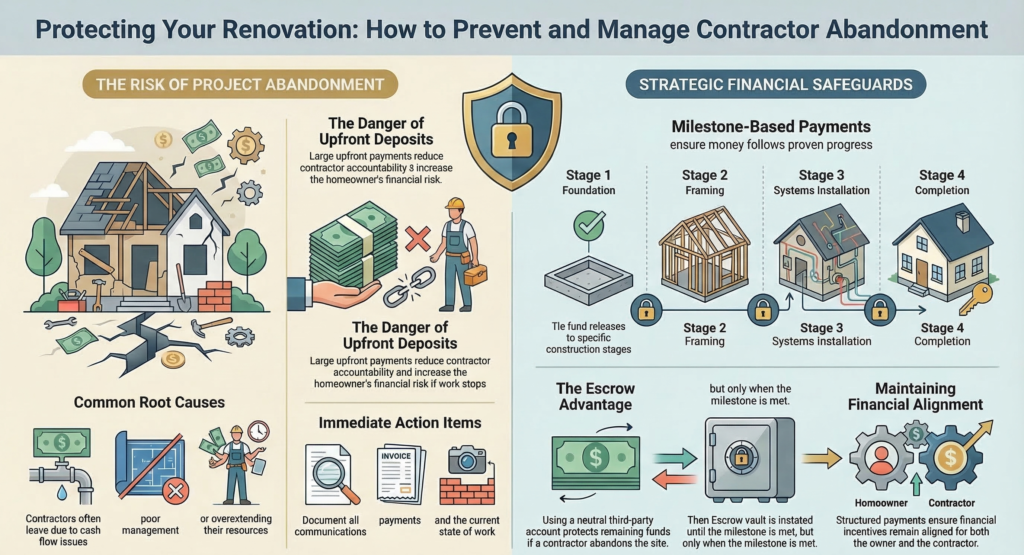
One of the most effective ways to prevent problems when a contractor disappears is to structure project payments around clearly defined milestones.
This approach is known as milestone payment management.
Instead of releasing large sums of money upfront, payments are tied directly to specific stages of completed work.
For example:
- Project commencement
- Completion of demolition
- Installation of framing or structural components
- Installation of key materials
- Final inspection and project completion
Each payment is released only after the corresponding milestone has been completed.
This structure creates a much more balanced financial relationship between homeowners and contractors.
For homeowners, it ensures that payments reflect real progress on the project.
For contractors, it provides a clear and predictable payment schedule tied to completed work.
This is where construction escrow protects renovation funds, ensuring payments are only released when specific project milestones are completed.
The Role of Construction Escrow
Another powerful tool that supports milestone payment management is construction escrow.
In this model, project funds are deposited into a neutral third-party escrow account before the project begins.
The escrow agent holds the funds securely and releases payments according to the agreed milestone schedule.
This structure provides several important benefits:
- Funds are protected throughout the project
- Payments are released only when milestones are completed
- Both parties operate under a clear financial framework
- Disputes over payments are significantly reduced
Most importantly, if a contractor disappears, the remaining funds are still protected within the escrow account.
Why Secure Payment Structures Are Becoming the New Standard
In many industries, financial safeguards are already standard practice.
For example:
- Real estate transactions use escrow accounts
- Commercial construction projects rely on structured draw schedules
- Lenders control payment disbursements in large development projects
Residential construction, however, has historically relied heavily on trust between homeowners and contractors.
As renovation projects become more complex and expensive, more homeowners are beginning to recognize the importance of financial safeguards.
Secure payment structures, milestone payments, and construction escrow are gradually becoming the new standard for responsible renovation planning.
Some industry experts even describe escrow as the system that construction needs as a financial referee, helping keep projects fair and transparent for everyone involved.
Turning Renovation Risk Into Renovation Confidence
Renovations will always involve uncertainty. Weather delays happen. Materials arrive late. Unexpected structural issues can emerge once construction begins.
But financial chaos does not have to be part of the process.
When payment structures align with project progress, both homeowners and contractors benefit. Funds remain secure, expectations are clear, and the risk of disputes decreases dramatically.
Most importantly, projects can move forward with greater trust and transparency.
Because while construction surprises may be unavoidable, the contractor vanishing act does not have to be.
Learn more about construction escrow services and how they can protect both homeowners and contractors during renovation projects.
Don’t Let Your Renovation Become a Vanishing Act
Frequently Asked Questions
1. What should I do if my contractor disappears during a project?
If a contractor disappears during a project, the first step is to document everything. Keep records of your contract, payments, communication, and the current state of the work. Attempt to contact the contractor in writing and request clarification. If there is no response, you may need to consult a construction attorney, file a complaint with your state contractor licensing board, or pursue legal remedies depending on your contract terms. This situation can become complicated quickly, which is why structuring payments carefully from the beginning is so important.
2. Why do contractors sometimes disappear mid-project?
When a contractor disappears, the cause is not always fraud. While some cases involve bad actors, many situations occur because of cash flow problems, poor project management, unexpected personal emergencies, or taking on too many projects at once. Construction is a demanding industry, and financial instability can sometimes cause contractors to abandon work if they cannot continue operating.
3. Can I prevent a contractor from disappearing with my money?
While no system can eliminate all risk, homeowners can greatly reduce the chances that a contractor disappears by using construction escrow; avoiding large upfront deposits and using structured payment schedules. Payments should be tied to clear construction milestones so money is released only as work progresses. This approach creates accountability and helps ensure that financial incentives remain aligned throughout the project.
4. What is the safest way to structure payments for a renovation project?
The safest approach is to use milestone-based payments, where funds are released in stages as specific portions of the work are completed. Many projects also use construction escrow, where the funds are placed in a neutral third-party account before construction begins. Payments are then released according to the agreed milestone schedule, providing financial protection for both the property owner and the contractor.
5. How does construction escrow protect homeowners if a contractor disappears?
Construction escrow protects homeowners because the project funds are held by a neutral third party instead of being paid directly to the contractor upfront. If a contractor disappears or abandons the project, the remaining funds are still protected in the escrow account. This allows the homeowner to pause the project, resolve disputes, or hire a new contractor without losing the remaining project budget.
6. What happens if a contractor abandons a construction project?
If a contractor abandons a construction project, the homeowner may have several options depending on the contract and local laws. These may include terminating the contract, hiring another contractor to complete the work, filing a complaint with the state licensing board, or pursuing legal action to recover damages. Project abandonment can also lead to disputes over payments, unfinished work, and potential lien issues if subcontractors were involved.
7. Can a contractor legally take a deposit and not start work?
Contractors are typically allowed to request deposits to secure materials or reserve a place in their schedule, but the amount and rules vary by state. If a contractor takes a deposit and fails to start work within the agreed timeline without explanation, it may be considered a breach of contract or even fraud in certain cases. Clear contracts and milestone-based payment schedules help reduce this risk by tying payments to actual project progress.
8. Why do construction projects fail financially?
Construction projects can fail financially for several reasons, including poor budgeting, unexpected cost overruns, contractor cash flow problems, or disputes between homeowners and contractors. When payments are made without clear milestones or oversight, financial misalignment can quickly develop. Structured payment systems and secure fund management can help prevent these issues and keep projects financially stable from start to finish.
For more insights about construction payment protection, explore our construction escrow blog for additional guides and resources.
- ADU Construction Escrow: How Investors Fund a Backyard Build Only as the Work Gets Done
- No Deposit Contractor? How to Start Work Without a Deposit and Still Get Paid
- How to Set Up a Construction Escrow Account: A Homeowner’s Step-by-Step Guide
- HOA Roof Replacement Escrow: How Property Managers Protect Reserve Funds on the Biggest Job
- Paying Cash to Build a House? How Homeowners Keep Control of Every Draw