There’s a moment at the start of every renovation when everything feels possible.
Plans are approved. The contractor seems solid. The budget looks manageable. Trust is high.
And then the money moves.
That’s usually where problems begin.
Not because someone intended to do something wrong; but because once funds are released without protection, leverage disappears, timelines blur, and even small issues turn into expensive disputes. This is exactly why construction escrow is becoming the quiet standard behind well-run renovation and construction projects.
Let’s break it down clearly; no legal jargon; no fluff.
What Is Construction Escrow?
Construction escrow is a financial safeguard that holds renovation or construction funds in a secure, neutral account. Money is released only when agreed-upon milestones are completed and verified.
Instead of paying a contractor directly upfront or sending money “as requested,” funds are:
- deposited into escrow before work begins
- tied to specific construction milestones
- released only after progress is confirmed
Think of escrow as the seatbelt for construction payments. You hope you never need it; but when something unexpected happens, it’s the only thing that keeps damage from becoming disastrous.
Why Traditional Construction Payments Fail
Most construction disputes don’t start with bad intentions. They start with bad payment structures.
Here’s what usually goes wrong:
Large upfront deposits
Once money leaves your account, control is gone. If delays occur, there’s no leverage to correct course.
Payments disconnected from progress
Paying based on dates or verbal updates instead of completed work leads to misunderstandings and conflict.
No neutral third party
When disputes arise, it becomes one person’s word against another’s; emotions escalate; projects stall.
Last payment chaos
The final draw is the most disputed payment in construction; inspections, punch lists, and permits turn into financial standoffs.
Construction escrow eliminates these pressure points before they ever appear.
How Construction Escrow Works (Step by Step)
Here’s how a protected project is structured:
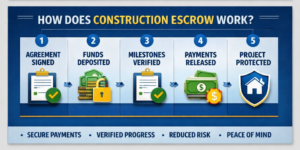
1. An escrow agreement is signed
All parties agree on scope, milestones, payment amounts, and conditions.
2. Funds are deposited securely
Money is placed into an escrow account before work begins; funds are verified and reserved.
3. Work progresses by milestones
Demolition, rough-ins, inspections, finishes; each phase has a clear definition.
4. Milestone completion is confirmed
Once a milestone is completed as agreed, payment authorization is triggered.
5. Funds are released
Payments are disbursed from escrow; lien waivers can be collected simultaneously.
This process removes emotion, pressure, and guesswork from payments.
Who Construction Escrow Protects (It’s Not Just Owners)
One of the biggest misconceptions is that escrow is “only for homeowners.” In reality, escrow protects everyone involved.
Property owners
- Funds remain protected
- Payments align with real progress
- No paying for unfinished work
Contractors
- Funds are pre-secured
- No chasing payments
- Cash flow becomes predictable
HOAs and condo boards
- Transparent fund management
- Reduced disputes and liability
- Clear accountability
Lenders and investors
- Better risk management
- Controlled disbursement
- Fewer stalled projects
Escrow doesn’t slow projects down; it stabilizes them.
Common Myths About Construction Escrow
“Escrow means we don’t trust the contractor”
False. Escrow protects against life events, financing delays, and miscommunication; not just bad actors.
“It’s too complicated”
Modern escrow is structured, clear, and efficient. Complexity comes from disputes; not protection.
“It’s only for huge projects”
Escrow is increasingly used on renovations starting at $25,000, especially when multiple vendors are involved.
“Contracts are enough”
Contracts define rights. Escrow protects money. You need both.
When You Should Absolutely Use Construction Escrow
Escrow isn’t overkill; it’s appropriate risk management when:
- the project exceeds $25,000
- multiple contractors or vendors are involved
- payments are spread over months
- financing or lender draws are used
- an HOA or shared ownership is involved
If losing access to the funds would stop the project; escrow should already be in place.
Why Construction Escrow Is Becoming the New Standard
The construction industry is changing.
Homeowners are more informed. Contractors are operating in tighter margins. HOAs face more scrutiny. Lenders demand transparency.
Construction escrow answers all of it with one principle:
Secure the funds first; then build.
Projects that use escrow experience:
- fewer disputes
- clearer communication
- faster resolutions when issues arise
- better working relationships overall
It’s not about preparing for failure. It’s about planning for reality.

Final Thought
Most construction stress isn’t caused by bad work; it’s caused by unprotected money.
Construction escrow doesn’t assume the worst; it prevents the worst from becoming possible.
If you’re planning a renovation, managing a project, or building for clients, protecting funds before work begins isn’t cautious; it’s smart.
If you’re exploring a renovation or construction project and want to understand how escrow fits into your payment structure, schedule a consultation or reach out directly.
Website: www.BuildSafeEscrow.com
Phone: 855-611-3532
Email: info@buildsafeescrow.com
Frequently Asked Questions About Construction Escrow
1. What is construction escrow and how does it work?
Construction escrow is a payment protection system where project funds are held by a neutral third party and released only when agreed-upon construction milestones are completed and verified. Instead of paying contractors directly upfront, the money is secured first and disbursed in stages as work progresses, reducing financial risk for everyone involved.
2. Is construction escrow only for homeowners who don’t trust their contractor?
No. Construction escrow is not about mistrust; it’s about risk management. Even reputable contractors and responsible homeowners face unexpected events such as financing delays, inspections, illness, or supply chain issues. Escrow protects both sides by ensuring funds are available and payments are tied to real progress, not assumptions.
3. At what project size does construction escrow make sense?
Construction escrow is commonly used for projects starting around $25,000, especially when there are multiple payments, multiple vendors, or long timelines. Renovations, new builds, HOA projects, and financed construction all benefit from escrow because losing access to funds at any stage could delay or derail the project.
4. How is construction escrow different from a standard contract?
A contract defines expectations and legal rights; construction escrow protects the money. While a contract outlines what should happen, escrow ensures funds are released only when those terms are met. The two work together, but escrow adds real financial enforcement that contracts alone cannot provide.
5. Does construction escrow slow down payments or construction timelines?
No. In fact, escrow often speeds projects up. Because funds are pre-secured and milestones are clearly defined, contractors don’t have to chase payments and owners don’t hesitate to release funds. This clarity reduces disputes, improves communication, and keeps projects moving forward.
Still have questions about construction escrow?
A short conversation upfront can prevent months of stress later.
If you want to understand whether construction escrow makes sense for your specific situation, a quick conversation upfront can save months of stress later.