
Construction payment disputes are the fastest way to turn a good project into a bad relationship. One side feels overpaid for unfinished work. The other feels stiffed for work already done. This guide is for both of you — property owners writing the checks, and contractors trying to get paid on time.
Table of Contents
- Why construction payment disputes happen
- 1. Defined milestones replace vague promises
- 2. Verified completion before release ends the “is it done?” fight
- 3. Written change orders stop scope creep from becoming a dispute
- 4. Clear lien waivers protect both sides at each release
- 5. A neutral fund holder removes the leverage games
- A short field example
- How escrow removes disputes at the source
- FAQ
- Get protected on your next project
- References
Construction payment disputes almost always start the same way: the money and the work fall out of sync. A deposit goes out before a shovel hits the ground. A progress payment lands before anyone confirms the phase is finished. Then something slips, and two people who started as partners end up as adversaries.
You have felt this tension whether you pay or get paid. Owners worry the deposit will vanish. Contractors worry the final check never comes. Both fears are rational. Both are solvable.
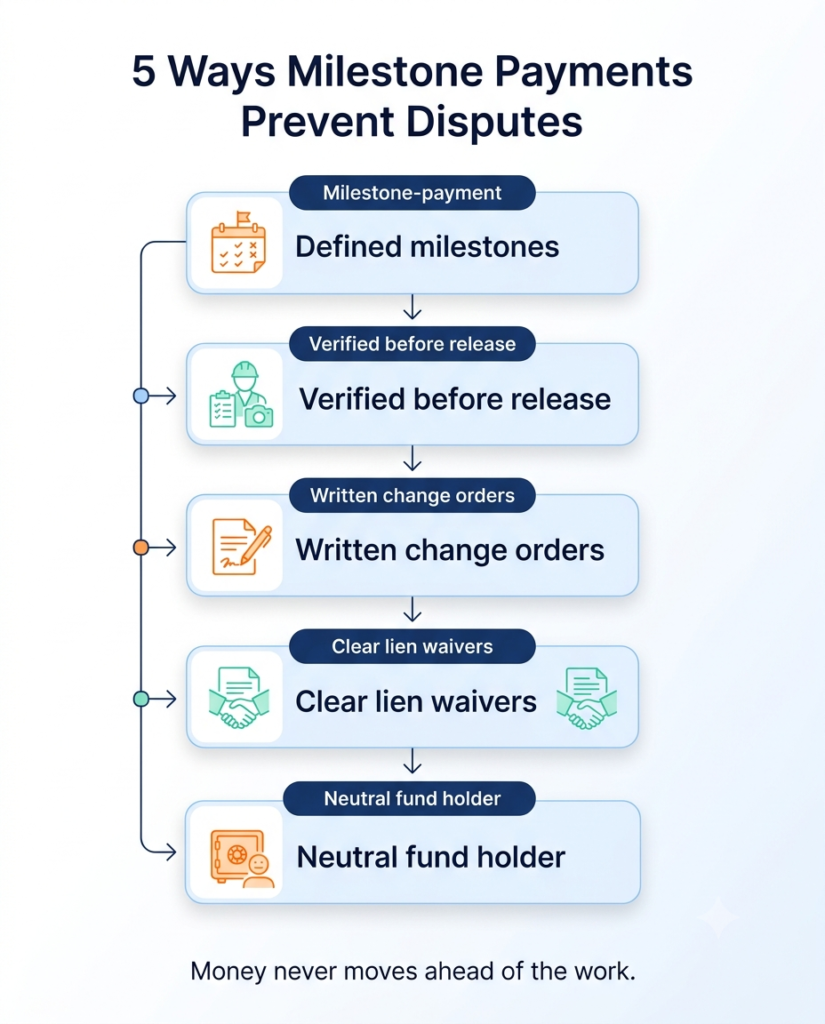
The fix is not more trust. Trust is a feeling. The fix is structure — specifically, milestone payments that tie every dollar to verified, completed work. Below are five concrete ways staged milestone payments prevent construction payment disputes, and protect the owner and the contractor at the same time.
Why construction payment disputes happen
Before the fixes, name the causes. Most construction payment disputes trace back to a handful of predictable failures.
The handshake is a liability. A verbal deal feels friendly. It also has no memory. When two people remember the same conversation differently, there is nothing to point to.
Money moves ahead of the work. This is the root of nearly every fight. Once cash has changed hands, leverage disappears. The paying side has nothing to hold. The working side feels pressure to chase what is already owed.
“Done” is undefined. Owner and contractor rarely agree on what “finished” means for a phase. Is drywall done when it is hung, or when it is taped, sanded, and primed? Without a definition, every release becomes a negotiation.
Scope changes stay verbal. The owner asks for one more thing. The contractor says yes to keep the peace. Nobody writes it down. Then the invoice arrives and the dispute begins.
Cash flow runs thin. Contractors often float labor and materials for weeks. According to industry payment research, slow and short payments are among the top stressors in the trades. When money is late, corners get cut, and disputes follow.
None of these are character problems. They are structure problems. And structure problems have structure fixes.
1. Defined milestones replace vague promises {#1-defined-milestones}
The first defense against construction payment disputes is a clear map of defined milestones. A milestone is a specific, agreed stage of work — demolition complete, rough-in inspected, cabinets installed, final punch list cleared.
Each milestone gets three things attached: a description of what “complete” means, a dollar amount, and a way to verify it. No milestone, no release. That is the whole rule.
This does two things at once. The owner knows exactly what each payment buys. The contractor knows exactly what unlocks their next check. Nobody is guessing.
When the stages are written before work starts, the argument is over before it begins. You are not negotiating in the middle of a heated moment. You are following a plan you both signed.
2. Verified completion before release ends the “is it done?” fight {#2-verified-completion}
The second fix is verified completion before release. Payment is not triggered by a calendar date or a friendly assumption. It is triggered by proof that the milestone is actually finished.
Verification can be simple: dated photos, an inspection sign-off, a lien waiver, or a walkthrough confirmation. The point is that a payment only moves after someone confirms the work matches the milestone.
For owners, this means you never pay for phantom progress. For contractors, this means once you deliver and it is verified, the money is right there — no chasing, no excuses. Getting paid becomes a structure, not a hope.
This single practice removes the most common construction payment disputes: the ones where one side says “it’s done” and the other says “no it isn’t.” Verification answers the question with evidence, not opinion.
3. Written change orders stop scope creep from becoming a dispute {#3-written-change-orders}
The third fix is the written change order. A change order is a documented agreement that updates the scope, price, or timeline when something shifts mid-project.
Changes are normal. The owner discovers a better tile. A wall hides a plumbing surprise. The problem is never the change itself — it is the unrecorded change. Verbal “sure, we can do that” moments are where budgets and relationships break.
A written change order fixes the price and the added milestone before the work happens. Both parties sign. The new amount folds into the payment schedule. Now there is no ambush invoice.
This protects everyone. Owners are not blindsided by costs they never approved. Contractors are not left eating labor they were quietly told to perform. Written changes keep small adjustments from turning into large construction payment disputes.
4. Clear lien waivers protect both sides at each release {#4-clear-lien-waivers}
The fourth fix is the lien waiver. A mechanics lien is a legal claim a contractor or supplier can place on a property when they have not been paid. A lien waiver is the document that gives up that claim once payment is made.
There are two kinds worth knowing. A conditional waiver takes effect only when the payment actually clears. An unconditional waiver takes effect immediately, whether or not the money arrives. Knowing the difference protects you.
When lien waivers are tied to each milestone release, both sides get certainty. The owner gets proof that the paid work will not come back as a claim on the property. The contractor and their subs confirm, in writing, that they were paid for that stage.
Exchanging the right waiver at each release closes the loop on that phase. It is one of the quietest, most effective ways to prevent construction payment disputes from surfacing months after the work is done.
5. A neutral fund holder removes the leverage games {#5-neutral-fund-holder}
The fifth fix is a neutral fund holder. This is where escrow earns its place. Instead of the owner holding the money (and the contractor worrying it will never come) or the contractor holding a deposit (and the owner worrying it will vanish), a neutral third party holds the funds.
The money sits in a secure, FDIC-insured account. It is committed to the project from day one, so the owner cannot walk it back and the contractor can see it is really there. It only releases when a milestone is verified complete.
That neutrality is the point. A neutral fund holder is not on the owner’s side or the contractor’s side. It follows the agreement you both signed. The money can’t vanish, and it can’t move ahead of the work.
This removes the leverage games that fuel construction payment disputes. Nobody is holding cash hostage. Nobody is performing work into a void. The structure, not either personality, controls the flow. You can see how this works on our escrow services page.
A short field example {#a-short-field-example}
Picture a kitchen and primary-suite renovation. Budget: $140,000. The owner has been burned before by a contractor who took a large deposit and slowed to a crawl. The contractor has been burned too, by a client who withheld the final payment over a punch-list nitpick.
They set up milestone payments through a neutral escrow. Five stages: demo, rough-in, drywall and paint, cabinetry and counters, and final punch list. Each stage has a defined “complete,” a dollar figure, and a verification step.
Midway, the owner asks to move a gas line for a range. The contractor writes a change order for $3,200. The owner approves it in writing. It becomes part of stage two. No surprise, no argument.
At each stage, photos and an inspection confirm completion, a lien waiver is exchanged, and escrow releases that milestone’s funds. The contractor is paid within days of finishing each phase. The owner never pays for work that is not done and verified.
At the end, there is no dispute to resolve — because the structure never let one form. That is the difference between hoping for a good outcome and building one.
How escrow removes disputes at the source {#how-escrow-removes-disputes-at-the-source}
Every construction payment dispute you have ever heard about shares one DNA strand: money moved out of sync with the work. Either payment ran ahead and leverage was lost, or payment ran behind and trust was lost.
Escrow fixes the timing. The funds are set aside and verified up front, so the contractor knows the money is real. The funds release only on verified milestones, so the owner knows every dollar bought finished work. Money should never move ahead of the work — escrow turns that principle into plumbing.
This is why the model protects both sides at once. It is not owner-friendly or contractor-friendly. It is dispute-unfriendly. The neutral structure gives each party exactly what they were missing: proof.
You still bring the agreement, the scope, and the professionals. Escrow simply makes sure the money follows the work instead of leading it. If you want the specifics, read our construction escrow FAQs or contact us with your project.
This article is general information, not legal or financial advice. For your specific situation, consult a qualified attorney or financial professional before you sign anything.
FAQ {#faq}
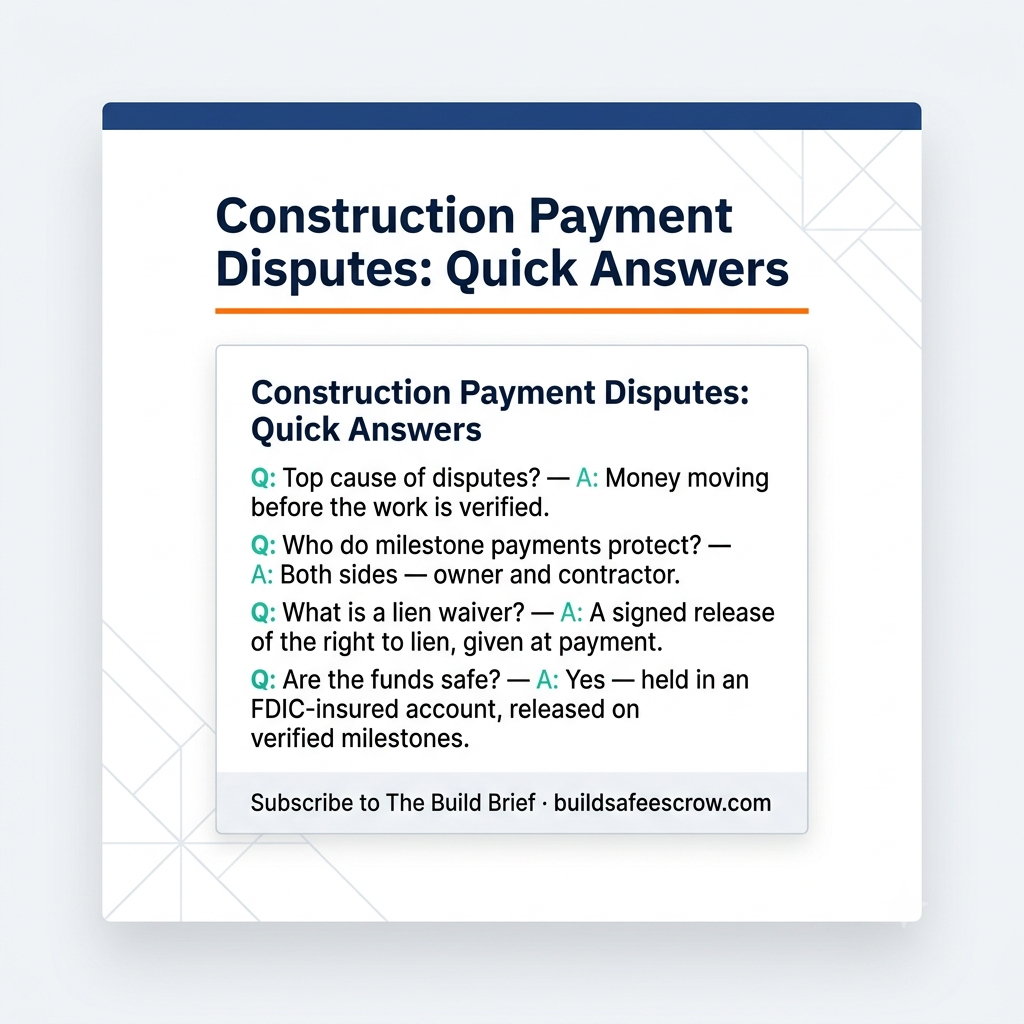
What is the most common cause of construction payment disputes? Money moving ahead of verified work. A deposit or progress payment goes out before the phase is confirmed done, and leverage disappears for both sides.
Do milestone payments protect the owner or the contractor? Both. Owners never pay for unfinished work. Contractors get paid promptly once a milestone is verified. The structure is neutral by design.
What is a lien waiver, and why does it matter? It is a document that gives up the right to place a lien on the property once payment is made. Exchanging one at each release closes out that phase for both parties.
What is the difference between a conditional and unconditional lien waiver? A conditional waiver takes effect only when payment actually clears. An unconditional waiver takes effect immediately, paid or not. Know which one you are signing.
Is escrow only for large commercial projects? No. Residential renovations, flips, and smaller builds benefit just as much. Any project where money and work can fall out of sync is a candidate.
Are the funds safe while they are held? Yes. Funds are held in a secure, FDIC-insured account and released only when a milestone is verified complete.
Get protected on your next project {#get-protected-on-your-next-project}
The best time to prevent a dispute is before the first payment moves.
For everyone: Get one short read each Friday on how construction money actually moves — subscribe to The Build Brief.
For property owners, managers, and investors: Protect your capital before the deposit leaves your account. Schedule a free consultation and we will map your milestones with you.
For contractors and specialty trades: Build trust. Win more projects. Get paid on milestones, not maybes. Join our free Trusted Contractor Network.
References
- Levelset / Procore — Construction payment and cash flow research: https://www.levelset.com/
- Associated General Contractors of America (AGC): https://www.agc.org/
- FDIC — Deposit insurance overview: https://www.fdic.gov/resources/deposit-insurance/