
If you’re a builder, renovator, or general contractor, you know the hardest part of the job often isn’t the work itself — it’s getting paid for it. Especially that last 10%.
Final payment disputes in construction are more common than you think — and they cost contractors time, money, and peace of mind.
In this post, we’ll break down:
- Why final payments are at risk
- The most common causes of disputes
- How to protect your payments using escrow and AI tools
🔍 Why Is the Final Payment So Often a Problem?
The final stage of a project is full of pressure — and that’s when most payment issues surface. You’re wrapping up punch lists, managing subcontractors, and preparing handover… but your client is looking for reasons to delay or reduce payment.
Here’s what contractors report as common frustrations:
- “They said the job wasn’t fully complete — even though it was.”
- “They started bringing up extras we didn’t agree to.”
- “They ghosted me after move-in.”
- “They wanted to ‘settle’ for a lower final payment.”
Sound familiar?
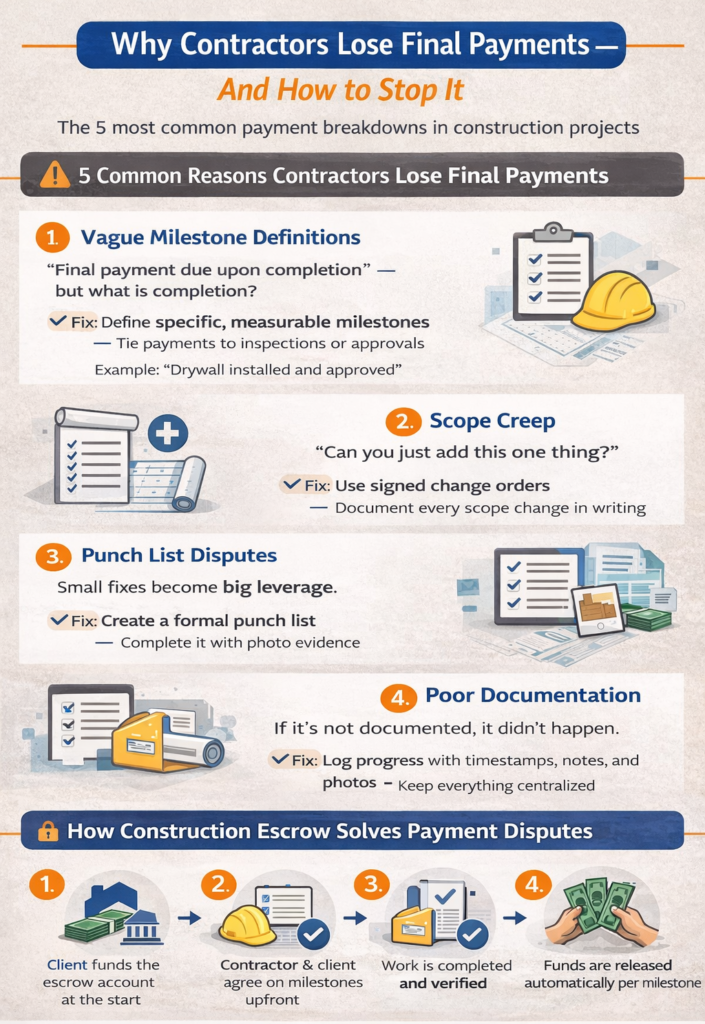
⚠️ 5 Common Reasons Contractors Lose Final Payments
1. Vague Milestone Definitions
If your contract says “final payment due upon completion” — what does “completion” really mean?
🛠️ Fix: Use specific, documented milestones (e.g., “drywall installed,” “client walk-through completed”).
2. Scope Creep
Clients ask for extras during the project… then expect it all to be included in the price.
🛠️ Fix: Use signed change orders and document every scope change in writing.
3. Punch List Disputes
Small imperfections or pending tasks give clients leverage to withhold payment.
🛠️ Fix: Create and complete a formal punch list with photo evidence.
4. Poor Documentation
If you can’t prove what was done, when, and how — your word may not be enough.
🛠️ Fix: Use tools that log progress with timestamps, notes, and visuals.
5. Lack of Trust
Clients fear they’ll pay, and something will be left unfinished. So they hold on to the money — just in case.
🛠️ Fix: Use an escrow service to give them confidence their money is safe and tied to real progress.
🔒 How Construction Escrow Solves Payment Disputes
Escrow protects both contractor and client by acting as a neutral third party.
Here’s how it works:
- Client funds the escrow account at the start
- You agree on project milestones in advance
- Funds are released as milestones are met
- No chasing, no begging, no drama
✅ You’re protected from non-payment
✅ They’re protected from unfinished work
✅ Everyone wins
🤖 Bonus: Use AI Tools to Back Up Your Progress
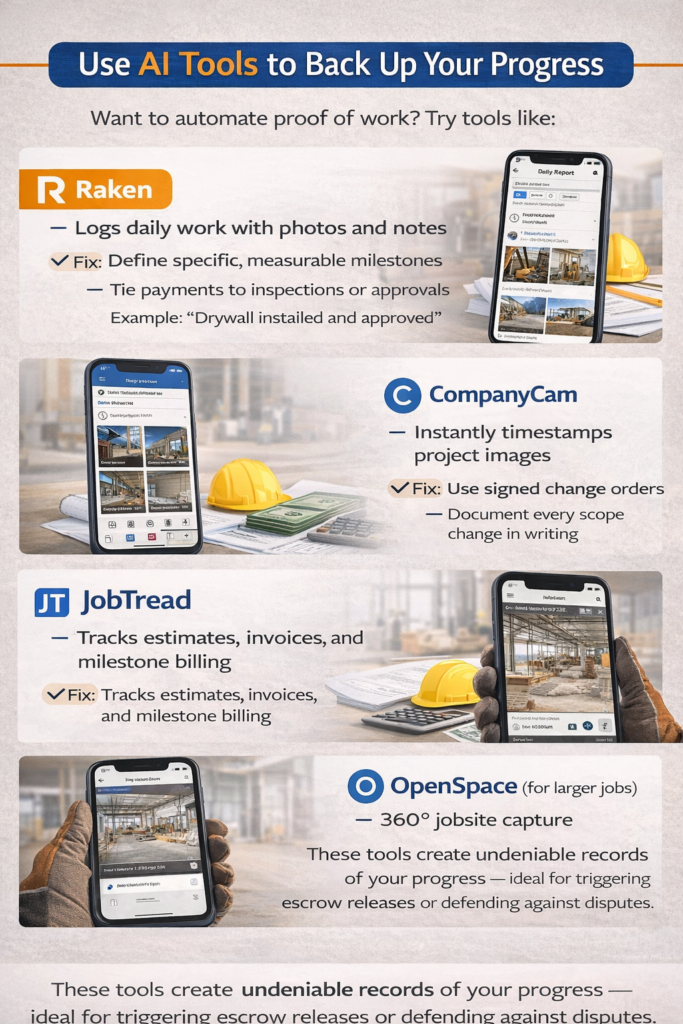
Want to automate proof of work? Try tools like:
- Raken – Logs daily work with photos and notes
- CompanyCam – Instantly timestamps project images
- JobTread – Tracks estimates, invoices, and milestone billing
- OpenSpace (for larger jobs) – 360° jobsite capture
These tools create undeniable records of your progress — ideal for triggering escrow releases or defending against disputes.
📥 Free Resource: Get Our Contractor Payment Protection Guide
Want a complete system to protect your payments?
🎯 Download: The Contractor’s Guide to Getting Paid On Time
Inside, you’ll get:
- Common dispute examples
- A final payment checklist
- How escrow + AI tools protect your business
- Bonus: Free setup offer for escrow services
📞 Need Help With Escrow for Your Next Project?
We help builders and renovators get paid on time, without conflict.
✅ Secure payment holding
✅ Milestone-based release
✅ Fast, fair, and transparent for both sides
📅 Book a free 15-minute call or learn more about our construction escrow services.
Why Contractors Lose Final Payments — And How to Stop It
Frequently Asked Questions (FAQs)
Why do contractors often struggle to get the final payment?
Final payments are often delayed or disputed due to vague contract terms, incomplete punch lists, scope changes, or lack of documentation. Clients may also withhold payment if they feel uncertain about project completion or quality. Using escrow and clear milestones helps prevent these issues.
What is construction escrow, and how does it work?
Construction escrow is a payment solution where a neutral third party holds project funds. The money is released to the contractor only when agreed-upon milestones are completed and verified, protecting both the contractor and the client from disputes or financial risk.
Can escrow be used for residential projects, or is it just for large commercial jobs?
Escrow works for both residential and commercial projects. In fact, it’s especially helpful for small contractors working with new clients, where trust hasn’t yet been established. It ensures fair, milestone-based payments on any size job.
How do AI tools help prevent final payment disputes in construction?
AI tools like Raken, CompanyCam, and JobTread automatically track job progress, log photos, and document completed work. This creates a timestamped trail of evidence that supports payment release and reduces arguments over what’s been done.
What should be included in a final payment checklist for contractors?
A solid final payment checklist should include:
Verified completion of all scope items
A signed punch list
Progress photos or walkthrough videos
Final invoice and change order approvals
Escrow release request (if applicable)
Having these items in place ensures clarity, reduces disputes, and speeds up final payment.