
Table of Contents
- The invoice that goes quiet
- What are milestone payments?
- Why milestone payments in construction beat the alternatives
- How to build a milestone payment schedule
- A sample schedule for a $60,000 kitchen
- How can milestones and incremental payments be used securely?
- The mistakes that turn a schedule into a dispute
- From the field: a remodeler in Columbus
- How escrow makes the schedule real
- FAQ
- References
The invoice that goes quiet
Milestone payments in construction exist because of a moment every contractor knows. You finish the rough-in, send the invoice, and wait. The owner is traveling. The owner has a question. The owner is “processing it.” The crew is already on the next phase and you are funding it out of pocket.
This guide is written for builders and general contractors, though owners will find the schedule section just as useful. It covers what milestone payments are, how to build a schedule that actually pays, and the structure that makes the schedule enforceable instead of aspirational.
What are milestone payments?
Milestone payments are a way of paying for construction in stages, where each payment is tied to a defined, verifiable piece of completed work rather than to a calendar date or a percentage of time elapsed.
With milestone payments in construction, the contract lists the milestones up front: demolition complete, rough plumbing and electrical passed inspection, drywall hung, cabinets set, final punch list signed off. Each one carries a dollar amount. When a milestone is finished and confirmed, that amount is released. Nothing is paid for work that has not happened, and nothing is withheld for work that has.
That is the whole idea. Money moves when the work is proven, in both directions. The owner never pays ahead of the work. The contractor never works ahead of the money.
Milestone payments in construction are sometimes called progress payments, stage payments, or draws. Lenders use “draw schedule” for the same concept on a construction loan. The mechanics are identical: a stage is defined, the stage is verified, the stage is paid.
Why milestone payments in construction beat the alternatives
There are three ways to structure payment on a project. Two of them create the disputes that milestone payments in construction were designed to end.
Large deposit, balance at the end. Common on residential jobs, and the worst structure for both sides. The owner hands over 30 to 50 percent with nothing built. The contractor then carries most of the project on credit until the final check, which is the one most likely to be delayed. Every incentive is misaligned.
Time-based payments. Monthly invoices, or payments every two weeks. Better, but the payment is tied to the calendar rather than to output. A slow month still gets invoiced. Owners start questioning what they are paying for, and the questions become delays.
Milestone payments. Tied to verifiable output. The owner can see exactly what each payment bought. The contractor can point to a finished stage and a clear contractual trigger. Disputes shrink because the thing being argued about, “is this stage done,” is answerable by walking into the room.
The Construction Financial Management Association has found for years that payment delays are the single largest drag on contractor cash flow, with typical receivables stretching past 60 days on commercial work. A milestone structure with a defined release trigger is the most direct fix a contractor can write into a contract.
How to build a milestone payment schedule
A good schedule for milestone payments in construction has five properties. Miss any of them and the schedule stops protecting you.
- Each milestone is a physical state, not an activity. “Rough electrical inspection passed” is a milestone. “Electrical work” is not. The test: could a third party walk in and confirm it in ten minutes?
- Each milestone carries a dollar amount that matches its cost. Front-load slightly to cover mobilization and materials, but stay honest. A schedule that pays 50 percent at demo is a deposit with extra steps.
- Five to eight milestones for a typical residential job. Fewer than four and each payment is too large to wait for. More than ten and the administration eats the benefit.
- The verification method is written down. Who confirms completion, how, and within how many days. Inspection sign-off, owner walk-through, photo documentation, or a neutral third party.
- The release timeline is written down. “Payment within three business days of verification.” Without a deadline, verification becomes another place to stall.
Add a small final milestone, typically 5 to 10 percent, for the punch list. It gives the owner comfort that details will be finished and gives you a defined endpoint instead of an open-ended “when everything is perfect.”
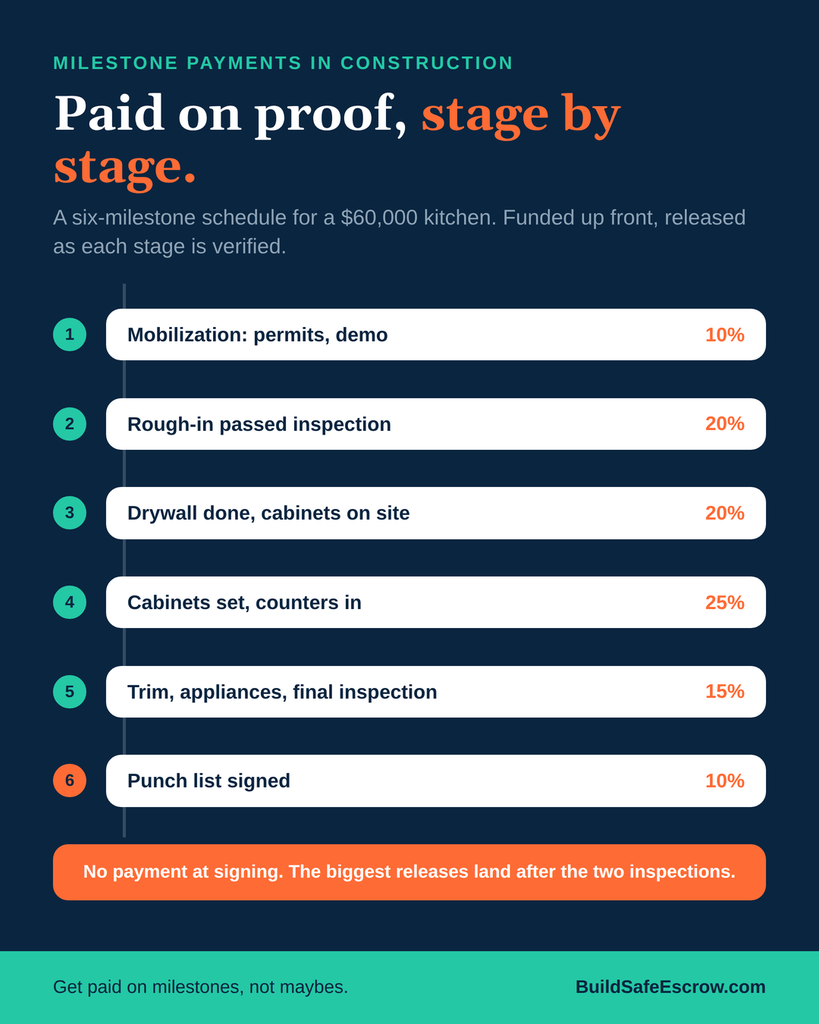
A sample schedule for a $60,000 kitchen
Here is what milestone payments in construction look like on a mid-range kitchen remodel with a minor layout change. Adjust the amounts to your costs.
| # | Milestone | Verified by | Amount | Cumulative |
|---|---|---|---|---|
| 1 | Mobilization: permits pulled, site protected, demo complete | Owner walk-through + permit number | $6,000 (10%) | 10% |
| 2 | Rough plumbing and electrical complete, inspection passed | Municipal inspection sign-off | $12,000 (20%) | 30% |
| 3 | Drywall hung and finished, cabinets delivered on site | Owner walk-through + delivery receipt | $12,000 (20%) | 50% |
| 4 | Cabinets set, counters templated and installed | Owner walk-through + photos | $15,000 (25%) | 75% |
| 5 | Plumbing and electrical trim, appliances installed, backsplash complete | Final inspection passed | $9,000 (15%) | 90% |
| 6 | Punch list complete and signed | Owner sign-off | $6,000 (10%) | 100% |
Notice what is not on the list: a payment “at signing” with nothing behind it. Mobilization is the first milestone, and it is real work. Notice also that the two biggest payments land after the two inspections, which are the two moments where a third party has already confirmed the work.
How can milestones and incremental payments be used securely?
Milestone payments in construction are secure when three things are true: the full project budget is funded before the first stage, each release is triggered by a verification the contract defines, and the money is held by a party that is neither the owner nor the contractor.
With milestone payments in construction, a schedule on paper is only as good as the account behind it. Contractors have learned this the hard way. The owner signs a beautiful six-milestone contract, then turns out to be paying from a line of credit that gets cut in month two. The milestones were fine. The funding was fiction.
Security comes from three things.
Funding before work. The owner deposits the full contract amount, or at least the next two milestones, before the first stage begins. This is the single strongest signal a contractor can ask for. It replaces the deposit entirely: you no longer need money in your account to prove the owner is serious, because the money is visible in an account committed to your project.
Defined verification. Inspection sign-offs are the gold standard because a municipal inspector has no stake in the outcome. For stages without an inspection, use a walk-through with a written checklist and dated photos. The contract should name the method and the deadline.
Neutral custody. If the owner holds the money, the contractor is exposed. If the contractor holds it, the owner is exposed. Construction escrow puts it with a neutral third party that releases each stage when the defined verification is met, and holds it if the verification is not. Neither side can move the money on their own.
For owners reading this: milestone payments in construction protect you as much as the contractor. You never pay for a stage that has not been verified, and the contractor’s incentive is to finish stages, not to collect deposits.
The mistakes that turn a schedule into a dispute
Most disputes over milestone payments in construction trace back to one of five drafting errors.
- Vague milestones. “Kitchen 50 percent complete” means nothing. Define the physical state.
- No verification deadline. Owners who are slow to walk through become owners who are slow to pay. Give verification a clock.
- Change orders outside the schedule. A change order needs its own milestone and its own amount, added in writing. Folding it into an existing milestone is how “you said this was included” starts.
- Final milestone too large. A 30 percent final payment invites a long punch list. Keep it at 5 to 10 percent.
- Payment method that can stall. A milestone triggers a release, but if the release is “the owner writes a check,” the stall moves to the checkbook. Fund the schedule in escrow so the release is mechanical.
From the field: a remodeler in Columbus
Lena runs a six-person remodeling company in Columbus, Ohio. For years she used the industry default: a third up front, a third at drywall, a third at completion. Her final third averaged 34 days late, and twice a year it took a demand letter.
Last year she moved every job to milestone payments in construction escrow, on a six-stage schedule. The first client balked at putting $58,000 into an account before demo. Lena walked him through it: the money was his until each stage was verified, the account was FDIC-insured, and she could not touch a dollar without a completed milestone. He agreed, partly because he realized he was getting more protection than a deposit ever gave him.
Over the following twelve months, her average time from milestone completion to payment fell to three days. She stopped carrying material costs on her credit line. She also noticed something she had not expected: her close rate on bids went up. Owners who were comparing three contractors chose the one whose payment structure protected them.
How escrow makes the schedule real
Everything above describes what milestone payments in construction should look like. Escrow is what makes it enforceable.
The owner funds the project into a neutral, FDIC-insured account before work begins. The milestone schedule is attached to the account. When a stage is complete and the defined verification is met, the release for that stage goes to the contractor, typically within days. If a stage is disputed, the money for that stage stays put while the dispute is resolved, and the money for completed stages has already been paid.
For contractors, that means the invoice never goes quiet, because the invoice has been replaced by a trigger. For owners, it means every dollar is tied to a finished, verified stage. Our escrow services page explains how a schedule is set up for a specific project, and the construction escrow FAQs cover what happens when a milestone is contested.
Milestone payments in construction are the structure. Escrow is the account that makes the structure hold. Money never moves ahead of the work, and work never runs ahead of the money.
FAQ
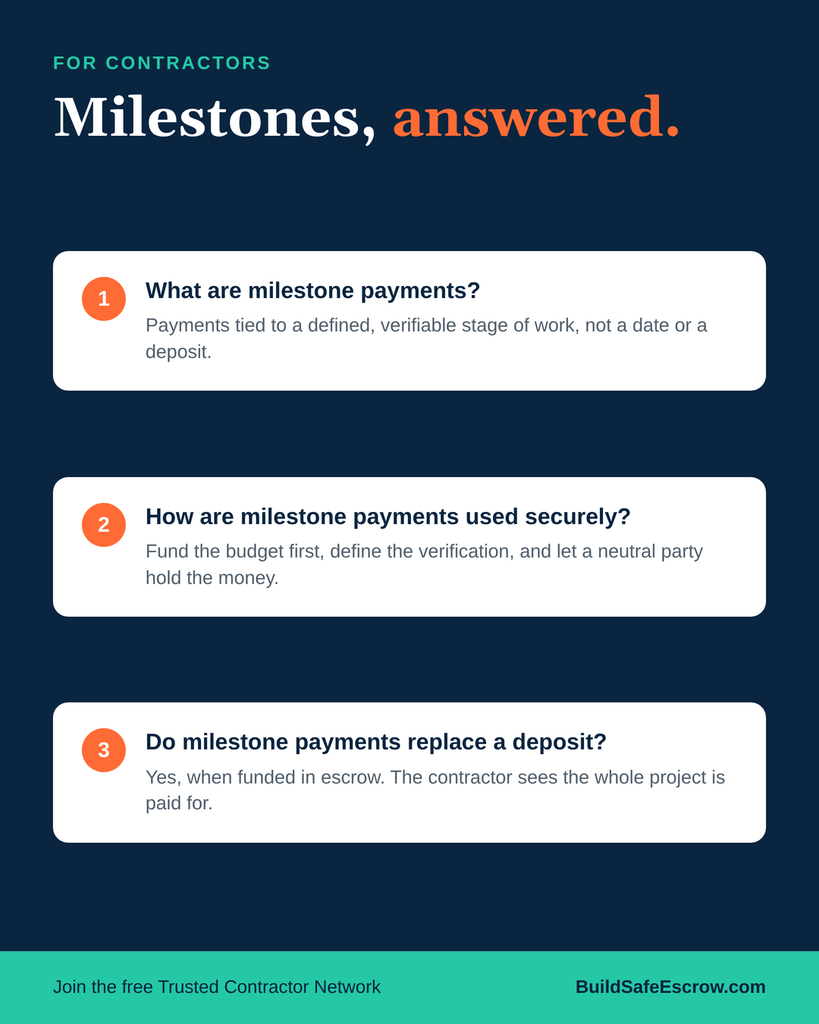
What is a milestone payment in construction? A payment released when a defined, verifiable stage of work is complete, such as rough-in inspection passed or cabinets set. It replaces deposits and calendar-based invoicing with payment on proof.
How many milestone payments in construction should a contract have? Five to eight for a typical residential remodel. Large commercial projects may run 15 or more, usually aligned to a lender’s draw schedule.
Who verifies milestone payments in construction? The contract should say. Municipal inspections are best where they exist. Otherwise, an owner walk-through with a written checklist and dated photos, or a neutral third party such as an escrow provider’s verification process.
Are milestone payments in construction good for contractors? Yes. Payment is tied to a trigger you control (finishing the stage) rather than a decision the owner controls (writing the check). Funded milestones also remove the need to carry materials on credit.
What happens if a milestone is disputed? With escrow, the money for that stage stays in the account while the dispute is resolved. Completed stages have already been paid, so a dispute over one stage does not freeze the whole project.
Do milestone payments replace a deposit? When the schedule is funded in escrow, yes. The contractor can see the full project is funded, which is stronger evidence than a deposit, and the owner never pays ahead of verified work.
Get paid on milestones, not maybes
Get one short read each Friday on how construction money actually moves. Subscribe to The Build Brief. https://buildsafeescrow.com/newsletter/
Contractors and trades: join the free Trusted Contractor Network. Build trust. Win more projects. Get paid on milestones, not maybes. https://buildsafeescrow.com/join-our-trusted-contractor-network/
References
- Construction Financial Management Association, Financial Benchmarker (days sales outstanding for contractors)
- American Institute of Architects, AIA Document G702, Application and Certificate for Payment
- Federal Deposit Insurance Corporation, deposit insurance coverage for escrow accounts
- Levelset (Procore), U.S. prompt payment and retainage laws by state