

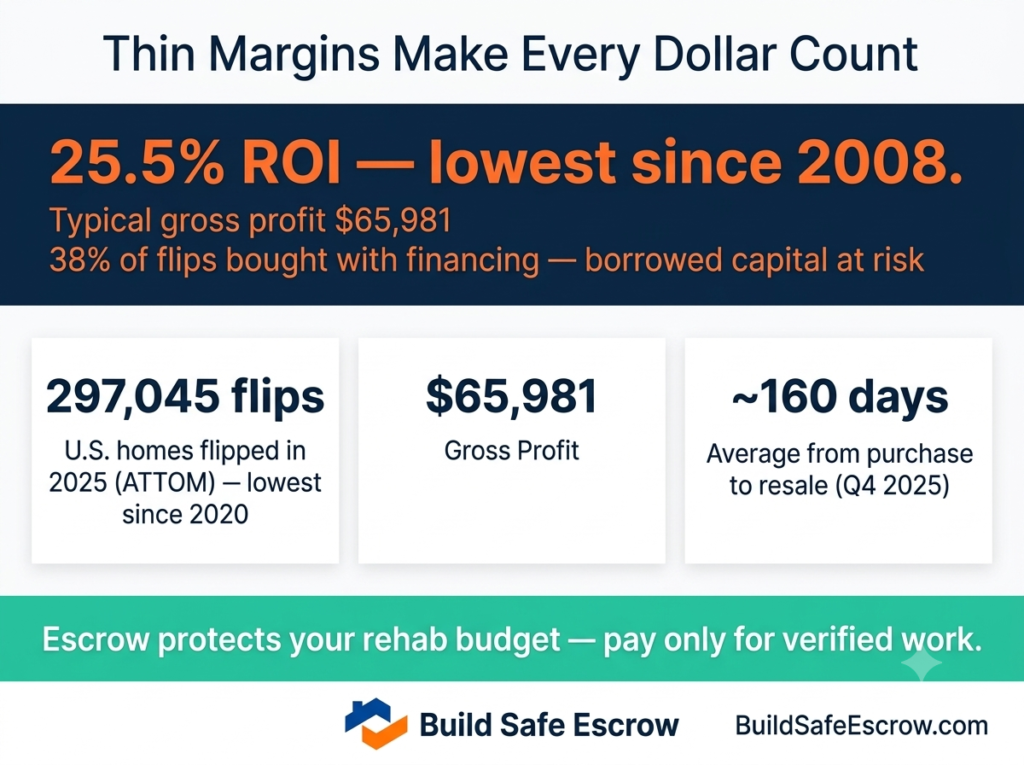
Fix-and-flip investing has always been a margin game, but the margins have rarely been this tight. ATTOM’s 2025 year-end U.S. Home Flipping Report counted 297,045 flips nationwide — the fewest since 2020 — with a typical gross profit of $65,981 and a 25.5% return on investment, the lowest since 2008. When the cushion is that thin, the renovation budget isn’t just a line item. It is the difference between a profitable flip and a loss. Protecting that capital is no longer optional — and escrow is one of the most effective ways to do it.
Why the flip math punishes wasted capital
On a flip, your profit is whatever is left after acquisition, renovation, holding, and selling costs. In today’s market, acquisition prices are at record highs and resale margins have compressed, so every dollar that leaks out of the renovation budget comes straight off your return. ATTOM found the typical flipped home took roughly 160 days from purchase to resale — nearly half a year of holding costs ticking while your capital is exposed. And 38% of flips were bought with financing, which means a meaningful share of investors are paying interest on borrowed money the entire time it sits in a half-finished project.
In that environment, the classic flip risks become existential. A contractor who takes a large draw and underperforms, a job that stalls and bleeds holding costs, a final payment dispute that delays the sale — any one of these can erase a quarter’s worth of margin. The investors who survive thin markets are the ones who stop treating renovation capital as money they’ve already spent and start treating it as money they release only for verified work.
The capital risks in a typical flip
- Front-loaded deposits: Large up-front payments to a contractor put your capital — often borrowed — at risk before any value is added.
- Stalled timelines: Every extra week a project drags adds holding and financing costs that eat directly into a thin margin.
- Underperformance: Paying ahead of progress removes your leverage to hold a contractor to the standard and schedule a profitable flip requires.
- Multi-property exposure: If you run more than one flip at a time, capital tied up or lost on one project starves the others.
How escrow protects a flipper’s capital
Construction escrow restructures how your renovation money moves so it is never exposed ahead of the work. Your rehab budget goes into a secure, neutral third-party account, and the contractor is paid in draws tied to verified milestones — demolition done, rough-in and inspections passed, finishes installed, project complete. Nothing is released until that stage is confirmed.
For an investor watching every basis point, that delivers a few specific advantages:
- Capital preservation: Your money — and your lender’s — stays protected in a neutral account until there is verified value to pay for. A contractor can’t disappear with a deposit that was never released.
- Schedule leverage: Because draws are tied to completed milestones, your contractor has a direct incentive to keep moving — which protects you from the holding costs that kill thin-margin flips.
- Cleaner financing: When you’re using borrowed capital, a milestone-based draw structure aligns naturally with how lenders like to see funds disbursed and documented.
- Repeatable discipline: Run the same milestone-escrow structure on every flip and you build a system that protects capital across a whole portfolio, not just one project.
Thin margins reward discipline
The decade after 2008 made flipping look easy, with margins that routinely topped 50%. That era is over for now. With returns back near pre-financial-crisis levels, the investors who keep winning are the disciplined ones — tighter on cost control, tighter on timelines, and tighter on where their capital sits and when it moves. Construction escrow is a tool built for exactly that discipline: it keeps your renovation budget protected, ties every payment to real progress, and removes the single most avoidable way a flip loses money. When the margin is this thin, protecting your capital is the strategy.
Frequently Asked Questions about Fix-and-Flip Renovations and How Investors Protect Their Capital With Escrow
How do fix-and-flip investors use escrow?
They place the renovation budget in a secure, neutral third-party account and pay the contractor in draws tied to verified milestones — demolition, rough-in and inspections, finishes, completion. Funds are released only as each stage is confirmed, so capital is never exposed ahead of the work.
Why does escrow matter more when flip margins are thin?
With ATTOM reporting 2025 flip returns at 25.5% — the lowest since 2008 — there’s little cushion to absorb a lost deposit, a stalled job, or a payment dispute. Any of those can wipe out a large share of the profit, so protecting every dollar of renovation capital becomes essential.
Does escrow help if I’m flipping with borrowed money?
Yes. About 38% of flips are bought with financing, and milestone-based escrow draws align with how lenders prefer funds to be disbursed and documented. It protects borrowed capital from being released before verified work is done and keeps a clean record of every draw.
Can escrow help keep a flip on schedule?
It creates the incentive to. Because draws are released only when a milestone is completed and verified, the contractor is motivated to keep progressing — which helps limit the holding and financing costs that erode a thin-margin flip over its roughly 160-day average timeline.
Can I use the same escrow structure across multiple flips?
Yes, and many investors do. Running a consistent milestone-based escrow process on every project builds repeatable capital discipline across a portfolio, so funds tied up or at risk on one flip don’t jeopardize the others.
References
- ATTOM — 2025 Year-End U.S. Home Flipping Report
- HousingWire — Home Flipping Volume Falls to 5-Year Low, Margins Hit 2008 Levels
- MBA Newslink — ATTOM: Home Flipping Dips; Profit Margins Shrink