
Table of Contents
- Why good contractors still end up chasing checks
- What is an escrow-ready contractor?
- Do contractors accept escrow payments?
- How to become an escrow-ready contractor: 6 moves
- Field example: one bid, two outcomes
- How escrow fixes the payment problem at the source
- FAQ: escrow-ready contractor questions
- Get paid on milestones, not maybes
- References

Becoming an escrow-ready contractor is the fastest way to stop chasing checks for work you already finished. If you are a builder, a general contractor, or a specialty trade like electrical, plumbing, roofing, or tile, you know this feeling. The drywall is hung, the inspection passed, and the invoice has been sitting for three weeks.
You call. The owner says the bank is “processing it.” You keep your crew on another job and float payroll on a credit line. Meanwhile, the next homeowner on your list wants to know why you need a deposit at all.
This is common. It is also preventable. The fix is structural, and it starts before you ever mobilize.
Why good contractors still end up chasing checks
Most payment problems start with a gap, not with bad people. The gap sits between when you do the work and when anyone has to prove the money exists.
Three root causes show up again and again:
- Unverified funding. You sign a contract on the owner’s word that the money is there. Nobody checks until your first draw is due.
- The deposit standoff. You ask for money up front to cover materials and mobilization. The owner, burned by a story about a contractor who vanished, refuses or haggles.
- Vague release terms. The contract says “payment upon completion.” Completion of what, judged by whom, and paid when? Each blank is a place for a dispute to live.
These risks shape who you bid for. According to Rabbet’s 2025 Construction Payments Report, “91% of GCs factor an owner’s payment reputation into bids,” and “88% declined to bid in the last year due to slow-pay reputations.”
Read that as a contractor. Nearly everyone in your seat is already screening owners for payment risk. The problem is that reputation is a guess. An escrow-ready contractor replaces the guess with a fact: the money is confirmed and held before work starts.
What is an escrow-ready contractor?
An escrow-ready contractor is a builder or trade who accepts project funds held by a neutral third party and released in stages as each agreed milestone is completed and verified.
That definition has four working parts.
First, escrow means a neutral party holds the money. It does not belong to you yet, and the owner cannot pull it back on a whim. Second, the funds are deposited before you mobilize, so you can verify the money exists before you commit a crew. Third, a milestone schedule spells out each stage of work and the dollar amount tied to it. Fourth, a release happens when that milestone is documented and approved under the terms both sides signed.
Being escrow-ready is mostly paperwork discipline. Your contract, your schedule of values, and your photo log already exist in some form. You are tightening them so a third party can act on them without a phone call.
Do contractors accept escrow payments?
Yes, many contractors accept escrow payments, and more owners now ask for it because it protects their money while proving yours is there.
Some contractors hesitate. They worry escrow means slower money or an extra layer of approval. In practice, the opposite tends to happen. When funds are confirmed up front and the release conditions are written down, there is less to argue about at each draw.
Escrow also protects the owner. That neutrality is the point. The owner knows their money will not move ahead of the work. You know the money is there and will move once the work is done. Both sides get the same rulebook. For an escrow-ready contractor, that rulebook is the selling point.
If you want the owner’s side of this conversation, our homeowner guide to hiring with escrow walks through what they look for.
How to become an escrow-ready contractor: 6 moves
None of these moves requires new software or a new business model. Each one makes you easier to hire and faster to pay.
1. Add escrow language to your standard contract
Put a short escrow clause in your template. Name the escrow holder. State that the full project amount, or at least the first phase, is deposited before mobilization. Attach the milestone schedule by reference.
Keep it plain. Rules on construction contracts vary by state, so have your own attorney review the final wording before you use it.
2. Build a milestone schedule owners can read
A milestone schedule is a list of work stages, each with a clear finish line and a dollar amount. Think “rough plumbing complete and inspected: $9,500,” not “phase 2.”
Good milestones are observable. Someone who is not a builder should be able to look at a photo and agree it is done. Aim for 4 to 8 milestones on a typical residential job. For more detail, see our guide to milestone payments through escrow for contractors.
3. Decide your proof of completion in advance
Proof of completion is the evidence that triggers a release. An escrow-ready contractor settles it before day one, so nobody improvises later.
Typical proof includes:
- Dated photos or a short video walk-through
- A passed inspection report, where one applies
- A signed lien waiver for that stage (a document where you or a sub give up lien rights for the amount paid)
- Material delivery receipts for large orders
4. Understand how releases work
A release is the moment escrowed money moves to you. You submit proof, the owner reviews it, and the escrow holder pays out under the contract terms. If the owner raises a concern, it gets addressed against the written standard, not against someone’s mood that week.
Ask your escrow provider how long reviews take and what happens if an owner goes silent. An escrow-ready contractor knows these timelines before quoting a schedule.
5. Retire the deposit argument
Deposits exist because you need cash for materials and mobilization. Escrow solves that differently. The first milestone can cover mobilization and a materials order, released when those items are on site.
The owner keeps control until something real has happened. You get funded early in the job without asking anyone to trust a stranger. If deposits are a recurring sticking point, our article on working as a no-deposit contractor goes further.
6. Pitch escrow inside your bid
Do not save escrow for the contract stage. Put it on the first page of your proposal. One line works: “All project funds are held by a neutral, FDIC-insured escrow service and released as each milestone is completed and verified.”
That sentence answers the owner’s biggest fear before they ask it. It also tells them you expect to be paid on schedule, which sets a professional tone from the start.
Field example: one bid, two outcomes
Consider a composite example. Dana Ruiz runs a small general contracting firm with a crew of six. She bids a $142,000 kitchen and primary bath remodel.
On her old approach, Dana asks for a 30% deposit, about $42,600. The owner balks and takes a lower bid that asked for nothing up front. A month later, Dana hears that contractor is waiting on a stalled refinance.
On the next comparable job, Dana leads as an escrow-ready contractor. Her proposal shows six milestones, starting with $18,000 for demolition, protection, and a cabinet order. The owner deposits the full $142,000 with the escrow holder before Dana’s crew shows up.
Dana now knows three things before she mobilizes. The money exists. Each release has a written finish line. And the owner has no reason to fear her, because her pay depends on verified work. Her draws arrive within days of each approved milestone instead of weeks after an invoice.
The numbers are illustrative. The pattern holds for any escrow-ready contractor.
[Infographic: see media placement notes]
How escrow fixes the payment problem at the source
Every payment fight traces back to the same imbalance: one side is carrying all the risk. Either you work ahead of the money, or the owner pays ahead of the work.
Escrow ends that standoff. The core rule: money never moves ahead of the work. The flip side matters just as much to you. Work never moves ahead of confirmed money.
Being an escrow-ready contractor helps in three places.
- Before the bid. You verify funds exist before you commit estimating hours or turn down another job. That turns the “will I get paid” question into a yes or no, not a gut call.
- During the job. Releases follow documented milestones, so you spend less time chasing and more time building.
At closeout, the final release is tied to the same written standard as every other stage. Retainage is the portion of each payment withheld until the project is complete. With escrow, it sits in the same neutral account with its own release condition.
Trust between an owner and a contractor matters. Escrow is not a replacement for trust. It is the structure that lets trust survive a delay, a change order, or a bad week.
Escrow is also neutral. The escrow holder is not on your side or the owner’s side. It follows the agreement both of you signed. Owners like that, and it is a big reason an escrow-ready contractor often wins the job over a lower bid. You can read more about how Build Safe Escrow handles deposits and releases in our escrow services overview, or browse our construction escrow FAQs.
FAQ: escrow-ready contractor questions
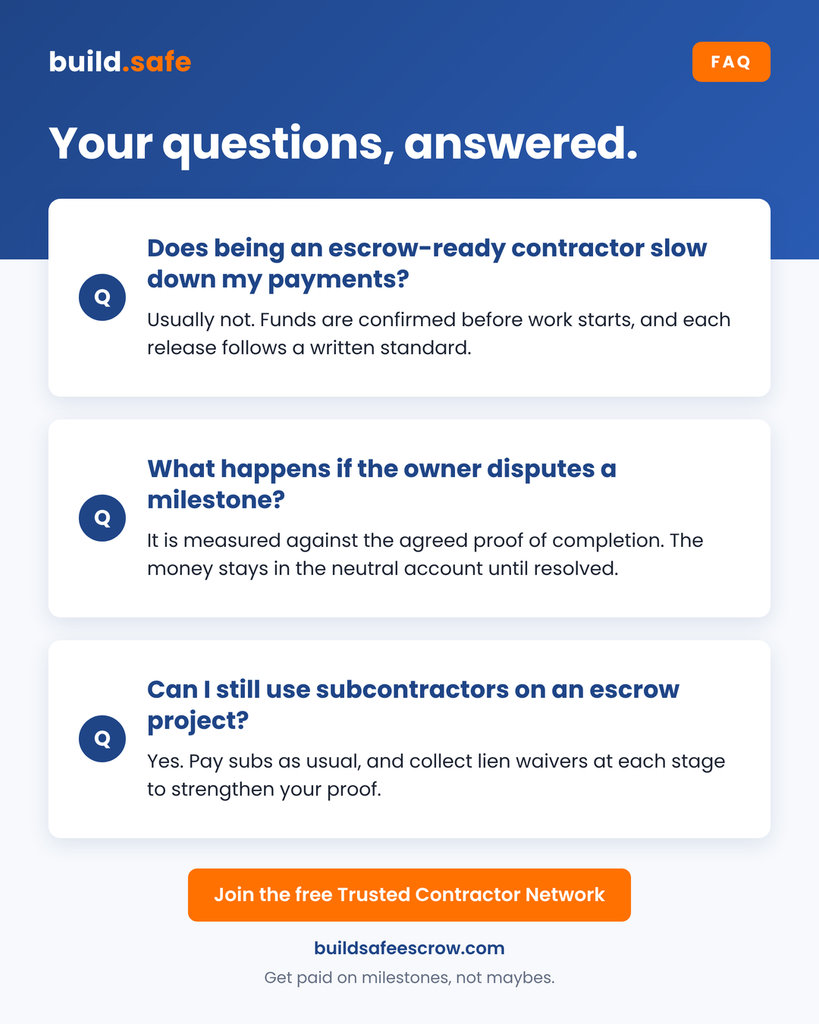
Does being an escrow-ready contractor slow down my payments?
Usually not. Funds are confirmed before work starts, and each release follows a written standard. That tends to shorten the gap between finishing a stage and getting paid.
Who pays the escrow fee?
It depends on the agreement. Some owners pay it, some split it, and some contractors build it into the bid. Settle it in writing before signing.
Can I still use subcontractors on an escrow project?
Yes. You pay your subs as you normally would. Collecting lien waivers from them at each stage makes your proof of completion stronger.
What happens if the owner disputes a milestone?
The dispute is measured against the proof of completion both sides agreed to. The money stays in the neutral account until it is resolved. For legal questions, talk with your own attorney.
Is escrow money safe while it is held?
With an FDIC-insured provider, funds sit in an insured bank account. FDIC coverage has limits by depositor and account category, so ask your provider how large balances are handled.
How do I explain escrow to an owner who has never used it?
Keep it to one sentence: their money is held by a neutral party and released only as each agreed stage is finished and verified.
Get paid on milestones, not maybes
Get one short read each Friday on how construction money actually moves: subscribe to The Build Brief.
Builders, general contractors, and specialty trades: build trust, win more projects, and get paid on milestones, not maybes. Join the free Trusted Contractor Network. Questions first? Book a free consultation.
This article is general information, not legal or financial advice. Contract and payment rules vary by state. Consult your own attorney or accountant before changing your contracts.
References
- Rabbet, 2025 Construction Payments Report
- FDIC, Understanding Deposit Insurance
- Levelset, Retainage glossary definition