
You finished the job. The tile is set, the drywall is painted, the fixtures are gleaming. You hand over the keys — metaphorically speaking — and then you wait.
And wait.
The check that was “on its way” three weeks ago still hasn’t arrived. The client has a dozen reasons: the holidays, a cash flow hiccup, a dispute over that one outlet you “forgot.” Meanwhile, your crew needs to be paid, your supplier invoice is due, and the next project is waiting on funds you don’t yet have.
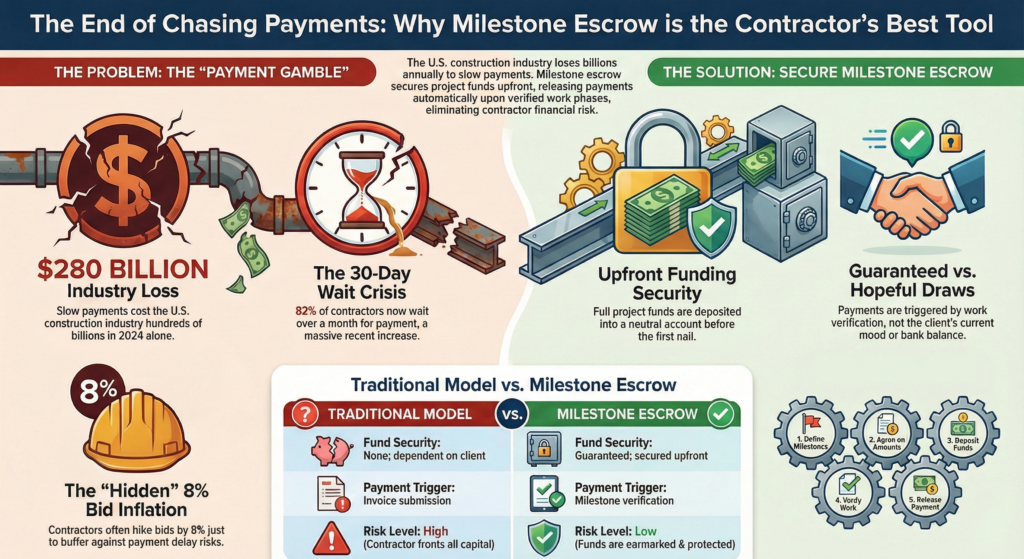
If this story sounds familiar, you’re not alone. According to Rabbet’s 2024 Construction Payments Report, slow payments cost the U.S. construction industry $280 billion in 2024 alone — and 82% of contractors now face payment waits of over 30 days, up from 49% just two years prior. Payment delays cost contractors not just money, but time, energy, and peace of mind they can’t get back.
There is a better way. It’s called milestone payments through escrow, and it changes the entire dynamic of how contractors get paid.
What Are Milestone Payments Through Escrow?
A milestone-based escrow arrangement is simple in concept: before work begins, the full project funds — or a phase-based deposit — are placed into a secure, neutral escrow account. Those funds are then released to you, the contractor, in draws as each agreed-upon milestone is completed and verified.
Think of it like a scoreboard that everyone agreed on before the game started. Foundation poured? Draw released. Framing complete? Draw released. Electrical rough-in done? Draw released. No ambiguity, no negotiation after the fact, no waiting by the phone.
The escrow account is managed by a neutral third party — not the homeowner, not you — which means the money is already there, already committed, and already earmarked for the work you’ve agreed to do.

Why Traditional Payment Arrangements Fail Contractors
The standard payment model in residential construction and remodeling has a structural flaw: it asks contractors to extend trust without any guarantee of return.
You put up capital for materials. You commit your crew’s time. You show up every day and deliver real, tangible progress. And then, at the moment of payment, you’re entirely dependent on whether the client chooses — and is able — to pay.
That’s not a business arrangement. That’s a gamble.
Here’s how it typically unravels:
The client runs low on funds mid-project. They didn’t budget properly, or life happened. Either way, the money they promised isn’t there anymore — and your invoice is last in line behind their mortgage and car payment.
A dispute surfaces at payment time. The work was done. But suddenly there’s a complaint about something minor, and the client withholds the entire draw while you wait for a resolution that may never come.
There’s simply no urgency. Without a structured system, there’s nothing forcing payment to happen on schedule. A client who’s busy, disorganized, or stalling has no real incentive to prioritize your invoice.
Milestone payments through escrow solve all three of these problems at once — because the funds are secured before the first nail is driven.
The Contractor Advantage: What Escrow Actually Gives You
Contractors who work through escrow don’t just get paid more reliably. They operate differently — with more confidence, better cash flow, and fewer headaches.
Guaranteed draws, not hopeful ones. When funds are already in escrow, your draw isn’t contingent on the client’s bank account or mood. The money is there. Verification triggers release. That’s it.
Cash flow you can actually plan around. Knowing when draws will hit — and knowing they will hit — lets you manage materials, payroll, and subcontractors with far more precision. A 2025 survey by Built found that 70% of contractors regularly face delayed payments — and to compensate, contractors are inflating their bids by an average of 8%. Escrow removes the need for that buffer. You stop bridging gaps with personal credit and start running your business like a business.
A paper trail that protects you. Every milestone, every approval, every disbursement is documented. If a dispute arises, you have a clear record of what was agreed to and what was completed. No more “he said, she said” at the end of a six-month project.
A competitive edge with serious clients. Property owners who are investing significant money in a renovation are increasingly looking for accountability and structure. Offering to work through escrow signals that you’re a professional who builds systems, not just structures. It closes deals.
Protection against the worst-case scenario. If a client hits financial hardship mid-project, funds already in escrow don’t evaporate. They’re committed and protected — meaning you get paid for the work you’ve done, even if the project pauses or ends early.
How Milestone Payments Through Escrow Work in Practice
The process is straightforward, and it starts before a single tool is picked up.
Step 1: Define your milestones. Work with your client to break the project into logical, verifiable phases. For a kitchen remodel, this might look like: demolition complete, rough-in inspected and passed, cabinetry installed, countertops and fixtures complete, final walkthrough approved. Each milestone should be specific enough to verify with photos or a brief inspection.
Step 2: Agree on payment amounts. Assign a draw amount to each milestone. These amounts should reflect the actual cost and labor intensity of each phase — not arbitrary percentages.
Step 3: Funds are deposited into escrow. Before work begins, the client deposits the agreed-upon funds into the escrow account. This is the moment the arrangement becomes real: the money exists, it’s committed, and it’s waiting for you to earn it.
Step 4: Complete the milestone, request the draw. Once a phase is done, you submit a request — typically with photos, progress notes, or a brief inspection. The escrow agent verifies completion and releases your payment.
Step 5: Repeat until the project is complete. Each milestone follows the same cycle: work, verify, release. By the end of the project, you’ve been paid in full, on time, at every stage.
A Real Shift in the Contractor-Client Relationship
There’s something worth noting beyond the mechanics: milestone payments through escrow change the emotional texture of a project.
When payment is uncertain, every conversation about progress is tinged with anxiety. Contractors find themselves soft-pedaling problems, avoiding hard conversations, or rushing work to hit a payment checkpoint before the client changes their mind. None of that produces great work or strong relationships.
When payment is structured and guaranteed, you can focus entirely on the build. Problems get surfaced and solved instead of buried. Communication stays honest. The client feels protected, you feel respected, and the project runs on trust that’s been earned — not just assumed.
That’s not an abstraction. It’s what happens when the financial structure of a project actually supports the people doing the work.
Ready to Stop Chasing Payments?
Build Safe Escrow was built specifically for the construction and renovation industry — by people who have lived through the frustration of unclear payment terms, slow disbursements, and deals gone sideways.
We set up escrow agreements, manage milestone-based draws, handle subcontractor payments, and keep every transaction documented from start to finish. Our flat fee structure means no surprises, and our process is designed to get out of your way so you can focus on the work. Want to see exactly how it works before you commit? Browse our contractor resources to learn what to expect at every stage.
If you’re tired of finishing jobs and hoping for the best, let’s talk.
Book a free consultation with Build Safe Escrow today and find out how milestone payments through escrow can transform the way you get paid — starting with your next project.
Build Safe Escrow is the nation’s first escrow company dedicated exclusively to construction and renovation projects. We protect funds, verify milestones, and make sure contractors get paid on time and in full.
What are milestone payments in a construction contract?
Milestone payments are scheduled draws tied to specific, verifiable stages of a construction or renovation project — such as foundation poured, framing complete, or final inspection passed. Rather than paying a contractor in one lump sum or on a loose schedule, milestone payments create a structured system where money is released only as real progress is made and confirmed.
How does escrow work for contractor payments?
Before work begins, the project funds are deposited into a secure, neutral escrow account managed by a third party. As each milestone is completed, the contractor submits documentation — photos, inspection results, or a progress report — and the escrow agent verifies the work and releases the corresponding draw. The contractor never has to chase a payment; the money is already there, waiting on progress.
Is escrow only for big construction projects?
No. Escrow works for projects of all sizes — from a bathroom remodel to a full home build. At Build Safe Escrow, we charge a flat fee regardless of project size, and that fee can even be split between the contractor and property owner. If money is changing hands for construction work, escrow adds value.
What happens if a client runs out of money mid-project?
This is one of the most common fears contractors have — and one of the strongest arguments for escrow. When funds are deposited into escrow before work begins, they are committed and protected. If a homeowner hits financial hardship later, the escrowed funds are already set aside for the project. You get paid for the work you’ve completed, regardless of what happens to the client’s finances afterward.
Can escrow help if there’s a dispute over whether work was completed?
Yes. Because every milestone is defined in writing before the project starts — and every draw request is documented with photos and verification — disputes become far easier to resolve. There’s no ambiguity about what was agreed to or what was delivered. The escrow agreement acts as a shared source of truth for both parties
Who controls the money in a construction escrow account?
Neither the contractor nor the property owner controls the funds unilaterally. The escrow agent — a neutral third party like Build Safe Escrow — holds and manages the account. Funds are only released when the agreed milestone conditions are met and verified. This structure is precisely what makes it trustworthy for both sides.
Does using escrow slow down my payments as a contractor?
Not with a dedicated construction escrow service. Unlike lender-based escrow, which can involve slow bureaucratic timelines, independent escrow companies like Build Safe Escrow are designed for speed and simplicity. Once a milestone is verified, funds are released promptly — often faster than waiting for a client to cut a check on their own schedule.
How do I convince a client to use escrow?
Frame it as protection for both of you, not just for them. Escrow tells a client that their funds are safe and will only be released as real progress is made — which actually makes it easier for them to commit to hiring you. Contractors who offer escrow as part of their process often close more deals, because serious property owners are looking for that kind of structure and professionalism.