
Learning to verify construction progress remotely is the difference between investing in another market and donating to one. This guide is for real estate investors funding rehabs, flips, and ground-up builds they cannot drive past: the capital is in one state, the framing is in another, and the only thing connecting them is whatever proof you insist on.
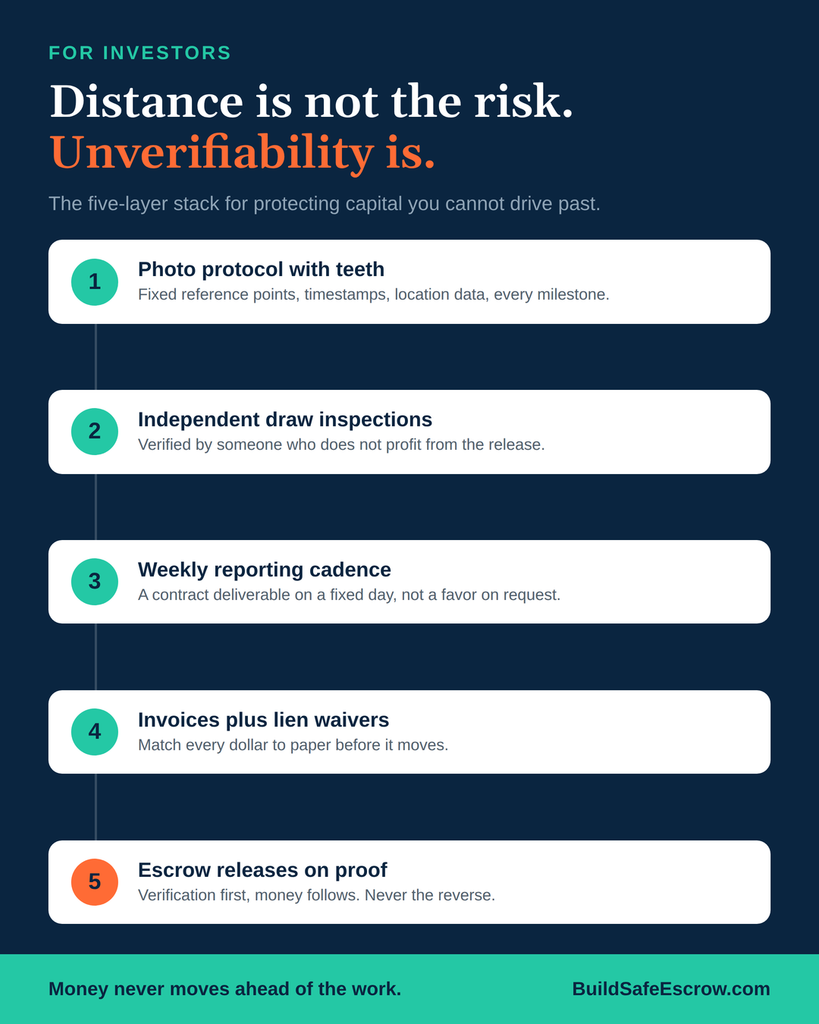
Table of Contents
- Why remote projects drift
- 1. Build a photo and video protocol with teeth
- 2. Put independent eyes on every draw
- 3. Write the reporting cadence into the contract
- 4. Match every dollar to paper
- 5. Give verification teeth with escrow
- A short field example
- How can I verify construction progress remotely?
- How escrow removes the problem at the source
- FAQ
- Protect capital you cannot drive past
- References
The first month always looks great. Photos arrive unprompted, the demo shots are dramatic, and the group chat is lively. Somewhere around the second draw request, the rhythm changes. Photos come when you ask. They are tighter shots, oddly framed, hard to place. The updates get shorter and the requests for money do not.
Nothing may be wrong. That is the maddening part: from 1,200 miles away, “nothing is wrong” and “the job stalled five weeks ago” look identical in a text thread. Distance does not create dishonesty. It creates unverifiability, and unverifiability is where projects drift. The playbook below is how investors verify construction progress remotely with a system instead of a feeling.
Why remote projects drift
Remote-project failures repeat the same handful of patterns.
The photos prove less than they seem to. An undated, uncropped photo of a framed wall tells you a framed wall existed at some point, somewhere. Without dates, location data, and wide context shots, photos document a vibe, not a milestone.
Draws run ahead of the work. Each request arrives slightly before the stage it funds is truly complete. The gap is small at first. Compounded over six draws, you have paid for a stage and a half that does not exist, and your leverage went with it.
One person controls all the information. When the contractor is also your photographer, your inspector, and your progress reporter, every update passes through the person being paid on it. Honest contractors resent the conflict; dishonest ones use it.
Each pattern survives for the same reason: nobody on your side could verify construction progress remotely with enough confidence to act.
Unpaid subs are invisible from out of state. You cannot overhear supply-house gossip from another time zone. The first sign that your contractor has not been paying the plumber can be a mechanics lien on your property, for work you already funded.
1. Build a photo and video protocol with teeth
Casual photos are marketing. A protocol is evidence, and evidence is what lets you verify construction progress remotely without leaning on anyone’s word. Write into the agreement exactly what visual documentation each milestone requires: wide establishing shots from fixed reference points you chose on day one, closeups of the specific work claimed, timestamps and location data on, and a short walkthrough video narrated room by room.
The fixed reference points matter more than the resolution. Photos taken from the same four corners every time are almost impossible to fake or recycle, and they let you see the delta between weeks at a glance. Store everything in a shared folder that builds a dated archive automatically.
A protocol also protects the good contractor. Clear documentation requirements mean their draw requests sail through, and their professionalism becomes visible from 1,200 miles away.
2. Put independent eyes on every draw
Photos narrow the uncertainty. A third party closes it, because no one can verify construction progress remotely on the contractor’s testimony alone. Before each draw releases, someone who does not profit from the release confirms the milestone: a draw inspector, a local project manager you hired, or a licensed inspector doing a progress walkthrough. Lenders learned this lesson decades ago, which is why construction loans meter money out through inspected draws instead of wiring the budget on day one. Private capital deserves the same discipline.
An inspection typically runs a small fraction of one percent of the project per visit. Weigh that against the cost of discovering, at closing, that draw four funded a stage that never happened. Independence is the cheapest insurance on the job.
3. Write the reporting cadence into the contract
To verify construction progress remotely for months at a stretch, make reporting a contract deliverable rather than a favor. A short weekly update on a fixed day: what was completed, what is in progress, what is blocked, photos per the protocol. Silence gets treated as a red flag by agreement, not by argument.
Cadence changes the psychology on both ends. The contractor builds documentation into the week instead of scrambling when asked. You stop feeling like a nag for wanting to know where your money went, because the wanting was mutual and contractual from the start.
4. Match every dollar to paper
To verify construction progress remotely you need paper as well as pixels: visual proof covers what was built, and documents cover who was paid.
At every release, match three documents: the invoice for the stage, the supporting receipts for major materials, and conditional lien waivers from the contractor and the major subs and suppliers on that stage. The waiver exchange is your defense against the invisible-unpaid-subs problem: it converts “trust me, everyone is paid” into a signed document from each party who could otherwise lien the property.
Keep the ledger current: budget, drawn to date, verified to date, remaining. Five minutes a week, and at any moment you can answer the only question that matters, which is whether the money out matches the work standing.
5. Give verification teeth with escrow
Steps one through four let you verify construction progress remotely. They do not, by themselves, act on what you learn. If the money sits in your checking account and the contractor calls with a hardship story on a Friday, every protocol in the file folder depends on your willingness to say no over the phone, repeatedly, to someone you need.
Move the funds to a neutral escrow account and the structure says no for you. Escrow is where the work you did to verify construction progress remotely turns into control. The project budget sits in a secure, FDIC-insured account from day one. Releases happen when milestones pass verification: the protocol photos, the independent inspection, the waiver exchange. Not before, not on charm, not because the week was hard.
The order of operations reverses. Instead of money moving and verification chasing it, verification happens and money follows. That single inversion is most of what it means to protect capital at a distance.
A short field example
Grant invests from Seattle in single-family rehabs around Kansas City. On his third project, the drift got him: draws ran a half-stage ahead of the work, the photos were always of the same two rooms, and when he finally flew out in week eleven, the “nearly finished” house needed six more weeks and $19,000 he had already paid out. He finished the project at roughly break-even and almost quit the market.
Project four ran on the full stack Grant now uses to verify construction progress remotely. The budget went into neutral escrow at signing. The rehab was split into five milestones, each with protocol photos from fixed corners, a local draw inspector’s sign-off, and waivers matched to every release. In week six, a draw request arrived early; the inspector’s walkthrough found the electrical rough-in half done. Under the old arrangement, that call would have been an argument. Under escrow, nothing needed arguing. The milestone waited nine days, passed, and released.
The project closed on budget. Grant never boarded a plane, and his contractor, the same one from project three, later told him the structure made the job easier: “I always knew exactly what got me paid.”
[MEDIA: Infographic, 4:5, placed here. The remote verification stack: photo protocol, independent inspection, reporting cadence, paper trail, escrow release. Alt text: “Infographic showing a five-layer system to verify construction progress remotely with escrow releases.”]
How can I verify construction progress remotely?
To verify construction progress remotely, combine a dated photo and video protocol shot from fixed reference points, independent third-party inspections before each draw, a contractual weekly reporting cadence, invoice and lien waiver matching at every release, and a neutral escrow account so money only moves on verified milestones.
The layers back each other up. Photos catch what reports gloss over, inspections catch what photos stage, waivers catch what inspections cannot see, and escrow makes all of it binding instead of advisory. No single layer is exotic. The protection comes from running all five, every draw, without exception, including the draws where everything seems fine. Especially those.
How escrow removes the problem at the source
Every remote-project horror story shares one mechanical feature: money moved on unverified claims, and the distance meant nobody caught it until the gap was expensive. The photos, inspections, and paperwork all exist to shrink that gap. Escrow closes it.
With the budget in a neutral, FDIC-insured account, verification stops being a courtesy the contractor extends and becomes the trigger that pays them. Your capital cannot be released by pressure, sympathy, or a persuasive phone call, because you are not the one releasing it. And your contractor gains something too: proof on day one that the entire budget exists, and a payment machine that rewards documented work in days.
Distance stops being the weakness in the deal. Trust is a feeling; structure is protection, and structure travels. Money never moves ahead of the work, whether you are standing on the site or three states away.
See how staged releases work on our escrow services page, or get quick answers in our construction escrow FAQs.
This article is general information, not legal or financial advice. Lien rules and inspection requirements vary by state, so consult your own professionals for your specific situation.
FAQ
What is the best way to verify construction progress remotely without flying out? Run the five-layer stack: a fixed-reference photo protocol, an independent inspector at each draw, weekly contractual reporting, invoice and waiver matching, and escrowed funds that release only on verified milestones. Run all five layers to verify construction progress remotely and site visits become optional rather than the safety net.
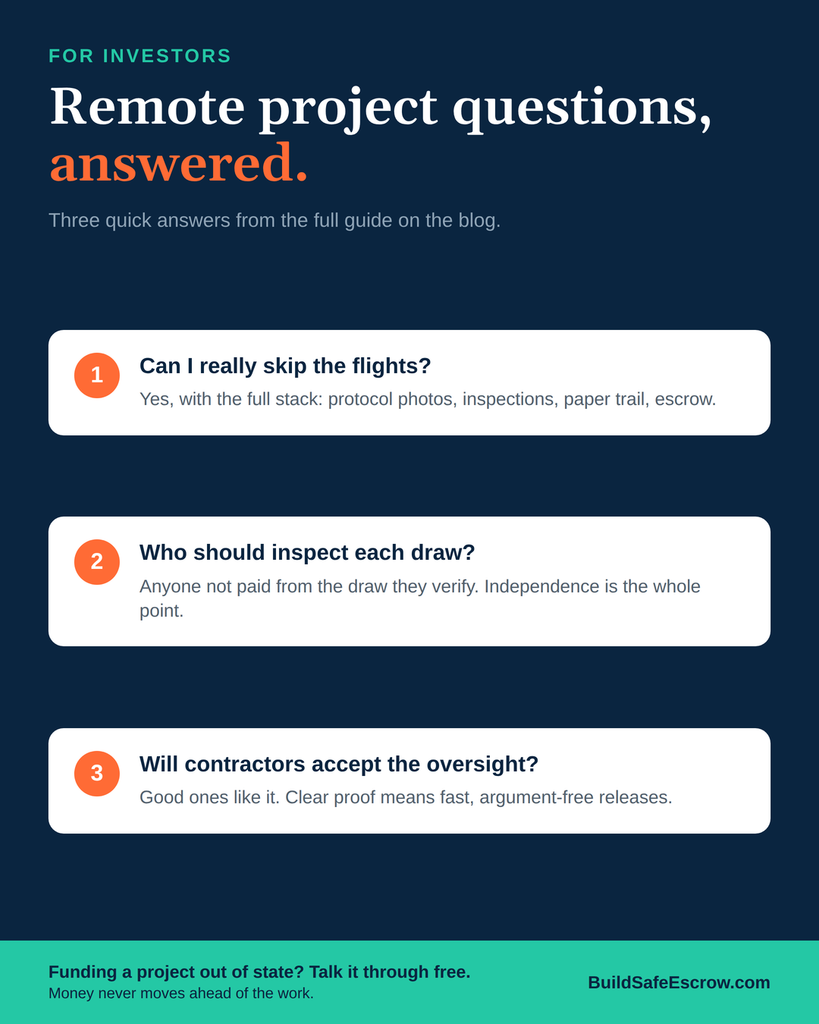
Who should do the independent inspections? A third-party draw inspector, a licensed local inspector, or a local project manager with no stake in the release. The only disqualification is being paid out of the draw they are verifying.
What should progress photos include to verify construction progress remotely? Wide shots from the same fixed reference points every time, closeups of the claimed work, timestamps and location data, and a brief narrated video walkthrough. Recycled or unplaceable photos are the oldest trick in remote projects.
Can my contractor refuse this much oversight? Some will push back, and the pushback is information. Good contractors tend to like the structure once they see it: clear documentation means fast, argument-free releases, and escrow proves the budget is real before they mobilize.
Does escrow work across state lines? Yes. The account is neutral and the release rules travel with the agreement, which is exactly what makes it suited to out-of-state investing. Your leverage stops depending on your zip code.
Protect capital you cannot drive past
The market can be a thousand miles away. When you can verify construction progress remotely, the proof standard is identical to the one you would demand across the street.
For everyone: Get one short read each Friday on how construction money actually moves: subscribe to The Build Brief.
For investors: Before the next wire goes out, put the verification stack and the escrow account in place. Schedule a free consultation and we will map the milestones with you.
References
- Investopedia, construction loans and draw schedules explained: https://www.investopedia.com/
- American Institute of Architects, payment application documents (G702/G703): https://www.aiacontracts.com/
- Levelset, lien waivers and payment resources: https://www.levelset.com/
- FDIC, deposit insurance overview: https://www.fdic.gov/resources/deposit-insurance/