

The contract is ready. The contractor is standing in your kitchen with a pen. And then comes the number.
Table of Contents
- The moment every owner freezes
- How much deposit should I give a contractor?
- Why contractor deposit protection is so hard to get right
- Seven rules for contractor deposit protection
- A short field example
- How escrow solves the deposit problem at the source
- FAQ
- Protect your deposit before you sign
- References
The moment every owner freezes
Contractor deposit protection is the question nobody prepares you for. You are a homeowner or a property owner, the contract is drafted, the start date is set — and then you are asked to hand over a percentage of the whole job before a single tool comes out of the truck.
You do not want to insult a good contractor by hesitating. You also do not want to be the person who wired thirty percent to someone who never came back. That tension is why owners either overpay out of politeness, or underpay out of fear and lose a good builder to a better-organized client.
There is a safe number. Behind the safe number, there is a safer structure. Good contractor deposit protection gives you both.
How much deposit should I give a contractor?
A reasonable deposit is 10 percent of the contract price, and in most cases it should never exceed one third. Anything above that, and you are financing the contractor’s business rather than funding your own project.
That is the short answer. Here is the fuller one.
Several states have already decided this for you. California caps the down payment on a home improvement contract at $1,000 or 10 percent of the contract price, whichever is less. Nevada uses the same formula. Maryland limits it to one third of the contract price. Other states set no cap at all, which does not mean a large deposit is safe — only that no one is stopping you.
A legitimate deposit covers something specific: permit fees, a custom order, materials bought before work begins. It is not a retainer or a good-faith gesture. It should map to a real, nameable cost, and you should be able to ask what that cost is and get a straight answer.
Real contractor deposit protection is not about negotiating the percentage down to zero. It is about making sure whatever you pay is tied to something that actually exists.
Why contractor deposit protection is so hard to get right
The deposit is not arbitrary. It exists because contractors have a genuine cash-flow problem, and understanding that makes you a better client — and a safer one.
Contractors front real money. Materials, permits, and crew mobilization get paid before the first invoice clears. A contractor who takes no deposit at all is financing your project on their own credit line — which is not a point in your favor. Sometimes it means they are stretched thin enough to be desperate for the work.
Suppliers demand deposits too. Custom cabinetry, specialty windows, and long-lead HVAC equipment often require payment at order. Those costs are real and they land before demolition.
There is no industry standard. Ask five contractors and you will get five percentages. That is not dishonesty. It is a fragmented industry with no central rulebook, which means the number lands on you to evaluate.
Nobody explains what happens next. The deposit gets discussed. The second payment, the third, and the final release usually do not. Owners fixate on the front number and sign a payment schedule they never read.
And the worst outcomes are quiet. A contractor who takes a large deposit and disappears is rare. One who takes a large deposit, starts strong, runs the money into another job, and slows to a crawl is far more common. Your money is gone, the work is forty percent done, and there was never a dramatic moment where you knew you were in trouble. Quiet failures are exactly what contractor deposit protection is built to catch.
Every one of these is a structure problem. Structure problems have structural fixes.
Seven rules for contractor deposit protection
Here is the practical core. Seven rules you can apply before you sign anything.
1. Anchor to 10 percent. Start at 10 percent of the contract price. If a contractor asks for more, that is a question, not automatically a problem. Ask what the money is for. A good contractor will tell you: “Your windows are a custom order, 22 percent of the job, and the supplier bills at order.” That is an answer. “That’s just how I do it” is not.
2. Never pay a deposit in cash or by wire. Pay by check or credit card, both of which create a record and, in the case of a card, a dispute path. Cash and wire transfers are effectively irreversible. This is the single easiest piece of contractor deposit protection available to you and it costs nothing.
3. Check your state’s cap before you negotiate. In a state that limits deposits, the cap is your ceiling and the conversation is already over — the law has done your contractor deposit protection for you. If your state sets no cap, you have to set your own. Your licensing board publishes this, and it takes five minutes to look up.
4. Tie the deposit to a named cost. Write it into the contract. Not “deposit: $9,000” but “deposit: $9,000, covering permit fees ($1,400) and the custom window order ($7,600).” Now the money is documented as a purchase, not a transfer, and you have a receipt trail if things go sideways.
5. Read the whole payment schedule, not just the first number. A 10 percent deposit followed by 40 percent at demolition is worse than a 20 percent deposit followed by four verified progress draws. The front number is the one you notice. The schedule is the one that determines your exposure.
6. Verify the license and the insurance before the money moves. Not after. A license lookup and a certificate of insurance take one afternoon, and both are free. Owners skip this step because the deposit conversation created social pressure to move fast — which is exactly why verification belongs before the check.
7. Put the money somewhere neither of you controls. This is the rule that makes the other six easier, and it is the heart of contractor deposit protection. If the funds sit in a neutral third-party account and release on verified progress, the deposit percentage stops being the thing that determines whether you get robbed.
Notice the pattern. Six of these rules are documentation and verification. The seventh changes where the money physically sits — which is why it carries most of the weight in real contractor deposit protection.
A short field example
Camille owns a four-unit building in a market where good contractors are booked six months out. She found one she liked for a $140,000 gut renovation on two vacant units. He asked for 35 percent up front — $49,000 — and said that was standard for a job that size.
She did not argue. She asked what the money covered. He named $18,000 in materials and a permit package, which left roughly $31,000 unaccounted for.
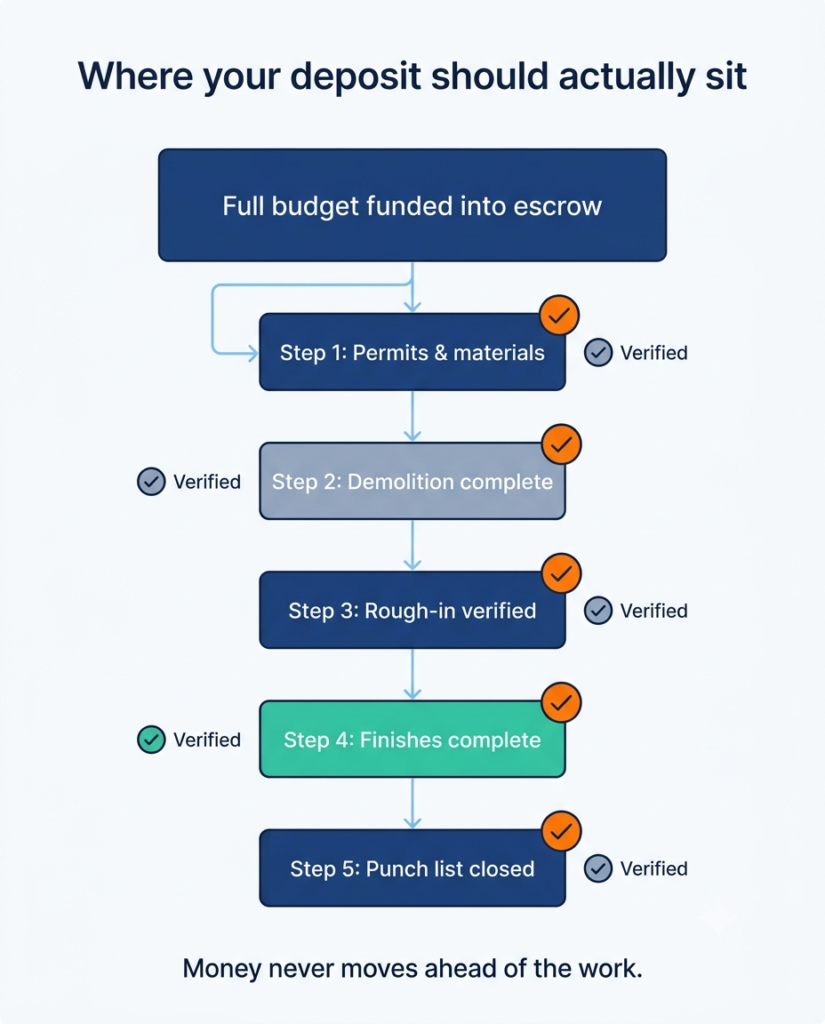
So Camille made a counteroffer. She would fund the entire $140,000 into escrow before work began — the full budget, confirmed and visible to both of them — and release $18,000 immediately against the materials invoice and the permit receipts. The rest would release across five verified milestones.
The contractor got something better than a large deposit: proof the whole job was funded, on day one, by a client who would not run out of money halfway through. Camille got something better than a small deposit: her capital tied to work she could see.
He took the job. The renovation finished eleven days late and on budget. The only argument they had was about tile.
How escrow solves the deposit problem at the source
Here is the thing about the deposit debate: it is an argument about how much trust to extend to a stranger, conducted at the worst possible moment, with no information.
Escrow ends the argument by removing the premise. Contractor deposit protection stops being a negotiation and becomes a mechanism.
A construction escrow account is a neutral, FDIC-insured third-party account that holds the project funds before the work begins. Build Safe Escrow is not a lender, not a contractor, and not on either side of the table. We hold the money and release it in stages, as each agreed milestone is completed and verified.
Read what that does to the deposit question. The contractor gets certainty — the full budget is confirmed and committed before mobilization. No more wondering whether the owner is good for the back half of the job. The owner gets protection — money moves only against completed, verified work. No more handing five figures to someone on the strength of a handshake and a business card.
The deposit stops being a leap of faith and becomes a scheduled, documented release. That is the whole point: money should never move ahead of the work. Trust is a feeling. Structure is protection.
If you want to see how the milestone schedule gets built for a specific job, our escrow services page walks through the mechanics, and our construction escrow FAQs answer the questions owners ask most often before their first project.
FAQ
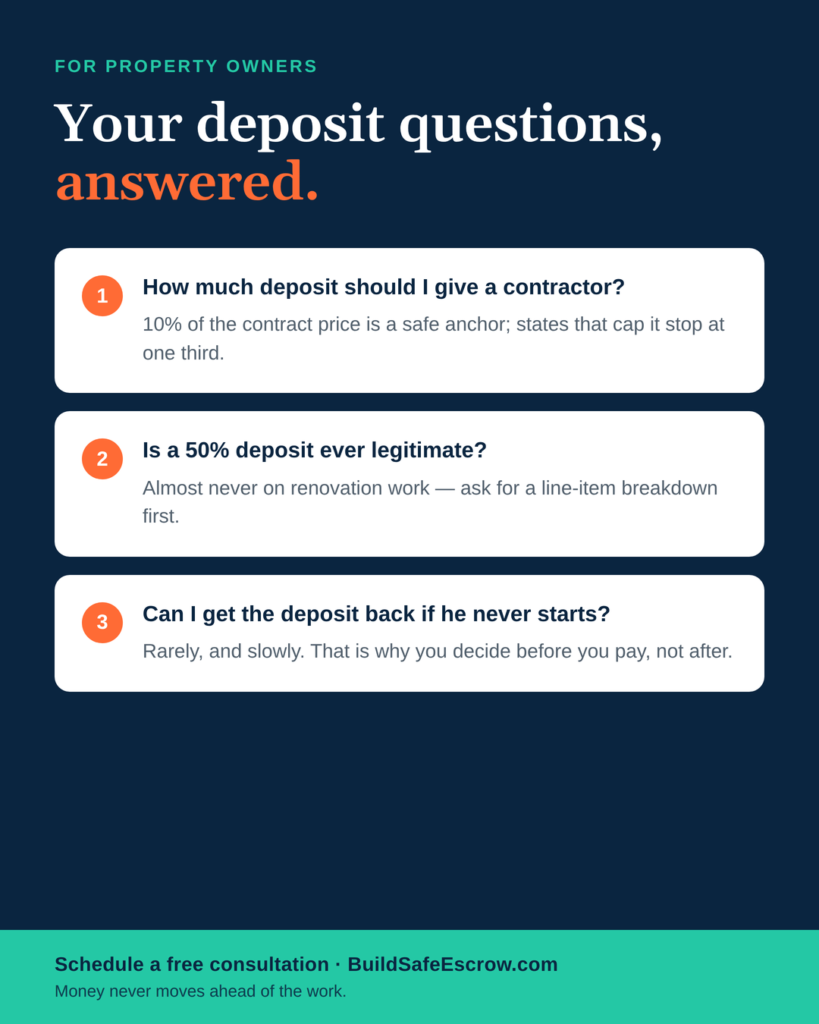
Is a 50 percent deposit ever legitimate? Almost never for renovation work. It can be defensible on small jobs that are nearly all custom material, but on a job of any size it means you are funding the contractor’s operations. Ask for a line-item breakdown first.
What if my contractor refuses to accept escrow? That is information. Reputable contractors generally welcome escrow, because it guarantees the money exists and removes their biggest risk — an owner who runs out of funds mid-project. A flat refusal to discuss contractor deposit protection at all, without a reason, is worth paying attention to.
Can I get my deposit back if the contractor never starts? Sometimes, and it usually requires a demand letter, a licensing board complaint, or small claims court. It is slow and the recovery rate is poor. This is why contractor deposit protection is a decision you make before you pay, not after.
Does a deposit mean the contractor is committed to my start date? Not by itself, and this is a gap in most contractor deposit protection thinking. Commitment comes from a contract with a start date, a completion date, and consequences. A deposit without those terms buys you a place in line that can be quietly resold.
Is a credit card really better than a check? For the deposit specifically, yes. Cards carry chargeback rights that checks do not. Many contractors add a processing fee — on a deposit, that fee is often worth paying.
Who pays for construction escrow? It varies by deal and it is negotiable. On renovation projects it is commonly split, or absorbed by whichever party proposed it. Relative to the size of the deposit at risk, the cost is small.
This article is general information, not legal or financial advice. Deposit limits and remedies vary by state — check with your own attorney or your state licensing board for your specific situation.
Protect your deposit before you sign
You do not need to become an expert in construction finance. Contractor deposit protection comes down to one habit: money moves on proof of work, not proof of optimism.
Schedule a free consultation and we will walk through your project, your payment schedule, and where your deposit is actually exposed — before you sign anything. → Schedule a free consultation
Get one short read each Friday on how construction money actually moves. → Subscribe to The Build Brief
References
- Federal Trade Commission — Hiring a Contractor
- FDIC — Deposit Insurance
- California Contractors State License Board — Consumer Resources
- National Association of Home Builders