
You are paying to build out a space you don’t own, on a landlord’s timeline, through a contractor you didn’t hire. That is a lot of exposure for one signature.
Table of Contents
- The exposure no commercial tenant talks about
- Why tenant improvement money is so exposed
- Five ways tenant improvement escrow protects your build-out
- A short field example
- How tenant improvement escrow removes the risk at the source
- FAQ
- Protect your build-out before the first dollar moves
- References
The exposure no commercial tenant talks about
Tenant improvement escrow exists to solve a problem unique to commercial tenants: you fund a build-out in a space you do not own, and your money is exposed the moment it leaves your account. You signed the lease. You committed the capital. Now the drywall, the HVAC, and the finishes are all being installed by people who answer to a schedule you don’t control.
A tenant improvement — often called a build-out or TI — is the work that turns a bare or dated commercial space into something you can operate in. A TI allowance is the money a landlord contributes toward it. Whether the dollars are yours, the landlord’s, or a mix, the same risk applies: pay ahead of the work, and you are financing a promise.
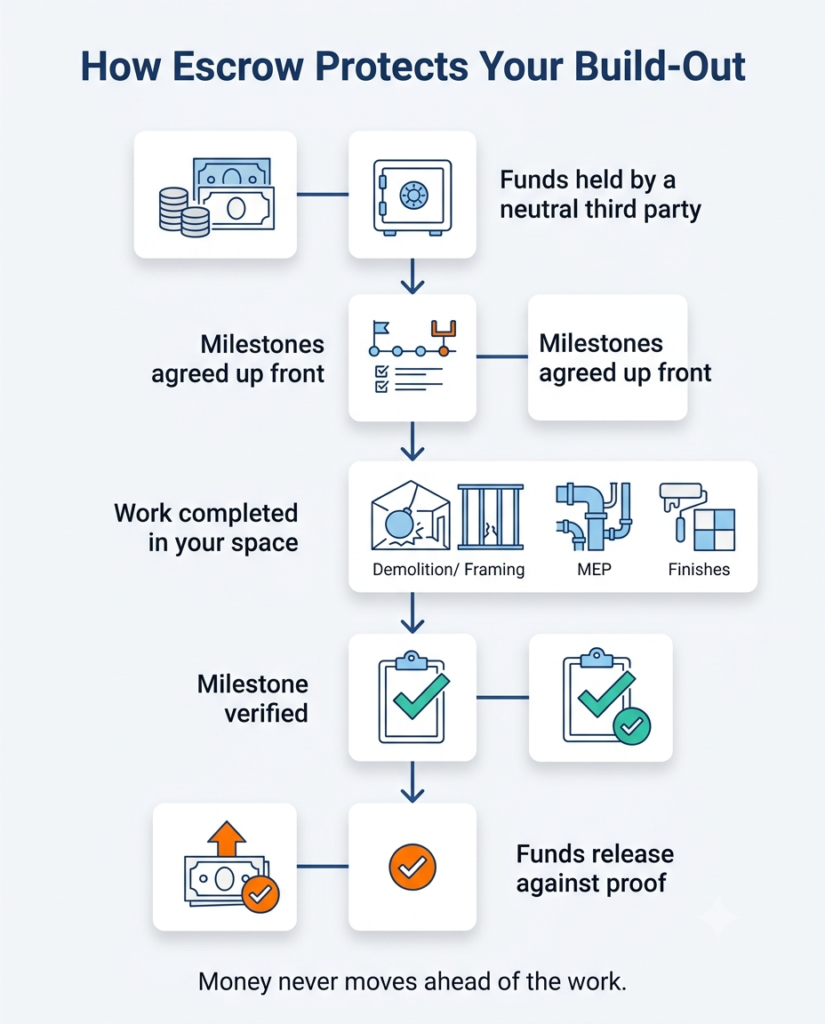
Tenant improvement escrow closes that gap. It is a neutral, third-party account that holds the build-out funds and releases them in stages — only as each agreed milestone is completed and verified. Build Safe Escrow is not a lender, not a contractor, and not on anyone’s side. We hold the money and release it as the work earns it.
Let’s walk through why TI money goes sideways — and how structure fixes it.
Why tenant improvement money is so exposed
The exposure is not bad luck. It comes from a handful of predictable gaps baked into how build-outs are funded.
You pay before you can verify. Deposits and progress payments often go out on invoice, not on proof. You are trusting that the work behind the invoice is actually done to spec.
You don’t control the contractor. In many deals the landlord or a general contractor runs the build. Your money funds work you are not directing and cannot easily inspect day to day.
The TI allowance has strings. Reimbursement often lags. You front the cost, submit paperwork, and wait — carrying the spend while approvals crawl through email.
A dispute freezes your opening. One disagreement over scope or quality, and the schedule slips. For a tenant with a lease clock and a launch date, a delay is not an inconvenience. It is lost revenue.
The money can be redirected. Funds meant for your fit-out get absorbed into a contractor’s cash flow or another job. By the time it shows, your space is behind and short.
Every one of these is a structure problem, not a character problem. Structure problems have structural fixes. That is exactly what tenant improvement escrow provides.
Five ways tenant improvement escrow protects your build-out
Here is the practical core. Tenant improvement escrow delivers five concrete protections, each one a reason to require it before your fit-out begins.
1. A neutral third party holds the funds. The build-out money sits in a secure, FDIC-insured account controlled by neither you, the landlord, nor the GC. No single party can move it. Your capital waits where cash-flow pressure and competing priorities cannot reach it.
2. Releases are tied to verified milestones. Funds move only when a defined milestone — demolition, framing, mechanical/electrical/plumbing, finishes, punch list — is completed and verified. Payment answers one question: was this work actually done to spec? If yes, it releases. If no, it waits.
3. Your dollars only pay for finished work. No more paying on an invoice and hoping. With tenant improvement escrow, every dollar is matched to work you can confirm. You stop financing promises and start funding progress.
4. The schedule gets protected. Because scope and milestones are agreed and documented up front, there is far less to argue about mid-project. Disputes stay contained to one item instead of freezing the whole build. Your opening date is safer.
5. The allowance is handled cleanly. Whether the funds are yours, a TI allowance, or a blend, escrow gives everyone one transparent record of what was deposited, verified, and released — which makes reconciliation with the landlord simple. See how our escrow services structure milestone releases for commercial build-outs.
Notice the pattern. Every protection points the same direction: the money is confirmed early and moves only on proof of work.
A short field example
Consider a growing company — call them Meridian — signing a lease for a 6,000-square-foot office. A generous TI allowance, an ambitious open date, a GC chosen by the landlord.
Meridian used to handle build-outs the old way. Progress payments went out on invoice. On an earlier space, the GC billed for mechanical work that was only half finished, then hit a cash crunch on another job. Meridian’s fit-out stalled for five weeks. They pushed their move-in, paid overlapping rent on two spaces, and lost a quarter of runway to a delay they never saw coming.
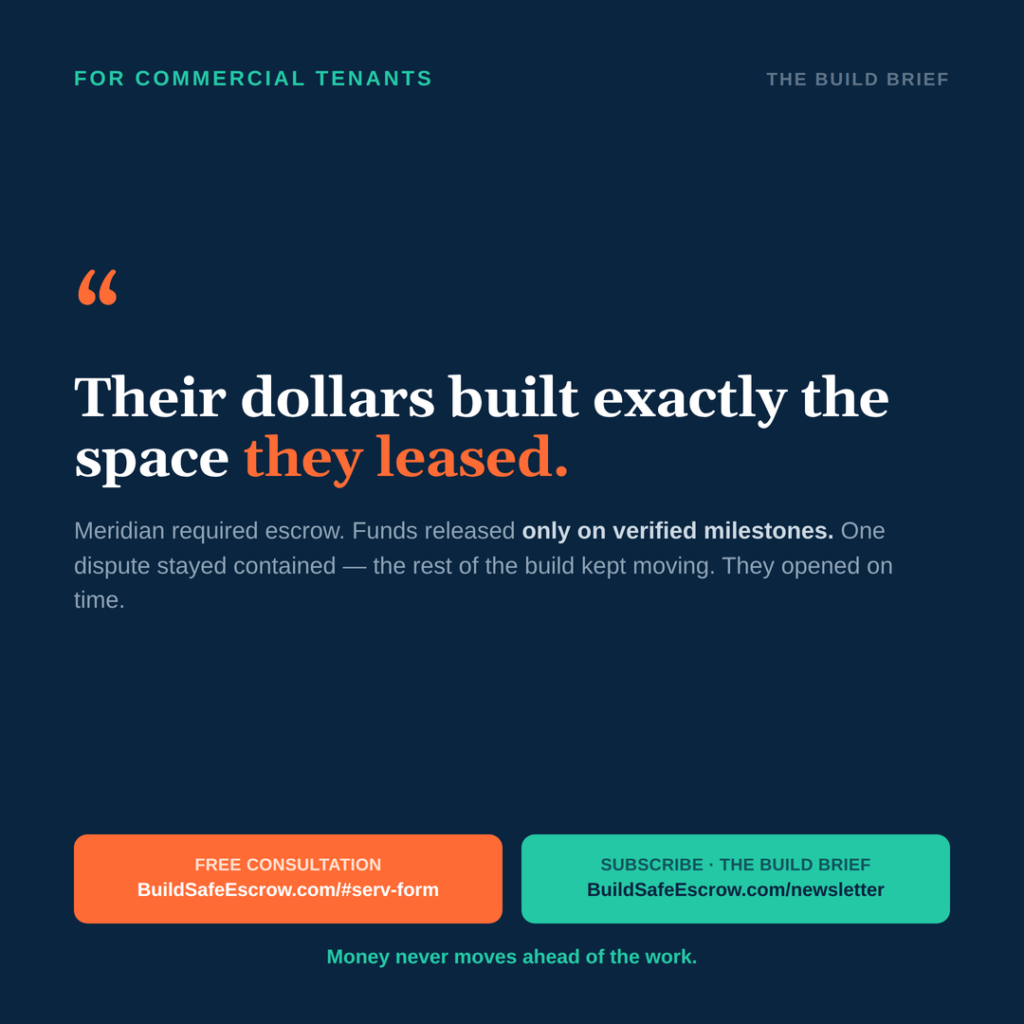
This time, Meridian required tenant improvement escrow. The build-out funds went into a secure, FDIC-insured account, released against five verified milestones. When the GC’s other job ran short, nothing happened to Meridian’s money — it released only on verified progress in their space. When a finish-scope disagreement came up, it stayed contained to that one item while the rest of the build kept moving. Meridian opened on time.
They financed nothing on faith. Their dollars built exactly the space they leased. That is tenant improvement escrow doing precisely what it should.
How tenant improvement escrow removes the risk at the source
Trust is a feeling. Structure is protection. The reason TI money gets exposed is that it is allowed to move ahead of the work.
Escrow fixes that by fixing the sequence. Money should never move ahead of the work. With escrow in place, it can’t. The funds are held by a neutral party and released only when a milestone is verified. From your seat as the tenant, the protection is simple and total: your build-out capital sits in an insured account and converts into finished space, milestone by milestone, on proof.
You stop paying on invoices you can’t verify. You stop absorbing a contractor’s cash-flow problems as your own delay. You stop watching your open date slip. A neutral third party holds the money, verifies the work, and releases the funds. That is the entire mechanism, and it runs in your favor.
Want to see how verification and release timing work step by step? Our construction escrow FAQs break down milestones, verification, and disbursement in plain language.
FAQ
What is tenant improvement escrow? It is a neutral, third-party account that holds your build-out funds and releases them only as each agreed milestone is completed and verified — so your dollars pay for finished work, not invoices.
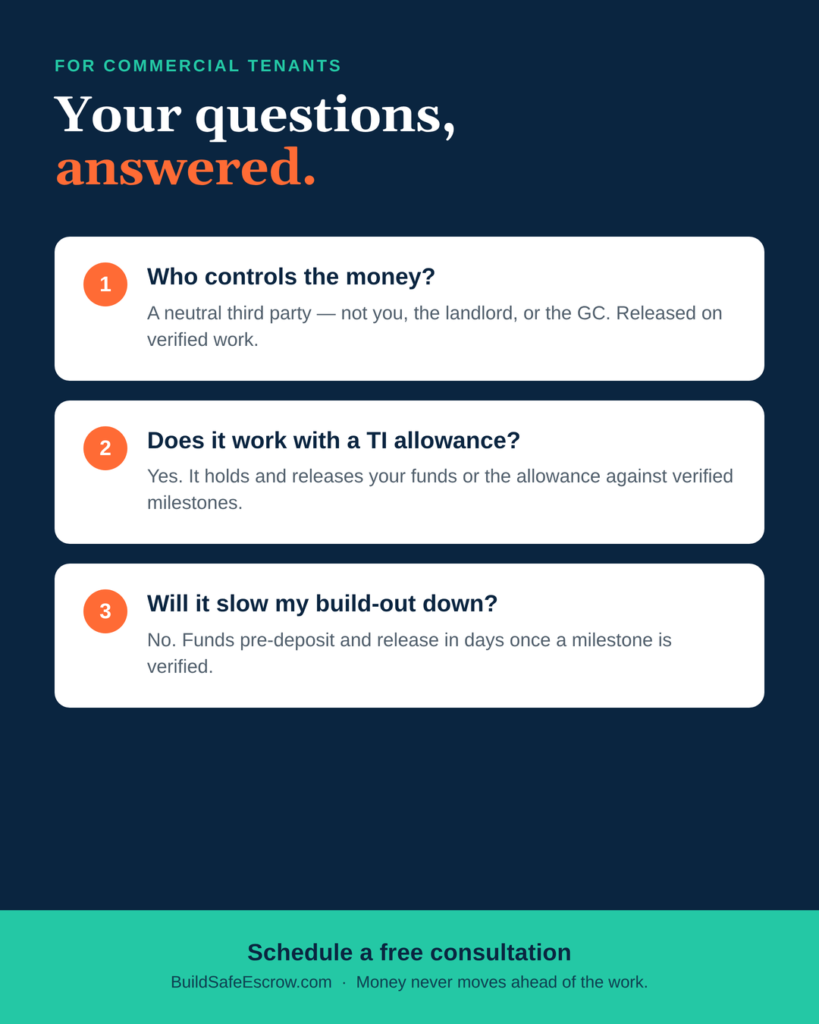
Who controls the money? A neutral third party. Not you, not the landlord, not the GC. Funds sit in a secure, FDIC-insured account and release only on verified milestones.
Does escrow work with a TI allowance? Yes. Whether the funds are yours, a landlord allowance, or both, escrow holds and releases them against verified work and gives everyone one clean record for reconciliation.
Will escrow slow my build-out down? No. Funds are deposited before work begins and release in days once a milestone is verified. It protects your open date rather than threatening it.
What happens if there’s a dispute over the work? Because scope and milestones are agreed up front, most disputes stay contained to one item. The rest of the build keeps releasing on schedule.
Is my money safe while it waits in escrow? It is held in a secure, FDIC-insured account by a neutral third party — not commingled with a contractor’s operating account. Released only on verified milestones.
This article is information and structure, not legal or financial advice. Talk to your own attorney or accountant about your specific lease and build-out agreements.
Protect your build-out before the first dollar moves
If you fund a fit-out in a space you don’t own, one habit changes everything: put the money where it can’t move ahead of the work.
Get one short read each Friday on how construction money actually moves — subscribe to The Build Brief.
Ready to tie your build-out to verified work? Schedule a free consultation and see how tenant improvement escrow protects your TI dollars from day one.
References
- FDIC — Deposit Insurance: https://www.fdic.gov/resources/deposit-insurance/
- U.S. Small Business Administration — commercial leasing & build-outs: https://www.sba.gov/
- Levelset / Procore — mechanics liens & commercial payment resources: https://www.levelset.com/
- BOMA International — commercial real estate standards: https://www.boma.org/